“Radical Candor” by Kim Scott


No doubt you heard the advice as you grew up: “if you can’t say anything nice, don’t say any anything at all.” Many people still operate according to that rule even when in a position of leading or directing people. While this advice may work for everyday life, it can be a disaster when adopted by managers. On the other hand, there are some people who, when they have achieved a management position, believe it is their responsibility or privilege to boss people around, demanding that their voice is the only one that matters. This attitude can also be disastrous for a manager. The book “Radical Candor” by Kim Scott proposes a model of leadership based on the idea that the best boss is the one that can “care personally and challenge directly.” When a leader can effectively combine these two skills, they are most effective at influencing, inspiring, developing, and directing their team. Only when we clearly show that we care personally can people accept our effort to challenge directly. And only when we challenge directly are people convinced that we truly do care personally.

My view is that leadership is the ability to influence built upon a relationship of trust and respect. This correlates with the concept of Radical Candor. Trust is built by caring personally. Respect is built by challenging directly.

This combination of caring personally and challenging directly is a balancing process and is modulated by our understanding of the recipient and the way in which they perceive both the caring and the challenging. Challenging, or guidance, is always meant to impact the future of recipient; therefore, it includes both praise and criticism.

When our ability to care personally and to challenge directly is out of balance, the ability to lead can be impacted adversely. Ms. Scott describes the various combinations of caring and challenging as follows:
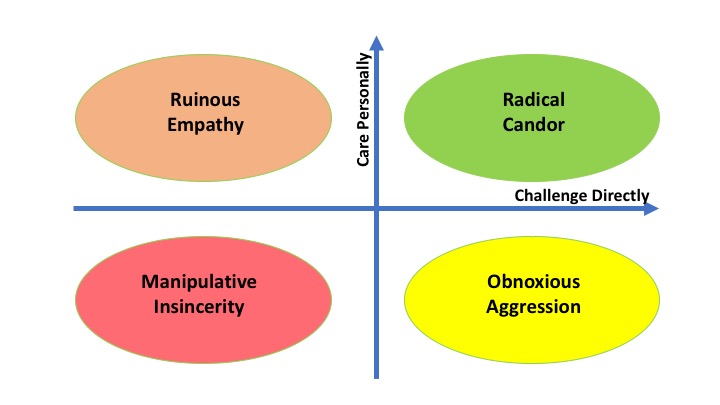
Obnoxious Aggression is when a boss is prone to criticize without showing that they care about the recipient. The boss comes off as a “jerk” and the recipient is made to feel incompetent.

Ruinous Empathy is when a boss cares so much that they are unable to ever challenge; this is the “when you can’t say anything nice” person in action. It is ruinous because the recipient never is given feedback that will lead to growth.

Manipulative Insincerity is the result of a boss that doesn’t care enough to challenge. The worst version of leadership, this is generally the result of a boss that is only focused on him- or herself. It’s praise that is false or condescending and criticism that is neither clear nor kind.

Radical Candor is the healthy mix of caring and challenging that leads to growth and influence.

The first portion of the book defines and explains Radical Candor, building the case for why it is the best model for today’s leadership in the workplace. In fact, Radical Candor is a concept useful in any relationship or communication. In the process of describing Radical Candor, Ms. Scott further defines caring as understanding what motivates each person on the team through a process of exploration and communication. She also describes the open communication and guidance that embodies challenging directly.

The second half of the book is devoted to demonstrating what Radical Candor looks like in action, presenting advice and tools for the day-to-day practice of leading a team in a Radical Candor fashion. This includes advice on building relationships in the workplace, getting and giving guidance, building and motivating a team, and on getting stuff done, as she describes it. In the chapter on results, the book contains a GSD or Getting Stuff Done model, in which Ms. Scott describes the various types of meetings that she believes a team should utilize and the general steps for accomplishing projects. These steps are: Listen, Clarify, Debate, Decide, Persuade, Execute, Learn, and back to Listen. The advice regarding giving guidance gives some helpful advice on hiring, firing, promotions, and performance reviews. In summary, the Radical Candor model should become a philosophy of interacting with people on our team.

While this book spends considerable describing the actions or skills that result from a Radical Candor style of leadership, for many people the concept of Radical Candor is as much an urging to character growth as it is a recipe for competency. Radical Candor requires a development of relationships that may be a challenge to many people. Yet I believe that effective leadership is built upon such relationships.

I highly recommend this book and the character growth that is required to embrace and live in a Radical Candor fashion.

Are you ready to care personally and to challenge directly as you lead people? What growth do you need to undertake in order to do so effectively?


A Leadership View of Performance Reviews

For some people, performance reviews are the one time when they tell their direct reports how their work is perceived. Sometimes these reviews are simply a perfunctory fulfillment of a corporate requirement or the necessary step required for a salary increase. Often the performance review, whether it be annual, quarterly, or some other frequency, is the only time that a boss might discuss the level of performance, suggestions for improvement, or career aspirations. On the other side of the table, the team member may walk into the review meeting with some fear, either of the unknown or of the possibility of criticism.

For a true leader, the performance review process can be quite different. The performance review is an opportunity to mentor or coach and an opportunity build relationship. Here are some thoughts on the performance review in an effective leadership model:

  1. The performance review is a time for summarizing and consolidating an ongoing dialogue about performance, development, and aspirations. An effective leader has a habit of continually communicating with his or her direct reports. This continual process includes frequent 1:1 meetings to discuss work progress and performance, identify issues regarding organizational processes or resources, and relationship building through discussion of aspirations, satisfaction, and so forth. Additionally, an effective leader provides impromptu guidance and feedback, both positive and negative, whenever the occasion arises to directly view the work of the team member. This process of continual feedback need not be time consuming; a 1:1 meeting can typically be accomplished in 15-30 minutes every week or two and impromptu feedback can be done in 2-3 minutes while walking out of a meeting. With these habits in place, the team member knows exactly what to expect in a performance review as it is a summary and deeper dive into topics that have been discussed over time.
  2. The performance review is a balance of past and future. The performance review is a wasted opportunity if it only looks at the past and the team member leaves the meeting without a clear view of what needs to or is likely to happen in the future. There needs to be agreement regarding the level of past performance, but leadership always has a forward focus. Therefore, the time needs to be split between the review of performance and a discussion of the future. This view of the future includes a discussion of the areas of emphasis for the team member, definition of a personal development plan, and career aspirations and potential. Focusing on the future keeps those that did well in the past from resting on their laurels and prevents those that have underperformed from wallowing in despair. Once this discussion of the future takes place, these plans and areas for emphasis become topics to be touched upon in the ongoing 1:1 meetings.
  3. The performance review needs to be an effective discussion regarding expectations and performance. The review is more than providing a rating score of performance or announcing the impact on compensation. In fact, these two things often get in the way of clear communication regarding just how the team member is perceived and what they might expect in the future of their career. Here are some further points to make it an effective discussion that benefits both the leader and the team member:
    • Schedule adequate time. A proper discussion of performance and future expectations requires some time, probably an hour, not ten minutes at the end of the day. As a leader, it is an opportunity to be utilized.
    • Prepare and provide a written summary of the major points of discussion. Sometimes the discussion draws out thoughts and emotions that make it difficult for the team member to capture the entire discussion. A document provides a point of reference for future review.
    • Deliver the rating and compensation news at the end of the meeting or even at a short follow-up session. The team member can focus too much attention on the numbers and tune out the discussion if they see these first. The value is in the discussion.
    • Don’t rely on your own perceptions. As you are preparing for the meeting, seek input from other people in the organization that are familiar with the team member’s work so that you aren’t biased in your review or only have part of the story.
    • Make the review meeting a two-way discussion. Ask the team member to come prepared to also review your performance as a leader. By doing so, you first take some of the fear out of the process and also may get some important feedback, even perhaps some feedback that might impact your perception of the team member’s performance.
    • Appropriately stage the meeting. Meeting at your desk might not be the best setting for a discussion of your working relationship and the expectations that you have for the team member. A small table somewhere, perhaps even a lunch meeting, may be a better environment for the type of discussion that best serves the long-term function of this meeting.

An effective leader is continually building towards the future and developing the relationship through which he or she can influence the members of the team. The entire performance review process – impromptu guidance, 1:1 discussion, and the periodic review/rating – is a platform for doing so.

Are you providing and receiving necessary feedback with your team members? What other tips do you have for optimal use of the performance review process?

Strategic Competencies

Competency or competence is defined as “the ability to do something successfully or efficiently” by the Oxford dictionary. Vocabulary.com defines competency as “the quality of being adequately or well qualified physically and intellectually.” We can think of competency either on the personal level, the skills that a person brings to the tasks they face, or on an organizational level. On the organizational level, competencies are the skills, processes, or knowledge that the organization possesses. In other words, competencies are the things that the organization does exceptionally well. Some organizations are able to describe a long list of competencies or things that they do exceptionally well.

From a strategic perspective, only a very select group of competencies are relevant. These are variously referred to as core competencies, distinctive competencies, or strategic competencies. Some people split hairs in differentiating between what would be termed core, distinctive, or strategic competencies but any difference in the definition of these three terms is inconsequential. Therefore, we can use these three terms interchangeably.

A strategic competency is what sets an organization apart from competitors in their ability to meet customer needs. To qualify as a strategic competency, it must 1) be a skill, process or knowledge that the company possesses, 2) have value to the customer, and 3) be difficult for competitors to duplicate.

A strategic competency must be a skill, process, or knowledge that the organization possesses. It drives the way the organization produces its product or service offering. It is not a piece of equipment, but it could be the knowledge to develop specialized equipment or to use equipment in a specific way.

A strategic competency must develop value for the customer. As stated above, there could be many competencies in an organization but only the ones that develop value for the customer have the potential to be strategic competencies. A manufacturing facility that is skilled in its ability to be clean and organized has a competency, but it is unlikely to be strategic. A culture that values teamwork and collaboration in and of itself is not a strategic competency but could support a competency such as speed of development. A strategic competency enables the organization to better meet particular needs of customers.

A strategic competency must be difficult for competitors to duplicate. If an organization is just one of many companies that possesses a particular skill, it is not a strategic competency. If the skill or knowledge can be quickly reproduced by others, it is not a strategic competency. It must be unique or fairly unique to be a strategic competency.

Strategic competencies are the skills or knowledge that underlie or produce a competitive advantage. Competitive advantage is the ability of an organization to provide a greater value in meeting the needs of customers. In a way, strategic competencies and competitive advantage can be thought of as opposite sides of the same coin. Strategic competencies are the abilities of the organization to produce higher value for the customer; competitive advantage is the perception on the part of the customer of the higher value provided.

One of the key purposes of strategic planning is to identify the most important strategic competency (or competencies) and then to identify and allocate the resources and actions that will further develop them. By doing so, the organization builds the capability to deliver value to the customer and a competitive advantage over other potential suppliers.

Does your organization understand its strategic competencies? Does your plan focus on further developing these strategic competencies?

The Loneliness of Leadership

One of the most frequently voiced complaints of leaders is the loneliness that accompanies the position of leader. The old saying, “It’s lonely at the top” frequently proves to be true. Leadership can create a feeling of isolation for several reasons:

Lack of peer relationships– As people progress up the ladder in an organization they have peers with whom they can exchange ideas or commiserate until they find themselves in the position of leader. As a leader of an organization and even sometimes as a team leader, a person can find that those peer relationships dissolve, either because the former peers see the leader in a different light or because the leader makes the dangerous choice of feeling they are above others.

The need for confidentiality– As a leader there are certain bits of information that cannot be shared. For example, leaders might be privy to certain personal struggles facing an individual team member. Or the leader may be involved in confidential business negotiations. Certain items must be held private by the leader. Allowing this confidentiality to control isolates the leader.

The tendency of the organization to hold the leader aloft– In some instances, for one reason or another, people in the organization do not have a reciprocal relationship with the leader. This could be caused by the leader being somewhat intimidating, often unintentionally. People might feel that the leader doesn’t have the time or interest to be bothered with relationships. “I don’t want to waste the leader’s time.” Or information might be withheld out of fear, either of repercussions or of loss of power by the team member.

Focus on others– Generally, leaders are wired to meet the needs of others. They spend so much of their time listening and giving to others, they do not benefit from the balanced conversation and idea exchange that meets their own social needs. Their relationships all become one-sided.

Work consumes all of life– Leaders can be focused on achieving results. When overly so, they actually do not have time for personal interactions that are not goal-related.

Difficulty in finding people that can understand – Sometimes the pressures or just the nature of the issues dealt with in leadership are unfamiliar territory for family members or casual friends. Without an ability to relate to the leader or vice versa, these family or casual friendships can leave a leader without the feeling of being understood.

And, dare we say, arrogance– Some people, when moved into a position of leadership, fall into the trap of thinking that they are better than those around them. They can think that they are smarter and have all the answers. They can mistake leadership for command and control and not see the need for relationship. These people push away others and drive themselves into isolation.

This feeling of isolation can leave a leader dissatisfied or even feeling empty. Relationship is a fundamental need that is a part of how we were designed and how we best function. Carrying a load of stress and responsibility without the fulfillment of social needs such as understanding, affirmation, empathy, and so forth leaves a leader emotionally and even physically exhausted. Intentional effort is required to break this feeling of isolation. Most often this effort needs to focus on building healthy and meaningful relationships that bridge the causes described above. The antidote to isolation is community. Some ways to defeat the isolation of leadership include the following:

Join a peer group.Since this isolation is a common complaint of leaders, there are many programs that provide a platform to build relationships with other leaders in which the group members relate well with each other and can help meet the social/emotional needs of other group members.

Develop a personal board of advisors.For a small business, a board of advisors might serve the dual purpose of meeting relational needs and providing some business guidance. Some leaders find it helpful to gather together a group that can know them deeply and keep them grounded.

Find a mentor or coach.Besides the normal function of advising or coaching, a relationship with a mentor or coach can provide some of the relational nutrients necessary for healthy integration.

The general requirement for breaking through the feeling of isolation is developing stable, meaningful relationships with people who can relate to the issues and responsibilities of leadership and who are able and willing to meet the relational/emotional needs that all leaders have.

Do you ever experience loneliness in your leadership role? What do you do about it?

(We at New Horizon Partners, Inc. organize peer groups for leaders that provide the opportunity for growth in a context of “one anothering” relationships. Please contact us if you would like to learn more.)

Be Slow to Anger

In two recent articles we have been examining communications and the wisdom presented in the letter from James in the Bible when we are told that “Everyone should be quick to listen, slow to speak, and slow to become angry(James 1:20b NIV). This verse reminds us of three important truths – that listening is of highest importance, that we should be thoughtful in speaking or communicating, and that we must manage our emotions so that we communicate effectively.

To be an effective leader, one must be an effective communicator. For a leader, communication is much more than the transfer of information, it is connection and inspiration. Communication is necessary for developing alignment and executing strategy. Communication is the basis for a relationship of trust and respect, the foundation of leadership.

This wisdom of becoming quick to listen, slow to speak, and slow to anger is applicable to any communication whether it be in the workplace or at home, in a one-on-one discussion or a memo to all hands. In two previous articles we looked at the importance and practice of effective listening and wise speaking (or writing). We now come to the third element of communication included in this verse – the importance of managing emotions.

The last part of this particular verse could have broader implications than just communications. It actually speaks to our need to develop our emotional intelligence. In his book, Primal Leadership, author Daniel Goldman describes emotional intelligence as being composed of four hierarchical domains:

  1. Self-awareness – understanding your own emotions
  2. Self-management – appropriate control of your own emotions
  3. Social awareness – recognizing and understanding the emotions of others
  4. Relationship management – dealing effectively with other individuals or teams

The passage from James is speaking more specifically about the need for us to appropriately manage our own emotions, mentioning anger because unchecked anger in communications can be a damaging emotion. There are instances where anger is appropriate and where there is a need to express it. There are also times when a person might feel anger without recognizing the source or might be prone to lash out at either the wrong people or in the wrong way.

More specifically addressing the theme of communication that runs through this particular verse, there is a need to use our emotional intelligence in all communications. In any conversation or communication, we need to exercise all four domains:

  1. We need to be aware of our emotions. In a conversation, what is said or the way it is presented can prompt an emotional reaction. Sometimes our emotions can creep up on us. A word or thought can trigger a memory from earlier in the day or earlier in our life. We need to develop our awareness and understanding of our emotions, recognizing and identifying the emotions that are present at any given time and understanding their source.
  2. We need to manage our emotions. If we are not strong in emotional intelligence or aware at the moment, emotions can sometimes become a runaway train. We need to train ourselves to first recognize our emotions and then to make rational decisions about whether and how to express them in communications. In the realm of neuroscience, this practice requires interrupting the limbic system that tends to control emotions and giving our prefrontal cortex a voice in interpreting and managing our emotions. The idea is that we are to manage our emotions rather than allowing them to manage us.
  3. We need to be aware of emotions in others. In a conversation, this means interpreting the words, the underlying context, and the accompanying body language of the other person for the emotions that might be present. When preparing written communications or delivering a speech, this can mean thinking from the viewpoint of the audience to infer or predict what emotions might be present and to communicate in a way that addresses those emotions. Which brings us to the fourth domain –
  4. We need to deal effectively in relationships. This means going beyond recognizing the emotions in the other party, to communicating in a way that helps them recognize and respond appropriately to the emotions that arise within them. Communication in this way resolves conflict and draws people together.

The passage from James focuses specifically on anger because anger can be so dangerous. It can turn a conversation from healthy to hurting or from logical to lethal. Anger can be destructive to relationships. Anger in a conversation has a tendency to escalate back and forth between two parties. What began as a simple conversation can turn into threats, insults, and all sorts of damage. Hence, the advice to “be slow to anger.”

Are you able to accurately recognize your emotions and manage them appropriately? How are you growing in emotional intelligence?

Be Slow to Speak

To be an effective leader, one must be an effective communicator. For a leader, communication is much more than the transfer of information, it is connection and inspiration. Communication is necessary for developing alignment and executing strategy. Communication is the basis for a relationship of trust and respect, the foundation of leadership.

The letter from James in the Bible presents important wisdom regarding communication when it tells us that “Everyone should be quick to listen, slow to speak and slow to become angry(James 1:20b NIV). This verse reminds us of three important truths – that listening is of highest importance, that we should be thoughtful in speaking or communicating, and that we must manage our emotions to communicate effectively. This wisdom is applicable to any communication whether it be in the workplace or at home, in a one-on-one discussion or a memo to all hands. In a previous article we looked at the importance and practice of effective listening. This article will now focus on the second step – speaking. In an upcoming article we will look at the importance of managing emotions to successful communications.

The idea of being “slow to speak” is not addressing the tempo of our speaking nor is it telling us to be quiet. Rather, it is a warning against reacting rashly and blurting out something we would rather not say. It is an encouragement to consider our words carefully and thoughtfully so that we may communicate effectively.

When we are confronted in a discussion, especially an emotional discussion, there is a choice as to whether we will react or respond. To react means that we reply immediately in a way that might be driven by emotions of the moment. To respond indicates that we have given adequate thought to formulate a reply that shows the proper respect for the other party and presents information in a logical fashion. Some people are skilled at responding quickly while others may take more time to properly think through the proper response. The instruction to “be slow to speak” suggests that it is better to schedule a time to continue the discussion if needed in order to properly respond rather than to react in a way that we might later regret.

For the normal flow of communication, the concept of “being slow to speak” means that we give adequate thought to our communications to make them most effective. Again, this can apply to any communication, written or verbal, to any audience. Here are some thoughts on the requirements of effective communication:

Know your audience.Before preparing any communication, first think about the audience. Who are they? What are their concerns or desires? What do they need to know or what fears need to be addressed? What is the background for this communication that needs to be considered? What questions are likely to arise that need to be addressed up front?

Speak directly to them.Whatever the format and means of communicating, from a team meeting to a memo sent halfway around the world, developing a communication that is most like a direct conversation is generally the best solution. In today’s corporate world, people are more frequently using the term “conversations” to describe communications because it conveys the proper tone for developing alignment, inspiration, or understanding. There are times when a contract is necessary but most communication should be built on a more personal language that draws in the recipient rather than pushing them off.

Be clear and candid.Stating the facts honestly and forthrightly is the best solution. Understand the audience and then present the information that they need to know. Communicate in a way and with the information that and answers their questions rather than prompts more. There is always a tension between brevity and comprehensiveness but a focus on clarity can be consistent with brevity.

Be yourself.Part of being authentic is being who you are in all contexts. Communication is most effective when it is from the heart, not just the mouth. Allow your emotion to show as long as it is respectful. For example, if you need to announce staff reductions, there is likely to be some sadness. Don’t allow yourself to be a talking head. Allowing yourself to be seen in what and how you communicate builds trust. People relate to a person, not a title or a position.

All of these practices, and others like them, reflect the same concept – thoughtful communication is effective communication. Being slow to speak requires putting the brain in gear before the mouth (or pen or keyboard) is engaged. Effective communication brings the organization together positively, aligning and inspiring the effort necessary to move forward.

Are you taking the time to effectively communicate?

Be Quick to Listen

To be an effective leader, one must be an effective communicator. For a leader, communication is much more than the transfer of information, it is connection and inspiration. Communication is necessary for developing alignment and executing strategy. Communication is the basis for a relationship of trust and respect, the foundation of leadership.

The letter from James in the Bible presents important wisdom regarding communication when it reads “Everyone should be quick to listen, slow to speak and slow to become angry(James 1:20b NIV). This verse reminds us of three important truths – that listening is of highest importance, that we should be thoughtful in speaking or communicating, and that we must manage our emotions to communicate effectively. This article will focus on the first step – being quick to listen. Future articles will look at the other two elements of effective communication – speaking wisely and managing emotions.

Why must listening come first, one might ask? Especially, perhaps, one who is so full of himself or herself that he or she thinks that only their own opinion is important. But a real leader places high value on every person, a value that is equivalent to the value he places on himself. Stephen Covey popularized the advice of “seek first to understand, then to be understood.” This philosophy demonstrates the value of the other person. It also enables our communication to be more effective. Only when we understand the position of the other person are we able to communicate in a way that is responsive to and respectful of the other person’s mindset.

Listening involves more than receiving the words or the information being relayed. Effective listening has these three elements:

  1. Receiving the information.
  2. Understanding the underlying meaning or purpose of the information.
  3. Interpreting the underlying communication from the accompanying emotion and body language.

Sometimes the communication that we receive is simply a delivery of information. But more frequently, the words are only a small part of what is actually being communicated, even when the other person might be unaware of what all is being subconsciously being communicated. An effective listener pays attention to the complete message and interprets the words based on the entire communication.

In order to fully or effectively listen, follow these steps:

  • Face the speaker and maintain eye contact.Talking to someone while they are looking elsewhere, such as scanning the room, viewing their screen, or reading, is like trying to hit a moving target. The speaker has no idea how much of the conversation is sinking in. By the listener not focusing on the conversation, the speaker can feel unimportant and frustrated. Instead, the listener should demonstrate the value of the other person and the importance of the information by focusing on the speaker.
  • Be attentive and provide feedback.As the listener, be present in the conversation and demonstrate that you are tracking with the information being communicated. This might involve a head nod or occasional comments or questions, such as “I can see how that makes your task difficult” or even a “hmmm” to verify that you are involved and receiving the message.
  • Keep an open mind.Listen without judging either the speaker or the information being presented. This is a part of demonstrating our value of other people. Don’t jump to conclusions or hijack the conversation. The speaker is presenting their thoughts and feelings and deserves to be fully heard and understood.
  • Hear the entire message.Wait until the message is fully received before forming your response. If the listener is making judgments or organizing a rebuttal while the other person is speaking, they have compromised their effectiveness as a listener and may not hear the message correctly or completely. If the speaker is asking for a solution, wait until the message is delivered and a solution is requested. As humans, and this is especially true for leaders, we can be quick to offer solutions when they are not desired or appropriate.
  • Ask clarifying questions, but without interrupting.As the listener, you want to be sure that you clearly understand the entirety of what is being communicated. To do so may require drawing out more information or developing clarity about what is being communicated, including the unsaid elements of communication. As appropriate, use pauses on the part of the speaker to ask questions or verify your understanding. It’s best not to interrupt and, by all means, do not derail the conversation or take it down a rabbit hole.
  • Pay attention to what isn’t said.An effective listener takes in and interprets the entire message. This includes the words or information presented, the underlying emotion with which those words are laced, and the body language of the presenter. This is an important part of emotional intelligence, understanding the emotions of others. It is all part of the message, and the unsaid portions can sometimes be even more valuable than the actual information communicated.

A skilled listener values the presenter and demonstrates that value in the way that they receive information. A skilled listener is also able to draw more knowledge out of a conversation by using the tools described. It is often said that we are given two ears and one mouth to demonstrate the importance of listening. The concept of being quick to listen is a reminder of its priority in communication.

Do you communicate in a way that values the other party? Are you an effective listener?

Leadership and Self-acceptance

One of the factors that can hold a leader back from being fully effective is the lack of self-acceptance. Without a good dose of self-acceptance, a person can either be blocked from performing to potential or can be deluded into thinking they are more than they actually are. There is a strong correlation between a person’s acceptance of themselves and their acceptance of others. In fact, self-acceptance is often described as a prerequisite for the acceptance of others. And the acceptance of others is a crucial part of establishing a relationship of respect, a necessary foundation for leadership.

There are two distinct aspects of self-acceptance. The first is self-regard, that is, appreciating yourself as a person. The second aspect of self-acceptance is the ability to accept your imperfections.

A positive self-regard can be thought of slightly differently than self-esteem. A positive self-regard is a healthy sense of self, relatively uninhibited by the negative inner narrative. This negative inner narrative, variously described as the critical voice, the inner judge, or the saboteur, is a universal reality, everyone has a critical voice inside their head. This critical voice, when unimpeded, can essentially cripple a person, making them unable to step into unfamiliar or stressful situations, or making them go “all bad” at the slightest hint of critical feedback.

A person with a positive self-regard is not an egotist. In fact, a false bravado is often the sign of person who has not learned how to quiet that critical voice and develop a positive self-regard. Instead, they use this false bravado or show a large ego as a means to cover the inner judge.

A person with positive self-regard understands the critical voice and has learned to keep it quiet or countermanded. This person sees the positives that outweigh the negatives on which the critical voice is focused. Developing this positive self-regard is a process of identifying the negative inner narrative, understanding its erroneous roots or origins, and then correcting it with a more accurate narrative. This more accurate narrative is built upon strong self-awareness.

The second element of self-acceptance is the ability to accept personal imperfections. Again, this element is built on accurate self-awareness. No human being is perfect; every one of us has some flaws. It is not possible to be gifted or talented in every area. A part of self-awareness is understanding both strengths and weaknesses. This ability to accept our imperfections or weaknesses allows us to accept, or even seek, honest and complete feedback. It enables us to seek assistance or to delegate to others those tasks for which we are not particularly well-suited.

Perhaps even more importantly, proper and accurate self-acceptance is the basis for vulnerability, in which we demonstrate or express our humanity and humility. People can only fully relate to us when they feel that there is a basis for connection in our shared humanity. This connection is an important part of building a relationship or trust and respect that leads others to accept or even seek our leadership influence.

How far have you progressed in your self-acceptance? What is preventing you from accepting and showing your humanity to those in your circle of influence?

Culture Trumps Strategy

Business guru Peter Drucker once said, “Culture eats strategy for breakfast!” By this he did not mean that strategy was unimportant but, rather, that culture is a more important determinant of the success of a company than strategy. Culture is the “set of values and attributes that shape how things get done in the organization.” Getting the culture right is a prerequisite for making the strategy work. This is because culture determines our ability to implement.

Any strategy is only as good as its implementation. Thoughts in our head or on paper do not create value. Action creates value if it is the right action. Strategy defines the action but culture energizes the action. The right culture provides the motivation, innovation, and collaboration that provide the energy for implementation. The right culture aligns the organization and its resources with its strategy so that it all works together to achieve the desired results. The best strategy in an organization with a poor culture or a culture that is not aligned with the strategy falls flat because the implementation fails.

On the other hand, a mediocre strategy from an organization that has a great culture can still lead to a very successful business. A great culture is attractive and infectious. Culture alone can draw in loyal customers. Picture a commodity business, perhaps selling gravel. There are not a lot of opportunities to innovate or differentiate the product of gravel. But a culture that delivers excellent customer service and relationships can become a competitive advantage and provide the basis for a successful strategy.

Culture and business strategy are inextricably linked. The best companies get them both right but culture can determine the success or failure of any strategy.

Which one is holding back your organization – strategy or culture? What action are you taking to move forward or develop alignment?

Competitive Advantage

Competitive advantage is what makes one supplier better than other suppliers. It is an advantage over competitors gained by offering consumers greater value, either by means of lower costs or by providing greater benefits and service that justifies higher prices. The objective in strategy is to develop a sustainable competitive advantage, one that cannot be easily replicated by competitors. If it can be quickly replicated by competitors, then it is not an advantage.

If a business is unable to develop a sustainable competitive advantage, it is doomed to be a commodity supplier, able to compete only on price but without a cost advantage to back it up. Without a defined, sustainable competitive advantage, businesses will generally be low profit, low return companies and constantly struggling to compete.

Companies may develop a competitive advantage that is based on either a cost advantage or a differentiation advantage. The cost or differentiation advantage might apply to an overall market or to a specific segment of a market (i.e., a focus strategy). These advantages can be built upon various elements.

A cost advantage can be built upon the following:

  • Operational excellence or expertise – An organization might have the ability to design processes and manage their operation in such a way that their costs are below what competitors are able to achieve.
  • Access to lower cost inputs – An organization can be positioned, located, or associated with some source that provides lower cost raw materials, capital, or labor.
  • Know how – A company might have special knowledge, either patented or trade secrets, that enable it to produce at a lower cost than competition.

A differentiation advantage is always based on better meeting customer needs and can be built upon a wide variety of elements that might include the following:

  • A technology advantage that enables a company to provide product or service benefits that other competitors are unable to offer.
  • An innovation advantage that enables a company to stay one step ahead of the offerings of competitors.
  • An agility or adaptability advantage that enables a company to react more quickly to changing customer needs.
  • An information or market awareness advantage that enables a company to more fully comprehend the needs of customers and provide a package of products and services that is more highly valued.
  • A brand name or market image that provides an advantage over competitors.

Companies develop a competitive edge when they produce attributes that allow them to outperform their competitors. As mentioned above, a competitive advantage must represent a benefit to customers, meeting their needs, and represent a value beyond that available from competitors. The strength of a sustainable competitive advantage determines the ability of a business to achieve a stable or growing market position and a price that contains a level of profit that other competitors are unable to achieve.

Does your strategic planning process identify your business’ sustainable competitive advantage and how to achieve it?