An Effective Strategy Should Say ‘No’

An effective strategy sets the direction for a business but it also should be specific enough to say no—no to pursuing certain customers, no to entering certain markets, no to certain programs or investments, even no to hiring a certain person. No to choices that diverge from the optimal direction for the organization.

Strategic planning sets the direction for an organization by describing where and how the business will compete in order to provide value to target customers that will lead to accomplishing the organization’s strategic objectives. The purpose is to define and provide a clear, succinct statement of strategy that can guide decisions within the organization.

Strategy should focus the organization’s efforts and investments on those with the highest return potential. The strategy then becomes a screen that sifts through decisions regarding which business opportunities to pursue and about the allocation of resources. With an effective plan and management process the organization can then say yes to the right opportunities and no to the suboptimal choices.

For example, one of my recent manufacturing operation clients lacked a clear strategy. They were indiscriminately pursuing sales volume in hopes of making up losses on individual products with volume. In the meanwhile, they were teetering on the brink of bankruptcy.

Sensing an opportunity, an outside group acquired the company. Their first action was to define a clear strategy, a route to profitability. They identified the organization’s core competencies and the customers that were buying the specific products utilizing those competencies. This identified the size, shape and other characteristics of their preferred products and the specialized elements of the associated manufacturing process. Then they carefully examined the customers of such products and their value criteria. This led to identifying small lot sizes and quick-order turnaround as things highly valued by the target customers.

By focusing their new strategy on these very specific criteria, they moved from competing with 11,000 companies within a similar industry classification to facing only two or three operations with a similar value offering.

Having documented and communicated this newly defined strategy throughout the organization, they went about transforming the business. One early step was shedding the customers and products that no longer fit within their strategy yet represented two-thirds of sales—not a task for the faint of heart. But they quickly found that some good cost management and the early steps in growing their targeted business resulted in a strong return to profitability.

This strategy, with time and energy spent on buy-in throughout the organization, greatly simplified company management. Being more focused, the company is now recognized in their industry for their expertise, and many potential customers come seeking quotes. The strategy also provides the guidance to allow them to quickly say, “Nope, that doesn’t fit what we do well.” The people on the shop floor understand the importance of quick product changeovers and turning around orders quickly. This understanding results in a steady stream of innovations and process improvements coming from the floor. Every investment or expenditure of resources can now be examined with the strategy as a guiding light: “Does this investment help us move further down the path described by the strategy?” In short, the specificity and clarity of the strategy has resulted in unity and clarity within the organization in providing value to the customer, which in turn has enabled the company to achieve above-average returns.

Organizations typically make two mistakes in their strategic planning efforts. First, by not thinking deeply enough or not recognizing the value and purpose of effective strategic planning, they don’t develop a plan with the clarity and specificity to actually guide any decisions. Second, they don’t recognize that the purpose of planning is to guide every decision. The strategic plan does not belong on the bookshelf. It must be clearly communicated to the organization and continually held up as the signpost providing direction for the long-term development of the business.

Does your strategic plan optimize your decision-making process? Does it indicate when to say no and when to say yes?

(This article was previously published in IndustryWeek.)

Case Study in Strategic Focus

In a recent article we discussed strategic focus, the idea that companies should first develop a laser-focused strategy, i.e., a definition of precisely where and how they intended to compete, that provided the best path to achieving the company’s goals and objectives. Perhaps the greatest purpose of strategic planning is this second part of strategic focus, that the strategy needs to be clearly and consistently communicate to the entire organization and then used as a guiding light for the allocation of resources – capital, energy, thought, and actions – to maximize the likelihood of implementing and achieving the plan.

Some years ago, a client invited me in for a discussion about how to grow their business; more specifically, they wanted to talk about finding new customers. As I began to learn about the company and its business, I found different views of what they were and who they served. Most concerning, when talking to the sales director I was told that they were looking for anyone that bought plastic products. Of course, this demonstrated that they had no strategic focus at all and explained why they were struggling and needed help.

They were a part of an industry with thousands of competitors and tens of thousands of customers. Without having a clear definition of where and how they wanted to compete, they often found themselves competing for business based on the lowest cost for customers that had little expectations of value desired. While they competed for lots of low-price business, they had a substantial engineering function which was a requirement of some of their best customers but which few of their competitors offered. This represented a higher cost that was often not valued by many customers. They also a sophisticated quality and process control system, again representing a higher cost than the run-of-the-mill competitor. Without a strategy and strategic focus, the more business they gained, the more their net margins declined.

As we dug into this project, we naturally needed to begin with a strategic planning process. As part of this process we spent time talking about the need for strategic focus in order to be successful and maximize profitability. In defining their strategy, the where and how to compete, and the ways in which they wished to differentiate themselves from the mass of competitors, they decide to keep and build upon their strong engineering capability and the quality and process control standards. This led them to define their desired customers as manufacturers who would attribute value to an ability to re-design, consolidate, and improve the components that they purchased and would attribute value to the superior quality and consistency of parts.

This planning process and the subsequent communication process brought most of the team together, marching to the same beat of differentiation and serving a select set of customers. In the process, they learned some new language to use in evaluating business opportunities and decisions about allocation of resources.

The organization share this focus except for one person, one person who was key to the implementation. The sales director was either unable or unwilling to adopt the same focus as the rest of the organization. Throughout the planning process and subsequently he saw his role as “finding any potential customer that bought plastic parts.” In conversations with the company president, I pointed out this problem. In spite of the fact that the sales director and the company president where close and long-time friends, we agreed that he would be better served finding different employment. I then introduced them to a potential candidate that I knew would embrace the importance of focus and would be driven to find the right customers as defined by their strategic plan.

As a result, their profitability shot up and the business over the next few years grew from one plant to three plants. The right strategy was helpful, but strategic focus was the key to this company’s turnaround.

Does your organization have an appropriate and well-defined strategy? Does your organization understand it and have they rallied around it to develop strategic focus?

Strategic Focus

Strategic planning has many purposes. It provides the opportunity and impetus to examine your market environment, your customers, and your competitors and to think about the past and the future in each of these areas. Strategic planning provides the opportunity to examine and refine your organization’s mission, vision, goals, and objectives. The strategic planning process provides an opportunity to refine your strategy – to define again where and how you will compete to best meet the organization’s goals and objectives. Strategic planning asks the organization to plan the specific tactics and actions that will implement the strategy and lead to achieving those goals and objectives.

But perhaps the most important purpose of a strategic plan is to focus the organization and all of its resources on the most important activities and investments that will lead to achieving the plan. The plan is both a communication tool and a sieve to keep the organization’s actions and investments pure. Peter Drucker once said, “Culture eats strategy for breakfast.” I often say that a mediocre strategy well executed is likely to create more value than the best strategy poorly implemented. Both of these statements are based on the fact that any strategic plan is only as good as the organization’s ability to rally around the plan and to work as a tight-knit, collaborative unit in pursuing the implementation without distraction. This is what we refer to as strategic focus.

Strategic focus means that the organization is diligent in examining every action and every investment to assure that they move us down the road to become what the plan defines. No one in the organization has a sacred cow, or a pet project, or an interesting opportunity that diverts any attention or resource from the strategic plan.

To achieve strategic focus, the plan needs to be clearly laid out and defined so that all parties understand and so that there are no open ends. To achieve focus, the plan needs to be communicated frequently and clearly so that all understand and buy in. There is another saying, “When you are tired of saying it, people are beginning to understand it.” The plan needs to be visible and present in every discussion that might lead to activity or allocation of resources that could possibly be relevant to the plan. Each person must see their role in achieving the plan.

There are many reasons why organizations fail to achieve focus, and therefore fail to implement or achieve their plan. Most of the time it is because they don’t see the importance of day-to-day reminding of what they hope to achieve. Too often the planning process is a sterile, one-time process of development. Sometimes it is introduced to the organization in a single meeting, where it is presented in summary without making each person’s role and the importance of achieving the plan clear. Often the plan is put on the shelf or stuffed in a drawer, never to be seen again until the next year, when we wonder why it never happened.

If you want to develop a strategic plan, it ought to be one that actually defines a plan of action and that plan of action needs to be part of the organization’s daily activities. It requires strategic focus.

Does your organization seek to implement a strategic plan that really affects the way that you compete? Do you develop strategic focus that drives your implementation?

Where and How to Compete

The best definition of business strategy, at least in my opinion, is a statement of where and how an organization intends to compete. A longer version of this definition would be business strategy is a description of where and how an organization intends to compete, using the organization’s core competencies to meet customers’ needs and provide a compelling value to the customer. So, what does a statement of where and how to compete entail?

Where to compete describes and differentiates what is within and what is outside of the scope of business in which the company wishes to compete. This can include any combination of the following elements:

  • Geographic scope – this could include a locality or a region. It might also include a description, calling to mind certain retailers that define their market by demographics of certain locations over a broader scope, for example, a retailer that does business only in small towns.
  • Product or service offering – the particular definition of the company’s product or service offering defines where they will compete. This begins to overlap with the definition of how to compete. Breadth of product offering is one part of the process of defining where to compete.
  • Preferred market segments – segmentation begins to define more specifically where to compete and some of the definitions of segmentation can greatly overlap with the definition of how to compete. Defining segments can be as specific as defining the one customer that the company intends to supply. Segmentation can include dimensions such as vertical markets, demographics or psychographics of customers, distribution segmentation, occasion-based segmentation, and many others.

How to compete moves more deeply into defining how the company will allocate resources and present itself to the customer. Defining how to compete requires an understanding of customer needs and matching these needs with core competencies, either current or desired. At its highest level, how to compete requires a choice between the generic strategies of low cost producer or differentiate supplier. Defining how to compete can involve many different dimensions as the company positions its value offering to meet specific customer needs and to stack up against the offerings of competitive suppliers. For one supplier, how to compete might include providing the highest level of precision, for another, the most durability, for another, the sleekest design, for another, the best customer service, etc.  The two major dimensions of how to compete are –

  • Price and cost positioning – understanding the needs of customers, the economic value of the product/service offering, and the relative positioning versus competitors and alternatives.
  • Features and benefits packaging – understanding the value of the product/service offering relative as defined by customer needs and relative to competitors and alternatives.

Business strategy provides focus for the organization’s allocation of resources and guides the actions of the organization as it builds its future. The more clearly and precisely the company is able to define its strategy in terms of where and how it plans to compete in the future, the more effective the organization can be in developing its competitive position.

How clearly has your organization defined where and how it intends to compete?

Focus and Choice

Business strategy is about focus and choice. Strategy answers the question, what will we choose to focus on and what will we choose not to focus on? The struggle that many organizations deal with when trying to think strategically is a fear of bypassing any business opportunity. But not every business opportunity is a good opportunity. By failing to focus, the organization spreads its limited resources too thinly. Business strategy, when defined well, forces the organization to focus its resources on the business opportunities that are expected to provide the highest leverage, generating greater returns on the investment made.

One of our early consulting projects was with a manufacturing company that had been acquired by an equity fund. The owners brought us in to help the operating company define a growth strategy. When the owners described the company, they referred to “valuable, proprietary technology.” Their description was hard to understand but on my first visit to the company’s shop floor I saw this manufacturing process. To me it seemed “proprietary” as I had never seen or heard of their process elsewhere in their industry, but it was not “valuable.” In fact, it was a legacy manufacturing process. The business had its roots as a startup serving very low volume applications. This particular process had been “valuable and proprietary” when the company was a startup and trying to grow to $5million. But they were now a $50million company tasked with doubling again in size. This legacy manufacturing process was still in use serving a small percentage of their customers and applications. While it only represented a small portion of business, it required an inordinate amount of organizational energy to keep the process running and to serve these low-volume customers. In fact, it took so much energy to serve this small segment of business that they could never find resources, especially the energy, to achieve their objective of growing to $100million. In developing a strategy for growth, they were forced to make a choice.

Business strategy defines where and how to compete. A successful strategy requires making choices about where, in other words, with which products, in which markets, for which customers, will the organization serve. It also requires choices about how to compete, in other words, at what level of pricing, with what combination of products and services or features and benefits. In order to provide this choice of particular value offering, the organization needs to make choices regarding how to produce and deliver, in other words, with what manufacturing processes, at what level of integration, at what level of quality, etc. Strategy, then, describes the choices made regarding the value offering and the customers to be served.

Many organizations struggle to make these choices. They fear that, by focusing on the highest and best opportunity, they bypass other opportunities and, therefore, miss out on sales revenue opportunities. But, by failing to focus, the organization dilutes its potential to maximize return on investment. By failing to focus, companies fail to maximize efficiencies in production and confuse the organization and the market.

On the other hand, a strategy that has made clear choices provides direction for the entire organization. The engineering function knows what the product should and should not contain. Operations can optimize their manufacturing processes. Sales and marketing can identify the right customers and communicate the right message that responds to the needs of the chosen market segment. While the organization may bypass some sales revenue, the return on sales and return on investment is maximized when the organization has a clear sense of what it is, who it serves, and how it provides value.

Does your organization’s strategy have the clarity to identify the right focus and choices?

Strategic Focus

Strategic focus is essential to business success. It is the ability to identify the one path that the business intends to take to accomplish its objective and to then relentlessly pursue that path while ignoring other paths along the way.

Many businesses fail to focus which dilutes their resources and can eventually drain or drown the business. The reason that companies fail to focus is a fear of missing a business opportunity. This is especially true for young entrepreneurial businesses. Granted, we hear of stories in which a business pursued something out of their ordinary line of business and serendipitously found a great business opportunity. But this is the exception rather than the rule.

Lack of strategic focus dilutes resources because the organization spends its resources pursuing opportunities that have cross purposes. The danger comes in when one day the organization is pursuing business that requires lowest costs, the next day they pursue business that requires higher levels of production capabilities, then they pursue some business that requires unique customer service commitments, and so forth. As these different customer requirements come into the business, the organization spends time, money, and energy to develop each of them. And the result is that resources are cast about and the capabilities are given (at no cost) to customers who do not value them.

We should clarify here that strategic focus is a different, although similar, concept than a focus strategy. In the classic book, Competitive Strategy, author Michael Porter defines three broad or generic choices for strategy:

  • Cost leadership strategy in which the business pursues the lowest cost of producing or delivering its product or services.
  • Differentiation strategy in which the business pursues unique design or production capabilities that provided added value in meeting customer needs.
  • Focus strategy in which the business pursues a well-defined segment of the market in which it is able to develop either a cost leadership or differentiation advantage for a certain set of customers.

The smart business finds a business strategy in which they have faith and relentlessly pursues it. Strategic focus is this ability to define and pursue a clearly defined strategy that delivers value to a clearly defined set of customers. Strategic focus causes the organization to ignore business opportunities that do not fit within the strategy and the customer definition. It unites the organization in its effort to continually build the capabilities that make it unique. Strategic focus drives the organization to identify and pursue the customers that value the firm’s capabilities or product/service offering.

One of the purposes of strategic planning is to communicate and unite the organization to pursue the defined strategy based on the belief that this strategy will produce results that meet the firm’s objectives. In turn, the organization needs to have a culture that draws the organization together in pursuit of this strategic focus.

Does your organization have strategic focus? Is everyone on the same page and pursuing the same strategy?

Resilience and Business Strategy

Resiliency is often spoken of as an important character trait of an individual. A healthy person is expected to be highly resilient. Resilience is the strength and speed of our response to adversity or change. The Oxford Dictionary defines resilience as “the capacity to recover quickly from difficulties; toughness.”

There is a similar concept of organizational resilience that can apply to business strategy. This organizational or corporate resilience is the strength and speed with which an organization is able to respond to changes in the competitive or market environment or other events that might affect the health and well-being of the firm. These changes could be technology-driven changes, economic changes, changes in the competitive landscape, or anything else that might affect the organization’s ability to compete effectively. Some examples of the types of adversity that organizations might face could be a decision by a major customer to vertically integrate the product that the organization supplies, the entrance of a new and powerful competitor, a technology that makes the organization’s product obsolete, or a decision by a customer to move production or sourcing off-shore. Other types of adversity could include a fire that damages production capability or the death of a key member of the organization. Resiliency includes both the ability to foresee or prepare for possible adverse situations and to respond and recover when they do happen.

Part of the strategic planning process should include a risk assessment. The thought process for this assessment is to consider the various potential risks and the likelihood of occurrence. For the highest potential risks or those with the greatest potential impact on the viability of the organization, the planning process should give some thought to either contingency plans or implementing actions beforehand that mitigate any potential impact of the higher-risk potential adversities.

Strategic planning should lay out a course of action and allocate resources to improve the organization’s ability to compete. As such, strategy and the strategic planning process provide focus. Yet, the need for resiliency requires that the organization sometimes explores or experiments with other potential strategies, business models, or courses of action. It is not inconsistent, in fact it is wise, to explore alternatives that might unfold into the future, either because of a change in the environment or due to the discovery of a strategic path that generates higher value. The bottom line: an organization, like an individual, cannot be complacent but must be taking in and processing information and considering the impact and the alternatives in a changing world.

Is your organization working to build its resilience?

Case Study in Strategy Effectiveness

I define business strategy as a description or statement of where and how an organization intends to compete. A longer version of this definition would be business strategy is a description of where and how an organization intends to compete, using the organization’s core competencies to meet customers’ needs and provide a compelling value to the customer. Sometimes it can be difficult to translate this rather academic definition into a real-life strategy. A case study of what strategy is and how it can transform a business can be helpful in developing our understanding.

Some years ago, two of my friends bought a business and transformed it simply by defining and implementing a great strategy. Of course, it took some effort to first define a great strategy and then to implement it by changing the way the business operated. On the other hand, the investment was primarily in thought and discipline.

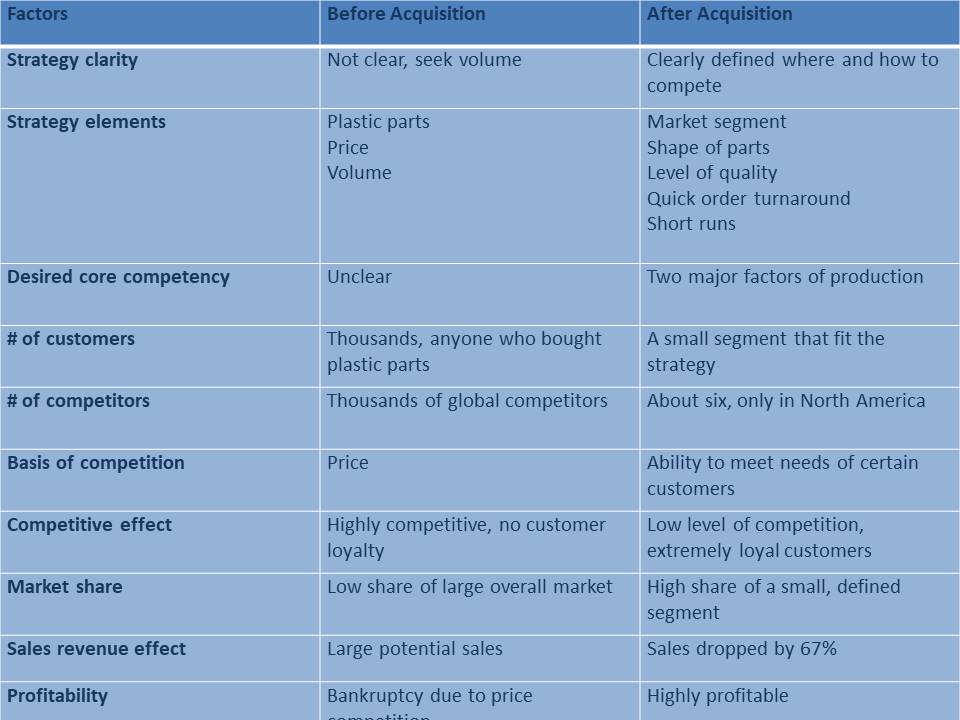
The business happened to be an injection molding business. Before the acquisition, the company was a fairly large molder of plastic parts mainly for the automotive industry. While every business has a strategy of some sort, either explicit or implicit, it is hard to describe just what the strategy was before the acquisition. As with many of the thousands of injection molding businesses, the strategy could be described as “find and pursue any business that they could make.” That would be the where of strategy. The how of their strategy might be described as competing on price with a hope of building volume. Without any clear core competency or competitive advantage, the company competed mainly on price. And without anything to set it apart, it competed with hundreds or thousands of other companies with similar capabilities. Therefore, the company faced stiff price competition and customers that had no loyalty but would quickly switch suppliers for a lower price. Since they continually needed to give price concessions to keep their volume, it was not surprising that the business went into bankruptcy.

As my friends acquired the business out of bankruptcy, they defined a strategy for success. The impetus of the strategy was to utilize the productive capacity of the acquired company while developing some particular core competencies. The immediate impact of the new strategy was to fire most of the previous company’s customers and focus on a new set of customers, resulting in an immediate shrinking of the company to one-third of the sales revenue. However, the one-third of the revenue was more profitable than the previous company had ever been.

Their new business strategy had five elements that defined where and how they would compete. First, it defined the sorts of products that they thought they could produce well. Secondly, it defined the kinds of markets that they hoped to serve, and then it described what the expectations would be of their target customers and the skills that they would need to offer. There were two primary markets that they wished to serve, and these were narrowly defined, both expensive equipment markets. They knew that the producers of this sort of high-priced equipment would have high expectations for quality and that suited the company just fine. By the nature of these equipment markets, they expected that customers would demand short runs and much smaller quantities than the norm that they had dealt with before their business had collapsed. Also, these customers would demand quick order turnaround.

The newly-defined strategy was targeted at meeting a clear set of needs for a specific set of customers. By providing a clearly superior value to these customers, the strategy led to satisfied customers. More importantly, the strategy defined a market and way to compete that eliminated most of the potential competitors. For this particular set of customers and their needs, there were not many competitors who were able or willing to develop the capability to serve this segment.

The new strategy provided focus for the re-organized company. It identified the customers that they would and, by default, would not serve. It defined the products that they would and would not produce. Most importantly, it defined the two core competencies that they would pursue – 1) the ability to consistently make this type of part at the necessary levels of quality and 2) the ability to efficiently produce short runs with fast turnaround. With the strategy in place, they knew precisely what capabilities they needed to develop. The strategy then guided the equipment in which they invested, the skills and technology that they would develop, the employees that they would hire and promote, and other decisions that shaped the company. With a clear strategy that focused and guided all of their decisions, they became a very successful and profitable operation. Most importantly, the strategy defined the value that they would offer to their select set of customers so that they developed strong and stable relationships with their customers.

Does your organization have a clear and compelling strategy that guides your decisions and defines how you will succeed?

SWOT Analysis

Most people in the business world are familiar with SWOT analysis – Strengths, Weaknesses, Opportunities, and Threats. SWOT analysis is useful in many life and business decision-making situations. It is an important part of the strategic planning process. Despite being familiar to most people, it is not always used effectively in the planning process. This article presents a reminder of how SWOT should be used in the strategic planning process.

The Strengths and Weaknesses portion of SWOT is an inward view. They present the advantages or disadvantages of the organization, Strengths providing the advantages and Weaknesses describing the disadvantages. They are considered relative to the capabilities of competitors and in the context of customer needs. As an example, a new building or a certain manufacturing process is not a strength. Being more efficient because of a new, more organized building or a new manufacturing process could be a strength if it provided an advantage of faster delivery or lower costs, assuming that this was important to customers. The strength is actually then faster delivery or lower costs due to ….. Or another example, the ability to make our product a brighter blue is only an advantage or a Strength if customers actually would prefer a brighter blue. If any shade of blue is acceptable or if the customer would not pay more or switch suppliers for a brighter blue or if competitors already have a brighter blue, then there is no advantage or Strength.

Sometimes in evaluating Strengths and Weaknesses, organizations might ask the question “What do we do well or not so well?” But this question is too vague. In identifying Strengths it is better dig deeper and to answer questions such as the following. Imagine just the opposite to understand Weaknesses.

  • What would our customers say is our strength or advantage?
  • Why do we get the order?
  • What resources do we have or have access to that give us an advantage?
  • What knowledge or intellectual property do we have that others might not have?
  • What processes are we skilled at that give us an advantage?
  • What do we have, know, or do that our competitors wish they had?
  • What are the major reasons for our profitability or market share?

The Strength or Weaknesses needs to precisely defined, such as a $10 cost advantage due to specially-designed production advantage or 20% advantage in signal attenuating performance due to patent #99999.

Opportunities and Threats are the result of external factors. Opportunities are elements in the market environment that could be exploited. Threats are elements in the market environment that could present risk or cause trouble for the business. The market environment in Threats and Opportunities must be thought of broadly. It is more than current customers or current markets. Threats and Opportunities are affected by the entire value chain, by world politics and economics, by social changes, by environmental or resource impacts, by technologies of various sorts, etc. as well as factors impacting customers and competitors.

The questions that might be asked relative to identifying Opportunities are endless but here are a few examples:

  • Do our customers have unmet needs relative to our products or services?
  • Are there similar customers or markets that have similar needs to our markets or customers?
  • Are there particular segments of the market that are underserved or where competition is thin?
  • Are there competitors that might be exiting the market or leaving opportunities for us?
  • Are there potential changes in economics, politics, societal norms, regulations, or technologies that could result in opportunities for our products or services?
  • Are there changes in technologies or other factors that could present opportunities to improve or greatly change the way that we produce products?

Similarly, there could be a long list of questions regarding threats. Here is a sampling:

  • How healthy are our customers and is there risk of an industry shakeout?
  • How likely is the potential for new competitors entering our market?
  • What current or potential activities could lead to more aggressive action from our competitors?
  • Is there a potential for changes in the value chain that could adversely affect our customers or their need for our product or services?
  • Are there potential changes in economics, politics, societal norms, regulations, or technologies that could present risks for the market for our products or services?
  • Are there changes in technologies or other factors that could threaten our ability to produce products?

To get the full value of SWOT analysis in the planning process requires a rigorous effort. The items listed should be precise and definable. The list in each section should be realistic and prioritized. The analysis communicates best with only a short list of the most important factors. The purpose of the SWOT analysis is to increase the understanding of the business and to drive the implications into strategy and action plans.

Once you understand how to compile a good SWOT analysis, the results should provide a deeper view of your business. The SWOT analysis tool provides a means to explore new opportunities and improve your decision-making process.

Is your SWOT analysis clear enough to impact your strategic direction?

Strategic Situation Analysis

In the strategic planning process, defining the strategy is a function of combining goals and objectives that define what the organization would like to accomplish with the realities of the situation. The situation analysis is a vital part of the planning process because it sets the context in which the organization will operate in the planning period and results in a clear view of priorities.

The situation analysis provides the basis for the decisions to be made in the definition of strategy and the implementation steps for moving forward. It is sometimes referred to as the SWOT (strengths, weaknesses, opportunities, and threats) analysis but we should think of it more broadly than people generally view SWOT analysis. The situation analysis should not be an onerous documentation of everything we know about the market and our position. Rather it provides a disciplined opportunity to think through and identify the particular factors that will affect our market and our ability to be effective in it. It’s better to have five bullet points of the things that will prompt a decision about where and how to compete than five pages of data, tables, and graphs that have no bearing on the way that we will do business in the future.

The situation analysis examines both the external and internal factors that will affect the business and its ability to compete in the planning period. In other words, it answers the questions “what will affect the market in which we compete?” and “what will affect our ability to be successful in competing?”

The external elements of the situation analysis can be divided into macro and micro factors. Macro factors would include analysis of political/legal, economic/demographic, social/cultural, or technological (sometimes called PEST analysis) changes or trends that will affect, either positively or negatively, the market or our ability to compete in the market.

The micro factors focus on customers and competitors. Regarding customers, we answer the question of “what are the important elements or what changes will we see in potential customers and their need, willingness, or desire to purchase products or services similar to ours?” This might include the number or health of potential customer, changes in industry structure, changes in end markets, etc. Regarding competitors the analysis addresses similar questions, such as “who are the key competitors and what are their capabilities that impact our ability to compete?”, “what changes are we likely to see in the number or the capabilities of competitors?”, or “what is the competitive environment and how is it likely to change?”

Again, the purpose of the situation analysis is to identify the factors that will affect our ability to compete and achieve the goals and objectives. We are searching for the threats and opportunities that will impact the organization over the planning period or beyond. We need enough information to enable us to understand the threat or opportunity and then to craft a strategy that will appropriately respond.

The second major part of the situation analysis is the analysis of internal factors. The internal analysis is focused on where we stand, how well we compete, where we need to improve, and what are we able to capitalize upon. It examines the strengths and weaknesses relative to customer needs and relative to other competitors in the market. In preparing the internal analysis we need to examine areas such as market position (market share, brand awareness and position, distribution or channel position, sales capability, etc.), technology (product or process capabilities), staff or culture, access to resources (financial and other), operational capability (efficiency, capacity, etc.), and other areas that might affect our ability to compete in the market. The goal in the internal analysis is to provide the information that will enable us to identify and prioritize the way to use resources that will strengthen our ability to compete.

The biggest challenges that organizations struggle with in the situation analysis portion of strategic planning is either 1) not thinking broadly enough about the areas that might affect their market opportunities and ability to compete or 2) spending a lot of time documenting things that have no impact on their future. The analysis that backs up the strategic planning process should be an ongoing effort of the organization to understand the market, the customers, the competitors, and themselves. The plan itself is then a distillation of all of these areas to identify where the threats and opportunities exist and where our strengths can be applied or our weaknesses shored up to make us a more effective competitor. The end result of the situation analysis should be a crisp and clear description of the factors that lead to strategic choices.

Is your strategic plan crisp and clear? Where do you find the greatest struggle in analyzing and communicating the situation that your organization faces?