Developing a Coaching Culture

Built upon humility and valuing others, it is a subset of servant leadership.

Too often, leaders think that they are responsible for making most, if not every, decision in their organizations. Perhaps their ability to make good decisions has played a large part in advancing to a position of leadership, so they continue on that track. Perhaps they enjoy the power or control that they feel in making every decision. Or maybe they just don’t trust the people around them to make good decisions.

Often, making decisions at the top seems the most expedient thing to do. Whatever the reason, “the buck stops here (and only here)” is the way that many leaders operate.

When describing a leader’s role in his 1974 book Management, Peter Drucker listed five specific leadership roles, as follows:

  1. Setting objectives
  2. Organizing the group
  3. Motivating and communicating
  4. Measuring performance
  5. Developing people

Our task here is not to examine each of these roles, but rather to notice that making every decision is not among the five.

One responsibility that is part of the five, however, is developing people. The way leaders develop people shapes the quality of the decisions their people make. In the book Built to Last, Jim Collins describes successful companies as having talent “stacked like cordwood.” One of the best ways of developing people and building that talent pool is by incorporating coaching into leadership—in other words, build a coaching culture within the organization.

Culture within an organization can be thought of as the ways we work together and treat people both within and beyond the organization. According to Richard Daft in The Leadership Experience, culture can be defined as the set of key values, assumptions, understandings and norms that are shared by members of an organization and taught to new members as correct. Culture is not a statement but a practice throughout the organization. And culture flows downhill. Especially in small- to mid-size enterprises, the behavior of the leader(s) of the organization becomes the culture of the organization.

A coaching culture, then, is a set of behaviors in which the skills and practices of coaching become a primary means of interacting. These skills and practices include: demonstrating value placed on those people with whom we interact, practicing humility, listening to understand and asking powerful questions.

These powerful questions are not leading or judgmental, nor simply advice wrapped with a question mark. They are questions seeking to know real thoughts from the real person. This coaching culture, built upon humility and valuing others, could be considered a subset or a specific form of servant leadership.

Characteristics of a Coaching Culture

Beyond the four distinctives—valuing others, practicing humility, listening well, and asking great questions–here are some telltale signs of a coaching culture:

  • Multilevel and same-level coaching.
  • Team-oriented posture, a sense of mutual ownership; it is an “all for one, one for all” mindset.
  • Open, frequent, constructive communication from all stakeholders, both up and down the organizational structure as well as peer-to-peer.
  • Consistent, high-quality feedback, at all levels.
  • A common coaching practice and language.
  • Input sought and freely provided without regard to hierarchy.
  • Leaders that are positive role models.
  • Clear alignment and integration of human resources.
  • A pervasive attitude of servant leadership or serving one another.

A coaching culture is not nirvana nor an environment where everyone always gets along, and no one is ever unhappy. But it can grow to be an organization where all people are valued and where team members at all levels have space to grow, receive honest and helpful feedback, and pursue professional goals. And the end result is that the team members’ and the organization’s goals become more closely aligned.

There are many benefits of building a coaching culture for the organization and the people in the organization, including:

  • Empowered and engaged team members.
  • Team members feel supported and are willing to take calculated risks.
  • Increased productivity.
  • Change moves faster and with less resistance.
  • Increased buy-in or motivation as team members make or participate in decisions that they then implement.
  • High employee satisfaction and commitment.
  • Low employee turnover.
  • Being an organization that people want to join.

For many organizations, moving from status quo to a coaching culture can be daunting and difficult. And making a half-hearted or poorly executed attempt can cause serious damage to existing relationships, as the gesture can appear manipulative or improperly motivated. So, moving to a coaching culture is not for the faint of heart or those unwilling to experience substantial personal growth and change.

The best way to begin developing a coaching culture is to cultivate strong coaching skills within a small cadre of motivated leaders, remembering that culture flows downhill.

Coaching within an organization generally takes place in three modes: spontaneous, invited or structured coaching. This well-trained cadre of coaching leaders might then begin by using short, spontaneous coaching whenever they see an opportunity. This spontaneous coaching is much like the idea of providing feedback on the spot. In this case, the practice is to explore decisions and actions as we see them, in order to build and sharpen the decision process.

Eventually, people within the organization will begin to recognize this behavior as the new norm. The coaching cadre can then begin converting requests for direction or advice into invited coaching discussions. Over time, people will value the developmental advantage and begin asking for structured coaching. They will also begin following the role models they have witnessed. As this develops, it will become time to introduce a coaching vocabulary and teach coaching skills more broadly in the organization. Eventually, if done well, this new mode of behavior will work its way into most (likely not all) people in the organization, and you will begin to see the results in the way that people interact and work together.

Do you consider coaching a major part of leadership? What steps are you taking to increase the ability and capacity for coaching throughout your organization?


(This article was previously published in IndustryWeek.)
A Coaching Culture: What It Takes, Why It’s Important

Today’s workers often base their job satisfaction on three major factors:

  • Purpose – they want to know how they contribute to society.
  • Partnership – they want connections with the people around them and with the organization.
  • Plan for development – they want to know that their leaders care enough to help them grow and prepare for the future.

We can achieve these things and many other advantages by developing a coaching culture in our organizations. This recent article, published in IndustryWeek, describes what a coaching culture looks like, how it can be developed, and how it benefits the organizations.

150 Great Coaching Questions

One of the best descriptors of a coaching relationship is the analogy of a stagecoach – a coach helps a person move from where they are to where they want to be. As a coach, we help the client make that movement through the combination of powerful listening and asking powerful questions. Through these two skills, the client discovers answers or direction within themselves that lead to the desired movement.


Coaches most often establish a relationship with a client in which, over time and through several sessions together, the client develops a plan and takes action to achieve the goal that he/she has established for the coaching relationship. Often, we use the G.R.O.W. model to guide the coaching relationship through the process of establishing a Goal for growth or change, examining the Realities around this goal and the process, exploring some Options that the client might use to grow or change, and then defining the Way (some call it Will) that the client chooses to pursue this growth or change.

Below are 150 questions that provide examples of the types of questions that a coach might use within the coaching relationship, to help the client discover and define a plan for growth or change. Every coaching relationship is a little bit different, so these questions need to be tailored to the coach, the client, and the nature of the relationship.

The coaching relationship generally extends over a number of sessions together. While we often use the G.R.O.W. model to guide the overall relationship, the client also sets goals for each coaching session and defines actions to be pursued between sessions. This first set of questions are some examples that might be used at the beginning of each coaching session.

  • How was your week, two weeks, month?
  • What’s on your mind today?
  • How have you grown this week?
  • What did you learn?
  • What are you grateful for?
  • What did you accomplish this week?
  • Of the actions we talked about last time, what did you accomplish?
  • What progress have you made towards your goal for our coaching relationship?
  • What would you like to focus on for our conversation?
  • What is the biggest issue on your mind today/this week?
  • Based on the amount of time we have together today, what would be your ideal outcome from our conversation?
  • What would you like to have achieved by the end of this session?
  • What would you like to take away from our conversation?
  • How can our session today help you with the current challenges you are facing?

Once the session moves into coaching, the first session(s) are most likely focused on defining the Goal for the coaching relationship. Questions regarding the Goal might look like the following:

  • What do you want to get from this coaching relationship?
  • What is your current biggest problem or challenge?
  • What’s missing in your life right now?
  • What would you like more of in your life?
  • What would you like less of?
  • What is your desired outcome or goal?
  • What’s the real challenge here for you?
  • What is it specifically that you want to achieve?
  • What would it look like if you were entirely successful?
  • Describe your ideal outcome from this coaching…
  • What would you like to happen that is not happening now, or what would you like not to happen that is happening now?
  • Why are you hoping to achieve this goal? What is the deeper meaning or personal significance that this goal has for you?
  • What do you want to achieve long term?
  • When do you want to achieve it by?
  • What will change if you achieve this goal?
  • Help me understand why this change is particularly meaningful to you.
  • Describe this goal or challenge a bit more…
  • What positive things do you feel will happen if you accomplish what you’re trying to achieve?
  • If you don’t change this, what will it cost you in the long run?
  • How would your life be transformed if you changed this right now?
  • What does success look like?
  • What do you imagine it would look like if you could accomplish this?
  • How will you know if you have achieved your goal?
  • How long have you been thinking about this goal? What are some of the thoughts that you have had about this?
  • What’s important to you about that outcome or result?
  • Is this goal pulling you forward or are you struggling to reach it?
  • Is that positive, challenging, attainable?
  • What would be your next goal after you achieve your current one?
  • What’s the bigger picture?

Once a Goal has been defined (or at least a first version of one), coaching moves on to examining the Realities of the situation. Here are some sample questions that demonstrate what this phase of the coaching relationship might look like:

  • What’s the current situation?
  • How would you like it to be?
  • What’s your biggest obstacle to achieving this goal?
  • What have you tried?
  • What will happen if you don’t take this step?
  • What is in your control?
  • What’s standing in your way?
  • What’s the cost of not taking action?
  • What’s the benefit of taking action?
  • What’s getting in the way of your progress?
  • What will things look like after you’ve been successful?
  • What’s worked for you in the past?
  • When have you been successful in a similar situation in the past?
  • What did you do to make it successful?
  • How does this affect the people around you?
  • Are you focused on what’s wrong or what’s right?
  • How long have you been thinking about this?
  • What’s stopping you from taking action?
  • What will you have to give up in order to make room for your goals?
  • What qualities/resources do you have to help you?
  • What are the internal/external obstacles?
  • What’s the downside of your dream?
  • What’s the benefit of this problem?
  • What strengths can you utilize in making this change?
  • How can you turn this around and have better results next time?
  • What does your intuition tell you about this?
  • Have you ever experienced something like this before?
  • What are some ways this challenge is impacting you or others?
  • What can you learn from this situation?
  • Do you have a gut feeling about this?
  • How do the key principles and priorities you live by apply here?
  • If you could start over again, what would you do differently?
  • What specific events led you to that conclusion?
  • What are you doing to not achieve your goal?
  • If your main obstacle didn’t exist, how would your life look?

As the client comes to more fully understand the Realities of the situation, she/he is equipped with the information to begin exploring the Options that might exist for moving toward the goal. The coach might use questions such as the following to assist in that process.

  • What do you see as the first step to accomplishing your goal?
  • Are there any steps you could take right away that would significantly improve your situation?
  • What might you do to take you closer after that?
  • Can you think of some alternatives? Is there another way?
  • Who might you ask for help? Who else?
  • What are the pros and cons of this option?
  • Which possible pathway do you feel prepared to go down?
  • What would you do if time/money/resources weren’t an issue?
  • What has worked for you in the past when it comes to situations like this?
  • How might you draw on that same approach in this case?
  • Tell me about the resources that would be helpful? How or where might you acquire those?
  • What might your family or friends suggest that you do?
  • If a friend were in your shoes, what advice would you give them?
  • How would you tackle this if time wasn’t a factor?
  • What option appeals to you most right now?
  • Imagine you had no barriers, what would that look like?
  • What else could you do?
  • Think of someone you respect. How would she/he handle this situation?
  • What haven’t you considered that might have an impact?
  • What resources do you need?
  • What would you have to believe for this option to be right?
  • What’s the worst that can happen, and can you handle that?
  • How can you solve this problem so it never comes back?
  • How can you learn what you need to know about this?
  • Is this the best option you can imagine or is there something greater?
  • Which step could you take that would make the biggest difference, right now?
  • What fears or inner drives are influencing your response? How could you remove those things from the equation so you can make a better decision?
  • Tell me what you think would happen if you tried doing that?
  • How might you broaden your current line of thinking?
  • What has worked for you already? How could you do more of that?
  • What’s the best/worst thing about that option?
  • What are the pros/cons of pursuing each option? Which is most advantageous?
  • What would it cost in terms of time and resources to do this? What would it cost if you don’t do this? What’s the cost if you don’t decide or let circumstances overtake you?
  • What decision would best align with your faith? What is God saying to you on this?
  • What will really make the biggest difference here?
  • If you weren’t scared, what would you do?
  • What might make the difference that could change everything?

After exploring Options, the client should be ready to choose or define a specific action plan (the Way) with milestones and target dates for moving forward. Here are some sample questions for the Way (or Will) phase of coaching:

  • Which opportunity or option are you going to pursue?
  • What is a first step you can take?
  • What are the steps you’re going to take? What’s the very first thing you will do?
  • What are the next three steps? What else?
  • What specific actions will you take to achieve your goal? What is your time frame?
  • Have you decided to take action or are you just hoping you will?
  • What are you willing to commit to here?
  • Who do you have to support you or hold you accountable?
  • What support do you need to get that done?
  • When precisely are you going to start and finish each action step?
  • How might you turn these steps into a plan?
  • Who needs to know what your plans are?
  • What will you do now?
  • When will you do it?
  • How specifically will you know you’ve completed that action/goal?
  • What could arise to hinder you in taking these steps?
  • What personal resistance do you have, if any, to taking these steps?
  • What will you do to eliminate these external and internal factors?
  • What support do you need and from whom?
  • What will you do to obtain that support and when?
  • What roadblocks do you expect or that require planning?
  • Have you considered the potential barriers?
  • Tell me how you plan to overcome these obstacles…
  • What commitment on a 1-to-10 scale do you have to taking these agreed actions?
  • What prevents this from being a 10?
  • What could you do or alter to raise this commitment closer to 10?
  • What does this accomplishment mean to you?
  • How will you celebrate that?
  • To what extent does this meet all your objectives?
  • Is there anything missing?

At the end of each coaching session, the coach needs to check in with the client to assure that they are both on track and that the client is achieving his/her expectations for the coaching relationship. The client should also have a set of action steps to accomplish prior to the next coaching session. The wrap-up to each coaching session might use questions like the following:

  • Is there anything else you want to talk about now or are we finished?
  • What was your biggest win of the session today?
  • What actions do you plan to take in preparation for our next session?
  • Are there any other actions that would be helpful before we next meet?
  • What was most useful for you?
  • What’s been your major learning, insight, or discovery so far?
  • Are there any important questions that have not been asked?
  • What had real meaning for you from what you’ve spoken about? What surprised you? What challenged you?

As mentioned earlier, these are simply examples of the types of questions that might be used in a coaching relationship. Some of these might easily fit into different phases of the G.R.O.W. model or a coach might prefer some other model for guiding the conversation, still using similar questions.

The important thing to remember in coaching is that the coach’s responsibility is to practice powerful listening that leads to powerful questions. The coach’s role is to use questions like these to assist the client in drawing out the thoughts, hopes, dreams, fears, etc. that play a part in the client’s understanding and moving forward.

What other questions do you find effective in coaching others?

Ditch the Annual Performance Review

This article appeared in IndustryWeek and related newsletters in early June 2021 and was in the top 10 of most-read articles for the month of May and into June. The article proposes a more meaningful way of coaching and guiding team members in place of what is often a bureaucratic system of annual performance reviews. Give a read and tell me what you think.

A Case Study in the Value of Powerful Questions

“Good leaders ask good questions. The best leaders ask the best questions.”

Effective leaders spend much of their time coaching the people around them. They see the value that asking questions provides as they empower people and help in their development.

A friend recently told me about his experience as he began to use powerful questions in leadership. One of the people on his team had sent a message to the effect, “We need a decision on this.” As he related this to me, it seemed almost like an ultimatum and that she was clearly laying the responsibility on him. Since he and I had discussed The Power in Powerful Questions just days earlier, he opted out of his normal pattern of providing a quick decision.

Instead, he paused a couple of minutes and wrote a reply that contained a few questions. He didn’t tell me precisely what those questions were, but they probably went like this: “What do we need to accomplish through this decision?”, What are some of the alternatives that you have already considered and are there others that we should think about?”, “What are the major issues that we face in making this decision?” Knowing my friend, he probably ended his note with a clear and positive statement, such as, “I hope these questions are helpful as you formulate your recommended decision.”

A few days went by without a reply from the team member, and my friend began to have second thoughts. Having stepped out of his normal pattern, what was she thinking? Perhaps she was thinking that he was shirking his responsibility of making all the decisions, or maybe that he was hanging her out to dry on this particularly difficult decision, or that their relationship had been fractured for some reason. A few more days went by and he received a reply that both pleased and surprised him.

Her reply to his questions, which were in place of a quick decision, began with this statement, “Thank you for not making this decision but rather empowering and encouraging me to make a recommendation.” She then laid out the decision that she thought they should make along with the logic that supported it. As he read her recommended decision, he realized that it was much better than any decision that he would have thought of in this case. Being the person closest to this decision and responsible for its implementation, she had the most knowledge and the best perspective. Therefore, with some encouragement, she was able to reach the best decision.

By asking a few powerful questions, my friend had empowered the team member to think deeply and reach a great decision. As this pattern continues, she will no doubt be more satisfied and enthusiastic about her job responsibilities. And, with continued practice and coaching, she will grow in her ability to analyze situations and make decisions. And, by having the responsibility for both the decision and the implementation, she is now highly motivated to make it happen successfully. She is fully bought in.

Many people, when they reach a position of leadership, think that their knowledge and ability to make decisions got them there and that, as the leader, they are now responsible for making most, if not all, decisions. This could not be further from the truth. The most effective leaders make few decisions. They are responsible for the quality of decisions but one of the greatest purposes of leadership is to develop the people around them. To do so, requires asking the powerful questions that “sharpen the saw” for people in the organization so that those closest to the implementation are prepared and able to make those good decisions.

As a leader, are you more likely to make decisions or to ask the questions that help others think and decide well? Do you view this delegating of decision-making as losing your power or empowering others? Which of these, your power or empowering others, is more important to you?

The Coach Approach – Intro

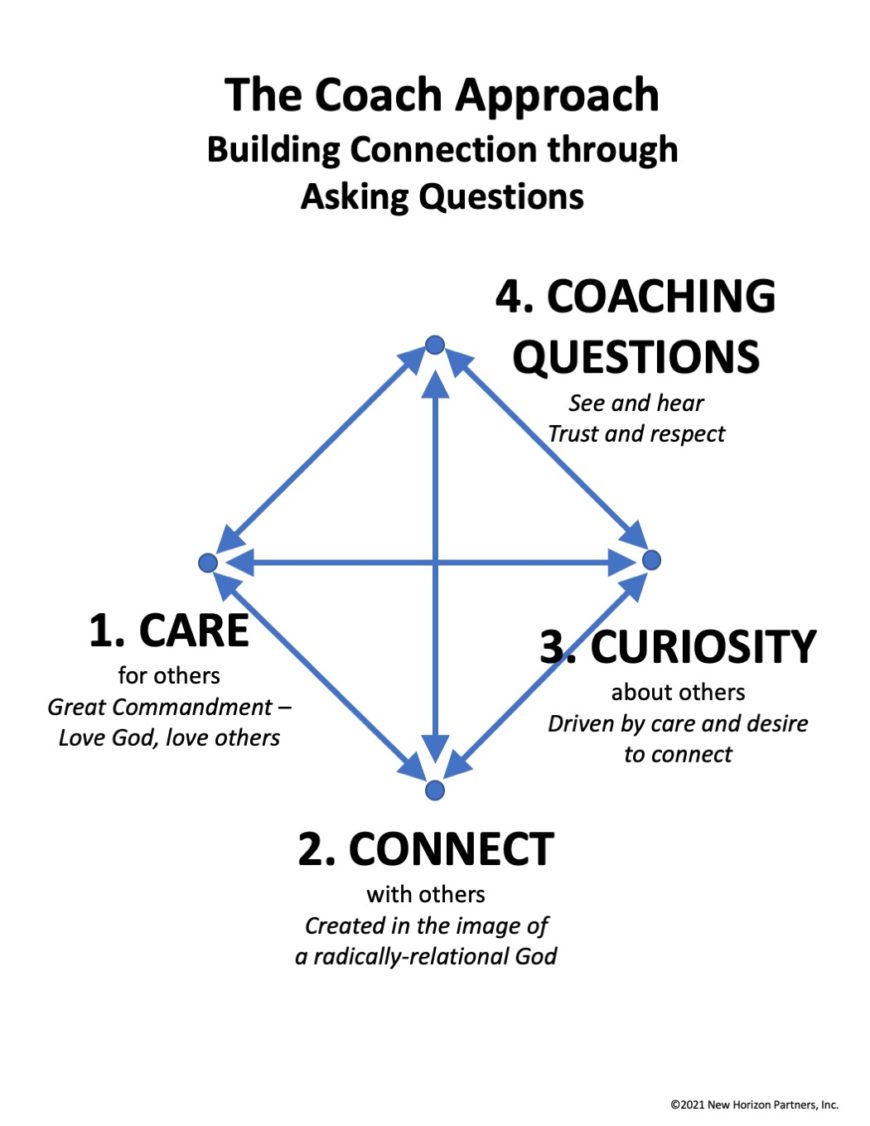
The Coach Approach© is a lifestyle or mindset of utilizing questions in conversations to build relationship and/or to help others to grow. It is an other-focused or “one another” approach to relating to the people around us. The Coach Approach could also be defined as “Making a practice of building conversations around powerful questions that are based on curiosity with the goal of building connection and demonstrating care for the people around us.”

This article is an introduction to the concept of the Coach Approach, which is then explained in a series of following articles on specific elements of the concept. The complete list of articles explaining what the Coach Approach is, why it is the best way to build relationship, and examples of the Coach Approach in action is shown later in this article. But first, here is the model of the Coach Approach in action:

Read the full series:

The Coach Approach, Part 1 – The Roadblocks

The Coach Approach, Part 2 – The Motivation

The Coach Approach, Part 3 – The Route

The Coach Approach, Part 4 – The Destination

The Coach Approach, Part 5 – The Coach Approach in Action

The Coach Approach, Part 6 – More of the Coach Approach in Action

The Coach Approach, Part 7 – Lessons from Mr. Rogers

500 Powerful Questions – Sample Questions

“Ask Powerful Questions” by Will Wise

While the title of this book makes it sound like a coaching book, it is more about a lifestyle or a process of building meaningful relationships. Ask Powerful Questions: Create Conversations That Matter is a book written by Will Wise along with Chad Littlefield. The book presents guidance for “asking intentional, empathetic questions that are rooted in our natural, genuine curiosity and followed up with deep listening.” Such questions, done well, lead to deeper conversations, better understanding, and stronger relationships.

The book is structured around a pyramid of ever-deeper skills that can develop the ability to ask these powerful questions, and more importantly, to develop a mindset that prompts one to ask questions rather than providing self-centered information or opinions. The pyramid has five levels of skill development that the authors believe to be necessary in developing the skill of asking powerful questions. Beginning at the bottom, or foundational, level of the pyramid, the five levels are as follows:

Intention (The Power of Clear Intention) – “I am willing to know you”
The authors claim, “You can only unlock the true potential of your questions by first being clear about the intentions you’re setting forth both for yourself and in sharing with others.” There are two levels at which we need to consider intention. First, as a questioner, we must understand and be driven by intention that is driven by curiosity and understanding, not some subterfuge or effort at manipulation. Also, the recipient of our questions must have an understanding or comfort with the questions’ intention. This might be inferred as part of a conversation but might also be a clarifying statement by the questioner.
Rapport (The Power of Being Present) – “I see you”
Rapport means building a relationship of trust. You might be able to ask a simple, yet powerful question of a perfect stranger, let’s say the cashier as you are buying groceries. But to actually develop a meaningful conversation, a certain degree of trust is necessary. So, rapport or connection is a prerequisite, but connection is also generally the result of a conversation driven by powerful questions.
Openness (The Power of Being Open) – “I hear you”
Of course, powerful questions are open-ended questions. But this openness, as the third level in building the pyramid, refers to our approach to a question; there is a requirement to be open-minded if we are truly asking powerful questions. This means that we are willing to receive and accept any answer without judgment and without any sense of the “right” answer. At this point in the book, the authors caution against using questions that begin with the word, “why,” and also against using questions that include the word, “you.” Both of these words can easily prompt defensiveness in the recipient.
Listening (The Power of Reflective Listening) – “I get you”
There is no power in a question if we are not ready to devote all of our attention to the answer. In this chapter of the book, the authors spend some time describing deep or active listening. They provide some powerful tools for reflective listening and break them various reflective listening methods.
Empathy (The Power of Connection) – “I feel with you”
Empathy can provide power behind the connection. The authors compare empathy with apathy and sympathy and state, “Choosing empathy allows the relationship to move toward connection, allowing for compassionate action. Apathy and sympathy can have the opposite effect and actually pull people apart.”

Throughout the book, the authors identify the traps that inhibit our powerful questions, a potential antidote for the traps, and tools to overcome or avoid the traps. At the end of each chapter presenting the skill levels of the pyramid, there are practical exercises to build the skill. Throughout the book, the authors cite research to reinforce the importance of these skills and offer relational and practical wisdom.

This is an excellent book with very practical advice about asking powerful questions. These powerful questions can assist us in developing great conversations and in building stronger relationships in any part of our life.

“The COACH Model” by Keith Webb

These days there are many books on coaching. Some of them are targeted for the professional life coach, some for the manager or leader who realizes the value of coaching to build relationships and develop team members, and others for the person who wants to build coaching skills as a part of relationship building. We have read and reviewed a number of books from each of these categories over the years. Another good coaching book that I would recommend is The COACH Model for Christian Leaders by Keith E. Webb. It has a subtitle of “Powerful leadership skills for solving problems, reaching goals, and developing others.” From the title and subtitle it’s clear that this is a book targeted at building coaching skills for the leader or manager. But it also presents some great tips for the individual that wants to build a coaching mindset for everyday life. Also, while the book is described as a resource for Christian leaders and is built upon some Scriptural wisdom, the concepts apply to anyone.

According to the author, most of us suffer from what he calls “know-it-all-ism”, the desire to give our opinion, solution, or knowledge. But coaching is quite the opposite. Coaching involves listening to others, asking questions to deepen thinking, allowing others to find their own solutions, and doing it in a way that makes people feel empowered and responsible enough to take action. To interact with another person in a coaching role requires a mindset, a skill set, and a tool set. The first three chapters of the book provide a nice description of the coaching mindset. While the book’s primary objective is to equip leaders for coaching team members, this description of coaching could be especially helpful to people who simply want to incorporate the coaching mindset into all of their relationships.

The central part of this book is a coaching process for leaders to use as they seek to develop people within their sphere of influence. The process is the COACH Model, which includes the following steps:

  • Connect – the connect step has two components. First, engaging or re-engaging with the coachee and second, following up on action items and previous discussions.
  • Outcome – the second step sets expectations for the outcome from the present conversation. This allows both the coach and coachee to know the path that the conversation is expected to follow and for them both to measure along the way to assure that they are on track.
  • Awareness – this step is the heart of the conversation wherein together, with the coach asking questions and the coachee reflecting and discovering, they seek insights, connections, and perspectives surrounding the topic and desired outcome.
  • Course – Having explored and reflected, the fourth step is the development of an action plan. Given what the coachee has discovered through the conversation, what are the steps for growth and development between today and the next discussion?
  • Highlights – the final step is a summary, but it has a greater purpose than just documenting the coaching session. By effectively summarizing, the discussion is consolidated into learning that is more likely to be retained and have impact.

While this might seem like a script for a coaching meeting, throughout the five chapters on this process the author builds further on the coaching mindset and provides practical advice on using these various steps in different situations. He wraps up the book with advice on incorporating these coaching tools in every relationship and in every part of our life. In describing the benefit of using the coaching mindset in all of our relationships, the author says the following:

“In our fast-paced world we too often cut short conversations that require exploration. We’re looking for easy answers that don’t create more work. Instead, encourage exploration by asking questions that will cause the other person to reflect more deeply. Then you’ll find underlying issues, meaning, and new learning.”

The Power in Powerful Questions

Today, the concept of coaching is familiar to most people and many people might describe coaching as a conversation built around questions. But there are questions and then there are powerful questions. If, in coaching, we hope to help others think deeply and find answers within themselves, we must first ask powerful questions.

Powerful questions are those open-ended questions that get to the heart of the topic and cause the other person to really stop and think. A silent pause in response to a question indicates that either our question made no sense, or it made perfect sense, but requires some contemplation and processing to answer.

Powerful questions can be thought of as having two dimensions.

First, powerful questions have a relational foundation:

  • They demonstrate our respect for the other person. Powerful questions are framed in such a way as to show that we think highly of the other person, respecting them in every way as a capable, intelligent, well-functioning creation of God.
  • They demonstrate our care for the other person. One favorite definition of love is “seeking the best for the other, regardless of whether it is deserved or reciprocated.” A powerful question is presented in way that seeks the best for the other.
  • They demonstrate our curiosity about the other person. Powerful questions seek to understand deeply the other person; what makes them tick. For example, they are not looking for external facts but the internal impact of those external facts.

Secondly, powerful questions have a developmental objective:

  • They seek to prompt reflection. The process of considering the question might prompt conclusions and connections that are not evident on the surface.
  • They might lead to discovery. In thinking deeply about a powerful question, they often result in discovering underlying beliefs, values, convictions, or capabilities that the other person had not yet found. The generation of ideas from within is a goal of coaching questions.
  • They should result in ownership. As the other person, considers these powerful questions, they develop conclusions or form a plan of action that is uniquely their’s. Such conclusions or action plans have greater value than any that might be imposed upon or suggested to them.

Three principals also help in structuring powerful questions:

  • Them or Me? Is this question for my benefit or the other person’s? The coaching mindset is a form of servant leadership, where we are seeking the best for the other.
  • Forward or Backward? Is this question focused on the past or moving forward? Coaching is about the future.
  • Building or Correcting? Does this question try to correct the other or help them build? Coaching is about growth and development.

The coaching mindset means that we build these dimensions and principals into the way we think and the way that we interact with the people around us. Whenever appropriate, we serve others by asking powerful questions.

Do you have the character required to ask powerful questions? What are you doing to build that character? What would it require from you to grow in this practice?


Here are some other articles on a similar topic: “Ask, Don’t Tell“, “Tell Me More About…“, “Ask Questions Instead of Giving Answers