An Effective Strategy Should Say ‘No’

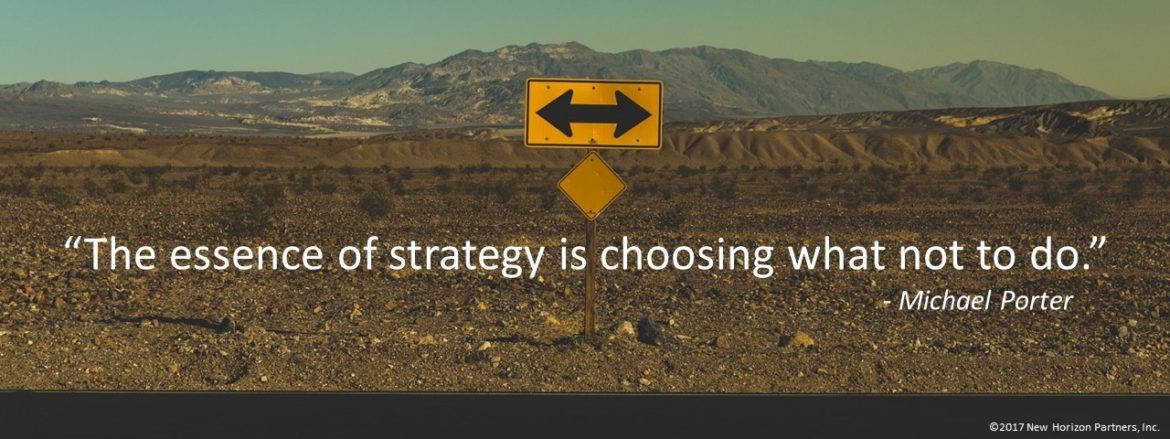
An effective strategy sets the direction for a business but it also should be specific enough to say no—no to pursuing certain customers, no to entering certain markets, no to certain programs or investments, even no to hiring a certain person. No to choices that diverge from the optimal direction for the organization.

Strategic planning sets the direction for an organization by describing where and how the business will compete in order to provide value to target customers that will lead to accomplishing the organization’s strategic objectives. The purpose is to define and provide a clear, succinct statement of strategy that can guide decisions within the organization.

Strategy should focus the organization’s efforts and investments on those with the highest return potential. The strategy then becomes a screen that sifts through decisions regarding which business opportunities to pursue and about the allocation of resources. With an effective plan and management process the organization can then say yes to the right opportunities and no to the suboptimal choices.

For example, one of my recent manufacturing operation clients lacked a clear strategy. They were indiscriminately pursuing sales volume in hopes of making up losses on individual products with volume. In the meanwhile, they were teetering on the brink of bankruptcy.

Sensing an opportunity, an outside group acquired the company. Their first action was to define a clear strategy, a route to profitability. They identified the organization’s core competencies and the customers that were buying the specific products utilizing those competencies. This identified the size, shape and other characteristics of their preferred products and the specialized elements of the associated manufacturing process. Then they carefully examined the customers of such products and their value criteria. This led to identifying small lot sizes and quick-order turnaround as things highly valued by the target customers.

By focusing their new strategy on these very specific criteria, they moved from competing with 11,000 companies within a similar industry classification to facing only two or three operations with a similar value offering.

Having documented and communicated this newly defined strategy throughout the organization, they went about transforming the business. One early step was shedding the customers and products that no longer fit within their strategy yet represented two-thirds of sales—not a task for the faint of heart. But they quickly found that some good cost management and the early steps in growing their targeted business resulted in a strong return to profitability.

This strategy, with time and energy spent on buy-in throughout the organization, greatly simplified company management. Being more focused, the company is now recognized in their industry for their expertise, and many potential customers come seeking quotes. The strategy also provides the guidance to allow them to quickly say, “Nope, that doesn’t fit what we do well.” The people on the shop floor understand the importance of quick product changeovers and turning around orders quickly. This understanding results in a steady stream of innovations and process improvements coming from the floor. Every investment or expenditure of resources can now be examined with the strategy as a guiding light: “Does this investment help us move further down the path described by the strategy?” In short, the specificity and clarity of the strategy has resulted in unity and clarity within the organization in providing value to the customer, which in turn has enabled the company to achieve above-average returns.

Organizations typically make two mistakes in their strategic planning efforts. First, by not thinking deeply enough or not recognizing the value and purpose of effective strategic planning, they don’t develop a plan with the clarity and specificity to actually guide any decisions. Second, they don’t recognize that the purpose of planning is to guide every decision. The strategic plan does not belong on the bookshelf. It must be clearly communicated to the organization and continually held up as the signpost providing direction for the long-term development of the business.

Does your strategic plan optimize your decision-making process? Does it indicate when to say no and when to say yes?

(This article was previously published in IndustryWeek.)

Case Study in Strategic Focus

In a recent article we discussed strategic focus, the idea that companies should first develop a laser-focused strategy, i.e., a definition of precisely where and how they intended to compete, that provided the best path to achieving the company’s goals and objectives. Perhaps the greatest purpose of strategic planning is this second part of strategic focus, that the strategy needs to be clearly and consistently communicate to the entire organization and then used as a guiding light for the allocation of resources – capital, energy, thought, and actions – to maximize the likelihood of implementing and achieving the plan.

Some years ago, a client invited me in for a discussion about how to grow their business; more specifically, they wanted to talk about finding new customers. As I began to learn about the company and its business, I found different views of what they were and who they served. Most concerning, when talking to the sales director I was told that they were looking for anyone that bought plastic products. Of course, this demonstrated that they had no strategic focus at all and explained why they were struggling and needed help.

They were a part of an industry with thousands of competitors and tens of thousands of customers. Without having a clear definition of where and how they wanted to compete, they often found themselves competing for business based on the lowest cost for customers that had little expectations of value desired. While they competed for lots of low-price business, they had a substantial engineering function which was a requirement of some of their best customers but which few of their competitors offered. This represented a higher cost that was often not valued by many customers. They also a sophisticated quality and process control system, again representing a higher cost than the run-of-the-mill competitor. Without a strategy and strategic focus, the more business they gained, the more their net margins declined.

As we dug into this project, we naturally needed to begin with a strategic planning process. As part of this process we spent time talking about the need for strategic focus in order to be successful and maximize profitability. In defining their strategy, the where and how to compete, and the ways in which they wished to differentiate themselves from the mass of competitors, they decide to keep and build upon their strong engineering capability and the quality and process control standards. This led them to define their desired customers as manufacturers who would attribute value to an ability to re-design, consolidate, and improve the components that they purchased and would attribute value to the superior quality and consistency of parts.

This planning process and the subsequent communication process brought most of the team together, marching to the same beat of differentiation and serving a select set of customers. In the process, they learned some new language to use in evaluating business opportunities and decisions about allocation of resources.

The organization share this focus except for one person, one person who was key to the implementation. The sales director was either unable or unwilling to adopt the same focus as the rest of the organization. Throughout the planning process and subsequently he saw his role as “finding any potential customer that bought plastic parts.” In conversations with the company president, I pointed out this problem. In spite of the fact that the sales director and the company president where close and long-time friends, we agreed that he would be better served finding different employment. I then introduced them to a potential candidate that I knew would embrace the importance of focus and would be driven to find the right customers as defined by their strategic plan.

As a result, their profitability shot up and the business over the next few years grew from one plant to three plants. The right strategy was helpful, but strategic focus was the key to this company’s turnaround.

Does your organization have an appropriate and well-defined strategy? Does your organization understand it and have they rallied around it to develop strategic focus?

Where and How to Compete

The best definition of business strategy, at least in my opinion, is a statement of where and how an organization intends to compete. A longer version of this definition would be business strategy is a description of where and how an organization intends to compete, using the organization’s core competencies to meet customers’ needs and provide a compelling value to the customer. So, what does a statement of where and how to compete entail?

Where to compete describes and differentiates what is within and what is outside of the scope of business in which the company wishes to compete. This can include any combination of the following elements:

  • Geographic scope – this could include a locality or a region. It might also include a description, calling to mind certain retailers that define their market by demographics of certain locations over a broader scope, for example, a retailer that does business only in small towns.
  • Product or service offering – the particular definition of the company’s product or service offering defines where they will compete. This begins to overlap with the definition of how to compete. Breadth of product offering is one part of the process of defining where to compete.
  • Preferred market segments – segmentation begins to define more specifically where to compete and some of the definitions of segmentation can greatly overlap with the definition of how to compete. Defining segments can be as specific as defining the one customer that the company intends to supply. Segmentation can include dimensions such as vertical markets, demographics or psychographics of customers, distribution segmentation, occasion-based segmentation, and many others.

How to compete moves more deeply into defining how the company will allocate resources and present itself to the customer. Defining how to compete requires an understanding of customer needs and matching these needs with core competencies, either current or desired. At its highest level, how to compete requires a choice between the generic strategies of low cost producer or differentiate supplier. Defining how to compete can involve many different dimensions as the company positions its value offering to meet specific customer needs and to stack up against the offerings of competitive suppliers. For one supplier, how to compete might include providing the highest level of precision, for another, the most durability, for another, the sleekest design, for another, the best customer service, etc.  The two major dimensions of how to compete are –

  • Price and cost positioning – understanding the needs of customers, the economic value of the product/service offering, and the relative positioning versus competitors and alternatives.
  • Features and benefits packaging – understanding the value of the product/service offering relative as defined by customer needs and relative to competitors and alternatives.

Business strategy provides focus for the organization’s allocation of resources and guides the actions of the organization as it builds its future. The more clearly and precisely the company is able to define its strategy in terms of where and how it plans to compete in the future, the more effective the organization can be in developing its competitive position.

How clearly has your organization defined where and how it intends to compete?

Focus and Choice

Business strategy is about focus and choice. Strategy answers the question, what will we choose to focus on and what will we choose not to focus on? The struggle that many organizations deal with when trying to think strategically is a fear of bypassing any business opportunity. But not every business opportunity is a good opportunity. By failing to focus, the organization spreads its limited resources too thinly. Business strategy, when defined well, forces the organization to focus its resources on the business opportunities that are expected to provide the highest leverage, generating greater returns on the investment made.

One of our early consulting projects was with a manufacturing company that had been acquired by an equity fund. The owners brought us in to help the operating company define a growth strategy. When the owners described the company, they referred to “valuable, proprietary technology.” Their description was hard to understand but on my first visit to the company’s shop floor I saw this manufacturing process. To me it seemed “proprietary” as I had never seen or heard of their process elsewhere in their industry, but it was not “valuable.” In fact, it was a legacy manufacturing process. The business had its roots as a startup serving very low volume applications. This particular process had been “valuable and proprietary” when the company was a startup and trying to grow to $5million. But they were now a $50million company tasked with doubling again in size. This legacy manufacturing process was still in use serving a small percentage of their customers and applications. While it only represented a small portion of business, it required an inordinate amount of organizational energy to keep the process running and to serve these low-volume customers. In fact, it took so much energy to serve this small segment of business that they could never find resources, especially the energy, to achieve their objective of growing to $100million. In developing a strategy for growth, they were forced to make a choice.

Business strategy defines where and how to compete. A successful strategy requires making choices about where, in other words, with which products, in which markets, for which customers, will the organization serve. It also requires choices about how to compete, in other words, at what level of pricing, with what combination of products and services or features and benefits. In order to provide this choice of particular value offering, the organization needs to make choices regarding how to produce and deliver, in other words, with what manufacturing processes, at what level of integration, at what level of quality, etc. Strategy, then, describes the choices made regarding the value offering and the customers to be served.

Many organizations struggle to make these choices. They fear that, by focusing on the highest and best opportunity, they bypass other opportunities and, therefore, miss out on sales revenue opportunities. But, by failing to focus, the organization dilutes its potential to maximize return on investment. By failing to focus, companies fail to maximize efficiencies in production and confuse the organization and the market.

On the other hand, a strategy that has made clear choices provides direction for the entire organization. The engineering function knows what the product should and should not contain. Operations can optimize their manufacturing processes. Sales and marketing can identify the right customers and communicate the right message that responds to the needs of the chosen market segment. While the organization may bypass some sales revenue, the return on sales and return on investment is maximized when the organization has a clear sense of what it is, who it serves, and how it provides value.

Does your organization’s strategy have the clarity to identify the right focus and choices?

Strategic Focus

Strategic focus is essential to business success. It is the ability to identify the one path that the business intends to take to accomplish its objective and to then relentlessly pursue that path while ignoring other paths along the way.

Many businesses fail to focus which dilutes their resources and can eventually drain or drown the business. The reason that companies fail to focus is a fear of missing a business opportunity. This is especially true for young entrepreneurial businesses. Granted, we hear of stories in which a business pursued something out of their ordinary line of business and serendipitously found a great business opportunity. But this is the exception rather than the rule.

Lack of strategic focus dilutes resources because the organization spends its resources pursuing opportunities that have cross purposes. The danger comes in when one day the organization is pursuing business that requires lowest costs, the next day they pursue business that requires higher levels of production capabilities, then they pursue some business that requires unique customer service commitments, and so forth. As these different customer requirements come into the business, the organization spends time, money, and energy to develop each of them. And the result is that resources are cast about and the capabilities are given (at no cost) to customers who do not value them.

We should clarify here that strategic focus is a different, although similar, concept than a focus strategy. In the classic book, Competitive Strategy, author Michael Porter defines three broad or generic choices for strategy:

  • Cost leadership strategy in which the business pursues the lowest cost of producing or delivering its product or services.
  • Differentiation strategy in which the business pursues unique design or production capabilities that provided added value in meeting customer needs.
  • Focus strategy in which the business pursues a well-defined segment of the market in which it is able to develop either a cost leadership or differentiation advantage for a certain set of customers.

The smart business finds a business strategy in which they have faith and relentlessly pursues it. Strategic focus is this ability to define and pursue a clearly defined strategy that delivers value to a clearly defined set of customers. Strategic focus causes the organization to ignore business opportunities that do not fit within the strategy and the customer definition. It unites the organization in its effort to continually build the capabilities that make it unique. Strategic focus drives the organization to identify and pursue the customers that value the firm’s capabilities or product/service offering.

One of the purposes of strategic planning is to communicate and unite the organization to pursue the defined strategy based on the belief that this strategy will produce results that meet the firm’s objectives. In turn, the organization needs to have a culture that draws the organization together in pursuit of this strategic focus.

Does your organization have strategic focus? Is everyone on the same page and pursuing the same strategy?

Case Study in Strategy Effectiveness

I define business strategy as a description or statement of where and how an organization intends to compete. A longer version of this definition would be business strategy is a description of where and how an organization intends to compete, using the organization’s core competencies to meet customers’ needs and provide a compelling value to the customer. Sometimes it can be difficult to translate this rather academic definition into a real-life strategy. A case study of what strategy is and how it can transform a business can be helpful in developing our understanding.

Some years ago, two of my friends bought a business and transformed it simply by defining and implementing a great strategy. Of course, it took some effort to first define a great strategy and then to implement it by changing the way the business operated. On the other hand, the investment was primarily in thought and discipline.

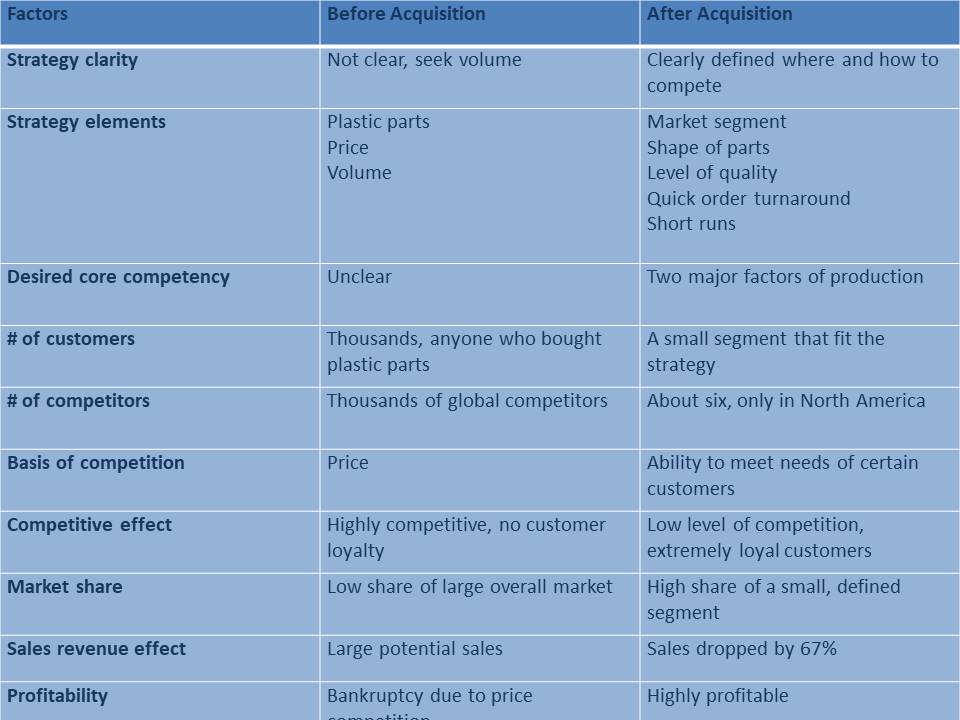
The business happened to be an injection molding business. Before the acquisition, the company was a fairly large molder of plastic parts mainly for the automotive industry. While every business has a strategy of some sort, either explicit or implicit, it is hard to describe just what the strategy was before the acquisition. As with many of the thousands of injection molding businesses, the strategy could be described as “find and pursue any business that they could make.” That would be the where of strategy. The how of their strategy might be described as competing on price with a hope of building volume. Without any clear core competency or competitive advantage, the company competed mainly on price. And without anything to set it apart, it competed with hundreds or thousands of other companies with similar capabilities. Therefore, the company faced stiff price competition and customers that had no loyalty but would quickly switch suppliers for a lower price. Since they continually needed to give price concessions to keep their volume, it was not surprising that the business went into bankruptcy.

As my friends acquired the business out of bankruptcy, they defined a strategy for success. The impetus of the strategy was to utilize the productive capacity of the acquired company while developing some particular core competencies. The immediate impact of the new strategy was to fire most of the previous company’s customers and focus on a new set of customers, resulting in an immediate shrinking of the company to one-third of the sales revenue. However, the one-third of the revenue was more profitable than the previous company had ever been.

Their new business strategy had five elements that defined where and how they would compete. First, it defined the sorts of products that they thought they could produce well. Secondly, it defined the kinds of markets that they hoped to serve, and then it described what the expectations would be of their target customers and the skills that they would need to offer. There were two primary markets that they wished to serve, and these were narrowly defined, both expensive equipment markets. They knew that the producers of this sort of high-priced equipment would have high expectations for quality and that suited the company just fine. By the nature of these equipment markets, they expected that customers would demand short runs and much smaller quantities than the norm that they had dealt with before their business had collapsed. Also, these customers would demand quick order turnaround.

The newly-defined strategy was targeted at meeting a clear set of needs for a specific set of customers. By providing a clearly superior value to these customers, the strategy led to satisfied customers. More importantly, the strategy defined a market and way to compete that eliminated most of the potential competitors. For this particular set of customers and their needs, there were not many competitors who were able or willing to develop the capability to serve this segment.

The new strategy provided focus for the re-organized company. It identified the customers that they would and, by default, would not serve. It defined the products that they would and would not produce. Most importantly, it defined the two core competencies that they would pursue – 1) the ability to consistently make this type of part at the necessary levels of quality and 2) the ability to efficiently produce short runs with fast turnaround. With the strategy in place, they knew precisely what capabilities they needed to develop. The strategy then guided the equipment in which they invested, the skills and technology that they would develop, the employees that they would hire and promote, and other decisions that shaped the company. With a clear strategy that focused and guided all of their decisions, they became a very successful and profitable operation. Most importantly, the strategy defined the value that they would offer to their select set of customers so that they developed strong and stable relationships with their customers.

Does your organization have a clear and compelling strategy that guides your decisions and defines how you will succeed?

A Different Differentiation

Strategic differentiation is achieved by providing a unique or different value offering to customers as compared to competitors. A strategy of differentiation is based on developing a deep understanding of customers’ needs and then meeting those needs in a unique way. The value offering is the whole package of product, service, and relationship benefits. The price to the customer comes into play when the customer evaluates the benefits or value of the offering. A frequent mistake that companies make is not understanding the needs of the customer in sufficient depth. Often product suppliers only look at product differentiation based on the benefits provided by the product. In the same way, service suppliers sometimes look too narrowly at the service provided.

business strategy differentiation Ken Vaughan

A consulting project from some time ago demonstrates the need to dig deep in understanding customer needs. I had done a couple of small projects for this particular client regarding product offering and go to market decisions. It had surprised me how successful they were in their primary business when it appeared to be a completely commodity product. My curiosity was satisfied in the next project. The owner of the company asked that I identify customer needs and help them further refine their business strategy. Through the usual process of in-depth interviews of customers and other industry participants, I discovered why my client was able to garner a large share of the market for a commodity product at a premium price. This competitive position was in the face of growing low-cost international competition and competitors that had various advantages in terms of manufacturing capabilities.

This client’s product was sold through an industrial distribution channel and generally combined with other products in the distributor’s final sale. Through the interview process we identified that the client’s product was a small portion of the sale amounting to a few dollars in a multi-hundreds total sale. The customer’s (the distributor) primary need was that the purchase of these ancillary parts was as painless as possible; it was really a matter of transaction cost. The price of my client’s product was so low insignificant compared to the total package being assembled by the distributor that their concern was simply that one phone call or order completion was all that was required. A second phone call to check on delivery, get an authorization for return goods, correct an error, or anything else would far outweigh any savings from a lower priced competitor.

The client’s customer service function was outstanding because they had a customer service manager who was a bit of a drill sergeant when it came to serving the customer. She understood the customer’s expectations and assured that they were being met. She was a good leader in that she developed a shared vision within the customer service function that the customer should never be disappointed or inconvenienced and she empowered her customer service reps to make the necessary decisions to carry out this vision.

The client’s strategy, the “where and how to compete”, embodied this vision. The “where” was obvious; they sold these particular, well-defined products through an industrial distribution channel. The “how to compete” was all about serving the customer and assuring that they provided the lowest cost of transaction with their impeccable service.

The lesson to be learned here is this: When a customer is buying a widget, the customer need is not for a widget. The customer need, in fact, is for the benefits that the widget will provide and for the benefits that the accompanying service and relationship will afford the customer. When seeking to determine customer needs and to defining a competitive strategy that will provide value to the customer and a profitable return to the organization, the firm needs to dig deep. Henry Ford is quoted as saying, “If I had asked people what they wanted, they would have said faster horses.” Steve Jobs said something to the effect that you can’t ask customers what they want, because they don’t know. Both of these thoughts are the same, in understanding customer needs one must dig deep to find the inner motivation and desire that even the customer might not recognize. Then the organization must develop a solution where the benefits derived from the product, service, and relationship meet those deeper needs.

Do you understand the real needs of your customers? Does your strategy move you towards a competitive advantage in meeting those needs?

Strategy Should Say No

An effective strategy sets the direction for the business but it also should be specific enough to say no – no to pursuing certain customers, no to entering certain markets, no to certain programs or investments, no to hiring a certain person. The strategy says no to choices that diverge from the optimal direction for the business to achieve its objectives.

Business strategy sets the direction for an organization by describing where and how the business will compete in order to provide value to the customer that will lead to accomplishing the organization’s strategic objectives. The purpose of strategic planning is to provide a clear and succinct statement of the organization’s strategy that can guide decisions within the organization. Strategy should focus the organization’s efforts to those with the highest return potential. The strategy then becomes a screen that sifts through decisions regarding which business opportunities to pursue and about the allocation of resources. With an effective plan and management process the organization can then say yes to the right opportunities and no to the suboptimal choices.

Strategy decisions Ken Vaughan

The business strategy provides a means to screen business opportunities. The organization should be able to compare every new business opportunity with the parameters of where and how to compete that is described in the strategy and decide if it fits. Sometimes organizations write what they call strategy in broad, vague terms because they do not want to limit their business options. One reason for this is that they are desperate to find any revenue to survive and fear passing by any revenue source, even those that will detract from their long-term profitability potential. A second possible reason is that they are incapable of properly positioning their business. To position the business requires a good understanding of customers and their needs, not just today’s needs but also evolving needs. It also requires an understanding of the organization’s core competencies and how these competencies can match with customer needs.

The business opportunities that maximize return are those where the organization can provide unique value based on its core competencies. The core competencies either provide a unique value to customers or they provide a unique economic advantage in generating solutions to customer needs. The strategy needs to clearly demonstrate how the organization is building its core competencies and what customer needs it seeks to fulfill. (For more thoughts on this, see the strategy example article.) Business opportunities that align with the strategy should be considered and pursued. Business opportunities that do not align with the strategy distract from a pursuit of competitive advantage and will not generate optimal returns. Those business opportunities that do not fall within the business strategy should be discarded.

Strategy also guides the organization in its allocation of resources. Resources applied to building core competencies that then lead to competitive advantage in providing value to the customer have the potential to generate a higher return. Scattering resources among a variety of programs that are not strategy driven dilutes efforts and resources. The strategy provides a means to screen projects and resource decisions. If a project or decision cannot demonstrate strategic value, the answer should be no.

We see then two common mistakes that organizations make in their strategic planning efforts. First, by not thinking deeply enough or not recognizing the value and purpose of effective strategic planning, they might not develop a plan with the clarity and specificity to actually guide any decisions. A second mistake is not recognizing the purpose of planning to guide every decision. In order to do so, the strategic plan needs to be clearly communicated to the organization and held out as the signpost providing direction for the long-term development of the business.

Does your strategic plan optimize your decision process?

Example of a Great Business Strategy

A fever for growth and volume was driving this company toward bankruptcy until they developed a great strategy that turned them around, resulting in consistent value creation.

Under previous owners a manufacturing company with which I am fairly familiar was growing by grabbing any piece of business they could find. They were heavily dependent on the automotive industry, faced a large number of similar competitors, and were rapidly going broke. The management team bought the company just before bankruptcy and proceeded to define a new business strategy that made more sense.

strategy-development-ken-vaughan

Their new business strategy had five elements that defined where and how they would compete. First, it defined the sorts of products that they thought they could produce well, secondly it defined the kinds of markets that they hoped to serve, and then it described what the expectations would be of their target customers and the skills that they would need to offer. There were two primary markets that they wanted to serve and they were narrowly defined, both expensive equipment markets. They knew that the producers of this sort of high-priced equipment would have high expectations for quality and that suited the company just fine. By the nature of these equipment markets, they expected that customers would demand short runs and much smaller quantities than the norm that they had dealt with before their business had collapsed. Also these customers would demand quick order turnaround.

One of the benefits of defining this strategy and pursuing these market niches was a change in the competitive dynamics; the number of truly capable competitors would shrink from thousands to a mere handful and it would be difficult for international competitors to meet the delivery requirements. Another advantage would be that the relative cost of the components that this company would produce would be a tiny fraction of the purchased components for their target customers. The target customers would have limited choices and would willingly pay for the value that the company could provide. As they shrank the business and shifted to this new strategy, sales declined by more than 60% as they “fired” customers but profit margins shot upwards and the net result was very advantageous.

The new business strategy provided a guide for where they should seek business. Not every piece of new business meets all five of the criteria, but the company is never tempted to chase an order just to gain volume. Customers who need the value offering that is provided are willing to pay a reasonable price with reasonable margins. There are still a few competitors with a similar value offering but the business for which they now compete is not subject to cutthroat pricing.

Once they established the market to be pursued and the value offering to be provided, the new business strategy met the other purpose of a strategy statement: it began to drive every decision and every action. They asked themselves, “What core competencies do we need to build to produce these particular types of parts at an extremely high level of quality?” and “What core competencies do we need to develop to provide efficient processes for short runs and quick order turnaround?” So the strategy began to drive every decision – the people to hire, the machines to install, the skills to learn, the technologies to develop, the orders to pursue or not pursue, the way to organize, the services to offer, which capabilities must be in-house, processes and procedures, etc. Everyone in the company marches to the same tune; they know the strategy and what makes the company unique and successful.

More than 20 years later this company still uses this same business strategy. It has continued to build the core competencies that enable it to produce their selected parts at very high levels of quality and work as a job shop in a high-volume industry. They consistently generate strong margins and growing sales revenue. The right business strategy saved them from the fate of many of their former competitors and built them into a strong and successful supplier.

Does your organization have a business strategy that sets it apart from the competition, drives the company’s decisions, and builds long-term value?

The Purpose of Business Strategy

The purpose of business strategy is to define how the organization should allocate resources in order to meet its goals and objectives and move toward its vision. Business strategy describes where and how the organization competes. This strategy is set in the context of customer needs, core competencies of the company, and the value offering relative to that of the competitors.

purpose-business-strategy

When I think of strategy, I focus on for-profit businesses because that is my experience and my audience for consulting. These same concepts apply to other types of organizations with some minor translation.

The primary goal of a business is to achieve a return on investment for those providing resources to the business. In the long run that return is a function of the value that they offer to customers compared to the perception of value of the offering in the eyes of customers.

Businesses provide some combination of goods and service to their prospective customers. This combination of goods and services is their value offering. Customers make choices about the value of each prospective supplier’s offering based on the customer’s needs. What level and array of service has value and how much? What features and benefits of products has value and how much? There are generally an array of prospective customers with varying needs and an array of potential suppliers with varying value offerings.

The ability of the organization to generate profits is a function of identifying customers with needs that match the organization’s ability to supply a value offering that is either produced more economically or a value offering that has unique value attributes (or some combination) compared to competitors. It is easy to see the extreme examples. Customers who buy sand often want the least expensive sand whereas customers who buy rocket engines probably have a unique set of desired features and benefits.

Organizations have a variety of capabilities to supply their package of goods and services. When certain of these capabilities are able to provide unique value to customers, we call this capability a core competency. Core competency might be proprietary technology that allows a unique design or manufacturing process resulting in some superior value to certain customers. It might be unique knowledge of a market or a customer’s needs. It might be unique access to lower-cost resources. It might be anything that differentiates us and adds value for the customer.

The purpose of strategy is to identify where and how to compete and to guide the allocation of resources. (For another interesting perspective of how strategy should allocate resources see this article in HBR by Michael D. Watkins.) Strategy identifies core competencies the organization is building that will enhance its value offering, the how to compete. Strategy identifies the types of customers that will most highly value the offering, the where to compete. Where to compete might include definition of region, demographics, end applications, specific names of customers, or many other attributes.

The strategy statement then should be a clear and concise statement of this where and how to compete. The organization should be able to look to the strategy statement in the midst of every decision and answer the question, “does this decision support and build our strategy?” The action plan is a natural outflow as we attempt to implement the strategy to build core competencies and achieve our objectives. These are all part of an overall strategic management system for the organization.

Every organization has a strategy, whether it is explicitly stated or implicit in the way that they operate, and whether it is well-defined or a murky mystery. How would you describe your organization’s strategy?