“The Advantage” by Patrick Lencioni

The big idea from Patrick Lencioni’s book, “The Advantage“, is summed up in the subtitle, “Why Organizational Health Trumps Everything Else in Business.” The book weaves together company culture, business strategy, and leadership philosophy to describe the path to organizational success. Lencioni makes the case that without health, organizations are prone to confusion, politics, and frustration that saps energy and makes them far less effective than their potential. The book makes the case that the best strategy, the best products, or the best people are all crippled within organizations that have not developed organizational health. With organizational health, the people within the organization are focused and efficient, therefore achieving higher goals more quickly.

Lencioni defines organizational health as integrity within the organization, “when it is whole, consistent, and complete, that is, when its management, operations, strategy, and culture fit together and make sense.” Another way to describe organizational health is a united leadership team with a clear business description and direction. He describes two fundamental requirements for success of an organization, when it is smart (demonstrated by effective strategy, marketing, finance, and technology) and healthy (demonstrated by minimal politics, minimal confusion, high morale, high productivity, and low turnover). His view is that most organizations spend the bulk of their effort on the smart requirement and very little effort on the organizational health requirement. This despite the belief that organizational health is far more important.

To achieve the advantage of organizational health, the book describes four disciplines, as follows:

  1. Build a Cohesive Leadership Team.
    This leadership team is defined as “a small group of people who are collectively responsible for achieving a common objective for their organization.” The key to building a healthy organization is in building cohesiveness in the leadership team, where the team members sacrifice their personal desires or interests for the benefit of the team. Lencioni lists five behavioral principles that must be embraced to build cohesiveness, as follows:
  • Building trust
  • Mastering positive conflict
  • Achieving commitment
  • Embracing accountability
  • Focusing on results
  1. Create Clarity.
    Too often we find organizations that exist as a group of silos, each with their own view of what is best for the organization or simply focused on their own departmental interests. A healthy organization is based on the leadership team rallying around a clear and consistent description of their business and its direction. Lencioni defines these six critical questions to provide the organization with what he terms clarity, describing the organization and its goals and direction:
  • Why do we exist?
  • How do we behave?
  • What do we do?
  • How will we succeed?
  • What is most important, right now?
  • Who must do what?

These questions define the business, its strategy, and the tactical priorities for achieving success. In Lencioni’s view, these six questions sum up the rallying points that bring the organization together.

  1. Overcommunicate Clarity.
    Of course, the author could have said that organizations need to communicate the answers to the six questions that provide clarity. But too often leadership sees this communication as a one-time activity rather than a continuous requirement. People in the organization will easily forget or become distracted unless leadership continually reinforces these critical elements of clarity. So that everyone in the organization is working toward the same goals, they all need to be reminded consistently and the leadership team needs to be sure that they are all giving the same message. Some organizations think that presenting the plan to all employees once should be enough to get buy-in. Other organizations never communicate; they just want people to do their jobs without any understanding of their employer and what needs to be accomplished to be successful. Instead, Lencioni suggests that organizations overcommunicate using every means possible so that everyone is focused on the same priorities.
  2. Reinforce Clarity.
    The fourth discipline that Lencioni describes as a necessity for building organizational health is through all of the human systems of the organization. For example, the hiring process needs to be structured so that candidates are screened first by their ability to fit with the values of the organization and then secondly for technical skills and past accomplishments. Similarly, the onboarding or orientation process should be considered a prime opportunity to communicate the answers to the six clarity questions. In the same way, the clarity questions should play a part in performance management, recognition, and compensation. Employees that do not fit with the values should be managed out of the organization, since they will cause a distraction to the rest of the organization

A theme throughout the book is simplicity. Bureaucracy and complicated systems defeat the purpose of uniting the entire organization with clarity. After describing the four disciplines of a healthy organization, Lencioni spends a final chapter describing his view of effective meetings consistent with the concept of a healthy organization.

Most of Patrick Lencioni’s books are written as business fables in which he focuses on elements of company culture and demonstrates failures and successes in building a successful organization. “The Advantage” is a practical guide that incorporates many of the concepts from Lencioni’s other books. While he tends to be a bit dogmatic, this book has a lot of great advice for building a healthy organization and healthy organizations outperform the rest of the world.


Strategic Situation Analysis

In the strategic planning process, defining the strategy is a function of combining goals and objectives that define what the organization would like to accomplish with the realities of the situation. The situation analysis is a vital part of the planning process because it sets the context in which the organization will operate in the planning period and results in a clear view of priorities.

The situation analysis provides the basis for the decisions to be made in the definition of strategy and the implementation steps for moving forward. It is sometimes referred to as the SWOT (strengths, weaknesses, opportunities, and threats) analysis but we should think of it more broadly than people generally view SWOT analysis. The situation analysis should not be an onerous documentation of everything we know about the market and our position. Rather it provides a disciplined opportunity to think through and identify the particular factors that will affect our market and our ability to be effective in it. It’s better to have five bullet points of the things that will prompt a decision about where and how to compete than five pages of data, tables, and graphs that have no bearing on the way that we will do business in the future.

The situation analysis examines both the external and internal factors that will affect the business and its ability to compete in the planning period. In other words, it answers the questions “what will affect the market in which we compete?” and “what will affect our ability to be successful in competing?”

The external elements of the situation analysis can be divided into macro and micro factors. Macro factors would include analysis of political/legal, economic/demographic, social/cultural, or technological (sometimes called PEST analysis) changes or trends that will affect, either positively or negatively, the market or our ability to compete in the market.

The micro factors focus on customers and competitors. Regarding customers, we answer the question of “what are the important elements or what changes will we see in potential customers and their need, willingness, or desire to purchase products or services similar to ours?” This might include the number or health of potential customer, changes in industry structure, changes in end markets, etc. Regarding competitors the analysis addresses similar questions, such as “who are the key competitors and what are their capabilities that impact our ability to compete?”, “what changes are we likely to see in the number or the capabilities of competitors?”, or “what is the competitive environment and how is it likely to change?”

Again, the purpose of the situation analysis is to identify the factors that will affect our ability to compete and achieve the goals and objectives. We are searching for the threats and opportunities that will impact the organization over the planning period or beyond. We need enough information to enable us to understand the threat or opportunity and then to craft a strategy that will appropriately respond.

The second major part of the situation analysis is the analysis of internal factors. The internal analysis is focused on where we stand, how well we compete, where we need to improve, and what are we able to capitalize upon. It examines the strengths and weaknesses relative to customer needs and relative to other competitors in the market. In preparing the internal analysis we need to examine areas such as market position (market share, brand awareness and position, distribution or channel position, sales capability, etc.), technology (product or process capabilities), staff or culture, access to resources (financial and other), operational capability (efficiency, capacity, etc.), and other areas that might affect our ability to compete in the market. The goal in the internal analysis is to provide the information that will enable us to identify and prioritize the way to use resources that will strengthen our ability to compete.

The biggest challenges that organizations struggle with in the situation analysis portion of strategic planning is either 1) not thinking broadly enough about the areas that might affect their market opportunities and ability to compete or 2) spending a lot of time documenting things that have no impact on their future. The analysis that backs up the strategic planning process should be an ongoing effort of the organization to understand the market, the customers, the competitors, and themselves. The plan itself is then a distillation of all of these areas to identify where the threats and opportunities exist and where our strengths can be applied or our weaknesses shored up to make us a more effective competitor. The end result of the situation analysis should be a crisp and clear description of the factors that lead to strategic choices.

Is your strategic plan crisp and clear? Where do you find the greatest struggle in analyzing and communicating the situation that your organization faces?

Strategy Is Not

A statement of business strategy describes where and how the firm will compete in order to accomplish its objectives, meet customer needs, and obtain a superior financial return. Strategy sets the boundaries around future decisions, describing which business opportunities should be pursued, how to invest resources, which skills to develop, who to hire, etc. The statement of strategy needs to be clear, specific, and concise enough to say yes to the preferred choices that are consistent with the strategy and no to the choices that are distractions from the strategy. The statement of strategy must be useful to all decision makers within the firm to keep everyone and everything operating within the direction defined by the business strategy.

Too often firms are either unable or unwilling to state a clear, specific, and concise strategy. Instead we find what purports to be strategy but simply consists of a bunch of buzzwords, or an agglomeration of goals and objectives, a very general description of mission, or a set of actions. Such a weak statement of strategy does not serve its purpose of guiding the future decisions of the firm or of defining where and how the firm will compete.

“Our differentiating value-added strategy is transformational change to reach a new paradigm of performance.” A collection of buzzwords does not define a strategy because it can be interpreted to be about anything. It does not provide direction for decision-makers.

“Our strategy is to grow top-line revenue 20% per year for the next five years.” Goals and objectives are not the strategy but are a prerequisite for strategy. The goals and objectives define where the firm wants to go but not how to get there. The strategy statement is intended define the path and drive the firm to a course of action to achieve the goals and objectives.

“Our strategy is to provide metal stampings and other metal components and fabrications.” A mission statement is not a business strategy. It simply describes what the firm is but not where and how the firm will compete. It does provide a specific definition of how the firm will develop its competitive advantage, so it cannot guide decisions as the firm evolves.

“Our strategy is to increase our machine shop capacity.” An action plan is not a statement of strategy. The action plan is the implementation of strategy, the specific things that will build the competitive advantage defined in the business strategy.

All of the examples above lack the clarity and specificity required to guide decisions by the organization. On the other hand a statement such as “We provide high quality, large, flat, injection-molded parts to the high-end, low-volume business and medical equipment market” provides a clear direction for decisions. The members of the organization know where and how they compete and what will be the expectations of their customers. The decisions that are made throughout the organization are then consistent with this defined strategy.

What are some examples of both good and bad strategy statements that you have seen?

Does your organization have a clear, specific, and concise strategy?

Understanding Market Attractiveness

Whether reviewing business strategy and current performance, considering entering a new market, or evaluating an acquisition or investment, understanding market attractiveness is an important step. Market attractiveness analysis provides a view of profit potential based on an examination of the underlying market factors. While the operating performance of a business may determine the actual level of profitability, market attractiveness sets the boundaries around profitability potential. The best performing company in a market with low attractiveness can only achieve a mediocre return. A company operating in a market that is highly attractive has the potential for high returns, given a strong strategy and effective implementation.

An understanding of market attractiveness is an essential part of the situation analysis in strategic planning, the step where we examine the business environment and the company’s position as the foundation for the business strategy. In making choices about the future direction of a business, market attractiveness is key. Market attractiveness is also a critical part of valuing an existing business. A common pitfall of investors is solely relying on past financial performance as a predictor of the future without ever looking at the underlying market attractiveness.

A recent consulting project provides a good illustration of the value of understanding market attractiveness. The client was interested in vertically integrating into a market (call it Mkt. A) that they saw growing. They asked our consulting firm to help them understand this market and guide them through planning and implementing the steps necessary for market entry. During our analysis we realized that Mkt. A was not particularly attractive but there was an adjacent market space, Mkt. B, that was much more attractive. Mkt. A was relatively unstructured; it was difficult to clearly define customers and competitors, but there were a lot of competitors. The customers were generally small, poorly-capitalized installers. The customers’ customers were open to a wide variety of substitute products. The buying factors were dominated by price. All of this meant that players in the market were under constant price pressure and margins were likely to be low. The adjacent Mkt. B, on the other hand, was highly structured and stable. The customers were capable and well-financed. There were only two viable competitors. The buying factors were predominantly product specifications and quality. While Mkt. A was larger and growing more rapidly, the profit potential in Mkt. B was greater. It was going to take a little more work for the client in terms of product development and manufacturing process improvement, but they were capable and the return on investment was likely to be much greater. Our analysis convinced the client to re-focus on the more attractive market and laid out a plan for market entry into Mkt. B.

While market size and market growth are often the first things that people think of in assessing market attractiveness, there are other more important considerations. The relative importance of various factors will be different for each company based on its vision, goals, and objectives. If the vision is to become a billion-dollar company, market size may be critical. On the other hand, for a company in the 95% of businesses that are less than $10 million in revenue, there may be many other factors more important than market size as it considers the means to maximizing return on investment.

In general terms, the factors of market attractiveness can be grouped into three overlapping areas: differentiation potential, pricing potential, and growth potential. Within each of these three areas are a variety of factors. The following might be some of the factors that determine market attractiveness.

Differentiation potential – The ability to differentiate, that is, to provide a unique value to customers, is a key factor in driving the potential profitability of a business. Certain elements of market attractiveness contribute to the ability to differentiate, and therefore to the potential return.

  • Customer factors – Who are the customers? Are they identifiable? How definable are their needs or buying factors? How complex are their needs? (Complex might be good or bad.) Are there opportunities to develop unique product or service offerings to meet customer needs? How well are their needs currently being met?
  • Technology factors – What sort of technology is involved in the product or in the production process? How mature is the technology? What opportunities are there for developing unique technology, either in product or process? Are there opportunities to develop unique and defendable intellectual property?

Pricing potential – Pricing potential is partially dependent upon the ability to differentiate but the industry structure and competitive environment determine the intensity of competition and the pressure on pricing.

  • Industry structure factors – How much leverage do buyers have in price negotiations? Are there many choices available to them, either in the number of suppliers or in alternative or substitute products? How much leverage do suppliers have in this industry? Can suppliers squeeze margins of the competitors?
  • Competitive factors – Who are competitors in this market? Are they identifiable? What are their capabilities? How intense is the competition? How easy is it for new entrants to come into the market?

Growth potential – Market size and growth is relevant but the most important part of market and growth is understanding the specific market segments that are to be addressed.

  • Market size – What is the market size? What is the growth rate? How will the market size and growth rate change over time?
  • Market factors – What factors are the drivers of the market? What are the growth opportunities? What are the risks regarding market size and growth? What are the segments or potential segments of the market?

Each particular business has its own market idiosyncrasies that determine market attractiveness. The challenge is to look beyond the simple and easy factors to develop a clear understanding of the structure of the market and the factors that will present either restraints on sales revenue and profitability or opportunities that can be exploited through a well-crafted strategy and action plan.

Do you understand the relative attractiveness of the market in which you operate? Are there opportunities to focus on more attractive market segments?

PEST Analysis

One of the potential tools for the situation analysis in strategic planning is the PEST analysis. No, this is not looking for insects and it is not referring to the competitors that make your life difficult. PEST analysis is shorthand for Political, Economic, Social and Technological analysis. It is often a part of the market and competitive environment analysis in a strategic planning process.

strategic planning outer focus

The big idea in PEST analysis is that a firm and its leaders should consistently have an outer focus that scans the horizon and remains aware of the trends and factors that are or may be impacting the business now or in the future. The strategic planning process provides a reminder to look at the big picture factors that might affect the market or business conditions and incorporate the potential effect and necessary actions related to those macro-factors. While often referred to under the acronym of PEST, this analysis may also extend into other areas that might affect the market or business such as legal, environmental, ethical, etc. although these can often be included under the primary PEST categories.

Too often firms can operate with a set of blinders, becoming too complacent in believing that nothing can change the way that the market has traditionally operated or the way that customers have functioned. Another risk is the result of being unwilling to face reality; we might see the changes but refuse to believe them. The PEST factors are not always threats; they can also present opportunities to take advantage of a changing situation to gain an advantage in the market.

Political factors can include rules and regulations that might change the way that business can operate as well as international issues. These might include things such as:

  • Employment law
  • Environmental regulations
  • Trade regulations
  • Tax policies
  • Governmental leadership
  • Political stability
  • International relations

Economic factors can include the macroeconomic environment that might affect the buying power of potential customers or the firm’s cost of capital. These might include things such as:

  • Inflation rates
  • Interest rates
  • Economic growth
  • Disposable income
  • Unemployment level
  • Foreign exchange rates

Social factors include demographic and cultural aspects that affect the external environment. They affect the way that people think and operate, impacting both buying decisions and employment practices. Social factors can be a broad range of things that might include:

  • Age distribution or demographics
  • Population growth
  • Lifestyle trends
  • Consumer attitudes and opinions
  • Consumer buying patterns
  • Fashion and role models
  • Ethnic/religious factors
  • Ethical issues

Technological factors are all of the changes of technology on a global basis. These can change a market or even obsolete a market. They can change the power or position of competitors and potential customers. Technology can affect any point in the value chain with the potential, for example, of eliminating the need for a customer’s product or services, thus impacting down the chain. Technological factors can include things such as:

  • Research and development
  • Trends in global technological advancements
  • Associated or substitutionary technologies
  • Legislation in technological fields
  • Patents
  • Licensing
  • Consumer preferences
  • Automation and manufacturing technologies

No doubt you can think of examples where the failure to comprehend or appreciate such PEST factors have eliminated or greatly impacted businesses, e.g., Google’s failure in China due to underestimating the political challenges, countless companies that have disappeared due to lower-priced imports, Blockbuster’s failure to see the shift to on-demand films, or the many phone and tech device manufacturers that missed the integrating of technologies in the iPhone. Admittedly, some of these factors can seem a greater risk to large, international companies but no firm can afford to ignore the potential threats or opportunities that might surface in the market environment that affects them.

Do you have an outer focus that is aware of threats and opportunities on the horizon?

A Different Differentiation

Strategic differentiation is achieved by providing a unique or different value offering to customers as compared to competitors. A strategy of differentiation is based on developing a deep understanding of customers’ needs and then meeting those needs in a unique way. The value offering is the whole package of product, service, and relationship benefits. The price to the customer comes into play when the customer evaluates the benefits or value of the offering. A frequent mistake that companies make is not understanding the needs of the customer in sufficient depth. Often product suppliers only look at product differentiation based on the benefits provided by the product. In the same way, service suppliers sometimes look too narrowly at the service provided.

business strategy differentiation Ken Vaughan

A consulting project from some time ago demonstrates the need to dig deep in understanding customer needs. I had done a couple of small projects for this particular client regarding product offering and go to market decisions. It had surprised me how successful they were in their primary business when it appeared to be a completely commodity product. My curiosity was satisfied in the next project. The owner of the company asked that I identify customer needs and help them further refine their business strategy. Through the usual process of in-depth interviews of customers and other industry participants, I discovered why my client was able to garner a large share of the market for a commodity product at a premium price. This competitive position was in the face of growing low-cost international competition and competitors that had various advantages in terms of manufacturing capabilities.

This client’s product was sold through an industrial distribution channel and generally combined with other products in the distributor’s final sale. Through the interview process we identified that the client’s product was a small portion of the sale amounting to a few dollars in a multi-hundreds total sale. The customer’s (the distributor) primary need was that the purchase of these ancillary parts was as painless as possible; it was really a matter of transaction cost. The price of my client’s product was so low insignificant compared to the total package being assembled by the distributor that their concern was simply that one phone call or order completion was all that was required. A second phone call to check on delivery, get an authorization for return goods, correct an error, or anything else would far outweigh any savings from a lower priced competitor.

The client’s customer service function was outstanding because they had a customer service manager who was a bit of a drill sergeant when it came to serving the customer. She understood the customer’s expectations and assured that they were being met. She was a good leader in that she developed a shared vision within the customer service function that the customer should never be disappointed or inconvenienced and she empowered her customer service reps to make the necessary decisions to carry out this vision.

The client’s strategy, the “where and how to compete”, embodied this vision. The “where” was obvious; they sold these particular, well-defined products through an industrial distribution channel. The “how to compete” was all about serving the customer and assuring that they provided the lowest cost of transaction with their impeccable service.

The lesson to be learned here is this: When a customer is buying a widget, the customer need is not for a widget. The customer need, in fact, is for the benefits that the widget will provide and for the benefits that the accompanying service and relationship will afford the customer. When seeking to determine customer needs and to defining a competitive strategy that will provide value to the customer and a profitable return to the organization, the firm needs to dig deep. Henry Ford is quoted as saying, “If I had asked people what they wanted, they would have said faster horses.” Steve Jobs said something to the effect that you can’t ask customers what they want, because they don’t know. Both of these thoughts are the same, in understanding customer needs one must dig deep to find the inner motivation and desire that even the customer might not recognize. Then the organization must develop a solution where the benefits derived from the product, service, and relationship meet those deeper needs.

Do you understand the real needs of your customers? Does your strategy move you towards a competitive advantage in meeting those needs?

Strategy Should Say No

An effective strategy sets the direction for the business but it also should be specific enough to say no – no to pursuing certain customers, no to entering certain markets, no to certain programs or investments, no to hiring a certain person. The strategy says no to choices that diverge from the optimal direction for the business to achieve its objectives.

Business strategy sets the direction for an organization by describing where and how the business will compete in order to provide value to the customer that will lead to accomplishing the organization’s strategic objectives. The purpose of strategic planning is to provide a clear and succinct statement of the organization’s strategy that can guide decisions within the organization. Strategy should focus the organization’s efforts to those with the highest return potential. The strategy then becomes a screen that sifts through decisions regarding which business opportunities to pursue and about the allocation of resources. With an effective plan and management process the organization can then say yes to the right opportunities and no to the suboptimal choices.

Strategy decisions Ken Vaughan

The business strategy provides a means to screen business opportunities. The organization should be able to compare every new business opportunity with the parameters of where and how to compete that is described in the strategy and decide if it fits. Sometimes organizations write what they call strategy in broad, vague terms because they do not want to limit their business options. One reason for this is that they are desperate to find any revenue to survive and fear passing by any revenue source, even those that will detract from their long-term profitability potential. A second possible reason is that they are incapable of properly positioning their business. To position the business requires a good understanding of customers and their needs, not just today’s needs but also evolving needs. It also requires an understanding of the organization’s core competencies and how these competencies can match with customer needs.

The business opportunities that maximize return are those where the organization can provide unique value based on its core competencies. The core competencies either provide a unique value to customers or they provide a unique economic advantage in generating solutions to customer needs. The strategy needs to clearly demonstrate how the organization is building its core competencies and what customer needs it seeks to fulfill. (For more thoughts on this, see the strategy example article.) Business opportunities that align with the strategy should be considered and pursued. Business opportunities that do not align with the strategy distract from a pursuit of competitive advantage and will not generate optimal returns. Those business opportunities that do not fall within the business strategy should be discarded.

Strategy also guides the organization in its allocation of resources. Resources applied to building core competencies that then lead to competitive advantage in providing value to the customer have the potential to generate a higher return. Scattering resources among a variety of programs that are not strategy driven dilutes efforts and resources. The strategy provides a means to screen projects and resource decisions. If a project or decision cannot demonstrate strategic value, the answer should be no.

We see then two common mistakes that organizations make in their strategic planning efforts. First, by not thinking deeply enough or not recognizing the value and purpose of effective strategic planning, they might not develop a plan with the clarity and specificity to actually guide any decisions. A second mistake is not recognizing the purpose of planning to guide every decision. In order to do so, the strategic plan needs to be clearly communicated to the organization and held out as the signpost providing direction for the long-term development of the business.

Does your strategic plan optimize your decision process?

Porter’s Five Forces

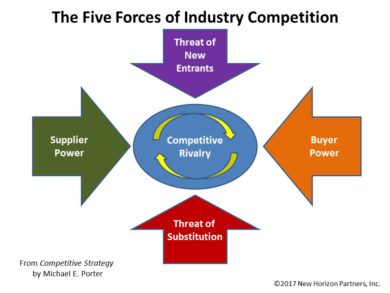
There are five general market or competitive forces that affect every business to some degree. These are often called Porter’s Five Forces because they were popularized in Michael E. Porter’s book, Competitive Strategy, published in 1980. The five forces result from industry structure and have an effect on the performance of a business and the attractiveness of a market. They describe the pressure on the industry participants and the impact on profitability performance of a company. The five forces are as follows:

Five Forces Strategy Consulting

  • Bargaining Power of Buyers
  • Bargaining Power of Suppliers
  • Threat of New Entrants
  • Threat of Substitution
  • Intensity of Rivalry among Existing Competitors

The strength and effect of each of the forces varies depending upon the industry structure. Most businesses will be strongly affected by at least one of these forces. Very few businesses are affected by all five. While the strength of the forces is largely a function of the industry structure, industry participants can often take some action to mitigate the effect of the forces. Understanding the industry structure and resultant competitive forces is an important part of the strategic analysis and planning process. In industries where the combination of these forces are high, the pressure limits the achievable profitability and returns, making the industry and the industry participants less attractive or making the business more challenging for existing participants.


The bargaining power of buyers is mainly dependent upon the size and strength of the buyers. Large and strong buyers that are able to easily switch suppliers or backward integrate have strong leverage in dictating price and terms. This is especially true when the product or service is more of a commodity rather than a differentiated product.

An obvious example of this situation is the automotive industry where the OEM’s have great strength, especially relative to some of the smaller suppliers of common products. They are often able to dictate pricing and drive margins down. When possible, the best defense in situations of high buyer leverage is to create differentiation in some way that provides more power to the seller or drive up switching costs. In some cases the strategic selection of customers can keep a supplier out of the worst scenarios of buyer leverage.

The bargaining power of suppliers is strong when they have unique materials, technology, or other means to control the industry participants that rely upon them. Situations where there are few qualified suppliers or where there is strong differentiation of the supplier or high switching cost and where the industry participant is small relative to the supplier are often instances where the supplier has high leverage.

Intel would be a good example where technology and brand power gives them a strong position relative to computer manufacturers. For many years Gore-Tex controlled the best material for water-proof active wear and could control the market. Another less obvious example is the position of a labor though a union such as the UAW. Examples of how companies position themselves by location decisions or design decisions to move away from high-leverage suppliers are common.

The threat of new entrants is largely a function of not having factors such as economy of scale, product differentiation or the ability to develop proprietary technology, switching costs, or strong brands. In industries that are largely commodities and where it is easy to start up a new participant, the continual flow or even the threat of new entrants drives down pricing and profits. Buyers use this leverage in price negotiations or sourcing decisions.

The restaurant business is an example where local businesses come and go every day. Commodity businesses like sand, stone, etc. and manufacturing businesses like machine shops or plastic injection molding are pressured by the ease of new entrants. One obvious solution is to build differentiation or switching costs by developing or adding technology or unique capabilities.

The threat of substitution is an often overlooked potential pressure because substitution can come from left field. Where threat of entry is new participants coming into an existing industry, the threat of substitution can partially or completely replace an existing industry. This is best demonstrated with some examples, such as high-fructose corn syrup replacing sugar refiners, fractional aircraft ownership replacing aircraft charters, electronic music files replacing the record and CD business, etc. Substitution can also include instances where a downstream product or industry is re-engineered to eliminate the need for certain products or services, with the example of video stores. The defense here is more a matter of being aware of the world outside of one’s particular products and industry. If the railroad industry had thought of themselves as being in the transportation business rather than the railroad business they might have retained their value by adapting rather than being replaced by substitute means of transport.

The intensity of rivalry among existing competitors is the area with which most industry participants are familiar. Competitive rivalry is a result of numerous competitors, slow industry growth, lack of differentiation, excess industry capacity, high strategic stakes, or high exit barriers. Most of the causes of competitive rivalry are out of the control of an individual industry participant. The one defense is differentiation either through technology or through unique capabilities or relationships. Apple is an example of a company that generally stays out of the competitive fray by continually differentiating itself and its products.

Analyzing the industry structure is a necessary step in understanding the value and profit potential of a business. This analysis can identify threats and opportunities. It sets the context for strategy decisions. Profitability and return on investment can be optimized by identifying market or industry opportunities that face lower competitive forces.

What are the pressures facing your industry and business? How can you mitigate the risks and develop opportunities?

The Process of Strategic Planning

Strategic planning is a tool that is useful for guiding day-to-day decisions and also for evaluating progress and changing approaches for moving forward. In a previous article we described the purpose of strategic planning. The process for strategic planning can often be an iterative process but it has these key elements:

  1. Set strategic goals and objectives
  2. Prepare a situation analysis
  3. Define or refine the business strategy statement
  4. Develop the action plan

Strategic planning is iterative in two dimensions. Within the process, for example, we might establish objectives and then discover through the process that the objectives need to be revised or that the strategy cannot be supported with actions. The process is also iterative over time as we should not be constantly developing a new plan but rather adjusting and revising the plan periodically as the reality of the market changes or as we adjust the objectives, strategy, or action plan.

strategic planning process Ken Vaughan

The strategic goals and objectives describe the targets or milestones that the organization plans to achieve over the planning period. In a previous article, we described in more depth the definition of goals and objectives. The plan might describe targets for sales revenue, profits or margins, market share, ROI, etc. It can also set goals and objectives for sources of revenue (e.g., % from new products or specific segments), levels of quality, customer satisfaction or retention. The list of potential goals and objectives is endless but the key is to identify the few that are strategically significant, in other words, which goals and objectives will mean that we have moved the organization toward our vision of a successful future? Better to have a short list of meaningful goals that the organization can rally around than a laundry list.

The situation analysis has two major components – the external analysis and the internal analysis. Obviously, the external analysis looks at the environment in which the company does business and the internal analysis looks at the company itself and its position in the market. There are lots of tools that might be used in the situation analysis such as SWOT analysis, PEST analysis, Porter’s Five Forces, etc. The important thing is not the quantity of charts and tables but rather the quality of the understanding of the business.

The external situation analysis describes the nature of the market and the competitive environment in which the organization competes. What is the market? How large and what are the drivers of the market and its growth? Who are the potential customers and what do they look like? How do they make decisions and what are their needs? What are the relevant segments of the market and how do they differ? How can we best understand the market and the customers? Who are the competitors? How do they compete? What are their strengths and weaknesses? Etc.

The internal situation or position analysis describes the organization’s capabilities and position relative to the market, the customer needs, and the competitors. It might include such things as identification of strategic issues; analyses of the mix of customers, products, or market segments; market share and trends; profitability and trends; customer perception, satisfaction, and retention; efficiency and capacity; culture and image: organizational structure and capabilities; strengths and weaknesses; etc. Again, this isn’t an exercise in developing an overwhelming compilation of charts and tables and analyses. The purpose is to develop a realistic perspective of the company’s position and its ability to provide value relative to competitors and to develop core competencies that lead to competitive advantage in meeting the needs of customers.

Given the objectives, the market situation, and the competitive position, the next element of the strategic planning process is the statement of strategy. In previous articles we described the purpose of the business strategy and provided some descriptors of strategy. The strategy statement describes where and how the organization will compete to provide superior value in meeting customer needs. This is the heart of the strategic planning process. In the strategic planning process the goals and objectives describe what the strategy should achieve. The situation analysis provides the logic behind the strategy decision. The strategy statement provides the direction for decision-making for the organization to move forward towards its objective and its long-term vision.

The final element of the strategic planning process is the action plan. The action plan describes the tactics and specific actions required to implement the strategy. It describes the actions that will take the organization from its present position to the position where it will achieve the goals and objectives. A previous article described tactics and action plans. The action plan needs to be specific enough that it can be monitored and it needs to be a realistic set of actions that will achieve the necessary change in performance to actually carry out the strategy and reach the objectives.

The strategic planning process should not be onerous. It is an opportunity to step back from the day-to-day operation of the business and think about how the organization should change or what actions are necessary to achieve a longer-term vision.

Is your planning process driving your organization forward or driving it crazy?

The Purpose of Strategic Planning

The purpose of strategic planning is to gain control of the future and the destiny of the organization. If your experience of strategic planning is developing a ream of paper full of tables and charts that then gets put in a drawer or on a shelf, never to be seen again, or if your experience is simply producing a long-range forecast of performance and calling it a plan, then you haven’t done a “strategic” plan.

The four purposes of strategic planning are as follows:

  • Define or refine business strategy
  • Establish overall goals and objectives
  • Develop an action plan
  • Communicate direction to the organization

In previous articles we defined business strategy as a statement of where and how to compete based on an understanding of customer needs and the organization’s core competencies. The strategic planning process is a context in which we understand those customer needs and those organizational core competencies. In examining these we are equipped to either define or refine the business strategy so that we might delineate the optimal path for achieving the organization’s objectives. The destiny of the organization is dependent on identifying a path in which the organization can create value for its customers which then creates value for its stakeholders.

The strategic planning process provides a means for setting some long-term goals and objectives. These goals and objectives are set in the context of the long-term vision for the organization and serve as milestones or targets for the development of the organization. Sometimes setting these objectives is an iterative process as the organization considers the possible impact of various strategy alternatives. The next steps in the destiny of the organization is defined in these goals and objectives.

Setting a strategy is a call to action. The strategic planning process is a context for identifying the actions necessary to implement the business strategy and to reach for the objectives. The destiny of the organization requires a proactive set of actions if we wish to influence it.

The final purpose for the strategic plan is to communicate to the organization the future direction of the organization. The strategic plan sets the direction for every decision. Therefore every decision-maker needs to understand and buy into the plan. The destiny of the organization is dependent on marshalling the resources of the organization and investing them wisely towards shaping the future.

Is your planning strategic? Will it positively affect the destiny of your organization?