Larry King – Questioner Extraordinaire

Larry King, the radio and television host and interviewer, earned his living and his reputation by asking questions. And not just simple questions, but often powerful questions. He was less interested in the facts than he was in the person. With his death this past week at the age of 87, it is interesting to look back at some of his thoughts on interviewing, listening, and asking questions. Here are a few quotes and the philosophy that guided his radio and television shows:

  • “I love asking questions. I’ve been doing it all my life. When I was 9 years old, I asked the bus driver, ‘Why do you want to drive a bus?’ And I’m still doing that, ‘Why do you want to drive a bus?’”
  • “Every day of my life is a learning experience, and I’m fascinated by everything. My curiosity in all those years has never dimmed since I was a little kid. I like interviewing weathermen – ‘Where does weather begin?’ I’ve asked that question to weathermen – you know the answer? West Africa. All weather begins in West Africa.”
  • “I never learned anything while I was talking.”
  • “If I’m going to learn, I must do it by listening.”
  • “The key to interviewing is listening. If you don’t listen, you’re not a good interviewer. I hate interviewers who come with a long list of prepared questions, because they’re going to depend on going from the fourth question to the fifth question without listening to the answer. … I concentrate solely on the answer, and I trust my instincts to come up with more questions.”
  • “Simple questions are the best. Because when you think—I watch some of these press conferences, and the question takes longer than the answer.”
  • When Larry King was asked “What’s the best interview question?”  He responded, “’Why?’ is the greatest question because you can’t answer it in one word, and it forces the other person to think.”
  • “‘What happened?’ That’s the simplest question in the world. ‘Why’d you do this?’ ‘What happened?’”
  • “When the Gulf War was on, and we would have guests on every night associated with the war: writers, politicians, generals. And I always asked the same question: ‘What happened today?’ I wasn’t there. You were there. You were covering it. ‘What happened?’ That’s the simplest question in the world. ‘Why’d you do this?’  ‘What happened?’”
  • “If you’re the Prime Minister of Great Britain, and you get up in the morning, your first few questions should be: ‘What happened?’ ‘Why?’ ‘How is this happening?’ And you don’t know – you have to learn. We’re all learning. We’re learning every day.”
  • “I never use the word ‘I’ when I interview someone.  I think it’s irrelevant.”
  • “I don’t pretend to know it all. Not, ‘What about Geneva or Cuba? ′ I ask, ‘Mr. President, what don’t you like about this job? ′ Or ‘What’s the biggest mistake you made? ′ That’s fascinating.”
  • “When I ask a question, it’s almost like I’m saying, ‘Help me.’ I think basically that’s what we’re all doing: ‘help me understand.’”
  • “I love doing what I do. I love asking questions. I love being in the mix.”
  • “You cannot talk to people successfully if they think you are not interested in what they have to say, or you have no respect for them.”
  • “Listen to the answer because the answer can often give you the next question.”
  • The secret of success is an absolute ungovernable curiosity.”
  • “It is the interviewee that is the story, not the interviewer. Your job is to put the ball on the tee and let the interviewee knock it out of the park. That’s why you should ask simple-but-specific questions about the interviewee in their moment.”
  • “I start very simple. ‘What is it like to pitch in the World Series?’ Then I follow up. The most important question is not the first one, it’s the follow up. That’s where the honesty is.”
  • “Even when they give you some kind of canned answer, you ask, ‘Why? Or Why not?’ Then it becomes a real conversation.”
  • “The first rule of my speaking is: listen!”
  • “The worst way to ask a question is by making a long, rambling statement, then asking the panelist ‘what do you think of that?’”
  • “Remember, asking questions is the secret of good conversation. I’m curious about everything, and if I’m at a cocktail party, I often ask my favorite question: ‘Why?’ If a man tells me that he and his family are moving to another city: ‘Why?’ A woman is changing jobs: ‘Why?’ Someone roots for the Mets: ‘Why?’ On my television show, I probably use this word more than any other. It’s the greatest question ever asked, and it always will be. And it is certainly the surest way of keeping a conversation lively and interesting.”
  • “I just love asking questions. I love people. It’s in my DNA. I’m cursed – and blessed.”

What value do you see in asking questions? Are you in the habit of telling or asking?

500 Powerful Questions

In previous articles in this series on the Coach Approach, we defined Powerful Questions as questions that prompt real thought and reveal a part of the real person. We might ask these questions of others (or ourselves) in order to create a meaningful conversation, build a relationship, or help someone grow or address an issue in their life.

Powerful Questions can be about most anything and can be asked in many life situations. Of course, they are only powerful when they fit the definitions and characteristics that describe them. Sometimes the simple questions need a “Why” or a “Tell me more” to make them truly powerful. And it is easy to take one question and reform it in multiple ways. Here are more than 500 questions that can be powerful when asked with the intent of knowing and understanding the recipient:

  • What was your favorite moment thus far today?
  • What brings you in a good mood?
  • Describe to a 6-year old what you do in life?
  • What are 3 words that describe you best?
  • What always makes you smile?
  • How do you contribute to a better society?
  • What are the 3 most important aspects to support your lifestyle?
  • When you were little, what did you think you were going to be?
  • How do you feel about taking risk?
  • What’s your most (un)healthy habit?
  • If there is anything you would do differently in your life, what would it be?
  • Who would you like to have dinner with tonight (could be anyone, dead or alive)?
  • What genre of book/movie has the most impact on you?
  • Which music genre do you listen to the most?
  • What’s the nicest compliment you’ve ever received? From who?
  • What advice would you give your 20-year old self?
  • What is one life lesson that you think everyone should know?
  • What’s your biggest fear that you’ve overcome?
  • What was the most dangerous situation you’ve been in?
  • What’s the most unbelievable thing that’s ever happened to you?
  • Where would you live if you had no ties to any specific place?
  • What is one thing you want to accomplish in your lifetime and why is this important to you?
  • What was your favorite subject in school?
  • What was the last book that you read?
  • What have you never done before?
  • What time did you wake up this morning?
  • What was the first thing you did this morning?
  • What was the best gift you’ve ever received?
  • When was the last time you said “I love you” to someone other than your partner?
  • What is your earliest childhood memory?
  • What did you love doing as a child that you don’t do anymore?
  • What gets you excited about life?
  • What life lesson did you learn the hard way?
  • What do you wish you spent more time doing five years ago?
  • Do you ask enough questions or do you settle for what you know?
  • Who do you love and what are you doing about it?
  • What’s a belief that you hold with which many people disagree?
  • What can you do today that you were not capable of a year ago?
  • Do you think crying is a sign of weakness or strength?
  • What was your last dream about?
  • How do you relax yourself when stressed out?
  • How do you unlock your creativity?
  • What is your favorite meal of the day?
  • Where was the last place you’ve visited?
  • What do you do when you have to wait (e.g. at the doctors)?
  • Which TV show are you following right now?
  • How often do you talk to strangers?
  • What was the last picture you took?
  • What’s your favorite drink?
  • If money wasn’t an issue, how would that make your life different?
  • Have you ever done something competitively?
  • Who do you ask for advice when you have to make a difficult decision?
  • What’s your favorite thing you have at home?
  • What’s your favorite way to travel?
  • What do you want to do before you die?
  • When was the last time you tried something new?
  • Who do you sometimes compare yourself to?
  • What’s the most sensible thing you’ve ever heard someone say?
  • What would you do differently if you knew nobody would judge you?
  • Do you celebrate the things you do have?
  • What is the difference between living and existing?
  • If not now, then when?
  • Have you done anything lately worth remembering?
  • What does your joy look like today?
  • Is it possible to lie without saying a word?
  • If you had a friend who spoke to you in the same way that you sometimes speak to yourself, how long would you allow this person to be your friend?
  • Which activities make you lose track of time?
  • What things hold you back from doing what you really want to do?
  • If you had to teach something, what would you teach?
  • What would you regret not fully doing, being or having in your life?
  • Are you holding onto something that you need to let go of?
  • When you are 80-years-old, what will matter to you the most?
  • When is it time to stop calculating risk and rewards and just do what you know is right?
  • How old would you be if you didn’t know how old you are?
  • Would you break the law to save a loved one?
  • What makes you smile?
  • When it’s all said and done, will you have said more than you’ve done?
  • If you had the opportunity to get a message across to a large group of people, what would your message be?
  • If the average human lifespan was 40 years, how would you live your life differently?
  • What do we all have in common besides our genes that makes us human?
  • If you could choose one book as a mandatory read for all high school students, which book would you choose?
  • Would you rather have less work or more work you actually enjoy doing?
  • What is important enough to go to war over?
  • Which is worse, failing or never trying?
  • When was the last time you listened to the sound of your own breathing?
  • What’s something you know you do differently than most people?
  • What does ‘The American Dream’ mean to you?
  • Would you rather be a worried genius or a joyful simpleton?
  • If you could instill one piece of advice in a newborn baby’s mind, what advice would you give?
  • What is the most desirable trait another person can possess?
  • What are you most grateful for?
  • Is stealing to feed a starving child wrong?
  • What is one thing that really scares you?
  • What do you want most?
  • Are you more worried about doing things right, or doing the right things?
  • What has life taught you recently?
  • What is the one thing you would most like to change about the world?
  • Where do you find inspiration?
  • Can you describe your life in a six-word sentence?
  • If we learn from our mistakes, why are we always so afraid to make a mistake?
  • What impact do you want to leave on the world?
  • What is the most defining moment of your life thus far?
  • In the haste of your daily life, what are you not seeing?
  • If life is so short, why do we do so many things we don’t like and like so many things we don’t do?
  • What lifts your spirits when life gets you down?
  • Have you ever regretted something you did not say or do?
  • Has your greatest fear ever come true?
  • Why do we think of others the most when they’re gone?
  • What is your most beloved childhood memory?
  • Is it more important to love or be loved?
  • If it all came back around to you, would it help you or hurt you?
  • If you had the chance to go back in time and change one thing, would you do it?
  • If a doctor gave you five years to live, what would you try to accomplish?
  • What is the difference between falling in love and being in love?
  • Who do you think stands between you and happiness?
  • What is the difference between innocence and ignorance?
  • What is the simplest truth you can express in words?
  • What gives your life meaning?
  • Can there be happiness without sadness?  Pleasure without pain?  Peace without war?
  • What’s the one thing you’d like others to remember about you at the end of your life?
  • Is there such a thing as perfect?
  • To what degree have you actually controlled the course your life has taken?
  • What does it mean to be human?
  • If you looked into the heart of your enemy, what do you think you would find that is different from what is in your own heart?
  • What do you love most about yourself?
  • Where would you most like to go and why?
  • Is it more important to do what you love or to love what you are doing?
  • What do you imagine yourself doing ten years from now?
  • What small act of kindness were you once shown that you will never forget?
  • What is your happiest childhood memory?  What makes it so special?
  • Do you own your things or do your things own you?
  • Would you rather lose all of your old memories or never be able to make new ones?
  • How do you deal with someone in a position of power who wants you to fail?
  • What do you have that you cannot live without?
  • When you close your eyes what do you see?
  • What sustains you on a daily basis?
  • What are your top five personal values?
  • Why must you love someone enough to let them go?
  • Do you ever celebrate the green lights?
  • What personal prisons have you built out of fears?
  • What one thing have you not done that you really want to do?
  • Why are you, you?
  • If you haven’t achieved it yet, what do you have to lose?
  • What three words would you use to describe the last three months of your life?
  • Is it ever right to do the wrong thing?  Is it ever wrong to do the right thing?
  • How would you describe ‘freedom’ in your own words?
  • What is the most important thing you could do right now in your personal life?
  • If you could ask one person, alive or dead, only one question, who would you ask and what would you ask?
  • If happiness was the national currency, what kind of work would make you rich?
  • What is your number one goal for the next six months?
  • Would you ever give up your life to save someone else?
  • What one superpower would you most like to have? How would you use that power?
  • Are you happy with yourself?
  • What is the meaning of ‘peace’ to you?
  • What are three moral rules you will never break?
  • What does it mean to allow another person to truly love you?
  • Who or what do you think of when you think of love?
  • If your life was a novel, what would be the title and how would your story end?
  • What would you not give up for $1,000,000 in cash?
  • When do you feel most like yourself?
  • When you help someone do you ever think, “What’s in it for me?”
  • What is your greatest challenge?
  • How is God working in your life these days?
  • How do you know when it’s time to continue holding on or time to let go?
  • How do you define success?
  • If someone could tell you the exact day and time you are going to die, would you want them to tell you?
  • If I could grant you one wish, what would you wish for?
  • What have you read online recently that inspired you?
  • Why do religions that advocate unity divide the human race?
  • If you could live one day of your life over again, what day would you choose?
  • What can money not buy?
  • If you left this life tomorrow, how would you be remembered?
  • Beyond the titles that others have given you, who are you?
  • If you could live the next 24 hours and then erase it and start over just once, what would you do?
  • Is it possible to know the truth without challenging it first?
  • What word best describes the way you’ve spent the last month of your life?
  • What makes everyone smile?
  • What do you owe yourself?
  • What would your ‘priceless’ Mastercard-style commercial be?
  • Can you think of a time when impossible became possible?
  • Why do you matter?
  • How have you changed in the last five years?
  • What are you sure of in your life?
  • When you think of ‘home,’ what, specifically, do you think of?
  • What’s the difference between settling for things and accepting the way things are?
  • How many of your friends would you trust with your life?
  • What’s your definition of heaven?
  • What is your most prized possession?
  • How would you describe yourself in one sentence?
  • What stands between you and happiness?
  • What makes a person beautiful?
  • Is there ever a time when giving up makes sense?
  • What makes you proud?
  • How do you find the strength to do what you know in your heart is right?
  • Where do you find peace?
  • When have you worked hard and loved every minute of it?
  • How short would your life have to be before you would start living differently today?
  • Is it better to have loved and lost or to have never loved at all?
  • What would you do if you made a mistake and somebody died?
  • Who do you trust and why?
  • If you were forced to eliminate every physical possession from your life with the exception of what could fit into a single backpack, what would you put in it?
  • When does silence convey more meaning than words?
  • What little-known fact about you would most surprise your friends?
  • How do you spend the majority of your free time?
  • Who do you think of first when you think of ‘success?’
  • What did you want to be when you grew up?
  • How will today matter in five years from now?
  • How have you helped someone else recently?
  • What is your greatest skill?
  • Do you see to believe or believe to see?
  • How are you pursuing your dreams right now?
  • What’s the next big step you need to take?
  • If today was the last day of your life, would you want to do what you are about to do today?
  • If today was the last day of your life, who would you call and what would you tell them?
  • Who do you dream about?
  • What do you have trouble seeing clearly in your mind?
  • What are you looking forward to?
  • What is the number one thing you want to accomplish before you die?
  • What is something you know you do differently than most people?
  • Is there something you need help with at this moment?
  • Is there someone I can connect you with?
  • What are you (un)secretly good at?
  • What talent do you wish you’d have?
  • What makes you feel most connected to others?
  • When is love a weakness?
  • What has been the most terrifying moment of your life thus far?
  • Who is the strongest person you know?
  • If you could take a single photograph of your life, what would it look like?
  • Is the reward worth the risk?
  • For you personally, what makes today worth living?
  • What have you done in the last year that makes you proud?
  • What did you learn recently that changed the way you live?
  • What is your fondest memory from the past three years?
  • What are the primary components of a happy life?
  • How would the world be different if you were never born?
  • What is your favorite song and why?
  • With the resources you have right now, what can you do to bring yourself closer to your goal?
  • What are your top three priorities?
  • Why do we idolize sports players?
  • What is the nicest thing someone has ever done for you?
  • What do you see when you look into the future?
  • What makes you angry?  Why?
  • What is the most valuable life lesson you learned from your parents?
  • What does love feel like?
  • What are your favorite simple pleasures?
  • If you could go back in time and tell a younger version of yourself one thing, what would you tell?
  • What do you do to deliberately impress others?
  • What will you never do?
  • Excluding romantic relationships, who do you love?
  • What is your earliest childhood memory?
  • What book has had the greatest influence on your life?
  • What three questions do you wish you knew the answers to?
  • What stands between you and happiness?
  • What makes a person beautiful?
  • Is there ever a time when giving up makes sense?
  • What makes you proud?
  • How do you find the strength to do what you know in your heart is right?
  • Where do you find peace?
  • When have you worked hard and loved every minute of it?
  • How short would your life have to be before you would start living differently today?
  • Is it better to have loved and lost or to have never loved at all?
  • What is the greatest peer pressure you’ve ever felt?
  • What’s the biggest lie you once believed was true?
  • In your lifetime, what have you done that hurt someone else?
  • What’s the best part of growing older?
  • What’s been on your mind most lately?
  • What do you think is worth waiting for?
  • What chances do you wish you had taken?
  • Where else would you like to live?  Why?
  • What motivates you to go to work each day?
  • What do you wish you had done differently?
  • What is your greatest strength and your greatest weakness?
  • When was the last time you lied?  What did you lie about?
  • What made you smile this week?
  • What do you do with the majority of your money?
  • What motivates you to be your best?
  • When was the last time you lost your temper?  About what?
  • What will you never give up on?
  • When you look into the past, what do you miss the most?
  • How would you describe the past year of your life in one sentence?
  • What is the most spontaneous thing you’ve ever done?
  • What makes you uncomfortable?
  • Who is one person that you admire? What qualities do you see that you wish you also had?
  • If you had to move 3000 miles away, what one thing would you miss the most?
  • What worries you about the future?
  • What one ‘need’ and one ‘want’ will you strive to achieve in the next twelve months?
  • What life lessons did you have to experience firsthand before you fully understood them?
  • Do you like the city or town you live in?  Why or why not?
  • What’s the best part of being you?
  • When you look back over the past month, what single moment stands out?
  • What do you do to relieve stress?
  • What is your happiest memory?
  • What is your saddest memory?
  • What would you like to change?
  • How many people do you love?
  • What’s the best decision you’ve ever made?
  • What’s your favorite true story that you enjoy sharing with others?
  • What is the most bizarre thing that has ever happened to you?
  • Right now, at this moment, what do you want most?
  • What are you waiting for?  How are you writing your life’s story?
  • What makes love last?
  • What good comes from suffering?
  • What’s the most important lesson you’ve learned in the last year?
  • Based on you current daily actions and routines, where would you expect to be in five years?
  • What was your last major accomplishment?
  • Through all of life’s twists and turns, who has been there for you?
  • What or who has been distracting you?
  • What are you looking forward to in the upcoming week?
  • Who is your mentor and what have you learned from them?
  • What are you uncertain about?
  • What do you think about when you lie awake in bed?
  • What’s something most people don’t know about you?
  • When you have a random hour of free time, what do you usually do?
  • If they put a statue of you on the town square, what caption would they include to describe you?
  • What makes you weird?
  • If you could relive yesterday what would you do differently?
  • What do you do over and over again that you hate doing?
  • Would you rather your child be less attractive and extremely intelligent or extremely attractive and less intelligent?
  • What white lies do you often tell?
  • What is the biggest change you have made in your life in the last year?
  • What do you understand today about your life that you did not understand a year ago?
  • Whose life have you had the greatest impact on?
  • What did life teach you yesterday? …last month? …last year?
  • Who impresses you?
  • What have you done that you are not proud of?
  • When should you reveal a secret that you promised you wouldn’t reveal?
  • How would you spend your ideal day?
  • What is the one primary quality you look for in a significant other?
  • What do you admire most about your mother and father?
  • What is the best advice you have ever received?
  • If you could live forever, would you want to?  Why?
  • If you had to be someone else for one day, who would you be and why?
  • What positive changes have you made in your life recently?
  • Who makes you feel good about yourself?
  • What is your biggest regret?
  • Which one of your responsibilities do you wish you could get rid of?
  • What’s something you don’t like to do that you are still really good at?
  • What type of person angers you the most?
  • What is missing in your life?
  • What is your most striking physical attribute?
  • What has fear of failure stopped you from doing?
  • Who would you like to please the most?
  • If you could go back in time and change things, what would you change about the week that just passed?
  • When you meet someone for the very first time, what do you want them to think about you?
  • Who would you like to forgive?
  • At what point during the last five years have you felt lost and alone?
  • What is one opportunity you believe you missed out on when you were younger?
  • What do you want more of in your life?
  • What do you want less of in your life?
  • Who depends on you?
  • Who has had the greatest impact on your life?
  • Are you happy with where you are in your life?  Why?
  • In one year from today, how do you think your life will be different?
  • How have you sabotaged yourself in the past five years?
  • Other than money, what else have you gained from your current job?
  • Whom do you secretly envy?  Why?
  • In twenty years, what do you want to remember?
  • What are you most excited about in your life right now – today?
  • What experience from this past year do you appreciate the most?
  • What is the most enjoyable thing your family has done together in the last three years?
  • How many hours of television do you watch in a week?  A month?  A year?
  • What is the biggest obstacle that stands in your way right now?
  • What do you sometimes pretend you understand that you really don’t?
  • What do you like most about your job?  What do you dislike most about your job?
  • What’s something new you recently learned about yourself?
  • In one sentence, how would you describe your relationship with your mother?
  • What was the most defining moment in your life during this past year?
  • What’s the number one change you need to make in your life in the next twelve months?
  • What makes you feel secure?
  • What is your favorite sound?
  • What are the top three qualities you look for in a friend?
  • What simple gesture have you recently witnessed that renewed your hope in humanity?
  • What is your favorite smell?
  • What recent memory makes you smile the most?
  • In one word, how would you describe your childhood?
  • What celebrities do you admire?  Why?
  • What is the number one motivator in your life right now?
  • What music do you listen to to lift your spirits when you’re feeling down?
  • If I gave you $1000 and told you that you had to spend it today, what would you buy?
  • What was the last thing that made you laugh out loud?
  • What is your biggest pet peeve?
  • Who was the last person you said “I love you” to?
  • What is your biggest phobia?
  • What are some recent compliments you’ve received?
  • How many friends do you have in real life that you talk to regularly?
  • How much money per month is enough for you to live comfortably?
  • When was your first impression of someone totally wrong?
  • How many hours a week do you spend online?
  • What do you love to do?
  • What specific character trait do you want to be known for?
  • Are you more like your mom or your dad?  In what way?
  • What is the number one quality that makes someone a good leader?
  • What bad habits do you want to break?
  • What is your favorite place on Earth?
  • What do you love to practice?
  • What questions do you often ask yourself?
  • What are you an expert at?
  • What are the three events or experiences that have had the most impact on who you are today?
  • How would an extra $1000 a month change your life?
  • What things in life should always be free?
  • What is your favorite time of the year?
  • What is something you have always wanted since you were a kid?
  • What is the most recent dream you remember having while sleeping?
  • What confuses you?
  • In what way are you your own worst enemy?
  • When did you not speak up when you should have?
  • What is your favorite quote?
  • What is your favorite fictional story?  (novel, movie, fairytale, etc.)
  • Where or who do you turn to when you need good advice?
  • What artistic medium do you use to express yourself?
  • Who or what is the greatest enemy of mankind?
  • What’s something you wish you had done earlier in life?
  • What is the closest you have ever come to fearing for your life?
  • How do you deal with isolation and loneliness?
  • What do you know well enough to teach to others?
  • What’s a quick decision you once made that changed your life?
  • What have you lost interest in recently?
  • What makes life easier?
  • What was the last thing you furiously argued about with someone?
  • What job would you never do no matter how much it paid?
  • What is the number one solution to healing the world?
  • What could society do without?
  • What stresses you out?
  • Now that it’s behind you, what did you do last week (or last month) that was memorable?
  • Where do you spend most of your time while you’re awake?
  • What makes someone a hero?
  • When in your life have you been a victim of stereotyping?
  • When was the last time you felt lucky?
  • When did you first realize that life is short?
  • What is the most insensitive thing a person can do?
  • What can someone do to grab your attention?
  • What do you usually think about on your drive home from work?
  • What’s one downside of the modern-day world?
  • What simple fact do you wish more people understood?
  • If you could do it all over again, would you change anything?
  • How would you describe your future in three words?
  • What activities bring you the most joy?
  • What’s on your bucket list?
  • If money didn’t matter, what would you do for work?
  • What’s the best vacation you ever went on?
  • Who are you closest with in your family?
  • What’s something that scares you in life?
  • What’s a cause that you’re passionate about?
  • What’s your favorite childhood memory?
  • What’s something challenging that you’ve overcome this year?
  • What book has impacted you the most?
  • What was the last movie that made you cry?
  • Do you prefer the city or the country?
  • What are you most looking forward to in the next year?
  • If you could travel anywhere, where would you go?
  • What was your best purchase this year under $100?
  • What’s your biggest regret?
  • What does friendship mean to you?
  • Where do you need support in your life right now?
  • What’s the best gift you’ve ever received?
  • What’s the best gift you’ve ever given?
  • What are you most proud of in your life?
  • What’s the biggest challenge you’ve faced in the last year?
  • What do you consider your biggest strength?
  • What’s your most embarrassing moment?
  • How do you like to be comforted when you’re sad?
  • What’s something you’ve learned about yourself this year?
  • If you could change something about yourself, what would it be?
  • Are you happy with your career right now?
  • If Jesus asked you, “Who do you say that I am?”, how would you answer?
  • What’s your biggest fear?
  • If you could, would you go back in time and change anything? If so, what?
  • What’s something you’ve done that was scary, but you persevered?
  • What would you like people to say at your funeral?
  • What would you do if you were told you had six months to live?
  • What do you consider your biggest failure and what did you learn from it?
  • If we planned a vacation together, where would you want to go and what would we do?
  • How can I be an even better friend to you?
  • What’s the biggest lie you ever told?
  • Have you ever given up on a dream?
  • What’s the best advice you ever received? How about the worst?
  • What’s something I don’t know about you?
  • How do you feel about growing older?
  • What would you be willing to give up or sacrifice to achieve your dreams?
  • How has your relationship with your parents changed over the years?
  • Is there a question you want to ask me but haven’t because you’re afraid of the answer?
  • What’s your happiest moment?
  • How will you know you’ve led a meaningful life?
  • What would you do this month if you didn’t have anyone around to take care of or take into account?
  • Suppose you have six months without the usual obligations (such as work, family responsibilities, and social activities). How would you spend this time?
  • What have you not yet achieved this year? What would you like to achieve?
  • What three things give you the most energy?
  • What keeps you awake at night?
  • What are your two best qualities?
  • What’s the best compliment you’ve ever gotten?
  • If you could go back and give one piece of advice to yourself at your high=school graduation, what would that be?
  • What do you consider the best decision of your life?
  • Who or what surprised you the most over the last year?
  • Who or what inspires you?
  • What is your biggest wish for the coming year?
  • What are you most thankful for?
  • In which area(s) do you want to grow?
  • When you look back next year at the photos you’ve taken, what do you want to see?
  • How will you indulge yourself in the coming year?
  • What do you think is the most fun thing we did together recently?
  • When were we at our best as a couple lately and when were we least like a team?
  • When have you laughed loudest lately?
  • What recent events have you learned a lot from?
  • What joint activity would you like to undertake with me in the coming days?
  • What outfit would you like me to put on again soon and what outfit would you like to (finally) go in the garbage can?
  • Imagine you are going to save money for the next six months. What would this be for and how could you do it?
  • What’s something I could do to make your day a little more fun tomorrow?
  • Imagine that you’re elderly and looking back on your life. What do you want to have meant in your loved one’s life and are you on the right track?
  • What will you do soon that you’ll remember with a smile in your old age?
  • What healthy habit would you like to begin in the days ahead?
  • What have you been doing well lately in our relationship and what could you have done better?
  • Imagine you could trade one of my traits for one of yours. What good quality of your own would you give to me and what good quality of mine would you like to have?
  • What are you grateful for that I’ve done for you lately?
  • What recent achievement of mine are you proud of?
  • What do you see as the first step to accomplishing your goal?
  • What might you do to take you closer after that?
  • Can you think of some alternatives? Is there another way?
  • Who might you ask for help? Who else?
  • In the past, what has worked for you? What did you learn from that?
  • Tell me what you think would happen if you tried doing that?
  • What are the pros and cons of this option?
  • Which possible pathway do you feel prepared to go down?
  • What would you do if time/money/resources weren’t an issue?
  • How will you measure your progress using this option?
  • What matters the most to you in your professional life? What do you believe passionately in?
  • What skills, talents, or competencies do you have that you are most proud of? Which make you the happiest? Which make you feel accomplished?
  • What would you love to be able to list on your ideal resume? How about if there were no barriers or boundaries?
  • Describe the last time you felt driven and motivated by your role (current or past). What were you doing? Who was around? Where were you?
  • When trying to learn a skill you’re passionate about, what are some barriers you’ve faced? How did you overcome these? Which did you need help with?
  • What do you feel is preventing you from learning the knowledge you’re after? Have you asked anyone else for help? If so, what happened?
  • What is one step you could take to get you closer to that career goal? What kind of development or opportunities might you need to make that step? What opportunities can you create by yourself?
  • What can you practically achieve between now and next week/month/quarter to take you closer to your goal?
  • How would you go about achieving your career goal if you had unlimited resources? What is already possible right now?


Coaching question: What are you going to do differently beginning tomorrow?


Here are some other articles on the value of asking Powerful Questions: “The Power in Powerful Questions“, “Ask, Don’t Tell“, “Tell Me More About…“, “Ask Questions Instead of Giving Answers

The Coach Approach, Part 7 – Lessons from Mr. Rogers

Fred Rogers, the well-known “Mr. Rogers,” was a great example of The Coach Approach. The Coach Approach can be described as “Making a practice of frequently using within conversations those powerful coaching questions that are based on curiosity with the goal of building connection and demonstrating care for the people around us.”

Fred would have resisted being described as a coach. He would describe himself as “just a person, doing what people are supposed to do with other people.” That is, caring, connecting, being curious, and asking questions in order to build relationships.

The recent movie, A Beautiful Day in the Neighborhood, stars Tom Hanks in the role of Fred Rogers. The movie uses the relationship between Fred Rogers and Tom Junod (called Lloyd Vogel in the movie), a magazine reporter, assigned to write a profile of Mr. Rogers. Through the developing relationship between the magazine reporter and Fred Rogers, we get to see the character, lifestyle, and beliefs of Fred Rogers. While some parts of the movie are fictionalized for dramatic effect, the character of Mr. Rogers and the development of the relationship with Junod/Vogel seems to be very close to reality.

As we defined The Coach Approach through this series of articles, we developed a model in which the “Four C’s” interact with each other as part of building a real relationship, one that is deeper than the normal surface relationship based on facts and clichés. The movie demonstrated these Four C’s in the life of Fred Rogers. (For more on the relationship between Junod and Rogers, see the article in Esquire magazine, Can You Say…Hero, that resulted from the assignment. Also of interest is the later article that Junod wrote for Atlantic magazine, My Friend Mister Rogers, discussing the movie and the reality that was Fred Rogers.)

Care

It is always difficult to separate caring from connecting because they seem symbiotic. In the movie we see one short scene where Mr. Rogers is praying for a long list of people. Anyone who requested prayer quickly went on Rogers’ list. One of the most telling scenes was when Rogers showed up unannounced and uninvited at the death bed of Junod’s father, just to be with Junod/Vogel and their family during that time. And the basic premise of the Neighborhood television show was to provide quality, caring programming for children, driven by Rogers’ values.

Connect

Fred Rogers was driven to connect, so much that the production company made special efforts to limit the people that might be allowed to interact with Fred Rogers, knowing that every interaction was likely to lead to connection and connection takes time, and time for connection means delays in program production. “We make so many connections here on earth. Look at us—I’ve just met you, but I’m investing in who you are and who you will be, and I can’t help it.” Fred Rogers to Tom Junod/Lloyd Vogel, as quoted in the movie. The movie is largely about the growing connection between Rogers and Junod/Vogel.

Curiosity

As Rogers built connection, he wanted to know more and more about the person on the other side of the connection. And he used that curiosity to then see deeply into the other person.

Coaching Questions

Curiosity by itself is useless unless it comes out in the form of questions. Fred Rogers was full of questions. Some of them seemed like trivial, simple questions while others were the types of questions that made a person stop in their tracks and think deeply.

If you haven’t seen the movie, take the time to do so. Even if you have seen it, perhaps you may want to watch it again with the Four C’s of The Coach Approach in mind. It could be considered a tutorial for building the habit of the Coach Approach and asking Powerful Questions.

Then, ask yourself this coaching question, “How can Fred Rogers be a model for me in building relationships with the people in my life?”

This article is part of a series regarding the use of questions to create meaningful conversations and build relationships. To read the whole series, go back to the Intro article.

The Coach Approach, Part 5 – The Coach Approach in Action

The idea of the Coach Approach or building the habit of asking Powerful Questions whenever possible is applicable to most of the interactions in our lives. They lead to more meaningful conversations and deeper relationships. Sometimes it is easiest to understand by seeing them in practice. Here are a few scenarios and how we might use Powerful Questions to either get to know someone, build a deeper relationship, or help others to grow.

Scenario #1 – Powerful Questions in Action in Business Leadership

The most effective leaders are excellent coaches. Rather than giving commands or providing answers, they look for opportunities to ask questions. For example, when a team member comes looking for a solution, a leader might ask, “What alternatives have you already considered? Are there any other solutions that you might consider? What are the pros and cons of the alternatives that you have identified? What do you think is the best solution?” By asking questions, a leader helps team members develop their thinking process and decision-making skills. Seeing them at work helps the leader evaluate their potential and their developmental needs.

The concept of an annual performance review with scripted questions is the antithesis of a leader/follower relationship. Instead, we might have a periodic progress review conversation, which might open with questions such as the following:

  • What do you find most challenging about…..
  • What are your hopes or dreams for the future? How can we help you achieve them?
  • What do you find most irritating about my leadership style or the way that I interact with people?
  • What do you see as goals for the next year?


Scenario #2 – Powerful Questions in Action at a Networking Event

Typically, we are meeting new people at a networking event. Some people settle for questions that seek name, where they live, what they do, etc. If we actually want to learn about this person, we are better served by asking questions, perhaps not as deep as we might ask a friend, but still questions that help us see a bit of who this new acquaintance is. These could be questions such as:

  • What led to you attending this event?
  • What are you hoping to get out of today?
  • What part of the presentation did you find…..
  • How will what you heard today impact your life?

Or a general question like:

  • What is your most prized possession and why?
  • If you were to give yourself a nickname, what would it be?
  • What are you doing to make the world a better place?


The Coach Approach, Part 4 – The Destination

The Power in Powerful Questions

In the previous segments of this series, we defined the Coach Approach as a lifestyle or mindset (we could also call it a habit) of utilizing questions to create meaningful conversations, build relationships, or help others grow. We develop this Coach Approach because we are designed and called to care for and connect with others and because we desire to know and understand the people around us.

A central part of the Coach Approach is the use of coaching questions, or what we most often call Powerful Questions, because that is what we truly want them to be, powerful. Here is my definition: Powerful Questions are questions that prompt real thought and reveal a part of the real person.

Powerful Questions seek to know and understand the other person; they seek thought, opinion, feelings. They are built upon care, desire for connection, and curiosity. They come from a genuine interest in the other person and require the use of deep listening skills where we see beyond just the words. Especially if we are coming from a coaching or counseling role, these questions can be formulated to create reflection, insight, awareness, or goals and action plans.

On the other hand, here are some traits that are counter to Powerful Questions. They are not closed-ended, they are not focused on facts alone. When asking these questions, they cannot be leading questions. They are not provocative, judgmental, or confrontational. They should not be asked in a way that causes defensiveness.

Instead what Powerful Questions are is open-ended, seeking a deeper level of intimacy or understanding, and asked from a posture that is open and accepting of whatever the reply may be. They be asked in a way that is sensitive to the context and the connection that we have with the other person.

In the Bible, Jesus asks more than 300 questions, depending upon how we count them. My favorite is one scene which shows up in three of the gospels in which Jesus first asks a fact-based question, “Who do people say that I am?” and he receives factual answers. Then Jesus asks a Powerful Question, “But who do you say that I am?” This is a great example of a Powerful Question because it seeks deep thought, a statement from the heart, a commitment, an answer based built on authenticity and a willingness to be vulnerable.

What do these Powerful Questions look like? They often begin with what, how, when, or where. They typically start with something like:

  • What seems most challenging about…..
  • What led to the decision to…..
  • Who do you ask for advice when…..
  • What was the best part of…..
  • When was the last time that you…..
  • How do you relax when…..
  • If money wasn’t an issue, how would you…..

We often know that we have asked a Powerful Question when we feel the urge to follow it on with another Powerful Question. Another signal of a Powerful Question is silence. It is human nature to fear silence in a conversation. When there is silence in the midst of conversation, it is like a vacuum, sucking us in to fill it with sound. Sometime try pausing for even 15 seconds in the midst of a conversation to see how uncomfortable it feels. But this is not the case with Powerful Questions. In fact, silence is generally a sign of success. It usually means that you have asked a truly Powerful Question that has caused the other person to think deeply.

Here are what I call the “friends of Powerful Questions,” statements that help the question process. They provide a segue, state an intent, or ask permission, opening the door to deep thought and understanding and to the next question.

  • “Tell me more about…..”
  • The AWE question – “And what else…..”
  • State intent with, “I’m curious…..”
  • Ask permission with, “Can I ask you more about…..”
  • Or, “Would you help me understand…..”
  • Reflective listening, with “What you seem to be saying…..”

Powerful Questions are the route to a more meaningful conversation, a deeper relationship, or helping another person to grow. While many of will at first struggle to step into asking such questions, the habit builds a richer life for both those who ask the questions and for the recipients of such questions.

Here are some coaching questions to think about: Are you able to ask Powerful Questions? What are some practices that would help you develop a comfort with asking, or answering, such questions?

This article is part of a series on the Coach Approach and the use of Powerful Questions. For an overview, see the Intro article. Or move on to Part 5 to see how Powerful Questions might be used in different parts of our lives.

Here are some other articles on a similar topic: “The Power in Powerful Questions“, “Ask, Don’t Tell“, “Tell Me More About…“, “Ask Questions Instead of Giving Answers


The Coach Approach, Part 3 – The Route

In the previous segment of this series, we proposed that human beings are both designed for and are called to care for each other and to connect with each other. The positive side of our humanity is built and demonstrated through caring and connection. Society functions well when its members care for or serve each other and have positive, healthy relationships or connections with each other.

It is difficult to care for and connect with another person from across the room. To care and connect requires that we begin to know and understand the other person. This desire or calling to care and connect, therefore, must prompt in us a natural curiosity. As we move towards the other, we ask ourselves, “Who is this person?”, “What motivates them?”, “What are their hopes and dreams?”, “Where do they struggle?”

That curiosity, in turn, prompts us to ask questions from which we develop this understanding of the other person. In fact, the only way (or at least the most likely way) that we can connect is by asking questions. For the sake of alliteration in our Coach Approach model, we will call these coaching questions, which also differentiates them from simple, fact-focused questions.

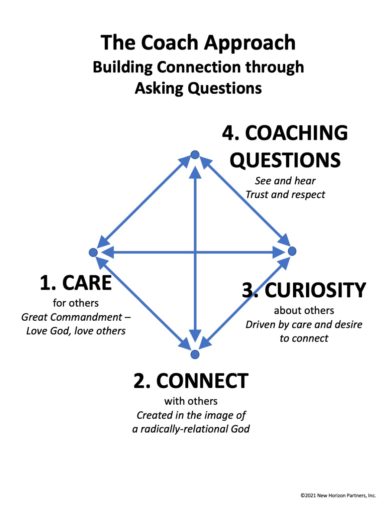
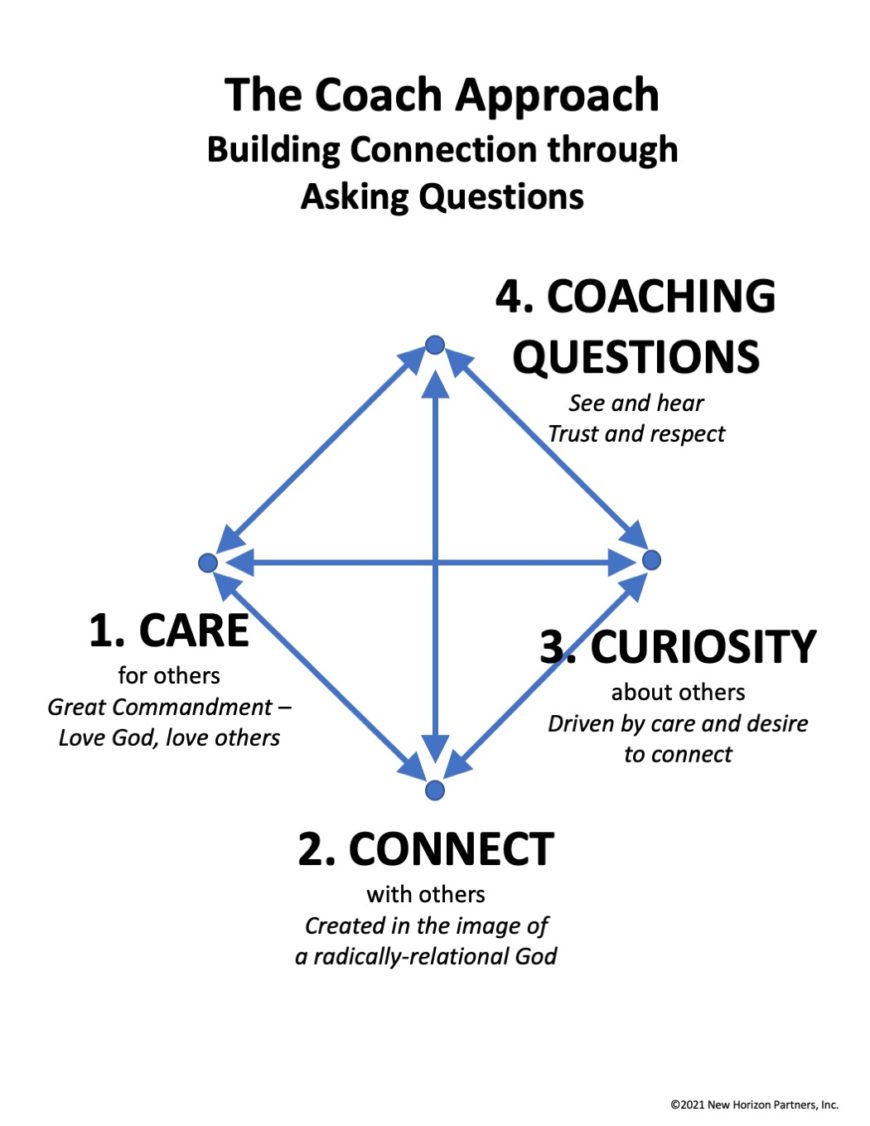
Again, by definition the Coach Approach is a lifestyle or mindset (we could also call it a habit) of utilizing questions to create meaningful conversations, build relationships, or help others grow. And here is the model that we use to understand and motivate us to build within ourselves the Coach Approach:

You will notice that the model has arrows that interconnect all of the Four C’s. This is because the Four C’s are not sequential, but they are all interconnected. For example, connection is foundational in that we are designed to be connected with each other and we are called to do so. Yet we are not able to really connect until we know and understand one another, which means that coaching questions are a prerequisite for connection. All of the Four C’s in the Coach Approach model are interconnected in this same way.

Our motivation to build this habit of the Coach Approach in our lives comes first from the fact that we are designed for and expected to care and connect for each other. We are also motivated by the important benefits achieved through exercising this habit of using questions to know and understand the other:

  • Create meaningful conversations – Conversations at a deeper level of intimacy.
  • Build relationships – People feel valued when we seek to understand and know them.
  • Help others grow – More likely to retain and act upon what comes from heart and out through mouth than what goes in ears.

Here are some coaching questions to think about: Are you comfortable asking questions at a deeper level of intimacy, questions that help you know the real person? What might you do to become more comfortable in doing so?

This article is part of a series on the Coach Approach. For an overview, see the Intro article. Or move on to Part 4 to learn about the Powerful Questions that are central to the Coach Approach.

The Coach Approach, Part 2 – The Motivation

In the first part of this series on developing a Coaching Mindset, we mentioned briefly the role that questions play in building connections with other people and then discussed some of the roadblocks to asking questions. People often lose that childlike curiosity and they become more self-focused. In general, people are more likely to provide answers rather than ask questions, seeking to serve themselves rather than build connections or serve others.

Why is it important to build (or rebuild) that curiosity about other people and seek to develop connections with people? What is our motivation for learning to ask powerful questions?

As a Christ-follower, my tendency is to answer these questions in Biblical terms. If you have a different belief system, I hope that you will read on and see that this discussion comes around to common sense wisdom for interpersonal relationships.

Called to care about each other

As human beings, we are called to love, or care for, other people. The most straightforward statement is in the gospel of John, chapter 13, where Jesus says, “A new commandment I give to you, that you love one another: just as I have loved you, you also are to love one another.” (ESV, John 13:34, Crossway Bibles). A similar thought shows up in the Greatest Commandment, which can be paraphrased as “Love God and love people.”  Throughout the Bible we are told to love one another, the answer to how people can coexist peacefully in this world.

In today’s culture the word love is more often used as a noun referring to a feeling, that emotion that comes with attraction, romance, or desire. This is not the historical or Biblical definition of love. My favorite definition of love comes from Dr. Paul David Tripp. It’s in his book on marriage, What Did You Expect?, and in other writings. His definition is as follows: “Love is willing self-sacrifice for the good of another that does not require reciprocation or that the person being loved is deserving.” Love is a verb. It is a word that denotes action or a decsion. This action is most often serving the other person. In Scripture, love for our neighbor comes to life in the many “one another” commands, which instruct us to care for one another.

In summary, the world functions best when we care about each other. When we do not care for the other person, we are self-serving, putting ourselves in competition or enmity with those around us. Only when we care about the other person are we able to build connection or relationship with them.

Called to connect with each other

As human beings, we are called to connect with each other. Created in the image of a highly relational God, we are created for relationship. Within Genesis 2:18 are the words, “It is not good that the man should be alone.” (ESV, Gen 2:18a, Crossway Bibles) While this verse is often used in regard to marriage, its application is much broader. God is highly relational as evidenced by the Trinity, as evidenced by the earthly life of Jesus, and as evidenced by God’s relationship with those that choose to follow Him. As a result of being created in His image, people function better when they have strong relationships with other people. In Scripture, we are described as all being part of one body, connected to each other through Christ.

In summary, there is a desire within each person to be seen, heard, and valued by other people. In isolation, a person tends to collapse in upon themselves or to wither away. As a creature of God and a member of society, we are called to connect with other people.

The interactions between people are simply perfunctory when they consist of simply an exchange of facts and clichés. When people exist as isolated beings, lives lack the richness and meaning that results from when being connected and caring for each other. We are called to care for and connect with those around us. Individually we function better when we care and connect with others and when others care and connect with us. Society functions well only when it is composed of people who care for each other and connect with each other.

In summary, we are designed to care and connect with each other and it is our Creator’s expectation that we will do so.

Here are some coaching questions to consider: What actions on the part of others makes me feel that others care about me and desire to connect with me? What actions do I take to care for and connect with others?

This article is part of a series on the Coach Approach. For an overview, see the Intro article. Or move on to Part 3 to learn more about the motivation behind the Coach Approach.

The Coach Approach, Part 1 – The Roadblocks

Most people recognize that asking questions is a large part of coaching others. If fact, asking questions is an important skill that goes beyond coaching. Asking questions is a core skill to connecting with others, building relationships, and to carrying on what we might call meaningful conversations. Yet we often have difficulty making questions a large part of our conversations. Before we discuss why questions are important and how to ask powerful questions, let us first understand the hurdles that we must overcome to incorporate questions into our lifestyle.

I like to think of communications along a continuum. Towards one end of this communication continuum, is the telling dynamic where communication is very one-sided. Communication here can be commands, a monologue, there is one voice that is important. The speaker spews out information or gives commands while the recipient simply takes in (or ignores) the information being given out. The next type of communications on the continuum would be presentations and instruction.

Somewhere around the middle of the communications continuum is the talking dynamic, the point where dialogue takes place. In this place, the speaker and hearer or recipient frequently trade roles. Both parties contribute to the conversation, with one dishing out information and the other taking it in, followed by a switch in roles from speaker to hearer and vice versa. In dialogue, the conversation often (though not always) builds one statement on top of another. In this part of the continuum are polite conversations and exchanges of facts.

Towards the other end of the communications continuum, is the question-answer dynamic. Towards this end of the continuum there can actually be two very different dynamics. One is the interrogation, in which the questioner is working to elicit, or perhaps drag, information, largely facts, out of the recipient. The other question-answer dynamic is driven by curiosity, in which the questioner asks questions, perhaps powerful, thought-provoking questions, in an effort to understand and connect with the recipient. Also on this end of the continuum would be the heart-to-heart communications, where two people might exchange feelings, dreams, or other deeper topics.

It is a part of our nature to spend more time telling rather than asking. On the communications continuum, most of us are most comfortable telling, some people are fairly good at dialogue, but few of us have developed the desire or the skill for asking, especially for asking, especially for seeking personal or more intimate information.

And why is it that we are more inclined towards telling? There seem to be two major reasons.

By nurture. If you have ever spent time with a two- or three-year old, you will know that they are full of questions. Various studies have shown that children between the ages of two to five ask a question every two minutes and 36 seconds and ask anywhere between 40,000 to 438,000 questions in those three years. But this part of our nature, the strong curiosity, seems to get pushed out or trained out as we mature.

Our education system is one culprit in breaking our habit of asking questions. You don’t score well on the SAT by asking good questions, but by providing the best answers. Throughout our school experience, the emphasis is on providing the right answers. Even better if you can be the fastest one to provide answers. So, we are trained to provide answers, but we receive very little training in asking questions.

For most of us, our jobs reward us for knowing and providing answers. This is especially true in the early years of a career. Only a few careers develop our ability to ask questions of people, driven by curiosity.

So, over the years, both our education and our careers reinforce the tendency to provide information and push out our natural curiosity about other people’s lives and our inclination to ask questions.

By nature. We mentioned above that, as a child, curiosity is a strong part of our human nature. But as we mature, our tendency is to become more egocentric, more self-focused, more self-centered. This plays out in a desire to be seen as intelligent, as one who has knowledge or the answers.

As we mature, our listening skills become more focused on hearing information that pertains to us. Our brains are wired to listen with a me-centered focus to defend, to fix, to win, to gain approval, etc. Also, our competitive reflex grows stronger, that part of us that wants to “one up” someone else’s story.

Another part of our nature is seeking expediency. Providing information often takes less time than asking questions and being curious. We tend to not invest time or effort in things that don’t have a short-term benefit for ourselves, another facet of our self-focus.

In general, people are more likely to provide answers rather than ask questions, seeking to serve themselves rather than build connections or serve others. Also, we tend to spend much effort in posturing, that is, portraying how we would like to be perceived rather than presenting our authentic selves. We fear vulnerability and we flee from deeper levels of intimacy.

In his book, The Seven Levels of Intimacy, Matthew Kelly lists the seven levels at which we communicate as the following:

  1. Cliché
  2. Facts
  3. Opinions
  4. Hopes & dreams
  5. Feelings
  6. Faults, fears, and failures
  7. Legitimate needs

People general operate within the first two levels, with clichés or facts. They fear moving beyond these two levels because the deeper levels present the reality of who we are. People tend to avoid revealing this reality for fear of not being accepted or being deemed unlovable.

So, there we have it. Most of our interactions are statements of clichés or facts. We are not likely to reveal much beyond that. And we are reticent to ask questions that demonstrate an interest in anything beyond clichés and facts.

Here are some coaching questions to consider: How much of my interactions with other people consists of clichés and facts? What keeps me from revealing or seeking to hear deeper thoughts? How much of my time in conversation is spent either in talking or thinking about myself and how much is spent in learning about and understanding the other person?

This article is part of a series on the Coach Approach. For an overview, see the Intro article. Or move on to Part 2 to learn about the motivation behind the Coach Approach.

The Coach Approach – Intro

The Coach Approach© is a lifestyle or mindset of utilizing questions in conversations to build relationship and/or to help others to grow. It is an other-focused or “one another” approach to relating to the people around us. The Coach Approach could also be defined as “Making a practice of building conversations around powerful questions that are based on curiosity with the goal of building connection and demonstrating care for the people around us.”

This article is an introduction to the concept of the Coach Approach, which is then explained in a series of following articles on specific elements of the concept. The complete list of articles explaining what the Coach Approach is, why it is the best way to build relationship, and examples of the Coach Approach in action is shown later in this article. But first, here is the model of the Coach Approach in action:

Read the full series:

The Coach Approach, Part 1 – The Roadblocks

The Coach Approach, Part 2 – The Motivation

The Coach Approach, Part 3 – The Route

The Coach Approach, Part 4 – The Destination

The Coach Approach, Part 5 – The Coach Approach in Action

The Coach Approach, Part 6 – More of the Coach Approach in Action

The Coach Approach, Part 7 – Lessons from Mr. Rogers

500 Powerful Questions – Sample Questions