Are You That Toxic Boss?

“People join the company but leave the boss.” We often hear this said. People accept a job opportunity for the possibilities that they see in the industry and the particular company. Then they leave the company because of the behavior of the boss to whom they report.

People might be disappointed or disillusioned in a boss that plays favorites or participates in cliques. They may view a boss as incompetent or not feel that they are able to mentor or provide support and development. But the greatest motivation for fleeing is a toxic boss, one who makes the job environment intolerable.

Too often the toxic boss doesn’t even realize that he/she is considered to be one; they don’t recognize the behaviors that define them as toxic because these behaviors are so deeply ingrained. Here are some clues to help you examine whether you are, in fact, that toxic boss that people complain about and want to escape:

  • Do you think that volume is more important than vision? A toxic boss seeks to overpower team members by shouting rather than presenting a rational position that can win followers.
  • Do you react in anger rather than seeking to understand? A toxic boss’ first reaction is often anger so as to squelch any other opinion. Anger is often an outcome of a self-centered perspective.
  • Are you quick to blame others for failures rather than admitting your part first? A toxic boss cannot admit their own failures and faults, so they must place the blame on others.
  • Do you look for opportunities to claim credit for yourself rather than passing it on to others? Toxic bosses only care about themselves and have difficulty in seeing or acknowledging the contributions of others.
  • Do you see the negative and miss the positive? A toxic boss will focus on the negative, describing only the potential downsides of a suggestion or an action while failing to consider the upside.
  • Do you intentionally withhold information or seek to empower others? A toxic boss sees information as power and is greedy about controlling the balance.
  • Do you make destructive comments or seek to build up and encourage others? A toxic boss is quick with sarcasm or cutting remarks in an effort to tear others down and show themselves to be witty or more intelligent.
  • Are you quick to pass judgment or do you have an open mind? A toxic boss has difficulty accepting ideas from others, thinking that others cannot have answers that are better than the boss’.
  • Do you avoid receiving feedback or seek it? A toxic boss has a high opinion of themselves and places low value on input from others.
  • Do you bully or harass others or treat them with respect? A toxic boss feels a need to tear others down or verbally beat others up as a means to build themselves up.
  • Do you value your reputation higher than truth? A toxic boss can be quick to lie in order to save face or build their position.

These behaviors of a toxic boss are often the result of serious character flaws in a person. For example, many of these behaviors are an effort to tear other people down as a means of compensating for a poor self-image. The bluster is a weak attempt to hide the internal fear.

If you recognize yourself in several of these comparisons, it may be helpful to do some deeper soul searching or seek input from others. Toxic bosses drive people away, especially the most capable people who are ready and able to think for themselves. If you find that you fall into the mold of a toxic boss, you may want to begin work on driving out these behaviors and building a stronger, more positive character.

Are you one of those toxic bosses? How would the members of your team describe you?
Dealing with a Toxic Boss

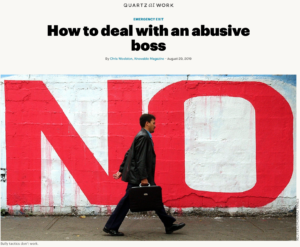
What do we mean when we speak about a toxic boss? A toxic boss is a person who believes that the way to get team members to perform is through shouting, belittling, and bullying the people that they should be leading. According to an article published by the business news organization, Quartz, about 10% of bosses fit the mold of abusive or toxic bosses. The article, written by Chris Woolston and originally published in Knowable Magazine, cites a wide variety of research and experts.

Often, the experts say, abusive bosses believe that this mode is the most effective way to manage people. Often this is the result of the Peter Principle, in which a functional or technical expert is promoted into a supervisory position without receiving appropriate training and development of leadership skills. Some research shows that the behavior of certain employees makes it more likely that their supervisor would resort to abusive practices.

It is often said that people join companies but leave poor bosses. The article speaks of more effective leadership practices rather than the abusive practices of a toxic boss.

The article provides some advice for those faced with a toxic boss, as follows:

  • Consider jumping ship. Since only 10% of bosses are toxic, chances are the next one would not be.
  • Team up. Employees often work together to warn and protect each other of a toxic boss.
  • Keep your distance. Few people enjoy being abused, so one alternative is to limit the interactions with the toxic boss as much as possible.
  • Take the long view. Some people tolerate a toxic boss with the view that all things must pass.
  • Don’t fan the flames. Keeping a low profile can make a person less of a target for the abusive behavior.
  • Play the game. One tried and true strategy is the practice of “kissing up,” working to appease the toxic boss.

A toxic boss demotivates team members, causing lost productivity and reduced performance. See the full article for a more detailed discussion of the perils of toxic bosses.

Leadership and the Peter Principle

Most people are familiar with the Peter Principle. This principle was first published in a 1969 book, The Peter Principle, by Laurence Peter and Raymond Hull. The Peter Principle observes that people in a hierarchy tend to rise to their own level of incompetence. That is, people are often promoted based on success in a previous position, until they reach a level at which they are no longer competent. Most often this is because the skills that they used to prove their competency at one level do not translate or stretch to the requirements at the next higher level.

Often the reason for reaching the Peter Principle position of incompetency is that the organization has promoted a person, who was very capable in a technical or functional role, into a management or leadership position. For example, a company might promote their best salesperson to a sales management position, such as regional manager or director of sales. Or, an organization moves their best engineer into an engineering management role. Or, the firm moves a successful accountant into a controller or other supervisory position.

The problem in these types of career moves is that the skills necessary to be successful in a functional or technical role are only a small part of the skillset needed at a higher, managerial level. Organizations often rely on the fact that the person has been successful in a functional role as one of the most important criteria for promotion. The promotion might be viewed as the reward for excellent performance at the previous level. In doing so, organizations often neglect to assess whether the candidate has the necessary capabilities to perform at a supervisory level or they fail to provide the training and development resources to prepare the candidate to be successful.

The cost of making such mistakes can be large. Take the example of promoting the best salesperson into a sales management role. Relationship skills are needed in both positions, but the relational skills needed to deal with customers can be quite different from the relational skills needed to lead a sales team. If the person fails at the higher level, the organization will frequently have lost both the best salesperson and the potential sales leader, meaning that the organization now needs to fill two important roles.

Part of this problem can be that firms have defined career paths in which the only way to move up to higher responsibilities and higher compensation is to move away from functional roles into managerial roles. Not everyone desires or is suited for such a move. Sometimes organizations have developed parallel career tracks, offering the option of moving higher in a functional role or moving into more managerial responsibilities. For example, a firm might have an engineering career track in which the highly-qualified and experienced engineers could have the option of moving into a role such as an engineering sage, in which the person becomes an internal technical consultant or resource for the engineering function.

For those star functional performers that desire moving into a managerial role, the Peter Principle highlights the need for assessment and training. The organization has a responsibility, and is a good steward of their people, when they make every reasonable effort to assure success at the next level. This means clearly understanding the capabilities of promotion candidates and comparing with the criteria for success at the next level. An important part of a leader’s responsibilities is preparing people for future success. The Peter Principle can be averted when organizations are aware and proactive in developing their people.

Does your organizational adequately invest in the future success of its people?

Ready, Fire, Aim

4 Character-Based Stumbling Blocks to Good Decision-Making

As leaders we are often called upon for decisions or to effectively guide a decision process. We face choices every day, some large, some small, some urgent, some mundane. A large part of a leader’s responsibility is focused on decision-making.

strategic decisions New Horizon Partners

A good decision process includes the following steps:

  • Ready – Identify and clearly articulate the pressing issue. This might require asking five whys or seeking other perspectives. Before we can make a good decision we need to understand and have consensus on what needs to be resolved.
  • Aim – Gather information and input. We need to make informed decisions. Once we understand the issue, we may need to identify contributing factors, decision options, and implications of various options. We may need both facts and the opinions of those involved or affected by the decision.
  • Fire – After we know the issue and understand the facts, we are ready to make a decision and take action. The final decision may fall to the leader, may be delegated, or there may be a team consensus process, depending upon the culture and nature of the decision required.

But sometimes people (or organizations) have certain stumbling blocks that interfere with making good decisions in an appropriate manner. Often these stumbling blocks can rise up out of character, interfering with an effective decision process.

Stumbling Block #1 – Ready, Fire, Aim – Some people are eager to make decisions. Maybe this comes from their desire for power or maybe from arrogance, believing they must have the right answer. These people make snap judgments and quick decisions without gathering the facts. Quick-trigger decisions can simply confuse the organization, sapping energy. Frequently someone needs to come back later and clean up the mess and choose a different path. Effective leaders are not enamored with either power or perfection but with performance; they seek to make good decisions.

Stumbling Block #2 – Ready, Ready, Ready for What? – Some people have trouble seeing the need for decisions because they have difficulty in facing reality. They cannot see the issues because they cannot accept that things are not the way that they perceive them. For example, they might refuse to believe that the market environment has changed (We don’t need to worry about those new entrants, they never survive.) or that the organization needs to change (We’ve always done it that way.) Effective leaders have a nice balance of optimism and skepticism; they are ready and able to embrace reality. They scan the horizon to identify issues early and move forward in making timely decisions.

Stumbling Block #3 – Ready, Aim, Aim, Aim…. – Some people have difficulty making a decision. They consistently need more information or they need to think about it for a while. “Let’s come back to this at another meeting.” Often this inability to make timely decisions is a result of a critical voice that tells them they need to be perfect, that they are not OK if they make a mistake. A few decisions are “do or die” but most are not. The decision process needs to gather input but, once we have the facts, we are often wasting time and energy as we wait for more information and a decision. Being timely is often as important as being right. Effective leaders have strength and confidence; with a healthy appetite for realism and facts, they are able to accept risks and the possibility of making a mistake now and then.

Stumbling Block #4 – Ready, Aim, Fi…….. – The decision is not complete until there is an appropriate action plan for implementation in place. Who does this affect? What needs to be communicated, to whom, and how? What actions need to take place? Who will be responsible? How will they be tracked? Some leaders are too busy moving on to the next issue and decision, which leaves the previous one half-baked in a sort of ADD scenario. Effective leaders understand the system and see things through; they are able to delegate and hold people responsible.

Effective leaders deal with reality and recognize issues that require decisions. In this process they are cognizant of the appropriate level for decision-making. They guide their people in gathering the relevant information needed for the decision process with reasonable confidence. They lead or oversee the appropriate decision-making process and assure that the decision is effectively implemented.

What is your decision process and where are your stumbling blocks?

Leaders and Managers

In business literature we often see the terms leader and manager used interchangeably. However the role of a leader and the role of a manager are different, even though there may be a fuzzy gray line between the two roles in certain aspects. If we understand the requirements of each role, we are better able to identify or develop people to serve in these roles.

leaders and managers Ken Vaughan Ohio

It is ideal when we have people who are capable in both leadership and management. At any level within an organization there is a mix of task, management, and leadership responsibilities but the relative mix changes. Entry level workers are generally responsible for tasks. As their capabilities and responsibilities grow they transition to more responsibility for management of resources, whether it be materials, people, or other resources. As they move to higher levels in the organization they transition to more leadership responsibilities. Of course, since leadership is influence, we can find opportunities to influence no matter what our role in life is. But in general, as a person moves to higher levels in an organization, the expectation is that they move through a process of growth from task to management to leadership.

Managers are very much stewards. They marshal resources and apply them to accomplish tasks or produce output. They are focused on

  • planning,
  • organizing,
  • and controlling.

Peter Drucker described the role of a manager as the following:

  • Setting objectives and planning. The manager translates vision and mission into goals for the group, and decides what work needs to be done to meet those goals.
  • Organizing. The manager divides the work into manageable activities, and selects people to accomplish the tasks that need to be done.
  • Motivating and communicating. The manager creates a team out of his people, through decisions on pay, placement, promotion, and through his communications with the team. This integrates the team to optimize productivity.
  • Measuring performance. The manager establishes appropriate targets and yardsticks, and analyzes, appraises and interprets performance.
  • Developing people. The manager develops the people in the group to optimize performance and prepare for upcoming tasks and goals.

Leaders are very much developers or builders. Their role is to develop people and the organization for the future. In the book, The Leadership Challenge, Kouzes and Posner describe the role of leadership as follows:

  • Model the way
  • Inspire a shared vision
  • Challenge the process
  • Enable others to act
  • Encourage the heart

In another article that I wrote recently, I describe the role of leaders as follows:

  • Leaders build – themselves, the people around them, their teams, and their organizations.
  • Leaders inspire – a strategic direction and vision for the future.
  • Leaders communicate – using candor and clarity to keep their people united.
  • Leaders challenge – both people and the organization to change and grow.
  • Leaders enable – people by delegating and removing constraints.
  • Leaders encourage – by building relationships where people are valued and motivated.

This then describes a sort of hierarchy in which leaders guide the development of vision and capability for the future, managers steward resources for today’s step forward, and workers accomplish the tasks required along the way.

Are you a leader or manager? What are your plans for growth to the next level?

The Process of Strategic Planning

Strategic planning is a tool that is useful for guiding day-to-day decisions and also for evaluating progress and changing approaches for moving forward. In a previous article we described the purpose of strategic planning. The process for strategic planning can often be an iterative process but it has these key elements:

  1. Set strategic goals and objectives
  2. Prepare a situation analysis
  3. Define or refine the business strategy statement
  4. Develop the action plan

Strategic planning is iterative in two dimensions. Within the process, for example, we might establish objectives and then discover through the process that the objectives need to be revised or that the strategy cannot be supported with actions. The process is also iterative over time as we should not be constantly developing a new plan but rather adjusting and revising the plan periodically as the reality of the market changes or as we adjust the objectives, strategy, or action plan.

strategic planning process Ken Vaughan

The strategic goals and objectives describe the targets or milestones that the organization plans to achieve over the planning period. In a previous article, we described in more depth the definition of goals and objectives. The plan might describe targets for sales revenue, profits or margins, market share, ROI, etc. It can also set goals and objectives for sources of revenue (e.g., % from new products or specific segments), levels of quality, customer satisfaction or retention. The list of potential goals and objectives is endless but the key is to identify the few that are strategically significant, in other words, which goals and objectives will mean that we have moved the organization toward our vision of a successful future? Better to have a short list of meaningful goals that the organization can rally around than a laundry list.

The situation analysis has two major components – the external analysis and the internal analysis. Obviously, the external analysis looks at the environment in which the company does business and the internal analysis looks at the company itself and its position in the market. There are lots of tools that might be used in the situation analysis such as SWOT analysis, PEST analysis, Porter’s Five Forces, etc. The important thing is not the quantity of charts and tables but rather the quality of the understanding of the business.

The external situation analysis describes the nature of the market and the competitive environment in which the organization competes. What is the market? How large and what are the drivers of the market and its growth? Who are the potential customers and what do they look like? How do they make decisions and what are their needs? What are the relevant segments of the market and how do they differ? How can we best understand the market and the customers? Who are the competitors? How do they compete? What are their strengths and weaknesses? Etc.

The internal situation or position analysis describes the organization’s capabilities and position relative to the market, the customer needs, and the competitors. It might include such things as identification of strategic issues; analyses of the mix of customers, products, or market segments; market share and trends; profitability and trends; customer perception, satisfaction, and retention; efficiency and capacity; culture and image: organizational structure and capabilities; strengths and weaknesses; etc. Again, this isn’t an exercise in developing an overwhelming compilation of charts and tables and analyses. The purpose is to develop a realistic perspective of the company’s position and its ability to provide value relative to competitors and to develop core competencies that lead to competitive advantage in meeting the needs of customers.

Given the objectives, the market situation, and the competitive position, the next element of the strategic planning process is the statement of strategy. In previous articles we described the purpose of the business strategy and provided some descriptors of strategy. The strategy statement describes where and how the organization will compete to provide superior value in meeting customer needs. This is the heart of the strategic planning process. In the strategic planning process the goals and objectives describe what the strategy should achieve. The situation analysis provides the logic behind the strategy decision. The strategy statement provides the direction for decision-making for the organization to move forward towards its objective and its long-term vision.

The final element of the strategic planning process is the action plan. The action plan describes the tactics and specific actions required to implement the strategy. It describes the actions that will take the organization from its present position to the position where it will achieve the goals and objectives. A previous article described tactics and action plans. The action plan needs to be specific enough that it can be monitored and it needs to be a realistic set of actions that will achieve the necessary change in performance to actually carry out the strategy and reach the objectives.

The strategic planning process should not be onerous. It is an opportunity to step back from the day-to-day operation of the business and think about how the organization should change or what actions are necessary to achieve a longer-term vision.

Is your planning process driving your organization forward or driving it crazy?

The Purpose of Strategic Planning

The purpose of strategic planning is to gain control of the future and the destiny of the organization. If your experience of strategic planning is developing a ream of paper full of tables and charts that then gets put in a drawer or on a shelf, never to be seen again, or if your experience is simply producing a long-range forecast of performance and calling it a plan, then you haven’t done a “strategic” plan.

The four purposes of strategic planning are as follows:

  • Define or refine business strategy
  • Establish overall goals and objectives
  • Develop an action plan
  • Communicate direction to the organization

In previous articles we defined business strategy as a statement of where and how to compete based on an understanding of customer needs and the organization’s core competencies. The strategic planning process is a context in which we understand those customer needs and those organizational core competencies. In examining these we are equipped to either define or refine the business strategy so that we might delineate the optimal path for achieving the organization’s objectives. The destiny of the organization is dependent on identifying a path in which the organization can create value for its customers which then creates value for its stakeholders.

The strategic planning process provides a means for setting some long-term goals and objectives. These goals and objectives are set in the context of the long-term vision for the organization and serve as milestones or targets for the development of the organization. Sometimes setting these objectives is an iterative process as the organization considers the possible impact of various strategy alternatives. The next steps in the destiny of the organization is defined in these goals and objectives.

Setting a strategy is a call to action. The strategic planning process is a context for identifying the actions necessary to implement the business strategy and to reach for the objectives. The destiny of the organization requires a proactive set of actions if we wish to influence it.

The final purpose for the strategic plan is to communicate to the organization the future direction of the organization. The strategic plan sets the direction for every decision. Therefore every decision-maker needs to understand and buy into the plan. The destiny of the organization is dependent on marshalling the resources of the organization and investing them wisely towards shaping the future.

Is your planning strategic? Will it positively affect the destiny of your organization?

Tactics and Action Plan

The tactics and action plan describe the activities of the organization to implement the business strategy and achieve the strategic objectives. The action plan is the final piece of a strategic management system that translates mission and vision into goals and objectives which then drive business strategy which then unfolds into action plans.

strategy-tactics-action-2

While the business strategy presents a long-term description of where and how the organization intends to compete, the tactics and action plan are focused on specific outcomes, the short-term time frame, and discrete steps. They describe the activity that will take place to further enhance the organization’s core competencies, build a sustainable competitive advantage, and deliver superior value to customers.

Tactics are programs, initiatives, and projects to implement the strategy, to incrementally change the organization in the direction of the vision, goals, and objectives. As such, tactics are at a higher level and are then composed of a variety of specific actions.

The action plan describes the specific tasks that will be performed in order to carry out the tactics, implement the strategy, and achieve the goals and objectives. These action plans need specific definition of the task, the responsible person, the completion date, and any resources required. These action plans are then constantly monitored to assure that the organization is progressing in the implementation of its strategy.

In a previous article we gave an example goal that might be “Develop a more capable and stable workforce.” One of the supporting objectives might then be “Reduce annual non-retirement turnover to less than 8% of the total workforce by January of 2020.” With this objective, a tactic might be a program to change the culture of the organization. One of the actions might then be to develop and roll out a comprehensive employee communication plan. The action plan will identify the responsible person, the resources required, and the milestone dates.

All organizations are constrained by limited resources – limited number of people, limited available funds, limited time, etc. The other purpose of the action plan is to prioritize the allocation of these resources towards the highest leverage activities. To achieve the organization’s objectives, we need to assure that we are investing our resources on the activities that will build value and generate the highest return.

Does your organization have a clear, effective strategy supported by a good action plan? What do you see as the biggest challenge regarding your action plan?

12 Practical Descriptors for Business Strategy

Business strategy is the linchpin between vision and action plans. With a good statement of strategy organizations are on the fast track to success. Without a good statement of strategy organizations can feel like they’re wandering in the desert. Some time ago we described a strategic management system that led from mission and vision through goals and objectives to strategy and on to tactics and action plans. Strategy is the critical element that bridges from what the organization hopes to be to the actions that will get it there.

Business strategy describes where and how the organization will compete. A good statement of strategy looks like the following: “We are an injection molder of large, flat parts for high-quality applications such as medical or business equipment where customers need short runs and quick turnaround of orders.

Here are some descriptors of business strategy:

  • First of all, a business strategy is a statement. It is not be a document or a book. It may be part of a strategic planning document. It may result from a strategic planning process. But a business strategy is simply a statement of where and how to compete.
  • The best strategies are concise, stated in one sentence. Certainly a strategy shouldn’t be more than a short paragraph, perhaps three sentences.
  • A strategy statement is an internal communication tool to align the organization and its activities with the vision and objectives. It assures that we are all working towards the same objectives in the same way.
  • Strategy is built on a knowledge of markets, customers, and their needs. It describes the unique value that we offer to customers based on this knowledge of their needs.
  • A strategy statement is a confidential communication about our competitive position. Strategy describes how we intend to differentiate our organization and its value offering from that of competitors. To broadcast the strategy outside of the organization and its strategic partners would open the door for competitors to gain the same knowledge and follow the same path.
  • Strategy describes the core competencies the organization intends to exploit to provide superior value to your customers. In our example we can see that core competencies might be capabilities for high-quality manufacturing, efficient production of low volumes, and the ability to quickly respond to orders.
  • Strategy defines a path to a sustainable competitive advantage. A core competency should be more than “just as good” as the competition.
  • Strategy guides decisions and our allocation of resources. Will hiring this person or investing in this piece of equipment enable us to enhance the core competencies that set us apart from competitors?
  • Strategy enables prioritizing our business opportunities. It describes our target market or target customers. Who are the customers that will most value the products or services that we’re offering? Every potential business opportunity can be vetted by the strategy. This might not mean bypassing every opportunity that doesn’t exactly match the ideal, but it enables us prioritize various business opportunities and focus our efforts on business that will be most profitable.
  • Strategy is the driver for all tactics and action plans. The action plans are simply the implementation of the strategy. Any action that does not support the strategy is wasted energy.
  • And finally, a business strategy must be realistic, not a pipe dream. The strategy should challenge the organization to a higher level of performance but not represent an impossibility.

What other descriptors would you have for a good business strategy?
Does your organization have a clear, concise statement that defines your business strategy?
Is it guiding your decisions and likely to take you towards your vision?

Goals and Objectives

goals-strategy-ohio-developmentGoals and objectives provide direction, inspiration, and a standard for measurement of performance for an organization. Goals define direction or destination while objectives set specific targets or milestones for performance measurement.

In a previous article we defined a strategic management system that began with mission and vision for an organization built upon core values and principles. The management system then defined a process for driving action plans that would achieve the vision. While vision is a long-term view of what we want the organization to someday become, goals and objectives set targets within the planning horizon along the path towards the organization’s vision. Once we establish goals and objectives, they should become a call to action for the organization.

Goals are qualitative statements that set direction into the future. They become the rallying points for the organization to move forward. Since goals set priorities for the organization, we can only have a limited number of them and they must be congruent with each other.

Objectives set the targets or milestones for moving forward. Objectives are quantitative and must always be SMART which means they are –

  • Specific – the terms or definition is clear and well understood within the organization
  • Measurable – there is an accepted and defined means of quantifying performance
  • Achievable – the organization must have the power and authority to take the necessary steps required to achieve the objective
  • Relevant – the objective must be a critical target that moves the organization towards its goals and vision
  • Time-based – there must be a stated target date for achievement of the objective

There is always the ability to state a definite yes or no as to the achievement of our objectives.

As an example of goals and objectives, let’s imagine an organization where its performance is highly reliant on the skills of its workers. A goal might be “Develop a more capable and stable workforce.” One of the supporting objectives might then be “Reduce annual non-retirement turnover to less than 8% of the total workforce by January of 2020.”

As we step through the management system from mission to action, each step gets more specific towards defining the critical action steps that must be taken to move the organization forward. Without clear goals and objectives, we have no way to judge the value of our actions.

Does your organization have clear goals and objectives? Do they align with your vision and prompt appropriate action?