Five Styles of Feedback

Providing performance feedback to team members is an essential part of a leader’s task. Effective leaders are focused on the engagement and development of the people in their organization. Feedback is one of the most important tools for evaluation and communication to help individuals understand their performance and to identify and pursue growth and learning opportunities.

What does effective feedback look like? In the book, Coaching for Performance, author John Whitmore identified five levels of feedback. The following description of styles of feedback is adapted from those five levels:

Attacking Feedback – Attacking feedback, rather than addressing performance, is personal criticism. Examples would be, “You are rude!” or “Why can’t you do anything right?” This type of feedback, if we can call it that, violates all of the guidelines for effective feedback.

Judgmental Feedback – While not specifically a personal attack, judgmental feedback still has that feel of degrading the person. An example – “That report was unintelligible and worthless” The recipient doesn’t need a big leap to infer that the statement reflects directly on his/her personhood and value.

Sterile Feedback – “The report was okay, but the conclusions didn’t seem very strong” is an example of sterile feedback. It is not an attack, but it does not provide much value. Unfortunately, this is a common example of what people call feedback in the workplace today because they are afraid to step into a real discussion of performance. It doesn’t clearly identify strengths and weaknesses of performance, nor does it offer much guidance for growth and improvement.

Ownership-Oriented Feedback – Ownership-oriented feedback leaves the ball in the other person’s court. “I looked at the brochure that you just finished. What do you think about it?” Any conversation that follows is not likely to focus on any issues of performance or lead to a quality discussion of opportunities for improvement. It would be an unusual person who would identify weaknesses in his own product and seek a discussion for growth.

Growth-Oriented Feedback – Growth-oriented feedback is, of course, the best type of feedback. The purpose for feedback is not to look at the past but, rather, to use past performance as a basis for defining action for a better future. Quality feedback might sound like this example: “Now that your report is finished, can we look at it together? What is the purpose of the report? How well did you address that purpose? What was the process used to develop the report and would you do anything differently? What comments have you received and would any of them change the way you developed or presented the report, if you were to do it again?” The questions used in the discussion are driven by the leader’s perception of areas for potential growth. Quality-oriented feedback is targeted to find the opportunities for growth and development and the result is an action plan to move forward.

In another article we presented ten guidelines for effective feedback. Effective feedback should include specific examples of behavior, either positive or negative, and the effects that were the results of the behavior. From the discussion of the behavior and the results, a coaching discussion should draw out a plan to build on positive behavior or to correct negative behavior for the future. Feedback builds on an analysis of performance to identify and pursue growth opportunities.

Which style of feedback do you most frequently use? What skills do you need to develop in order to consistently give growth-oriented feedback?

Ten Tips for Effective Feedback

Feedback is essential for the success of any organization. One of the goals of an effective leader is assisting his/her team members to grow and succeed. Providing feedback is an important tool for guiding people as they seek to improve performance and develop new skills or behaviors.

In a previous article we discussed four choices for feedback and made the point that positive feedback and corrective feedback were important tools for helping team members grow. Another article on feedback identifies five styles and made the case that we should seek to provide growth-oriented feedback.

Some people shy away from giving feedback. They might not understand the benefit of providing positive feedback, so they deem it unnecessary. Providing corrective or constructive feedback is sometimes difficult, especially for those that haven’t honed their skills for doing so. Effective leaders understand the benefit of liberally providing both positive and corrective feedback. Positive feedback demonstrates appreciation for the effort and value for the person. Corrective feedback, when done well, demonstrates the desire to help the team member to grow.

Here are ten tips on giving effective feedback:

  • Focus on performance, not the personality.Feedback should always be given in reference to specific actions or behaviors. We are either expressing appreciation for an action and the resulting benefit in positive feedback or we are discussing an action or behavior that we want to see improved. “You’re so smart” is not nearly as valuable as “I really appreciated the way that you helped the team come to that conclusion.” With the latter feedback the person understands the action and the benefit to the team. Regarding corrective feedback, a statement such as “The project was not delivered on time, which resulted in a big cost penalty from our customer” can lead to a discussion of reasons and corrective action. “You really messed up that project, as usual” is likely to prompt a defensive argument.
  • Emphasize facts, not feelings. “We have received seven complaints about missed deliveries” has more value than “You really disappoint me.” Facts verify the reality behind the discussion and, again, keep the discussion from becoming a personal matter.
  • Focus on the individual effort.Often the workplace includes team efforts. If the feedback is about the team’s results, the discussion needs to include the team. If the feedback is for an individual on the team, the discussion needs to focus on that person’s specific actions or his/her specific contribution to the team’s effort. Unless there is evidence that one person single-handedly impacted the team’s results, it is unfair and disheartening to be confronted with the team’s performance.
  • Feedback is best served warm.In other words, provide feedback as soon as possible after (or even during) the activity. The longer the time gap between the action and the feedback, the harder it will be for the recipient to tie the two together. The impact or benefit of the feedback is much reduced if the person has difficulty in recalling all of the facts regarding the action due to lapsed time.
  • Be clear, direct, and specific.A discussion that is focused on specific action or behavior and the specific results leads to a more productive analysis of the cause and a better definition of the specific action plan required to improve. Speaking in generalities ends with little understanding and minimal impact on the future. Feedback takes time to have value.
  • Focus on the fix.The goal of feedback is not to criticize a person or to gather a history. The goal is to help the recipient to grow and improve. The discussion of the situation or the past history is just to establish the need for an action plan. Therefore, the discussion should be weighted in favor of the future, with positive expectations for improvement and growth.
  • Use your words wisely.Feedback should be a respectful, professional discussion aimed at producing a positive outcome. Our language and behavior should be in line with this objective. Better to use the word “I” in demonstrating the impact and refrain from using the word “you”, which can sound judgmental of the person rather than the behavior.
  • Provide feedback in digestible doses.If we expect our feedback to have an impact on future performance, it is better for the recipient to walk away with one action plan regarding one issue. Storing up several items for discussion results in a confusing mess for the recipient to sort out after the discussion.
  • Make it a two-way conversation.With a goal of developing an action plan for improved performance, the feedback session needs to be a dialogue, not a monologue. People are more likely to implement an action plan that they have developed than one that is forced upon them. Therefore, once the issue has been identified and agreed upon, the feedback discussion works best when the leader moves to a coaching role, helping the recipient identify and own the cause of the problem and the action plan for improvement. It goes without saying that feedback is done best face-to-face or at least person-to-person, never via text, email, or letter.
  • Balance negative or corrective feedback with praise or positive feedback.People respond more strongly to negative statements than to positive statements. That’s why relationships are stronger when positive statements outweigh negative statements by a factor of 5:1 or even 8:1. Even when giving corrective feedback, the leader should find some positive things to say about the other person, the part of the process that was done correctly, a belief in their ability to improve, etc. When a person only hears negative comments or criticism from a boss, they lose heart and look for the door.

When done well, both positive feedback and corrective feedback can feel like positive interaction that is beneficial to the recipient and result in growth and improved performance. Done well, they both identify the behavior that is valued and expected. And move show the value that the leader places upon the team member and the desire to assist in building their future.

(If you found this article helpful, you may also enjoy a similar article in another blog that I write.)

Are you consistently providing effective feedback to your team members?

Four Choices for Feedback

One of the best ways to guide and direct the performance of team members is through consistent feedback. The annual review is too late to affect performance on day-to-day basis. People want to know whether they are meeting the standard, how their work or performance is perceived, and how they can grow and improve.

Here are four choices for the way that we, as leaders, might give feedback:

No Feedback– The absolute worst kind of feedback is none at all. People want to know where they stand. Most people want to perform well and meet the standard, if for no other reason than to stay employed. It would certainly be unfair to a person to reveal in an annual review that they have been missing the mark for the past year. Yet this is frequently done.

Negative Feedback– For some people, there is a reluctance to give negative feedback. Our mothers taught us that “If you can’t say something nice, say nothing at all.” For other people, they can only criticize. Negative feedback is a steady diet of not enough, not good enough, not acceptable. When presented in this way, it comes across as critical and is demoralizing. Negative feedback has no value and no place in effective leadership. Instead, keep reading.

Positive Feedback– While many people think of feedback as only presenting the bad news, there is always a need in relationship to express appreciation. This is what positive feedback does. As a leader, we need to find opportunities to both feel and express both gratitude and appreciation. It is easy to be so busy that we don’t take the time. Or we might have a subconscious thought that says a certain level of performance is what is expected. But expressing appreciation helps both the speaker and the hearer to have more positive thoughts. It strengthens the relationship between them. A culture of appreciation builds a motivated and enthusiastic team. Remember though that positive feedback should focus on specific action or behavior. “You’re so smart” is not nearly as valuable as “I really appreciated the way that you helped the team come to that conclusion.”

Corrective Feedback– There are also many opportunities for corrective feedback. Sometimes these are due to error or omission. But there are also many opportunities for growth and improvement. Corrective feedback is not intended to blame or criticize. Instead it is intended to understand the cause of a problem or shortfall and to prevent the problem or shortfall from reoccurring. While it may address a negative, such as a mistake or a problem behavior, corrective feedback is a gift to the recipient in that it is helping him/her grow or improve. It may improve the quality of their work, their productivity, or the quality of their life. Corrective feedback is a respectful dialogue that focuses on the problem. The best corrective feedback is done in a coaching mode, where the leader guides, through questions, a discussion in which the team member identifies the cause and the solution for prevention or improvement. When you might be tempted to use negative feedback, use corrective feedback instead.

Here are ten tips on giving effective feedback:

  1. Focus on performance, not the personality.
  2. Emphasize facts, not feelings.
  3. Focus on the individual effort.
  4. Feedback is best served warm, in other words, provide feedback as soon as possible after (or even during) the activity.
  5. Be clear, direct, and specific.
  6. Focus on the fix.
  7. Use your words wisely.
  8. Provide feedback in digestible doses.
  9. Make it a two-way conversation.
  10. Balance negative or corrective feedback with praise or positive feedback.

We will come back to these ten tips for a deeper discussion in another article.

The effective leader leads through a relationship of trust and respect. The effective leader demonstrates humility, caring deeply about the others, and is focused on the future, both of his/her organization and of the people that he/she leads. Applying liberal doses of feedback, both positive and corrective, builds the relationship and builds the followers.

Are you providing enough feedback to your team members, both positive and corrective?

Keep the Change!

The best leaders continually seek to grow in order to become even more effective. They seek new skills and they seek to build their character so that tomorrow’s version is better than today’s.

As a part of growth comes change. In delving into our self-awareness, we often find traits that do not serve us well and need to be improved or replaced. These traits might be anything in our character or personality or in the way that we function. Some common examples might be a fear of conflict, a tendency towards self-criticism, some weakness in listening skills, an inability to accept feedback, lack of respect for others, being too quick to offer solutions, or many other things. (If we are not finding opportunities for growth and improvement, then we are not being truthful in our self-assessment.)

Some people relish change. Some people fear and run from change. Most of us are in the middle. We know that change is necessary and helpful in the long-run but challenging or unsettling in the short-term.

Change requires sustained effort. It is said that it typically takes six weeks to build a new habit and six months to make that new habit a lifetime change. During those first six weeks, change requires a constant awareness and intentional effort. During that period between the six weeks and the six months, we need to be on guard that we don’t revert back to the old habit in a moment of stress or weakness.

In the book, The Servant Leader, authors Ken Blanchard and Phil Hodges offer seven reactions that people often have to change:

  1. People will feel awkward, ill at ease, and self-conscious when confronted by change.
  2. People will feel alone, even if everyone around them is going through the same change.
  3. People will think first about what they will need to give up.
  4. People will think that they can only handle so much change at once.
  5. People will be concerned that they don’t have enough resources in terms of time, money, skills, energy, etc. to implement the change.
  6. People will be at different levels of readiness for any particular change.
  7. If pressure is taken off, people will revert to old behaviors.

When first identifying the need for change, we might feel a negative energy. We become aware of the trait or practice that is having a negative effect and we feel regret or a desire not to be held back or suffer the consequence of this weakness. But mostly we just want the effect to go away or to be negated. Once we come to terms with the cause and effect, we might accept that change is necessary. If so, we identify the old pattern and define a new desired behavior. Then we define a plan for change. This plan must include a way to recognize and short-circuit the old behavior and to consciously replace it with the new, desired behavior.

Change is best accomplished as a team effort. The actual change process requires resources, often the greatest of which is energy. Recruiting an accountability partner or pursuing change in a group setting, such as a peer advisory group, adds energy from others around us and holds us accountable to continue the effort necessary for change. Without such a support team, it is often too easy to give up when we are partially up the slope towards the new behavior.

Change is often uncomfortable and requires considerable effort. But if we desire to be the best that we can be, we will constantly be in a state of change as we grow.

Where do you need to grow? How can you make change effective and lasting?

Volume or Vision

What sort of a boss are you? How do you motivate your team members?

For some people, their leadership practice consists of volume. Using a command and control style, they attempt to drive people to perform. Some of the command and control bosses think that the volume of their commands or stating them emphatically with colorful language, makes them more effective. These bosses demand respect and demand that their team members perform.

When speaking about leadership, we often talk about leaders and their followers. But the command and control boss doesn’t have followers, those that willingly contribute. Their team members are more like subjects or fiefs under the rule of the boss. This type of boss sees people as assets to be utilized.

Another choice for leadership could be termed the “vision” model. These leaders value their team members. They treat their team members with respect and build a relationship with them. In return, the team members respect and trust their leader. This leader communicates a vision to the team and the team willingly embraces the vision and follows the respected leader.

To some, this route to leadership may seem to require more effort. The right to lead is earned through character and effort. But the end result is much better. Team members in the “vision” model buy in to the vision and are willing to go the extra mile to achieve the leader’s goals. The team members are more satisfied and more fulfilled, leading to higher productivity and innovation. But in the final analysis, it isn’t just the performance achieved; rather, it is the way that people deserve to be treated.

What sort of a boss are you? How do you motivate your team members?

What Is Servant Leadership? – Part 2

Servant leadership turns the old perception of leadership upside down. Instead of being served by his or her followers, the servant leader is focused on serving those whom he or she is leading, helping them maximize their potential in life and on the job. In Part 1 of this article, we described what servant leadership is and made the point that servant leadership is not a set of skills but, rather, is an outflow of the character of a true servant leader.

If servant leadership grows out of the character of a certain sort of person, what are the traits of servant leadership? We can divide the traits of a servant leader into two categories – the internal traits and the external traits.

It takes a certain kind of person to be a true servant leader. Some of the internal traits that are typical of servant leaders are as follows:

  • Self-aware– servant leaders tend to be highly self-aware, know their strengths and weaknesses and comfortable with who they are and who they are not.
  • Mission-driven– servant leaders tend to have a clear understanding of their purpose in life and follow that purpose relentlessly.
  • Forward-focused– servant leaders face the future with anticipation and expectation, seeing what can be with vision and expectation.
  • Competent– servant leaders tend to be highly capable and constantly growing and developing themselves.
  • A person of character – a servant leader is trustworthy, demonstrates integrity and high moral standards.

While these internal traits are often true of any highly effective leader, what really sets a servant leader apart is the way in which he or she interacts or views their relationship with the people around them. The following traits are typical of the relationships of servant leaders with people in their sphere of influence:

  • Humility– servant leaders focus on the other people, not themselves. Their mindset is “you, not me.”
  • Value of people– servant leaders have a general belief in the value of every person. No matter the role or personality of the other, the servant leader sees their value as a created being. Their focus goes beyond the role of the other person; they value the whole person. They express appreciation and demonstrate inclusiveness.
  • Belief in people– not only is every person valued, but the servant leader sees potential in the other person. As a leader, they want each person to find the best opportunity to utilize their potential. They are encouraging and empowering.
  • Stewardship– servant leaders understand the privilege and responsibility of caring for others and contributing to the development of the other person.
  • Development of others– servant leaders make it a priority to help others in their personal growth. They look for potential and bring it out. They multiply themselves by developing leadership within others.
  • Communicators– servant leaders are good communicators. They seek and provide feedback. They seek to hear and know others and they communicate vision and direction.
  • Relational– servant leaders are open and inviting in relationship. They seek to know and be known. They are authentic and empathetic. They care about the other person.

One does not become a servant leader by simply practicing these skills. Rather these practices are a natural way of behaving because of the values and beliefs of the servant leader. If you wish to be an effective servant leader, you must first grow your character into the sort of person that naturally practices these traits.

The natural result of servant leadership is a team that is empowered and cohesive, valuing each other and working collaboratively toward the shared vision.

Is servant leadership a natural pattern for you? Are you growing your character towards becoming a more complete servant leader?

What Is Servant Leadership? – Part 1

Servant leadership turns the usual perception of leadership upside down. The common conception of leadership is a pyramid where the leader sits at the top and the hierarchy below supports and follows the leader. On the other hand, in servant leadership the leader supports those whom he or she leads. Servant leadership can be defined as leading in such a way as to meet the greatest needs and therefore maximizing the potential of those within one’s sphere of influence.

Some people are motivated to lead by a hunger for power or control. Some seek leadership because they desire recognition and what might be considered the high profile of a leadership position. Either of these types of leader is typified by seeking to develop the presence or charisma that leads to the leadership position; their focus is on themselves. On the other hand, a servant leader is most recognized by the humility demonstrated in leading; their focus is on the ones that they lead.

While we can find lists of the skills of servant leaders, true servant leadership goes deeper than a few skills. Servant leadership is an outpouring of the inner traits or character of a person that drives him or her to live in such a way. The most fundamental trait of a servant leader is that of valuing and believing in other people. This, after all, is true humility. Someone once said, humility is not thinking less of yourself, rather, it is thinking of yourself less.

The idea of servant leadership is not new. We can find the idea throughout history. In the Gospel of Mark, the concept of servant leadership is described in the tenth chapter, “42 And Jesus called them to him and said to them, “You know that those who are considered rulers of the Gentiles lord it over them, and their great ones exercise authority over them. 43 But it shall not be so among you. But whoever would be great among you must be your servant, 44 and whoever would be first among you must be slave (or servant) of all.” (from ESV, published by Crossway Bibles)

The term ‘servant leader’ was coined in the 1970’s by Robert Greenleaf as he proposed it as a philosophy of business leadership. Greenleaf said, “The servant-leader is servant first… It begins with the natural feeling that one wants to serve, to serve first. Then conscious choice brings one to aspire to lead. That person is sharply different from one who is leader first, perhaps because of the need to assuage an unusual power drive or to acquire material possessions…The difference manifests itself in the care taken by the servant-first to make sure that other people’s highest priority needs are being served. The best test, and difficult to administer, is: Do those served grow as persons? Do they, while being served, become healthier, wiser, freer, more autonomous, more likely themselves to become servants?

Servant leadership can be described as stewardship, in which the leader is entrusted with, and accepts a great deal of the responsibility for, the growth and develop of the people whom he or she leads.

We have focused here in Part 1 on the definition of servant leadership. In Part 2 we will dig into how servant leadership plays out in our daily practice.

Are you driven to use others or to serve others as you lead?

Team or Simply Workgroup?

In recent years the use of the word team has become more popular in organizations. Instead of the executive staff we now have the leadership team. Instead of the sales department or the salesforce we have the sales team. When we need to work on a process improvement project or plan the Christmas party we pull together a team to make it happen. There are project teams, work teams, functional teams, review teams, and so forth.

Besides the fact that it is the popular thing to do, most likely we use the term “team” in hopes that it will motivate the members to work collaboratively, as if calling it a team will make it a team. And perhaps there is some psychological effect that encourages the people who are on a team to behave in a more team-like fashion.

A team is a number of persons associated together in work or activity according to the Merriam-Webster dictionary. Wikipedia defines a team as a group of individuals working together to achieve a goal, but then goes on to describe those team members as having complementary skills and generating synergy through a coordinated effort. Most simple definitions of a team would describe it as a group of people who share these traits:

Clear, common goals.The team members know what goal is to be achieved and they agree upon what that goal encompasses. This might be achieving a certain level of sales if they are the sales team, developing a better business process if they are a re-engineering team, or having a successful and enjoyable Christmas party if they are the party planning team.

Relevant and complementary skills.The team members each bring a variety of skills and strengths to the team with the idea that together they represent a full and robust set of skills required to achieve the goal. They are able to use these skills cooperatively as the team requires.

Good communication skills and habits.The team members are able to work together because they are able to communicate effectively within the group, describing the work to be accomplished, the part that each will play in that effort, and the assistance that each need from other members of the group.

The definition above would represent most people’s understanding of a team. Yet, these definitions fall short of defining a true and effective team. In 2017 the Cleveland Cavaliers basketball team attempted to build a championship team by signing a number of all-star players to surround the great player already on the team. These players all understood the goal, had the skills, and were able to communicate, yet they failed miserably because they did not coalesce into a team. They remained individuals and were not able to operate in unison as a team.

The above description of what is commonly termed a team is actually more of a workgroup. They are together because the work that they do can be more effective with some synergy between the group members. A true and effective team is built upon a strong relationship or bond between the team members, so that they can operate in unison, or as one body with different parts.

To become a true and effective team, requiring this strong relationship, all of the members must share the following traits:

Know and be known by each other.This requires that all members must be authentic, bringing their true self to the team, and vulnerable, willing to share their humanity with the team, including failures and weaknesses.

Accept each other.When the team members fully know each other, they must be able to accept the whole person represented within each of their team members. This requires knowing and valuing both the strengths and weaknesses of each other.

Trust each other.This level of trust is an extension of acceptance. It is the knowledge that no one on the team is going to be judged by their thoughts or actions or their successes or failures. This trust then enables debate on issues that does not move into personal conflict. It allows every team member to fully participate without any fear of judgement.

Love each other.The word love may be the most misused and misunderstood word in the English language. The definition from Paul Tripp, although originally intended for marriage, is applicable to the way that team members regard each other: “Love is willing self-sacrifice for the good of another that does not require reciprocation or that the person being loved is deserving.” Team members demonstrate the humility that values the other team members above themselves.

Submit to the group.In this team environment every thought is acceptable, but the team needs to make collective decisions. In a true and effective team, the members are each able to voice and argue for their point of view. But at the end of the day, every team member must be able to fully support the decision of the team, even when it is far different from their own opinion or recommendation.

Be accountable to each other.Each team member is diligent about carrying their share of the load and following through on commitments. While the team is able to trust each other and each one can submit to the team consensus, there are times when a team member might inadvertently stray from what is best for the team. True and effective teams are able to address, correct, and move past any failures or missteps.

Be committed to each other.A true and effective team requires a level of humility that places both the collective team and the other members of the team above each individual member’s own interests. Together the team members recognize the value and strength that is represented in the team and are committed to building and maintaining the relationships. Through the team, each member is committed to the collective goals of the team.

In his book “The Advantage”, author Patrick Lencioni argues that organizational health is the most important determinant of success. A true and effective team at the leadership level is one of the key elements of organizational health. It is easy to see how this model of a leadership team can be more effective than the so common group of executives fighting political battles for their personal agendas. The true and effective team requires considerable effort and a careful selection of team members, but the benefit is enormous, both for the leadership of the organization and for the organizational culture.

Thanks to my friend, Kevin McHugh, one of the country’s top executive coaches, serving CEO’s of Fortune 500 and other major corporations. This article grew out of a recent wide-ranging breakfast discussion with Kevin on the topics of leadership, emotional intelligence, character growth, and peer groups.

Is your organization’s leadership a team or a work group?

Value People, Evaluate Performance

It is very easy to intermingle our view of people with our view of their actions, especially when we need to give corrective feedback. When we do so, the natural result is conflict as the other person feels personally attacked and most likely will defend themselves. When we fail to value the person, we make it impossible to build the relationship or trust and respect that effective leadership requires.

I learned the difference between criticizing the person and criticizing the action from my father-in-law, who was a great example of what it meant to be a man and a leader. On the two occasions where my actions angered him, we had discussions. In those discussions it was quite clear that he loved me personally but that he was disappointed in my actions. The discussions centered on my actions and the choices that I had made.

As a leader we need to always value the individual. This is common decency and a necessity for co-existing. It is also a command. In Scripture, the second part of the Greatest Commandment is to “love your neighbor as yourself.An effective leader demonstrates humility, valuing others as much as they value themselves.

How do we as leaders demonstrate the value that we place in the people on our team? Here are some suggested practices to incorporate into our daily interactions with the people around us:

  • Demonstrate a genuine interest.
  • Value their uniqueness.
  • Respect their values and beliefs.
  • Listen to their thoughts, opinions, and emotions.
  • Express gratitude for their contributions.

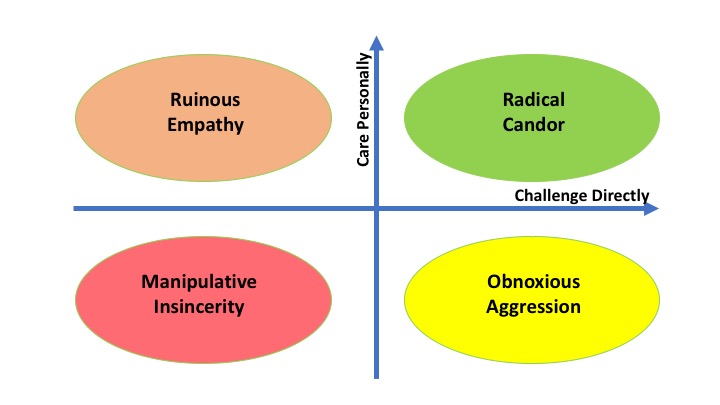
In her book, Radical Candor, author Kim Scott defines a model of leadership built on radical candor, which she defines as caring personally and challenging directly. This “challenging directly” is a matter of providing clear and proper guidance. We could also describe this type of relationship as “speaking the truth in love.”

How do we then provide guidance that values the person and evaluates performance? Here are some guidelines for effective guidance that evaluates performance:

  • Provide guidance from a relationship of personal caring. As mentioned, guidance is best received within a relationship of trust and respect. Therefore, there must be an ongoing dialogue that demonstrates this relationship. Obviously, if the only conversations are those delivering criticism, the guidance will likely not be welcomed or valued.
  • Don’t personalize guidance. It is not “you did….” or “you are….” but rather a focus on the actions or behavior. Avoid the fundamental attribution error, that is using perceived personality attributes, such as smart, stupid, lazy, greedy, etc.
  • Address specific action or behavior. Guidance is not focused on the person, for example, “you are so smart.” Neither is the best guidance given as general statements, such as “The presentation was good.” Rather, the best guidance focuses on the specific actions or behavior, such as “the logic that was shown in the presentation made it easy to follow” or “the presentation could have explored the alternatives more fully.”
  • Frame guidance based on the future. The purpose of guidance is to reinforce the positive performance or to improve the negative. Leaders use past action or behavior to guide people into a better future performance. Therefore, guidance uses the observed performance to either make recommendations for the future or to elicit thoughts about improving performance for the future.

Leadership based on valuing the person and evaluating the performance doesn’t mean that leaders need to accept performance that does not meet requirements or expectations. Part of caring personally is encouraging people to perform to their best. If their best is less than what is required or expected for the position, then perhaps they are in the wrong position. Helping and encouraging them to either grow to meet the position requirements or to find a different, more suitable position is the caring thing to do. This can mean firing a person who is better suited for an opportunity elsewhere. Even firing can be done in a way that expresses the value that we hold for the other person.

Is the feedback that you give helping your team reach their potential and meet expectations?

“Radical Candor” by Kim Scott


No doubt you heard the advice as you grew up: “if you can’t say anything nice, don’t say any anything at all.” Many people still operate according to that rule even when in a position of leading or directing people. While this advice may work for everyday life, it can be a disaster when adopted by managers. On the other hand, there are some people who, when they have achieved a management position, believe it is their responsibility or privilege to boss people around, demanding that their voice is the only one that matters. This attitude can also be disastrous for a manager. The book “Radical Candor” by Kim Scott proposes a model of leadership based on the idea that the best boss is the one that can “care personally and challenge directly.” When a leader can effectively combine these two skills, they are most effective at influencing, inspiring, developing, and directing their team. Only when we clearly show that we care personally can people accept our effort to challenge directly. And only when we challenge directly are people convinced that we truly do care personally.

My view is that leadership is the ability to influence built upon a relationship of trust and respect. This correlates with the concept of Radical Candor. Trust is built by caring personally. Respect is built by challenging directly.

This combination of caring personally and challenging directly is a balancing process and is modulated by our understanding of the recipient and the way in which they perceive both the caring and the challenging. Challenging, or guidance, is always meant to impact the future of recipient; therefore, it includes both praise and criticism.

When our ability to care personally and to challenge directly is out of balance, the ability to lead can be impacted adversely. Ms. Scott describes the various combinations of caring and challenging as follows:

Obnoxious Aggression is when a boss is prone to criticize without showing that they care about the recipient. The boss comes off as a “jerk” and the recipient is made to feel incompetent.

Ruinous Empathy is when a boss cares so much that they are unable to ever challenge; this is the “when you can’t say anything nice” person in action. It is ruinous because the recipient never is given feedback that will lead to growth.

Manipulative Insincerity is the result of a boss that doesn’t care enough to challenge. The worst version of leadership, this is generally the result of a boss that is only focused on him- or herself. It’s praise that is false or condescending and criticism that is neither clear nor kind.

Radical Candor is the healthy mix of caring and challenging that leads to growth and influence.

The first portion of the book defines and explains Radical Candor, building the case for why it is the best model for today’s leadership in the workplace. In fact, Radical Candor is a concept useful in any relationship or communication. In the process of describing Radical Candor, Ms. Scott further defines caring as understanding what motivates each person on the team through a process of exploration and communication. She also describes the open communication and guidance that embodies challenging directly.

The second half of the book is devoted to demonstrating what Radical Candor looks like in action, presenting advice and tools for the day-to-day practice of leading a team in a Radical Candor fashion. This includes advice on building relationships in the workplace, getting and giving guidance, building and motivating a team, and on getting stuff done, as she describes it. In the chapter on results, the book contains a GSD or Getting Stuff Done model, in which Ms. Scott describes the various types of meetings that she believes a team should utilize and the general steps for accomplishing projects. These steps are: Listen, Clarify, Debate, Decide, Persuade, Execute, Learn, and back to Listen. The advice regarding giving guidance gives some helpful advice on hiring, firing, promotions, and performance reviews. In summary, the Radical Candor model should become a philosophy of interacting with people on our team.

While this book spends considerable describing the actions or skills that result from a Radical Candor style of leadership, for many people the concept of Radical Candor is as much an urging to character growth as it is a recipe for competency. Radical Candor requires a development of relationships that may be a challenge to many people. Yet I believe that effective leadership is built upon such relationships.

I highly recommend this book and the character growth that is required to embrace and live in a Radical Candor fashion.

Are you ready to care personally and to challenge directly as you lead people? What growth do you need to undertake in order to do so effectively?