The Coach Approach, Part 3 – The Route

In the previous segment of this series, we proposed that human beings are both designed for and are called to care for each other and to connect with each other. The positive side of our humanity is built and demonstrated through caring and connection. Society functions well when its members care for or serve each other and have positive, healthy relationships or connections with each other.

It is difficult to care for and connect with another person from across the room. To care and connect requires that we begin to know and understand the other person. This desire or calling to care and connect, therefore, must prompt in us a natural curiosity. As we move towards the other, we ask ourselves, “Who is this person?”, “What motivates them?”, “What are their hopes and dreams?”, “Where do they struggle?”

That curiosity, in turn, prompts us to ask questions from which we develop this understanding of the other person. In fact, the only way (or at least the most likely way) that we can connect is by asking questions. For the sake of alliteration in our Coach Approach model, we will call these coaching questions, which also differentiates them from simple, fact-focused questions.

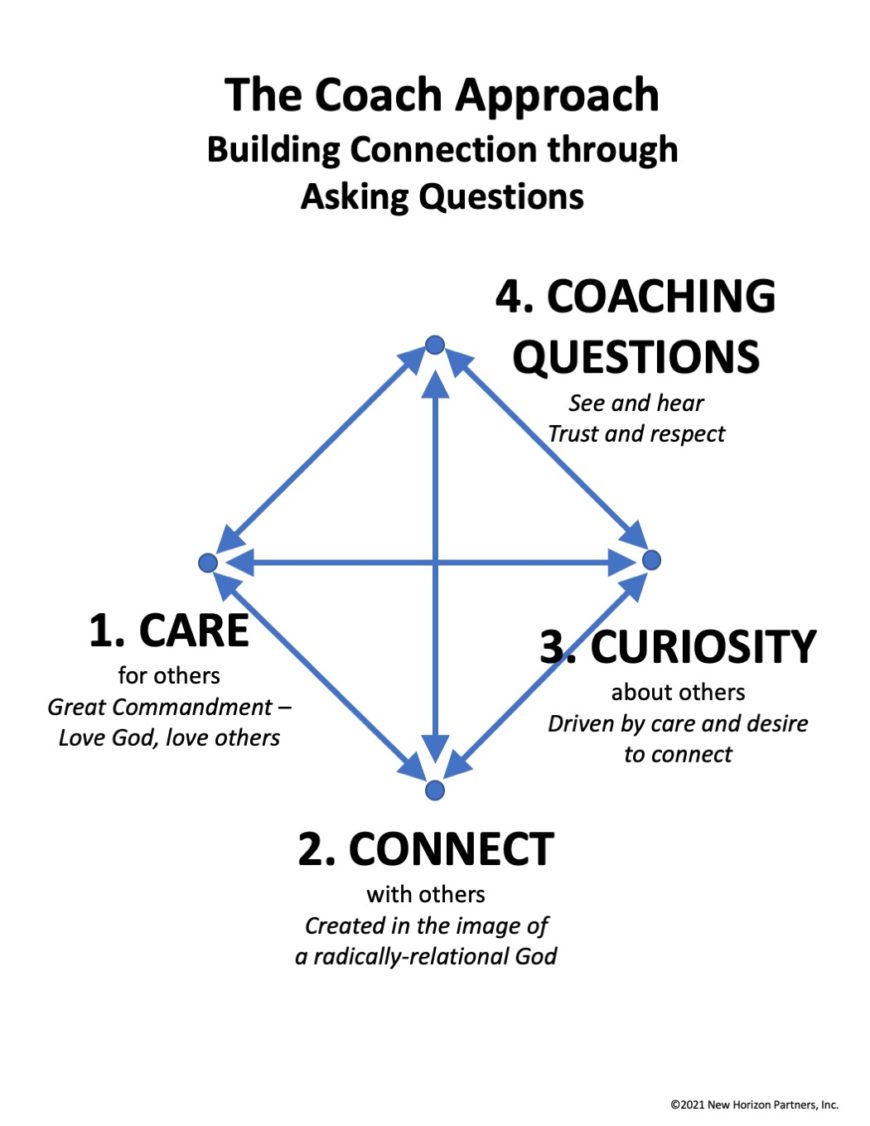
Again, by definition the Coach Approach is a lifestyle or mindset (we could also call it a habit) of utilizing questions to create meaningful conversations, build relationships, or help others grow. And here is the model that we use to understand and motivate us to build within ourselves the Coach Approach:

You will notice that the model has arrows that interconnect all of the Four C’s. This is because the Four C’s are not sequential, but they are all interconnected. For example, connection is foundational in that we are designed to be connected with each other and we are called to do so. Yet we are not able to really connect until we know and understand one another, which means that coaching questions are a prerequisite for connection. All of the Four C’s in the Coach Approach model are interconnected in this same way.

Our motivation to build this habit of the Coach Approach in our lives comes first from the fact that we are designed for and expected to care and connect for each other. We are also motivated by the important benefits achieved through exercising this habit of using questions to know and understand the other:

  • Create meaningful conversations – Conversations at a deeper level of intimacy.
  • Build relationships – People feel valued when we seek to understand and know them.
  • Help others grow – More likely to retain and act upon what comes from heart and out through mouth than what goes in ears.

Here are some coaching questions to think about: Are you comfortable asking questions at a deeper level of intimacy, questions that help you know the real person? What might you do to become more comfortable in doing so?

This article is part of a series on the Coach Approach. For an overview, see the Intro article. Or move on to Part 4 to learn about the Powerful Questions that are central to the Coach Approach.

The Coach Approach, Part 2 – The Motivation

In the first part of this series on developing a Coaching Mindset, we mentioned briefly the role that questions play in building connections with other people and then discussed some of the roadblocks to asking questions. People often lose that childlike curiosity and they become more self-focused. In general, people are more likely to provide answers rather than ask questions, seeking to serve themselves rather than build connections or serve others.

Why is it important to build (or rebuild) that curiosity about other people and seek to develop connections with people? What is our motivation for learning to ask powerful questions?

As a Christ-follower, my tendency is to answer these questions in Biblical terms. If you have a different belief system, I hope that you will read on and see that this discussion comes around to common sense wisdom for interpersonal relationships.

Called to care about each other

As human beings, we are called to love, or care for, other people. The most straightforward statement is in the gospel of John, chapter 13, where Jesus says, “A new commandment I give to you, that you love one another: just as I have loved you, you also are to love one another.” (ESV, John 13:34, Crossway Bibles). A similar thought shows up in the Greatest Commandment, which can be paraphrased as “Love God and love people.”  Throughout the Bible we are told to love one another, the answer to how people can coexist peacefully in this world.

In today’s culture the word love is more often used as a noun referring to a feeling, that emotion that comes with attraction, romance, or desire. This is not the historical or Biblical definition of love. My favorite definition of love comes from Dr. Paul David Tripp. It’s in his book on marriage, What Did You Expect?, and in other writings. His definition is as follows: “Love is willing self-sacrifice for the good of another that does not require reciprocation or that the person being loved is deserving.” Love is a verb. It is a word that denotes action or a decsion. This action is most often serving the other person. In Scripture, love for our neighbor comes to life in the many “one another” commands, which instruct us to care for one another.

In summary, the world functions best when we care about each other. When we do not care for the other person, we are self-serving, putting ourselves in competition or enmity with those around us. Only when we care about the other person are we able to build connection or relationship with them.

Called to connect with each other

As human beings, we are called to connect with each other. Created in the image of a highly relational God, we are created for relationship. Within Genesis 2:18 are the words, “It is not good that the man should be alone.” (ESV, Gen 2:18a, Crossway Bibles) While this verse is often used in regard to marriage, its application is much broader. God is highly relational as evidenced by the Trinity, as evidenced by the earthly life of Jesus, and as evidenced by God’s relationship with those that choose to follow Him. As a result of being created in His image, people function better when they have strong relationships with other people. In Scripture, we are described as all being part of one body, connected to each other through Christ.

In summary, there is a desire within each person to be seen, heard, and valued by other people. In isolation, a person tends to collapse in upon themselves or to wither away. As a creature of God and a member of society, we are called to connect with other people.

The interactions between people are simply perfunctory when they consist of simply an exchange of facts and clichés. When people exist as isolated beings, lives lack the richness and meaning that results from when being connected and caring for each other. We are called to care for and connect with those around us. Individually we function better when we care and connect with others and when others care and connect with us. Society functions well only when it is composed of people who care for each other and connect with each other.

In summary, we are designed to care and connect with each other and it is our Creator’s expectation that we will do so.

Here are some coaching questions to consider: What actions on the part of others makes me feel that others care about me and desire to connect with me? What actions do I take to care for and connect with others?

This article is part of a series on the Coach Approach. For an overview, see the Intro article. Or move on to Part 3 to learn more about the motivation behind the Coach Approach.

The Coach Approach, Part 1 – The Roadblocks

Most people recognize that asking questions is a large part of coaching others. If fact, asking questions is an important skill that goes beyond coaching. Asking questions is a core skill to connecting with others, building relationships, and to carrying on what we might call meaningful conversations. Yet we often have difficulty making questions a large part of our conversations. Before we discuss why questions are important and how to ask powerful questions, let us first understand the hurdles that we must overcome to incorporate questions into our lifestyle.

I like to think of communications along a continuum. Towards one end of this communication continuum, is the telling dynamic where communication is very one-sided. Communication here can be commands, a monologue, there is one voice that is important. The speaker spews out information or gives commands while the recipient simply takes in (or ignores) the information being given out. The next type of communications on the continuum would be presentations and instruction.

Somewhere around the middle of the communications continuum is the talking dynamic, the point where dialogue takes place. In this place, the speaker and hearer or recipient frequently trade roles. Both parties contribute to the conversation, with one dishing out information and the other taking it in, followed by a switch in roles from speaker to hearer and vice versa. In dialogue, the conversation often (though not always) builds one statement on top of another. In this part of the continuum are polite conversations and exchanges of facts.

Towards the other end of the communications continuum, is the question-answer dynamic. Towards this end of the continuum there can actually be two very different dynamics. One is the interrogation, in which the questioner is working to elicit, or perhaps drag, information, largely facts, out of the recipient. The other question-answer dynamic is driven by curiosity, in which the questioner asks questions, perhaps powerful, thought-provoking questions, in an effort to understand and connect with the recipient. Also on this end of the continuum would be the heart-to-heart communications, where two people might exchange feelings, dreams, or other deeper topics.

It is a part of our nature to spend more time telling rather than asking. On the communications continuum, most of us are most comfortable telling, some people are fairly good at dialogue, but few of us have developed the desire or the skill for asking, especially for asking, especially for seeking personal or more intimate information.

And why is it that we are more inclined towards telling? There seem to be two major reasons.

By nurture. If you have ever spent time with a two- or three-year old, you will know that they are full of questions. Various studies have shown that children between the ages of two to five ask a question every two minutes and 36 seconds and ask anywhere between 40,000 to 438,000 questions in those three years. But this part of our nature, the strong curiosity, seems to get pushed out or trained out as we mature.

Our education system is one culprit in breaking our habit of asking questions. You don’t score well on the SAT by asking good questions, but by providing the best answers. Throughout our school experience, the emphasis is on providing the right answers. Even better if you can be the fastest one to provide answers. So, we are trained to provide answers, but we receive very little training in asking questions.

For most of us, our jobs reward us for knowing and providing answers. This is especially true in the early years of a career. Only a few careers develop our ability to ask questions of people, driven by curiosity.

So, over the years, both our education and our careers reinforce the tendency to provide information and push out our natural curiosity about other people’s lives and our inclination to ask questions.

By nature. We mentioned above that, as a child, curiosity is a strong part of our human nature. But as we mature, our tendency is to become more egocentric, more self-focused, more self-centered. This plays out in a desire to be seen as intelligent, as one who has knowledge or the answers.

As we mature, our listening skills become more focused on hearing information that pertains to us. Our brains are wired to listen with a me-centered focus to defend, to fix, to win, to gain approval, etc. Also, our competitive reflex grows stronger, that part of us that wants to “one up” someone else’s story.

Another part of our nature is seeking expediency. Providing information often takes less time than asking questions and being curious. We tend to not invest time or effort in things that don’t have a short-term benefit for ourselves, another facet of our self-focus.

In general, people are more likely to provide answers rather than ask questions, seeking to serve themselves rather than build connections or serve others. Also, we tend to spend much effort in posturing, that is, portraying how we would like to be perceived rather than presenting our authentic selves. We fear vulnerability and we flee from deeper levels of intimacy.

In his book, The Seven Levels of Intimacy, Matthew Kelly lists the seven levels at which we communicate as the following:

  1. Cliché
  2. Facts
  3. Opinions
  4. Hopes & dreams
  5. Feelings
  6. Faults, fears, and failures
  7. Legitimate needs

People general operate within the first two levels, with clichés or facts. They fear moving beyond these two levels because the deeper levels present the reality of who we are. People tend to avoid revealing this reality for fear of not being accepted or being deemed unlovable.

So, there we have it. Most of our interactions are statements of clichés or facts. We are not likely to reveal much beyond that. And we are reticent to ask questions that demonstrate an interest in anything beyond clichés and facts.

Here are some coaching questions to consider: How much of my interactions with other people consists of clichés and facts? What keeps me from revealing or seeking to hear deeper thoughts? How much of my time in conversation is spent either in talking or thinking about myself and how much is spent in learning about and understanding the other person?

This article is part of a series on the Coach Approach. For an overview, see the Intro article. Or move on to Part 2 to learn about the motivation behind the Coach Approach.

The Coach Approach – Intro

The Coach Approach© is a lifestyle or mindset of utilizing questions in conversations to build relationship and/or to help others to grow. It is an other-focused or “one another” approach to relating to the people around us. The Coach Approach could also be defined as “Making a practice of building conversations around powerful questions that are based on curiosity with the goal of building connection and demonstrating care for the people around us.”

This article is an introduction to the concept of the Coach Approach, which is then explained in a series of following articles on specific elements of the concept. The complete list of articles explaining what the Coach Approach is, why it is the best way to build relationship, and examples of the Coach Approach in action is shown later in this article. But first, here is the model of the Coach Approach in action:

Read the full series:

The Coach Approach, Part 1 – The Roadblocks

The Coach Approach, Part 2 – The Motivation

The Coach Approach, Part 3 – The Route

The Coach Approach, Part 4 – The Destination

The Coach Approach, Part 5 – The Coach Approach in Action

The Coach Approach, Part 6 – More of the Coach Approach in Action

The Coach Approach, Part 7 – Lessons from Mr. Rogers

500 Powerful Questions – Sample Questions

9 Leadership Lessons 2020 Gave Us

An Article from the MIT Sloan Management Review

“As we approach these final days of 2020, a year that has tested our society like few others in recent memory, it’s safe to say that many people are looking forward to putting this year behind them. However, 2020 has also shed light on so many systemic issues facing individuals and companies across the globe that we would be remiss if we didn’t reflect on the lessons that we can take into the future.”

Thus begins this article in the MIT Sloan Management Review. 2020 was a year of profound challenges and changes. The speed of change increases every year but this past year especially held so many changes for leadership. These forced leaders to make many important decisions in rapid order, often with little time to ponder the alternatives and implications.

The article cited here is a compilation of lessons in leadership written by nine frequent contributors to the MIT Sloan Management Review. The nine big ideas are as follows:

  • Prepare for and Adapt to Increased Turbulence
  • Reorient Your Road Map with Sensemaking
  • Put Care at the Center of Leadership
  • Unleash the Collective Genius of Your Team
  • Foster a Culture That Enables Employees
  • Build Shared Understanding Through Dialogue
  • Emphasize Work-Life Balance for Your Teams
  • Give Special Attention and Care to Work Relationships
  • Build Restorative Habits into Your Routine

The full article is a short read (8 minutes) that briefly builds out each of these nine lessons. Obviously, since it is cited here, it is a worthwhile read.

Case Study in Strategic Focus

In a recent article we discussed strategic focus, the idea that companies should first develop a laser-focused strategy, i.e., a definition of precisely where and how they intended to compete, that provided the best path to achieving the company’s goals and objectives. Perhaps the greatest purpose of strategic planning is this second part of strategic focus, that the strategy needs to be clearly and consistently communicate to the entire organization and then used as a guiding light for the allocation of resources – capital, energy, thought, and actions – to maximize the likelihood of implementing and achieving the plan.

Some years ago, a client invited me in for a discussion about how to grow their business; more specifically, they wanted to talk about finding new customers. As I began to learn about the company and its business, I found different views of what they were and who they served. Most concerning, when talking to the sales director I was told that they were looking for anyone that bought plastic products. Of course, this demonstrated that they had no strategic focus at all and explained why they were struggling and needed help.

They were a part of an industry with thousands of competitors and tens of thousands of customers. Without having a clear definition of where and how they wanted to compete, they often found themselves competing for business based on the lowest cost for customers that had little expectations of value desired. While they competed for lots of low-price business, they had a substantial engineering function which was a requirement of some of their best customers but which few of their competitors offered. This represented a higher cost that was often not valued by many customers. They also a sophisticated quality and process control system, again representing a higher cost than the run-of-the-mill competitor. Without a strategy and strategic focus, the more business they gained, the more their net margins declined.

As we dug into this project, we naturally needed to begin with a strategic planning process. As part of this process we spent time talking about the need for strategic focus in order to be successful and maximize profitability. In defining their strategy, the where and how to compete, and the ways in which they wished to differentiate themselves from the mass of competitors, they decide to keep and build upon their strong engineering capability and the quality and process control standards. This led them to define their desired customers as manufacturers who would attribute value to an ability to re-design, consolidate, and improve the components that they purchased and would attribute value to the superior quality and consistency of parts.

This planning process and the subsequent communication process brought most of the team together, marching to the same beat of differentiation and serving a select set of customers. In the process, they learned some new language to use in evaluating business opportunities and decisions about allocation of resources.

The organization share this focus except for one person, one person who was key to the implementation. The sales director was either unable or unwilling to adopt the same focus as the rest of the organization. Throughout the planning process and subsequently he saw his role as “finding any potential customer that bought plastic parts.” In conversations with the company president, I pointed out this problem. In spite of the fact that the sales director and the company president where close and long-time friends, we agreed that he would be better served finding different employment. I then introduced them to a potential candidate that I knew would embrace the importance of focus and would be driven to find the right customers as defined by their strategic plan.

As a result, their profitability shot up and the business over the next few years grew from one plant to three plants. The right strategy was helpful, but strategic focus was the key to this company’s turnaround.

Does your organization have an appropriate and well-defined strategy? Does your organization understand it and have they rallied around it to develop strategic focus?

Strategic Focus

Strategic planning has many purposes. It provides the opportunity and impetus to examine your market environment, your customers, and your competitors and to think about the past and the future in each of these areas. Strategic planning provides the opportunity to examine and refine your organization’s mission, vision, goals, and objectives. The strategic planning process provides an opportunity to refine your strategy – to define again where and how you will compete to best meet the organization’s goals and objectives. Strategic planning asks the organization to plan the specific tactics and actions that will implement the strategy and lead to achieving those goals and objectives.

But perhaps the most important purpose of a strategic plan is to focus the organization and all of its resources on the most important activities and investments that will lead to achieving the plan. The plan is both a communication tool and a sieve to keep the organization’s actions and investments pure. Peter Drucker once said, “Culture eats strategy for breakfast.” I often say that a mediocre strategy well executed is likely to create more value than the best strategy poorly implemented. Both of these statements are based on the fact that any strategic plan is only as good as the organization’s ability to rally around the plan and to work as a tight-knit, collaborative unit in pursuing the implementation without distraction. This is what we refer to as strategic focus.

Strategic focus means that the organization is diligent in examining every action and every investment to assure that they move us down the road to become what the plan defines. No one in the organization has a sacred cow, or a pet project, or an interesting opportunity that diverts any attention or resource from the strategic plan.

To achieve strategic focus, the plan needs to be clearly laid out and defined so that all parties understand and so that there are no open ends. To achieve focus, the plan needs to be communicated frequently and clearly so that all understand and buy in. There is another saying, “When you are tired of saying it, people are beginning to understand it.” The plan needs to be visible and present in every discussion that might lead to activity or allocation of resources that could possibly be relevant to the plan. Each person must see their role in achieving the plan.

There are many reasons why organizations fail to achieve focus, and therefore fail to implement or achieve their plan. Most of the time it is because they don’t see the importance of day-to-day reminding of what they hope to achieve. Too often the planning process is a sterile, one-time process of development. Sometimes it is introduced to the organization in a single meeting, where it is presented in summary without making each person’s role and the importance of achieving the plan clear. Often the plan is put on the shelf or stuffed in a drawer, never to be seen again until the next year, when we wonder why it never happened.

If you want to develop a strategic plan, it ought to be one that actually defines a plan of action and that plan of action needs to be part of the organization’s daily activities. It requires strategic focus.

Does your organization seek to implement a strategic plan that really affects the way that you compete? Do you develop strategic focus that drives your implementation?

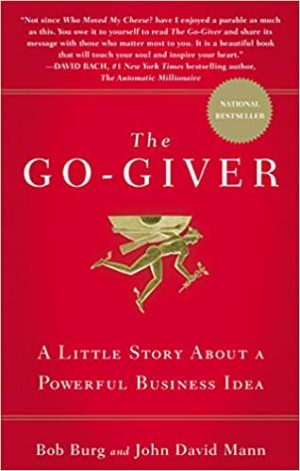
“The Go-Giver” by Bob Burg and John David Mann

This book, The Go-Giver: A Little Story About a Powerful Business Idea, is a short, quick read. Written by Bob Burg and John David Mann in a fable style, it tells the story of person who was struggling to reach his sales quota until he finds a new way to do business. This new way is to first build personal relationships that open up possibilities for business opportunities.

You might surmise correctly from the title that the idea of a Go-Giver is in direct contrast to a Go-Getter. What we consider a go-getter is quite often a person focused on him- or herself, looking out for “Number 1.” The go-getter is often out to win at any cost. While they may speak of win-win situations, the important thing in their mind is what they are going to get out of the transaction. And life is very much based on just that – transactions, without much consideration of relationships. The Go-Giver, on the other hand, is focused first on the other person. The important thing to the go-giver is providing value to the other and developing a relationship. Transactions are the reward that might result from serving the other.

And this is the big idea of the book, that what the authors term as the “Five Laws of Stratospheric Success” can lead to business growth and success. The five laws as listed in the book are as follows:

  • The First Law – The Law of Value – Your true worth is determined by how much more you give in value than you take in payment.
  • The Second Law – The Law of Compensation – Your income is determined by how many people you serve and how well you serve them.
  • The Third Law – The Law of Influence – Your influence is determined by how abundantly you place other people’s interests first.
  • The Fourth Law – The Law of Authenticity – The most valuable gift you have to offer is yourself.
  • The Fifth Law – The Law of Receptivity – The key to effective giving is to stay open to receiving.

These laws are, for the most part, in line with the Biblical commands to “one another”, that is to serve, love, help, etc. one another. And the “one another” is anyone that comes across our path, not just the ones that are deemed strategic opportunities. These laws and the “one another” commands should be guideposts for the way that we live and do business. The part of the book that is misleading is that everyone in the fable who lives out these five laws becomes a multi-millionaire. This is not realistic, and the book implies that this goal of generating great wealth is the one and only motivation for following such laws. I would submit that the true motivation should be “one anothering,” or caring for each other and providing value to all with whom we interact. Even with this major flaw, this book is an interesting and thought-provoking read.