Porter’s Five Forces

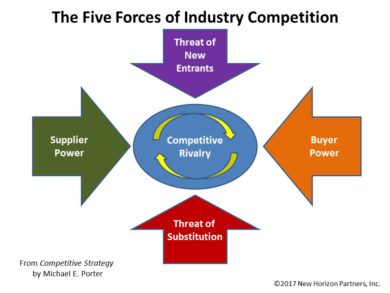
There are five general market or competitive forces that affect every business to some degree. These are often called Porter’s Five Forces because they were popularized in Michael E. Porter’s book, Competitive Strategy, published in 1980. The five forces result from industry structure and have an effect on the performance of a business and the attractiveness of a market. They describe the pressure on the industry participants and the impact on profitability performance of a company. The five forces are as follows:
Five Forces Strategy Consulting

  • Bargaining Power of Buyers
  • Bargaining Power of Suppliers
  • Threat of New Entrants
  • Threat of Substitution
  • Intensity of Rivalry among Existing Competitors

The strength and effect of each of the forces varies depending upon the industry structure. Most businesses will be strongly affected by at least one of these forces. Very few businesses are affected by all five. While the strength of the forces is largely a function of the industry structure, industry participants can often take some action to mitigate the effect of the forces. Understanding the industry structure and resultant competitive forces is an important part of the strategic analysis and planning process. In industries where the combination of these forces are high, the pressure limits the achievable profitability and returns, making the industry and the industry participants less attractive or making the business more challenging for existing participants.


The bargaining power of buyers is mainly dependent upon the size and strength of the buyers. Large and strong buyers that are able to easily switch suppliers or backward integrate have strong leverage in dictating price and terms. This is especially true when the product or service is more of a commodity rather than a differentiated product.

An obvious example of this situation is the automotive industry where the OEM’s have great strength, especially relative to some of the smaller suppliers of common products. They are often able to dictate pricing and drive margins down. When possible, the best defense in situations of high buyer leverage is to create differentiation in some way that provides more power to the seller or drive up switching costs. In some cases the strategic selection of customers can keep a supplier out of the worst scenarios of buyer leverage.

The bargaining power of suppliers is strong when they have unique materials, technology, or other means to control the industry participants that rely upon them. Situations where there are few qualified suppliers or where there is strong differentiation of the supplier or high switching cost and where the industry participant is small relative to the supplier are often instances where the supplier has high leverage.

Intel would be a good example where technology and brand power gives them a strong position relative to computer manufacturers. For many years Gore-Tex controlled the best material for water-proof active wear and could control the market. Another less obvious example is the position of a labor though a union such as the UAW. Examples of how companies position themselves by location decisions or design decisions to move away from high-leverage suppliers are common.

The threat of new entrants is largely a function of not having factors such as economy of scale, product differentiation or the ability to develop proprietary technology, switching costs, or strong brands. In industries that are largely commodities and where it is easy to start up a new participant, the continual flow or even the threat of new entrants drives down pricing and profits. Buyers use this leverage in price negotiations or sourcing decisions.

The restaurant business is an example where local businesses come and go every day. Commodity businesses like sand, stone, etc. and manufacturing businesses like machine shops or plastic injection molding are pressured by the ease of new entrants. One obvious solution is to build differentiation or switching costs by developing or adding technology or unique capabilities.

The threat of substitution is an often overlooked potential pressure because substitution can come from left field. Where threat of entry is new participants coming into an existing industry, the threat of substitution can partially or completely replace an existing industry. This is best demonstrated with some examples, such as high-fructose corn syrup replacing sugar refiners, fractional aircraft ownership replacing aircraft charters, electronic music files replacing the record and CD business, etc. Substitution can also include instances where a downstream product or industry is re-engineered to eliminate the need for certain products or services, with the example of video stores. The defense here is more a matter of being aware of the world outside of one’s particular products and industry. If the railroad industry had thought of themselves as being in the transportation business rather than the railroad business they might have retained their value by adapting rather than being replaced by substitute means of transport.

The intensity of rivalry among existing competitors is the area with which most industry participants are familiar. Competitive rivalry is a result of numerous competitors, slow industry growth, lack of differentiation, excess industry capacity, high strategic stakes, or high exit barriers. Most of the causes of competitive rivalry are out of the control of an individual industry participant. The one defense is differentiation either through technology or through unique capabilities or relationships. Apple is an example of a company that generally stays out of the competitive fray by continually differentiating itself and its products.

Analyzing the industry structure is a necessary step in understanding the value and profit potential of a business. This analysis can identify threats and opportunities. It sets the context for strategy decisions. Profitability and return on investment can be optimized by identifying market or industry opportunities that face lower competitive forces.

What are the pressures facing your industry and business? How can you mitigate the risks and develop opportunities?
“Integrity” by Dr. Henry Cloud

When we hear the word integrity in the context of character we think of the definition of being honest and having strong moral principles. In his book, “Integrity”, Dr. Henry Cloud uses another definition of integrity, that of being whole or undivided, as in integral or intact. The idea here is wholeness of the person or the character of the person. Character is the most important ingredient of leadership, more important than talent, brains, education, training, or any other component of success. An integrated character determines a leader’s potential to succeed and to avoid the pitfalls that can befall those of lesser character.

character based leadership Ohio

The measure of character is described by Cloud as the “wake” that is left behind us. What do those with whom we interact see us leave behind in terms of tasks and relationships? How positive is our “wake”? Do people feel that they have grown and accomplished much because of us? Or are they glad that they survived with minimal damage?

Character guides our thoughts and behaviors. Dr. Cloud defines character as the ability to meet the demands of reality, a broader definition than sometimes used. Speaking of the various capabilities required to lead, he says that “while you don’t need all the gifts that exist in the world, you do need all the aspects of character while you are putting your gifts to work.” The book is focused on the aspects of wholeness or integrity of character that Dr. Cloud says are critical for effective leadership, as follows:

  1. “The ability to connect authentically (which leads to trust).
  2. The ability to be oriented toward the truth (which leads to finding and operating in reality).
  3. The ability to work in a way that gets results and finishes well (which leads to reaching goals, profits, or the mission).
  4. The ability to embrace, engage, and deal with the negative (which leads to ending problems, resolving them, or transforming them).
  5. The ability to be oriented toward growth (which leads to increase),
  6. The ability to be transcendent (which leads to enlargement of the bigger picture and oneself).”

Dr. Cloud makes the point that the integrity of character means that all of these aspects must work together. “Strengths turn into weaknesses without the other parts of a person to balance them out.” While no one has a perfect balance of these abilities, the gap is their need and opportunity for growth.

Trust is an essential element of a leadership relationship. Without trust leaders cannot influence. Trust is built through connecting, through extending favor, and through vulnerability. Connection is based on empathy. Entering into another person’s reality, validating it, and treating it with respect builds connection. Invalidation destroys connection. Another element of building trust is through extending favor. This is described as being for the other person’s best interest without being dependent upon anything. Trust is also dependent upon a certain degree of vulnerability that represents strength that one can depend on but vulnerable enough that one can identify with. Effective leaders need to have a balance of transparency that people can see their vulnerabilities and how they are feeling about things.

An orientation toward reality is a requirement for integrity of character. Leaders “must be in touch with what is, not what they wish things were or think things should be or are led by others to believe they are.” People who are oriented toward reality have a hunger for the truth, whether it be about themselves, their organization, their markets, other people, their relationships, or whatever. They prefer to seek the truth and to then deal with it effectively. They seek feedback from others. They understand themselves and can then work effectively with others to utilize their strengths and work effectively to shore up their weaknesses. They are able to assimilate and accommodate.

People of integrated character have an orientation toward getting results. They understand the concept of ready, aim, fire in decision making and the importance of each step. They are ready to move forward. When things don’t go well, that is another reality that they will deal with and overcome. Even more than that, they are able to let go of things that are good so that they can move on to the best.

The ability to embrace the negative is part of the integrated character. “The ones who succeed in life are the ones who realize that life is largely about solving problems.” Therefore they seek the negatives and seek to resolve them. They do not see the negatives as something painful but as opportunities to make things better and move forward. “Integrated characters are able to recover motivation, hope, judgment, clear thinking, drive, proactivity, and the other faculties needed to move something forward after something bad happens.” They are able to differentiate between themselves and things external. They are also able to confront well when others are causing the negative and to rally the others to work together against the problem.

People with integrated character are oriented toward increase. Previous aspects spoke about results but this aspect is focused on personal growth, both of themselves and those that surround them. One principle of growth is that what is put to use, grows. Leaders need to be open and to hunger for growth. They look for both opportunities and for mentors or coaches that can contribute to their growth. If they think they know it all or do not expose themselves to new experiences and sources for growth, then they will experience disintegration, not growth. Another characteristic of people oriented toward growth is that they want others to grow as well. Those of character balance hunger and gratitude. They value the present without settling for the status quo.

People of integrated character are oriented toward transcendence. “To live and flourish, we must bow to the things larger than us.” “A person with integrated character is a person who possesses the awareness that it is not all about him or her, and the ability and willingness to make the necessary adjustments to the things that transcend him or her at any given juncture.” The mature character stands by his or her values and meets the demands of life.

The integrated character that Dr. Cloud describes is somewhat ideal. Every human being is to some degree unintegrated. None of us have the complete array of the character aspects but, if we wish to maximize our effectiveness, we should be working to grow in all aspects. The book ends by urging us to identify our gaps and growth plans and to move forward.

This is a great book and a must-read in the area of character-based leadership.

What is the nature of your “wake”? How complete is your integrated character and what are your growth plans?

The Process of Strategic Planning

Strategic planning is a tool that is useful for guiding day-to-day decisions and also for evaluating progress and changing approaches for moving forward. In a previous article we described the purpose of strategic planning. The process for strategic planning can often be an iterative process but it has these key elements:

  1. Set strategic goals and objectives
  2. Prepare a situation analysis
  3. Define or refine the business strategy statement
  4. Develop the action plan

Strategic planning is iterative in two dimensions. Within the process, for example, we might establish objectives and then discover through the process that the objectives need to be revised or that the strategy cannot be supported with actions. The process is also iterative over time as we should not be constantly developing a new plan but rather adjusting and revising the plan periodically as the reality of the market changes or as we adjust the objectives, strategy, or action plan.

strategic planning process Ken Vaughan

The strategic goals and objectives describe the targets or milestones that the organization plans to achieve over the planning period. In a previous article, we described in more depth the definition of goals and objectives. The plan might describe targets for sales revenue, profits or margins, market share, ROI, etc. It can also set goals and objectives for sources of revenue (e.g., % from new products or specific segments), levels of quality, customer satisfaction or retention. The list of potential goals and objectives is endless but the key is to identify the few that are strategically significant, in other words, which goals and objectives will mean that we have moved the organization toward our vision of a successful future? Better to have a short list of meaningful goals that the organization can rally around than a laundry list.

The situation analysis has two major components – the external analysis and the internal analysis. Obviously, the external analysis looks at the environment in which the company does business and the internal analysis looks at the company itself and its position in the market. There are lots of tools that might be used in the situation analysis such as SWOT analysis, PEST analysis, Porter’s Five Forces, etc. The important thing is not the quantity of charts and tables but rather the quality of the understanding of the business.

The external situation analysis describes the nature of the market and the competitive environment in which the organization competes. What is the market? How large and what are the drivers of the market and its growth? Who are the potential customers and what do they look like? How do they make decisions and what are their needs? What are the relevant segments of the market and how do they differ? How can we best understand the market and the customers? Who are the competitors? How do they compete? What are their strengths and weaknesses? Etc.

The internal situation or position analysis describes the organization’s capabilities and position relative to the market, the customer needs, and the competitors. It might include such things as identification of strategic issues; analyses of the mix of customers, products, or market segments; market share and trends; profitability and trends; customer perception, satisfaction, and retention; efficiency and capacity; culture and image: organizational structure and capabilities; strengths and weaknesses; etc. Again, this isn’t an exercise in developing an overwhelming compilation of charts and tables and analyses. The purpose is to develop a realistic perspective of the company’s position and its ability to provide value relative to competitors and to develop core competencies that lead to competitive advantage in meeting the needs of customers.

Given the objectives, the market situation, and the competitive position, the next element of the strategic planning process is the statement of strategy. In previous articles we described the purpose of the business strategy and provided some descriptors of strategy. The strategy statement describes where and how the organization will compete to provide superior value in meeting customer needs. This is the heart of the strategic planning process. In the strategic planning process the goals and objectives describe what the strategy should achieve. The situation analysis provides the logic behind the strategy decision. The strategy statement provides the direction for decision-making for the organization to move forward towards its objective and its long-term vision.

The final element of the strategic planning process is the action plan. The action plan describes the tactics and specific actions required to implement the strategy. It describes the actions that will take the organization from its present position to the position where it will achieve the goals and objectives. A previous article described tactics and action plans. The action plan needs to be specific enough that it can be monitored and it needs to be a realistic set of actions that will achieve the necessary change in performance to actually carry out the strategy and reach the objectives.

The strategic planning process should not be onerous. It is an opportunity to step back from the day-to-day operation of the business and think about how the organization should change or what actions are necessary to achieve a longer-term vision.

Is your planning process driving your organization forward or driving it crazy?

Your Growth Plans for 2017

growth-plans-leadership

At the beginning of a new year it seems appropriate to think about how we can grow in this coming year to increase our effectiveness. I like to think of growth in the three dimensions in which our life should be showing fruit – person, people, and performance.

Person – How effective am I as a person? What are the patterns of my thoughts and behaviors? What are the strengths and weaknesses in my character? In what ways do I plan to grow as a person over this year? Who will serve as my mentor? Who will hold me accountable?

People – How effective am I in my relationships? What relational skills do I need to build up? How would I describe my emotional intelligence strengths and weaknesses? Who are the people in my life where I need to strengthen or repair a relationship? What are my priorities and does my calendar reflect them? Where will I find encouragement and accountability along my growth path?

Performance – How effective am I in my performance, including career, ministry, or even my hobbies? What new areas of knowledge or skill will make me more well-rounded or add to my capabilities? What skills do I need to enhance? What do I need to add to my background for achieving my life plan?

The Townsend Leadership Program is a cohort leadership program based on the premise that leadership is built on character and competency. The program is structured to help participants increase their effectiveness and grow in these three areas of the fruit of our lives – person, people, and performance.

Contact us for a free 30-minute coaching session to develop a growth plan for 2017.

Leaders Lean In

The natural response to negative situations is to back away. Human nature is wired to be self-protective and so when confronting the negative the common response is to flee, fight, or freeze. But effective leaders learn to lean into the negative or difficult circumstances in order to either turn them around, power through, or to learn or build something for the future. There are a variety of situations where leaders should learn to lean in.

lean-in-character-development

Lean into conflict. Conflict can be positive when it is directed at fully exploring issues or decisions. Conflict is negative when it becomes personal attacks or driven by anger. Effective leaders step into conflict to resolve, diffuse, or guide the conflict towards a positive outcome.

Lean into mistakes. Admitting your own mistakes demonstrates vulnerability and builds relationship and trust by showing that you are human and humble. Look for opportunities to learn and teach from your mistakes.

Lean into reality. Some people perceive the world the way they would prefer it to be. In business this can mean perceiving customers to need what you supply, or perceiving markets to be growing when they have reached maturity, etc. On a personal level, people can overlook weaknesses or overestimate capabilities. Leaders are able to perceive and accept the realities that they face whether it is professionally, relationally, or personally. When we accept reality we can identify a path of overcoming or compensating for the situation.

Lean into adversity. Often people can become quickly discouraged when the path is not easy. Adversity clarifies thoughts and develops resolve. Leaders are persistent in their efforts to achieve reasonable goals.

Lean into truth. When truth is scary, some people are more comfortable bending or creating their own version of truth. Leaders stand on their values at the risk of disappointing others.

Lean into negative emotions. People are uncomfortable with negative emotions such as anger, sadness, jealousy, etc. and often move away from these. A leader faces into these emotions and helps those that are expressing them, be it themselves or others, to understand them and to appropriately process them.

Lean into failure. When facing a failure either on the part of the organization or an individual, the tendency might be to bury it. Leaders use failures as learning experiences by asking “What might have been done differently? What did we learn? How did we grow?”

Lean into relationships. Relationship building is not a negative thing, but can get crowded out by other activities. Leadership is influence and influence is achieved through relationship. Leaders work at building relationships were they demonstrate the value of the other and build trust and shared vision and goals.

The ability to lean in when it is not the natural thing to do or when it requires intentionality is a function of a leader’s character. They must have or develop within themselves the long-term view and the perspective to look for and appropriately react to opportunities to build and grow themselves and their people.

Do you have what it takes to lean in? How are you growing this in your character?

Leaders Are Communicators

Good leaders are good communicators. In order to build a team with a shared vision that works in a collaborative fashion, leaders must be great communicators. Three elements of communication are essential for leaders – clarity, candor, and connection.

leadership-development-communication

Clarity – leaders must communicate consistently and clearly.

  • Be proactive, people left in the dark wander from the vision and waste energy speculating.
  • Understand the purpose of every communication, define the objective.
  • Make it simple and concise, understandable to the audience and focused on the objective, communicate specifics not ambiguity.
  • It’s not just the “what” but also the “how” of communicating, appropriate to the purpose, with authority.

Candor – leaders need to be trusted to be followed.

  • Speak the truth, transparency builds trust.
  • Be honest and authentic, communicate from the heart.
  • Admit mistakes; people don’t relate to those pretending to be perfect, they relate to those that are human and humble.
  • Be willing to embrace the negative, both to admit it and to hear it.

Connection – communication is more than speaking and writing, leaders need to know and relate to their audience.

  • Communication includes listening to understand and perceiving emotions and attitudes.
  • In individual communication, read body language.
  • Speak to the concerns of the listener, know the context.
  • Promote two-way communication, solicit feedback.

Leadership is defined as influence; influence is based on relationship. This relationship is built on trust and transparency. This trust and transparency can only be achieved with open, clear, and consistent communications. Constituents need to be a part of the team. Without good communications there is likely to be either confusion or suspicion, depleting or deflecting the energy of the organization and interfering with teamwork and collaboration.

How well are you communicating? What is holding you back?

The Purpose of Strategic Planning

The purpose of strategic planning is to gain control of the future and the destiny of the organization. If your experience of strategic planning is developing a ream of paper full of tables and charts that then gets put in a drawer or on a shelf, never to be seen again, or if your experience is simply producing a long-range forecast of performance and calling it a plan, then you haven’t done a “strategic” plan.

The four purposes of strategic planning are as follows:

  • Define or refine business strategy
  • Establish overall goals and objectives
  • Develop an action plan
  • Communicate direction to the organization

In previous articles we defined business strategy as a statement of where and how to compete based on an understanding of customer needs and the organization’s core competencies. The strategic planning process is a context in which we understand those customer needs and those organizational core competencies. In examining these we are equipped to either define or refine the business strategy so that we might delineate the optimal path for achieving the organization’s objectives. The destiny of the organization is dependent on identifying a path in which the organization can create value for its customers which then creates value for its stakeholders.

The strategic planning process provides a means for setting some long-term goals and objectives. These goals and objectives are set in the context of the long-term vision for the organization and serve as milestones or targets for the development of the organization. Sometimes setting these objectives is an iterative process as the organization considers the possible impact of various strategy alternatives. The next steps in the destiny of the organization is defined in these goals and objectives.

Setting a strategy is a call to action. The strategic planning process is a context for identifying the actions necessary to implement the business strategy and to reach for the objectives. The destiny of the organization requires a proactive set of actions if we wish to influence it.

The final purpose for the strategic plan is to communicate to the organization the future direction of the organization. The strategic plan sets the direction for every decision. Therefore every decision-maker needs to understand and buy into the plan. The destiny of the organization is dependent on marshalling the resources of the organization and investing them wisely towards shaping the future.

Is your planning strategic? Will it positively affect the destiny of your organization?

The Link between Character and Emotional Intelligence

Character and emotional intelligence can be considered as two layers of our leadership capability, the two layers that are foundational to our leadership effectiveness. Character can be defined as the virtues, values, and traits that underlie our thoughts and actions. Emotional intelligence can be defined as the awareness and management of emotions, both our own and others’, to build positive relationships.

In the literature on leadership we often see character and emotional intelligence (EQ) treated as one and the same. Many of those writers that are focused on emotional intelligence (for example, Daniel Goleman) fold basic character traits into EQ. Similarly, those that are focused on character-based leadership treat EQ as a part of their definition of character. As an example, I facilitate a leadership development program using materials from Drs. Henry Cloud and John Townsend. They define character as ”that set of capacities the leader needs to meet the demands of reality.” Those capacities cover the combination of virtues, values, traits, and EQ behaviors.

character-emotional-intelligence-ohio

On the other hand, I generally think of character and emotional intelligence as two closely-linked but separate layers of leadership. Both character and EQ are a part of who we are as leaders. But emotional intelligence behaviors are built on top of the foundation of our character virtues, values, and traits. For example, respect for others is a character value that motivates our desire for relationship and drives us to further develop our empathy or our ability to work in a team.

This then is the basis for my analogy of a structure for leadership, where character (the virtues, values, and traits) is the foundation and emotional intelligence is the framework of our leadership. Those two ingredients are fundamental (or prerequisites) for making our leadership competency work. We can understand all the skills of leadership yet struggle if we have not yet built the strong foundation and framework upon which to build our leadership voice. Building our character and emotional intelligence is more than reading a few books, it is an experiential process since we build these into who we are and how we think. “We lead from who we are.”

What is your definition of character in leadership?

What are you doing to build the foundation and framework for your leadership?

Leaders Are Learners

Effective leaders are committed to constantly learning and growing. This desire to grow is driven by their character. Effective leaders have the following character traits:

  • Confident but not arrogant, they know they have been greatly blessed with talent but recognize room for growth.
  • Humble but not meek, they know that they have areas to improve and room to grow to be more effective.
  • Driven but not obsessive, they want to accomplish more, both for themselves and for those that they serve.

These character traits convince leaders that they can continually increase their effectiveness by continually learning. Much like the areas described in Goleman’s book, “Focus”, of inner, other, and outer focus, effective leaders seek to grow in these inner, other, and outer dimensions. They are especially focused on learning in the following areas:

leaders-learners-development-ken-vaughan

  • Character
  • Competency
  • Constituents
  • Context

Leadership is built on competency and character, with character as a foundational element. Leaders know that they need to continually build their character in order to be more effective. Character growth is more than reading and attending seminars, it requires intentional change and growth of our inner self. To do so usually requires some experiential learning like participation in a cohort leadership development program.

Leaders desire to grow in competency, developing skills to enhance and expand their capabilities. This might include leadership skills such as communications or culture development, but also technical or functional skills. In the earlier part of careers these might be in our functional area but, as we grow in responsibility, would include the expansion of our knowledge in other functional areas. To do so requires extensive reading, study, seminars or conferences, etc.

A third area for learning is constituents. Effective leaders know their people, how to motivate them, how to develop them, and how to help them be more effective. To do so requires that we be students of the people with whom we work.

Leaders also need to grow in context or their outer focus. They need to learn about other areas of technology, markets, business practices, etc. A broad base of knowledge can expand the leader’s perspective, enhance creativity, or identify new ways of thinking or doing business. To do so means we need to be on the lookout broadly for places to learn.

What are you doing to learn and grow? What is your plan for personal development?

Example of a Great Business Strategy

A fever for growth and volume was driving this company toward bankruptcy until they developed a great strategy that turned them around, resulting in consistent value creation.

Under previous owners a manufacturing company with which I am fairly familiar was growing by grabbing any piece of business they could find. They were heavily dependent on the automotive industry, faced a large number of similar competitors, and were rapidly going broke. The management team bought the company just before bankruptcy and proceeded to define a new business strategy that made more sense.

strategy-development-ken-vaughan

Their new business strategy had five elements that defined where and how they would compete. First, it defined the sorts of products that they thought they could produce well, secondly it defined the kinds of markets that they hoped to serve, and then it described what the expectations would be of their target customers and the skills that they would need to offer. There were two primary markets that they wanted to serve and they were narrowly defined, both expensive equipment markets. They knew that the producers of this sort of high-priced equipment would have high expectations for quality and that suited the company just fine. By the nature of these equipment markets, they expected that customers would demand short runs and much smaller quantities than the norm that they had dealt with before their business had collapsed. Also these customers would demand quick order turnaround.

One of the benefits of defining this strategy and pursuing these market niches was a change in the competitive dynamics; the number of truly capable competitors would shrink from thousands to a mere handful and it would be difficult for international competitors to meet the delivery requirements. Another advantage would be that the relative cost of the components that this company would produce would be a tiny fraction of the purchased components for their target customers. The target customers would have limited choices and would willingly pay for the value that the company could provide. As they shrank the business and shifted to this new strategy, sales declined by more than 60% as they “fired” customers but profit margins shot upwards and the net result was very advantageous.

The new business strategy provided a guide for where they should seek business. Not every piece of new business meets all five of the criteria, but the company is never tempted to chase an order just to gain volume. Customers who need the value offering that is provided are willing to pay a reasonable price with reasonable margins. There are still a few competitors with a similar value offering but the business for which they now compete is not subject to cutthroat pricing.

Once they established the market to be pursued and the value offering to be provided, the new business strategy met the other purpose of a strategy statement: it began to drive every decision and every action. They asked themselves, “What core competencies do we need to build to produce these particular types of parts at an extremely high level of quality?” and “What core competencies do we need to develop to provide efficient processes for short runs and quick order turnaround?” So the strategy began to drive every decision – the people to hire, the machines to install, the skills to learn, the technologies to develop, the orders to pursue or not pursue, the way to organize, the services to offer, which capabilities must be in-house, processes and procedures, etc. Everyone in the company marches to the same tune; they know the strategy and what makes the company unique and successful.

More than 20 years later this company still uses this same business strategy. It has continued to build the core competencies that enable it to produce their selected parts at very high levels of quality and work as a job shop in a high-volume industry. They consistently generate strong margins and growing sales revenue. The right business strategy saved them from the fate of many of their former competitors and built them into a strong and successful supplier.

Does your organization have a business strategy that sets it apart from the competition, drives the company’s decisions, and builds long-term value?