
Values and Principles

leadership-and-employee-engagement-hero

Values and principles set the boundaries for how an organizations operates and deals with its various stakeholders. In a previous article, we used the analogy of a funnel to describe the management system of an organization as it moved from broad concepts of operation to the definition of discrete actions. The foundation of such a management system are the values and principles held by the organization and its leaders.

All organizations have values and principles. Sometimes referred to as core values or company ethics, these values and principles guide the way that the organization operates and interacts with its various constituencies. Values and principles might be explicitly stated, such as a statement in a policy manual, annual report, or signage within the building. These explicit statements are an expression of the character traits that are expected in the business and its dealings with people.

For some organizations these values and principles are implicit, and employees and others are left to infer them from the actions and attitudes of the organization’s leadership. For some organizations, the core values are carved in stone while for other organizations they might seem like shifting sands. If we expect employees to behave in certain ways, of course, it is best to clearly communicate what the organization’s values and principles are and stand by them.

Values and principles are foundational for two different descriptive systems for an organization – the management system and the culture. The values and principles set the boundaries for the organization’s mission and vision and for the business strategy and specific actions. In terms of culture, the values and principles set the tone for the behaviors, attitudes, and relationships that the organization hopes to see within the organization and then reflected to customers.

Since values and principles are for an organization very much like character is for an individual, authenticity is important. The behavior of the organization (or of the people that make up the organization) must be congruent with the statement of core values. Otherwise, the constituents will see the statement of values and principles as a farce and have even less respect for and trust in the organization. The walk and talk of leadership must be meticulously consistent with the proclaimed values and principles and part of leadership’s role must be to reward behavior demonstrating values and correcting behavior that violates the organization’s values and principles.

As mentioned, values and principles set the foundation for an organization’s management system. The next article in this series will discuss mission and vision, where we begin to describe the specifics of what the organization is and aspires to be.
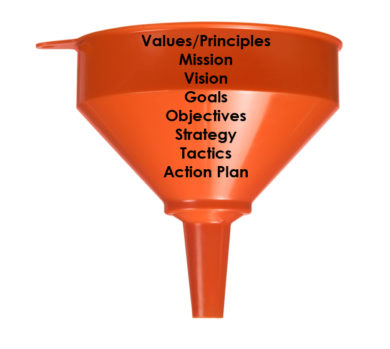
The Funnel: From Mission to Action

There are certain fundamental elements of a management system required to move a business or organization forward and keep it on track. These elements are the thoughts or documents required to align what we do each day with where we want to go as an organization. The essential elements are as follows, where one leads into the next:

Different people have slightly different definitions or uses for these various terms, for example, some regard objectives as the more general and goals as the specific, quantified targets. This article quickly defines each of these elements as I use them when consulting with clients. As they are described you will see that they blend together and move from a very broad view to very specific statements of action, hence the analogy of the funnel.

Values/Principles are the fundamental beliefs that the organization has about certain things, most frequently in regard to how it treats or deals with its various stakeholders. These values may be implicit in the way that the organization is managed or they may be explicitly stated.

Mission is a statement of the purpose of the business or organization. It describes what it is. We can view it as the statement to the world of what the organization does. Think of it as the sign on the front lawn.

Vision is a statement of what the organization wants to be. In my mind this is a private view of the hopes and dreams of the business. This might be the statement that one would use to draw in a potential investor.

Goals are statements of where the business wants to be or what they want to achieve in the future. Goals are qualitative statements that further define the vision. In a planning process we might set out some goals early as general targets that later become more specific objectives.

Objectives are the specific, quantified targets that further define the goals. They have associated dates and are milestones on the future pathway of the organization. Depending on the organization and the environment, the timeframe could be expressed in weeks, months, years, or decades. For most businesses these objectives will be 3 or 5 years in the future and often consist of targets for sales revenue, profits, market share, etc.

Strategy describes where and how the business will compete. It is the path to the goals and objectives. For a business this strategy is set in the context of customer needs, core competencies of the company, and the value offering relative to that of the competitors.

Tactics are programs, initiatives, and projects to implement the strategy, to incrementally change the organization in the direction of the vision, goals, and objectives.

The action plan describes the specific tasks that will be performed in order to carry out the tactics, implement the strategy, and achieve the goals and objectives. These action plans need specific definition of the task, the responsible person, the completion date, and any resources required.

Hopefully it is obvious that the elements of the management system must be in perfect alignment. When they are not aligned, we simply confuse the organization. There are certain actions that are a requirement of maintaining a business such as paying taxes and fixing a leaky roof. Other than these required tasks, all of our actions should be related to the higher levels of our system – the strategy, the objectives, and the vision. In developing this strategic management system the important measurement is not the weight of the documents but rather the clarity, logic, and consistency of communication.

As leaders of an organization, we are tasked with developing and communicating this management system and providing the guidance and resources to accomplish the vision.