Strategy Is Not

A statement of business strategy describes where and how the firm will compete in order to accomplish its objectives, meet customer needs, and obtain a superior financial return. Strategy sets the boundaries around future decisions, describing which business opportunities should be pursued, how to invest resources, which skills to develop, who to hire, etc. The statement of strategy needs to be clear, specific, and concise enough to say yes to the preferred choices that are consistent with the strategy and no to the choices that are distractions from the strategy. The statement of strategy must be useful to all decision makers within the firm to keep everyone and everything operating within the direction defined by the business strategy.

Too often firms are either unable or unwilling to state a clear, specific, and concise strategy. Instead we find what purports to be strategy but simply consists of a bunch of buzzwords, or an agglomeration of goals and objectives, a very general description of mission, or a set of actions. Such a weak statement of strategy does not serve its purpose of guiding the future decisions of the firm or of defining where and how the firm will compete.

“Our differentiating value-added strategy is transformational change to reach a new paradigm of performance.” A collection of buzzwords does not define a strategy because it can be interpreted to be about anything. It does not provide direction for decision-makers.

“Our strategy is to grow top-line revenue 20% per year for the next five years.” Goals and objectives are not the strategy but are a prerequisite for strategy. The goals and objectives define where the firm wants to go but not how to get there. The strategy statement is intended define the path and drive the firm to a course of action to achieve the goals and objectives.

“Our strategy is to provide metal stampings and other metal components and fabrications.” A mission statement is not a business strategy. It simply describes what the firm is but not where and how the firm will compete. It does provide a specific definition of how the firm will develop its competitive advantage, so it cannot guide decisions as the firm evolves.

“Our strategy is to increase our machine shop capacity.” An action plan is not a statement of strategy. The action plan is the implementation of strategy, the specific things that will build the competitive advantage defined in the business strategy.

All of the examples above lack the clarity and specificity required to guide decisions by the organization. On the other hand a statement such as “We provide high quality, large, flat, injection-molded parts to the high-end, low-volume business and medical equipment market” provides a clear direction for decisions. The members of the organization know where and how they compete and what will be the expectations of their customers. The decisions that are made throughout the organization are then consistent with this defined strategy.

What are some examples of both good and bad strategy statements that you have seen?

Does your organization have a clear, specific, and concise strategy?

Understanding Market Attractiveness

Whether reviewing business strategy and current performance, considering entering a new market, or evaluating an acquisition or investment, understanding market attractiveness is an important step. Market attractiveness analysis provides a view of profit potential based on an examination of the underlying market factors. While the operating performance of a business may determine the actual level of profitability, market attractiveness sets the boundaries around profitability potential. The best performing company in a market with low attractiveness can only achieve a mediocre return. A company operating in a market that is highly attractive has the potential for high returns, given a strong strategy and effective implementation.

An understanding of market attractiveness is an essential part of the situation analysis in strategic planning, the step where we examine the business environment and the company’s position as the foundation for the business strategy. In making choices about the future direction of a business, market attractiveness is key. Market attractiveness is also a critical part of valuing an existing business. A common pitfall of investors is solely relying on past financial performance as a predictor of the future without ever looking at the underlying market attractiveness.

A recent consulting project provides a good illustration of the value of understanding market attractiveness. The client was interested in vertically integrating into a market (call it Mkt. A) that they saw growing. They asked our consulting firm to help them understand this market and guide them through planning and implementing the steps necessary for market entry. During our analysis we realized that Mkt. A was not particularly attractive but there was an adjacent market space, Mkt. B, that was much more attractive. Mkt. A was relatively unstructured; it was difficult to clearly define customers and competitors, but there were a lot of competitors. The customers were generally small, poorly-capitalized installers. The customers’ customers were open to a wide variety of substitute products. The buying factors were dominated by price. All of this meant that players in the market were under constant price pressure and margins were likely to be low. The adjacent Mkt. B, on the other hand, was highly structured and stable. The customers were capable and well-financed. There were only two viable competitors. The buying factors were predominantly product specifications and quality. While Mkt. A was larger and growing more rapidly, the profit potential in Mkt. B was greater. It was going to take a little more work for the client in terms of product development and manufacturing process improvement, but they were capable and the return on investment was likely to be much greater. Our analysis convinced the client to re-focus on the more attractive market and laid out a plan for market entry into Mkt. B.

While market size and market growth are often the first things that people think of in assessing market attractiveness, there are other more important considerations. The relative importance of various factors will be different for each company based on its vision, goals, and objectives. If the vision is to become a billion-dollar company, market size may be critical. On the other hand, for a company in the 95% of businesses that are less than $10 million in revenue, there may be many other factors more important than market size as it considers the means to maximizing return on investment.

In general terms, the factors of market attractiveness can be grouped into three overlapping areas: differentiation potential, pricing potential, and growth potential. Within each of these three areas are a variety of factors. The following might be some of the factors that determine market attractiveness.

Differentiation potential – The ability to differentiate, that is, to provide a unique value to customers, is a key factor in driving the potential profitability of a business. Certain elements of market attractiveness contribute to the ability to differentiate, and therefore to the potential return.

  • Customer factors – Who are the customers? Are they identifiable? How definable are their needs or buying factors? How complex are their needs? (Complex might be good or bad.) Are there opportunities to develop unique product or service offerings to meet customer needs? How well are their needs currently being met?
  • Technology factors – What sort of technology is involved in the product or in the production process? How mature is the technology? What opportunities are there for developing unique technology, either in product or process? Are there opportunities to develop unique and defendable intellectual property?

Pricing potential – Pricing potential is partially dependent upon the ability to differentiate but the industry structure and competitive environment determine the intensity of competition and the pressure on pricing.

  • Industry structure factors – How much leverage do buyers have in price negotiations? Are there many choices available to them, either in the number of suppliers or in alternative or substitute products? How much leverage do suppliers have in this industry? Can suppliers squeeze margins of the competitors?
  • Competitive factors – Who are competitors in this market? Are they identifiable? What are their capabilities? How intense is the competition? How easy is it for new entrants to come into the market?

Growth potential – Market size and growth is relevant but the most important part of market and growth is understanding the specific market segments that are to be addressed.

  • Market size – What is the market size? What is the growth rate? How will the market size and growth rate change over time?
  • Market factors – What factors are the drivers of the market? What are the growth opportunities? What are the risks regarding market size and growth? What are the segments or potential segments of the market?

Each particular business has its own market idiosyncrasies that determine market attractiveness. The challenge is to look beyond the simple and easy factors to develop a clear understanding of the structure of the market and the factors that will present either restraints on sales revenue and profitability or opportunities that can be exploited through a well-crafted strategy and action plan.

Do you understand the relative attractiveness of the market in which you operate? Are there opportunities to focus on more attractive market segments?

PEST Analysis

One of the potential tools for the situation analysis in strategic planning is the PEST analysis. No, this is not looking for insects and it is not referring to the competitors that make your life difficult. PEST analysis is shorthand for Political, Economic, Social and Technological analysis. It is often a part of the market and competitive environment analysis in a strategic planning process.

strategic planning outer focus

The big idea in PEST analysis is that a firm and its leaders should consistently have an outer focus that scans the horizon and remains aware of the trends and factors that are or may be impacting the business now or in the future. The strategic planning process provides a reminder to look at the big picture factors that might affect the market or business conditions and incorporate the potential effect and necessary actions related to those macro-factors. While often referred to under the acronym of PEST, this analysis may also extend into other areas that might affect the market or business such as legal, environmental, ethical, etc. although these can often be included under the primary PEST categories.

Too often firms can operate with a set of blinders, becoming too complacent in believing that nothing can change the way that the market has traditionally operated or the way that customers have functioned. Another risk is the result of being unwilling to face reality; we might see the changes but refuse to believe them. The PEST factors are not always threats; they can also present opportunities to take advantage of a changing situation to gain an advantage in the market.

Political factors can include rules and regulations that might change the way that business can operate as well as international issues. These might include things such as:

  • Employment law
  • Environmental regulations
  • Trade regulations
  • Tax policies
  • Governmental leadership
  • Political stability
  • International relations

Economic factors can include the macroeconomic environment that might affect the buying power of potential customers or the firm’s cost of capital. These might include things such as:

  • Inflation rates
  • Interest rates
  • Economic growth
  • Disposable income
  • Unemployment level
  • Foreign exchange rates

Social factors include demographic and cultural aspects that affect the external environment. They affect the way that people think and operate, impacting both buying decisions and employment practices. Social factors can be a broad range of things that might include:

  • Age distribution or demographics
  • Population growth
  • Lifestyle trends
  • Consumer attitudes and opinions
  • Consumer buying patterns
  • Fashion and role models
  • Ethnic/religious factors
  • Ethical issues

Technological factors are all of the changes of technology on a global basis. These can change a market or even obsolete a market. They can change the power or position of competitors and potential customers. Technology can affect any point in the value chain with the potential, for example, of eliminating the need for a customer’s product or services, thus impacting down the chain. Technological factors can include things such as:

  • Research and development
  • Trends in global technological advancements
  • Associated or substitutionary technologies
  • Legislation in technological fields
  • Patents
  • Licensing
  • Consumer preferences
  • Automation and manufacturing technologies

No doubt you can think of examples where the failure to comprehend or appreciate such PEST factors have eliminated or greatly impacted businesses, e.g., Google’s failure in China due to underestimating the political challenges, countless companies that have disappeared due to lower-priced imports, Blockbuster’s failure to see the shift to on-demand films, or the many phone and tech device manufacturers that missed the integrating of technologies in the iPhone. Admittedly, some of these factors can seem a greater risk to large, international companies but no firm can afford to ignore the potential threats or opportunities that might surface in the market environment that affects them.

Do you have an outer focus that is aware of threats and opportunities on the horizon?

A Different Differentiation

Strategic differentiation is achieved by providing a unique or different value offering to customers as compared to competitors. A strategy of differentiation is based on developing a deep understanding of customers’ needs and then meeting those needs in a unique way. The value offering is the whole package of product, service, and relationship benefits. The price to the customer comes into play when the customer evaluates the benefits or value of the offering. A frequent mistake that companies make is not understanding the needs of the customer in sufficient depth. Often product suppliers only look at product differentiation based on the benefits provided by the product. In the same way, service suppliers sometimes look too narrowly at the service provided.

business strategy differentiation Ken Vaughan

A consulting project from some time ago demonstrates the need to dig deep in understanding customer needs. I had done a couple of small projects for this particular client regarding product offering and go to market decisions. It had surprised me how successful they were in their primary business when it appeared to be a completely commodity product. My curiosity was satisfied in the next project. The owner of the company asked that I identify customer needs and help them further refine their business strategy. Through the usual process of in-depth interviews of customers and other industry participants, I discovered why my client was able to garner a large share of the market for a commodity product at a premium price. This competitive position was in the face of growing low-cost international competition and competitors that had various advantages in terms of manufacturing capabilities.

This client’s product was sold through an industrial distribution channel and generally combined with other products in the distributor’s final sale. Through the interview process we identified that the client’s product was a small portion of the sale amounting to a few dollars in a multi-hundreds total sale. The customer’s (the distributor) primary need was that the purchase of these ancillary parts was as painless as possible; it was really a matter of transaction cost. The price of my client’s product was so low insignificant compared to the total package being assembled by the distributor that their concern was simply that one phone call or order completion was all that was required. A second phone call to check on delivery, get an authorization for return goods, correct an error, or anything else would far outweigh any savings from a lower priced competitor.

The client’s customer service function was outstanding because they had a customer service manager who was a bit of a drill sergeant when it came to serving the customer. She understood the customer’s expectations and assured that they were being met. She was a good leader in that she developed a shared vision within the customer service function that the customer should never be disappointed or inconvenienced and she empowered her customer service reps to make the necessary decisions to carry out this vision.

The client’s strategy, the “where and how to compete”, embodied this vision. The “where” was obvious; they sold these particular, well-defined products through an industrial distribution channel. The “how to compete” was all about serving the customer and assuring that they provided the lowest cost of transaction with their impeccable service.

The lesson to be learned here is this: When a customer is buying a widget, the customer need is not for a widget. The customer need, in fact, is for the benefits that the widget will provide and for the benefits that the accompanying service and relationship will afford the customer. When seeking to determine customer needs and to defining a competitive strategy that will provide value to the customer and a profitable return to the organization, the firm needs to dig deep. Henry Ford is quoted as saying, “If I had asked people what they wanted, they would have said faster horses.” Steve Jobs said something to the effect that you can’t ask customers what they want, because they don’t know. Both of these thoughts are the same, in understanding customer needs one must dig deep to find the inner motivation and desire that even the customer might not recognize. Then the organization must develop a solution where the benefits derived from the product, service, and relationship meet those deeper needs.

Do you understand the real needs of your customers? Does your strategy move you towards a competitive advantage in meeting those needs?

Porter’s Five Forces

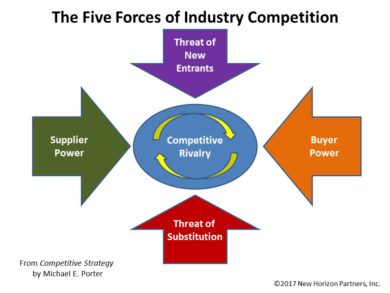
There are five general market or competitive forces that affect every business to some degree. These are often called Porter’s Five Forces because they were popularized in Michael E. Porter’s book, Competitive Strategy, published in 1980. The five forces result from industry structure and have an effect on the performance of a business and the attractiveness of a market. They describe the pressure on the industry participants and the impact on profitability performance of a company. The five forces are as follows:

Five Forces Strategy Consulting

  • Bargaining Power of Buyers
  • Bargaining Power of Suppliers
  • Threat of New Entrants
  • Threat of Substitution
  • Intensity of Rivalry among Existing Competitors

The strength and effect of each of the forces varies depending upon the industry structure. Most businesses will be strongly affected by at least one of these forces. Very few businesses are affected by all five. While the strength of the forces is largely a function of the industry structure, industry participants can often take some action to mitigate the effect of the forces. Understanding the industry structure and resultant competitive forces is an important part of the strategic analysis and planning process. In industries where the combination of these forces are high, the pressure limits the achievable profitability and returns, making the industry and the industry participants less attractive or making the business more challenging for existing participants.


The bargaining power of buyers is mainly dependent upon the size and strength of the buyers. Large and strong buyers that are able to easily switch suppliers or backward integrate have strong leverage in dictating price and terms. This is especially true when the product or service is more of a commodity rather than a differentiated product.

An obvious example of this situation is the automotive industry where the OEM’s have great strength, especially relative to some of the smaller suppliers of common products. They are often able to dictate pricing and drive margins down. When possible, the best defense in situations of high buyer leverage is to create differentiation in some way that provides more power to the seller or drive up switching costs. In some cases the strategic selection of customers can keep a supplier out of the worst scenarios of buyer leverage.

The bargaining power of suppliers is strong when they have unique materials, technology, or other means to control the industry participants that rely upon them. Situations where there are few qualified suppliers or where there is strong differentiation of the supplier or high switching cost and where the industry participant is small relative to the supplier are often instances where the supplier has high leverage.

Intel would be a good example where technology and brand power gives them a strong position relative to computer manufacturers. For many years Gore-Tex controlled the best material for water-proof active wear and could control the market. Another less obvious example is the position of a labor though a union such as the UAW. Examples of how companies position themselves by location decisions or design decisions to move away from high-leverage suppliers are common.

The threat of new entrants is largely a function of not having factors such as economy of scale, product differentiation or the ability to develop proprietary technology, switching costs, or strong brands. In industries that are largely commodities and where it is easy to start up a new participant, the continual flow or even the threat of new entrants drives down pricing and profits. Buyers use this leverage in price negotiations or sourcing decisions.

The restaurant business is an example where local businesses come and go every day. Commodity businesses like sand, stone, etc. and manufacturing businesses like machine shops or plastic injection molding are pressured by the ease of new entrants. One obvious solution is to build differentiation or switching costs by developing or adding technology or unique capabilities.

The threat of substitution is an often overlooked potential pressure because substitution can come from left field. Where threat of entry is new participants coming into an existing industry, the threat of substitution can partially or completely replace an existing industry. This is best demonstrated with some examples, such as high-fructose corn syrup replacing sugar refiners, fractional aircraft ownership replacing aircraft charters, electronic music files replacing the record and CD business, etc. Substitution can also include instances where a downstream product or industry is re-engineered to eliminate the need for certain products or services, with the example of video stores. The defense here is more a matter of being aware of the world outside of one’s particular products and industry. If the railroad industry had thought of themselves as being in the transportation business rather than the railroad business they might have retained their value by adapting rather than being replaced by substitute means of transport.

The intensity of rivalry among existing competitors is the area with which most industry participants are familiar. Competitive rivalry is a result of numerous competitors, slow industry growth, lack of differentiation, excess industry capacity, high strategic stakes, or high exit barriers. Most of the causes of competitive rivalry are out of the control of an individual industry participant. The one defense is differentiation either through technology or through unique capabilities or relationships. Apple is an example of a company that generally stays out of the competitive fray by continually differentiating itself and its products.

Analyzing the industry structure is a necessary step in understanding the value and profit potential of a business. This analysis can identify threats and opportunities. It sets the context for strategy decisions. Profitability and return on investment can be optimized by identifying market or industry opportunities that face lower competitive forces.

What are the pressures facing your industry and business? How can you mitigate the risks and develop opportunities?

The Process of Strategic Planning

Strategic planning is a tool that is useful for guiding day-to-day decisions and also for evaluating progress and changing approaches for moving forward. In a previous article we described the purpose of strategic planning. The process for strategic planning can often be an iterative process but it has these key elements:

  1. Set strategic goals and objectives
  2. Prepare a situation analysis
  3. Define or refine the business strategy statement
  4. Develop the action plan

Strategic planning is iterative in two dimensions. Within the process, for example, we might establish objectives and then discover through the process that the objectives need to be revised or that the strategy cannot be supported with actions. The process is also iterative over time as we should not be constantly developing a new plan but rather adjusting and revising the plan periodically as the reality of the market changes or as we adjust the objectives, strategy, or action plan.

strategic planning process Ken Vaughan

The strategic goals and objectives describe the targets or milestones that the organization plans to achieve over the planning period. In a previous article, we described in more depth the definition of goals and objectives. The plan might describe targets for sales revenue, profits or margins, market share, ROI, etc. It can also set goals and objectives for sources of revenue (e.g., % from new products or specific segments), levels of quality, customer satisfaction or retention. The list of potential goals and objectives is endless but the key is to identify the few that are strategically significant, in other words, which goals and objectives will mean that we have moved the organization toward our vision of a successful future? Better to have a short list of meaningful goals that the organization can rally around than a laundry list.

The situation analysis has two major components – the external analysis and the internal analysis. Obviously, the external analysis looks at the environment in which the company does business and the internal analysis looks at the company itself and its position in the market. There are lots of tools that might be used in the situation analysis such as SWOT analysis, PEST analysis, Porter’s Five Forces, etc. The important thing is not the quantity of charts and tables but rather the quality of the understanding of the business.

The external situation analysis describes the nature of the market and the competitive environment in which the organization competes. What is the market? How large and what are the drivers of the market and its growth? Who are the potential customers and what do they look like? How do they make decisions and what are their needs? What are the relevant segments of the market and how do they differ? How can we best understand the market and the customers? Who are the competitors? How do they compete? What are their strengths and weaknesses? Etc.

The internal situation or position analysis describes the organization’s capabilities and position relative to the market, the customer needs, and the competitors. It might include such things as identification of strategic issues; analyses of the mix of customers, products, or market segments; market share and trends; profitability and trends; customer perception, satisfaction, and retention; efficiency and capacity; culture and image: organizational structure and capabilities; strengths and weaknesses; etc. Again, this isn’t an exercise in developing an overwhelming compilation of charts and tables and analyses. The purpose is to develop a realistic perspective of the company’s position and its ability to provide value relative to competitors and to develop core competencies that lead to competitive advantage in meeting the needs of customers.

Given the objectives, the market situation, and the competitive position, the next element of the strategic planning process is the statement of strategy. In previous articles we described the purpose of the business strategy and provided some descriptors of strategy. The strategy statement describes where and how the organization will compete to provide superior value in meeting customer needs. This is the heart of the strategic planning process. In the strategic planning process the goals and objectives describe what the strategy should achieve. The situation analysis provides the logic behind the strategy decision. The strategy statement provides the direction for decision-making for the organization to move forward towards its objective and its long-term vision.

The final element of the strategic planning process is the action plan. The action plan describes the tactics and specific actions required to implement the strategy. It describes the actions that will take the organization from its present position to the position where it will achieve the goals and objectives. A previous article described tactics and action plans. The action plan needs to be specific enough that it can be monitored and it needs to be a realistic set of actions that will achieve the necessary change in performance to actually carry out the strategy and reach the objectives.

The strategic planning process should not be onerous. It is an opportunity to step back from the day-to-day operation of the business and think about how the organization should change or what actions are necessary to achieve a longer-term vision.

Is your planning process driving your organization forward or driving it crazy?

The Purpose of Strategic Planning

The purpose of strategic planning is to gain control of the future and the destiny of the organization. If your experience of strategic planning is developing a ream of paper full of tables and charts that then gets put in a drawer or on a shelf, never to be seen again, or if your experience is simply producing a long-range forecast of performance and calling it a plan, then you haven’t done a “strategic” plan.

The four purposes of strategic planning are as follows:

  • Define or refine business strategy
  • Establish overall goals and objectives
  • Develop an action plan
  • Communicate direction to the organization

In previous articles we defined business strategy as a statement of where and how to compete based on an understanding of customer needs and the organization’s core competencies. The strategic planning process is a context in which we understand those customer needs and those organizational core competencies. In examining these we are equipped to either define or refine the business strategy so that we might delineate the optimal path for achieving the organization’s objectives. The destiny of the organization is dependent on identifying a path in which the organization can create value for its customers which then creates value for its stakeholders.

The strategic planning process provides a means for setting some long-term goals and objectives. These goals and objectives are set in the context of the long-term vision for the organization and serve as milestones or targets for the development of the organization. Sometimes setting these objectives is an iterative process as the organization considers the possible impact of various strategy alternatives. The next steps in the destiny of the organization is defined in these goals and objectives.

Setting a strategy is a call to action. The strategic planning process is a context for identifying the actions necessary to implement the business strategy and to reach for the objectives. The destiny of the organization requires a proactive set of actions if we wish to influence it.

The final purpose for the strategic plan is to communicate to the organization the future direction of the organization. The strategic plan sets the direction for every decision. Therefore every decision-maker needs to understand and buy into the plan. The destiny of the organization is dependent on marshalling the resources of the organization and investing them wisely towards shaping the future.

Is your planning strategic? Will it positively affect the destiny of your organization?

Tactics and Action Plan

The tactics and action plan describe the activities of the organization to implement the business strategy and achieve the strategic objectives. The action plan is the final piece of a strategic management system that translates mission and vision into goals and objectives which then drive business strategy which then unfolds into action plans.

strategy-tactics-action-2

While the business strategy presents a long-term description of where and how the organization intends to compete, the tactics and action plan are focused on specific outcomes, the short-term time frame, and discrete steps. They describe the activity that will take place to further enhance the organization’s core competencies, build a sustainable competitive advantage, and deliver superior value to customers.

Tactics are programs, initiatives, and projects to implement the strategy, to incrementally change the organization in the direction of the vision, goals, and objectives. As such, tactics are at a higher level and are then composed of a variety of specific actions.

The action plan describes the specific tasks that will be performed in order to carry out the tactics, implement the strategy, and achieve the goals and objectives. These action plans need specific definition of the task, the responsible person, the completion date, and any resources required. These action plans are then constantly monitored to assure that the organization is progressing in the implementation of its strategy.

In a previous article we gave an example goal that might be “Develop a more capable and stable workforce.” One of the supporting objectives might then be “Reduce annual non-retirement turnover to less than 8% of the total workforce by January of 2020.” With this objective, a tactic might be a program to change the culture of the organization. One of the actions might then be to develop and roll out a comprehensive employee communication plan. The action plan will identify the responsible person, the resources required, and the milestone dates.

All organizations are constrained by limited resources – limited number of people, limited available funds, limited time, etc. The other purpose of the action plan is to prioritize the allocation of these resources towards the highest leverage activities. To achieve the organization’s objectives, we need to assure that we are investing our resources on the activities that will build value and generate the highest return.

Does your organization have a clear, effective strategy supported by a good action plan? What do you see as the biggest challenge regarding your action plan?

Goals and Objectives

goals-strategy-ohio-developmentGoals and objectives provide direction, inspiration, and a standard for measurement of performance for an organization. Goals define direction or destination while objectives set specific targets or milestones for performance measurement.

In a previous article we defined a strategic management system that began with mission and vision for an organization built upon core values and principles. The management system then defined a process for driving action plans that would achieve the vision. While vision is a long-term view of what we want the organization to someday become, goals and objectives set targets within the planning horizon along the path towards the organization’s vision. Once we establish goals and objectives, they should become a call to action for the organization.

Goals are qualitative statements that set direction into the future. They become the rallying points for the organization to move forward. Since goals set priorities for the organization, we can only have a limited number of them and they must be congruent with each other.

Objectives set the targets or milestones for moving forward. Objectives are quantitative and must always be SMART which means they are –

  • Specific – the terms or definition is clear and well understood within the organization
  • Measurable – there is an accepted and defined means of quantifying performance
  • Achievable – the organization must have the power and authority to take the necessary steps required to achieve the objective
  • Relevant – the objective must be a critical target that moves the organization towards its goals and vision
  • Time-based – there must be a stated target date for achievement of the objective

There is always the ability to state a definite yes or no as to the achievement of our objectives.

As an example of goals and objectives, let’s imagine an organization where its performance is highly reliant on the skills of its workers. A goal might be “Develop a more capable and stable workforce.” One of the supporting objectives might then be “Reduce annual non-retirement turnover to less than 8% of the total workforce by January of 2020.”

As we step through the management system from mission to action, each step gets more specific towards defining the critical action steps that must be taken to move the organization forward. Without clear goals and objectives, we have no way to judge the value of our actions.

Does your organization have clear goals and objectives? Do they align with your vision and prompt appropriate action?

Mission and Vision

mission-vision-management

Mission describes what you are and vision describes what you want to be. Both of these should be clear and concise statements focused on clearly communicating to the organization’s various stakeholders.

Organizations sometimes have long, convoluted statement that mix values, mission, and vision. Or they write statements that are so general that it’s impossible to determine what they actually are or do. There is little value to a statement such as “Be the worldwide leader in excellence” or “Exceed our customers’ expectations.” Both mission and vision statements need to be specific and unambiguous.

The mission statement describes why the organization exists. It should be written from the perspective of speaking especially to prospective customers and should answer the following questions:

  • What do we do?
  • How do we do it?
  • For whom do we do it?
  • Where do we do it?

Most often a mission statement is a single sentence, certainly not more than 2 or 3 sentences. Think of the mission statement as the elevator speech for the organization – if you had 15-30 seconds to explain what your organization is or does, what would you want to say? Another way to think of mission statement is what you might put on a sign in front of your building to invite prospective customers – not an advertising slogan, by the way, but a descriptive statement.

Where the mission statement describes the current state of the organization, the vision statement describes the desired future state. Where the mission statement speaks primarily to the prospective customer, the vision statement often speaks primarily to the organization’s employees.

The vision statement describes the aspirations of the organization, what it hopes to be in 5 or 10 years. It must be clear and concise but also inspirational as it must engage the employees and draw them into the development of the organization towards the long-term vision. The vision statement serves as a guideline for the organization’s long-term decisions.

Both the mission and the vision statements communicate to the various stakeholders of employees, customers, community, and investors although it is not necessary to publish both of them to all of these audiences. Both must be clear, concise, and unambiguous. Together with the values and principles, the mission and vision set the tone for the goals and objectives and the organization’s strategy. In a previous article we described a management system that translates mission into action plans. The next article in this series will define objectives and goals and their importance in motivating the organization.