“Radical Candor” by Kim Scott


No doubt you heard the advice as you grew up: “if you can’t say anything nice, don’t say any anything at all.” Many people still operate according to that rule even when in a position of leading or directing people. While this advice may work for everyday life, it can be a disaster when adopted by managers. On the other hand, there are some people who, when they have achieved a management position, believe it is their responsibility or privilege to boss people around, demanding that their voice is the only one that matters. This attitude can also be disastrous for a manager. The book “Radical Candor” by Kim Scott proposes a model of leadership based on the idea that the best boss is the one that can “care personally and challenge directly.” When a leader can effectively combine these two skills, they are most effective at influencing, inspiring, developing, and directing their team. Only when we clearly show that we care personally can people accept our effort to challenge directly. And only when we challenge directly are people convinced that we truly do care personally.

My view is that leadership is the ability to influence built upon a relationship of trust and respect. This correlates with the concept of Radical Candor. Trust is built by caring personally. Respect is built by challenging directly.

This combination of caring personally and challenging directly is a balancing process and is modulated by our understanding of the recipient and the way in which they perceive both the caring and the challenging. Challenging, or guidance, is always meant to impact the future of recipient; therefore, it includes both praise and criticism.

When our ability to care personally and to challenge directly is out of balance, the ability to lead can be impacted adversely. Ms. Scott describes the various combinations of caring and challenging as follows:
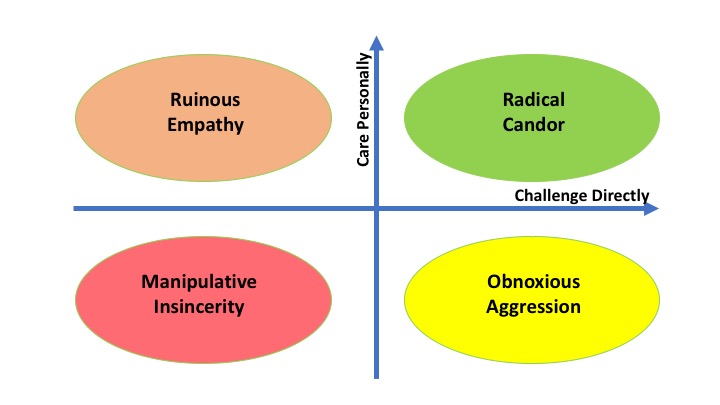
Obnoxious Aggression is when a boss is prone to criticize without showing that they care about the recipient. The boss comes off as a “jerk” and the recipient is made to feel incompetent.

Ruinous Empathy is when a boss cares so much that they are unable to ever challenge; this is the “when you can’t say anything nice” person in action. It is ruinous because the recipient never is given feedback that will lead to growth.

Manipulative Insincerity is the result of a boss that doesn’t care enough to challenge. The worst version of leadership, this is generally the result of a boss that is only focused on him- or herself. It’s praise that is false or condescending and criticism that is neither clear nor kind.

Radical Candor is the healthy mix of caring and challenging that leads to growth and influence.

The first portion of the book defines and explains Radical Candor, building the case for why it is the best model for today’s leadership in the workplace. In fact, Radical Candor is a concept useful in any relationship or communication. In the process of describing Radical Candor, Ms. Scott further defines caring as understanding what motivates each person on the team through a process of exploration and communication. She also describes the open communication and guidance that embodies challenging directly.
The second half of the book is devoted to demonstrating what Radical Candor looks like in action, presenting advice and tools for the day-to-day practice of leading a team in a Radical Candor fashion. This includes advice on building relationships in the workplace, getting and giving guidance, building and motivating a team, and on getting stuff done, as she describes it. In the chapter on results, the book contains a GSD or Getting Stuff Done model, in which Ms. Scott describes the various types of meetings that she believes a team should utilize and the general steps for accomplishing projects. These steps are: Listen, Clarify, Debate, Decide, Persuade, Execute, Learn, and back to Listen. The advice regarding giving guidance gives some helpful advice on hiring, firing, promotions, and performance reviews. In summary, the Radical Candor model should become a philosophy of interacting with people on our team.

While this book spends considerable describing the actions or skills that result from a Radical Candor style of leadership, for many people the concept of Radical Candor is as much an urging to character growth as it is a recipe for competency. Radical Candor requires a development of relationships that may be a challenge to many people. Yet I believe that effective leadership is built upon such relationships.

I highly recommend this book and the character growth that is required to embrace and live in a Radical Candor fashion.

Are you ready to care personally and to challenge directly as you lead people? What growth do you need to undertake in order to do so effectively?
Leaders Are Communicators

Leadership is influence and influence can only be achieved with good communications. Whether we are promoting a shared vision, encouraging team collaboration, developing our people, or any other part of the leadership role, communication is a key element that determines success as a leader.

Leadership is composed of character and competency. Since good communication is so fundamental to leadership it should be no surprise that there is also both a character and a competency component to good communications.

The best leaders have a drive to communicate, the character element. Because these leaders have a respect for people and a desire to build relationships, the desire to communicate is a part of who they are, a part of their character. These leaders have a desire to know and be known by the people with whom they interact. Communication ties in with the character traits of transparency, humility, openness, empathy and other key traits of leaders.

This desire to communicate should not be confused with the personality factors of introversion and extroversion. Extroverts gain energy through interaction with others while introverts use energy to interact. But the desire to know others and to communicate is a separate trait.

The other part of a leader’s communication is the competency or skill developed to do so most effectively. Great leaders are great communicators. They work hard at learning to communicate effectively. Some of the essential elements of communication competency are clarity, candor, consistency, congruency, and connection.

Clarity – leaders must communicate clearly at a level that is easily understood by the audience.

  • Be proactive; people left in the dark wander from the vision and waste energy speculating.
  • Understand the purpose of every communication, define the objective, and tailor the means and content to meet the objective.
  • Make it simple and concise, understandable to the audience, and focused on the objective; communicate specifics not ambiguities.
  • It’s not just the “what” but also the “how” of communicating – appropriate to the purpose, with authority.

Candor – leaders need to be trusted in order to be followed.

  • Speak the truth; honesty and transparency builds trust.
  • Be open and authentic; communicate from the heart.
  • Admit mistakes; people don’t relate to those pretending to be perfect, they relate to those that are human and humble.
  • Be willing to embrace the negative, both to admit it and to hear it.

Consistency – maintain a continual flow of information to stay connected.

  • Develop and implement a communication plan that schedules periodic communication, both written and verbal, to institutionalize communications.
  • Make a point of communicating both with the larger audience and on an individual basis with people throughout the organization.
  • Another part of consistency is making the message continually reflect the culture.

Congruency – communication is more than just the words that you write or speak.

  • In speaking, both to individuals as well as to a group, be sure that your body language reflects the message that you are seeking to deliver.
  • In written and oral communications, check the tone as well as the words you use.

Connection – communication is more than speaking and writing, leaders need to know and relate to their audience.

  • Communication is not just distributing information, it includes listening to understand and perceiving emotions and attitudes.
  • In individual communication, read body language.
  • Speak to the concerns of the listener, know the context.
  • Promote two-way communication, solicit feedback.

Your leadership success is dependent upon your communication character and competency.

What are doing to build your communication capability? What are the stumbling blocks to great communications?

Solutions, Not Problems

Leaders are forward-thinking. As important as completing today’s tasks, leaders focus on building their people and the organization in the process. An element of developing the members of the team is identifying the behaviors that hinder performance and coaching to new levels of capability.

When team members fail or underperform, one of the keys of successful coaching is to focus on solutions, not on the problem. Rather than saying “Why did this happen?” we should say “What did you learn?” or “What can you do different the next time?” Every failure should be viewed as a learning and growth opportunity.

If we focus on the “why” or the problem we are not developing for the future, but are focusing on the past. In fact, neuroscience tells us that we are raising the attention on the problem and likely to further imbed it into the team member’s thought process, therefore possibly increasing the likelihood of repetition in the future. If our discussion focuses on the “what” or the solution, we reinforce that mindset and make it more likely as a future behavior. When the next instance arises, we will have developed a thought process that can achieve a better outcome.

There are instances where a focus on the “why” or the problem makes sense. When we are addressing failure in a process, the “5 Why” methodology can lead to root cause identification. In this way, “why” leads to process improvement. But when dealing with people, the better question is a “what” question. For example,

  • Not “Why did you not close the sale?” but “What would be another way to try to close the next sale?”
  • Not “Why did you produce so much scrap?” but “What can you improve that will increase your quality levels?”
  • Not “Why did you fail?” but “What will you do next time to increase the chance of success?”

When dealing with processes, ask “why?” When dealing with people, ask “what?”

By focusing the discussion on the solution rather than the problem, the leader helps the team member develop the analytical skills to break down the problem, consider alternatives, and make decisions. A discussion of the problem is a negative discussion of the past. The solution discussion is a positive discussion that looks to the future

Are you spending too much of your time and energy on the past or are you moving forward?

Competency and Character

Great leadership is based on a combination of both strong competencies and excellent character. The best skills without the positive character traits leaves people cold. Great skills alone can obtain results for the short term but a stressful or highly emotional situation draws out true character and, if that character is weak, will cause followers to not trust and follow. . Great character traits without the skills can make a leader likeable but people don’t see a benefit for the future. Without strong leadership skills, people don’t see enough substance to develop long-term results.

Leadership competency or skills include such things as the ability to communicate, manage change, create a vision, read and understand people, influence others, and negotiate effectively. It includes the ability to digest information and think strategically. Relevant technical and functional skills are important such as scientific knowledge or a strong financial background. Competencies include decision-making and the ability to organize and manage. Competencies in the area of communication include the ability to write or speak clearly and convincingly, the ability to teach, and the ability to organize and manage meetings.

Competencies are learned skills. We develop them through experience, following an example or model, or some education process. This might be from a book or seminar. In a sense, competencies can be viewed as tools in a toolbox.

While competencies are what a person knows or is capable of doing, character is who we are. Character can be defined as the sum of virtues, values and traits. The character of a strong, effective leader includes such traits and virtues as integrity, honesty, confidence, humility, authenticity, passion, selflessness, ethical, and respect for others. Character is built into our lives through our beliefs and the practice of those beliefs over time.

In an effective leader competency and character flow together. It may be difficult at times to differentiate whether actions are based on competency or character. On the other hand, when a person is attempting to lead without a base of both competency and character, it can be both obvious and ineffective. Some further examples of both one-sided and blended actions are shown below.

  • A person with good communication skills can craft a document that presents the facts clearly. A leader with both communication skills and a respect for others presents the facts clearly and in a manner that values the audience and considers the impact and likely emotions of the reader.
  • A person with meeting management skills can organize and conduct an efficient meeting. A leader with both competency and character can conduct a meeting where the attendees feel a part of the process and that their input is valued.
  • A person with the ability to teach others can present information clearly when asked to do so. A leader with both competency and character looks for teaching opportunities in every interaction.

Evaluating and building our competencies can be straight-forward. What skills do we have and where do I need to build more or deeper skills? Evaluating and building our character requires a deeper look and a greater effort as we often actually need to change who we are as we strengthen our character.

Where do you need to grow and what is your plan for doing so?

Dealing with Conflict

One of the important elements of an organization’s culture is how it deals with conflict. Most often the way that the organization deals with conflict is a reflection or a result of the way that leadership deals with conflict. Conflict is often viewed as negative but it does not need to be. There are three general ways in which organizations deal with conflict: they allow negative conflict, they avoid conflict, or they strive to keep conflict positive. The difference between these three is the way in which conflict is managed and modeled by leadership.

Conflict culture leadership Ken Vaughan

Negative conflict is the type with which we are most familiar, filled with tension and anger. In fact, many of the definitions of conflict describe it in this way: 1) “hostile encounter: fight, battle, or war” or 2) “the pursuit of incompatible goals, such that gains to one side come about at the expense of the other.” Conflict becomes negative as it becomes an emotional, interpersonal battle where one party must win and the other must lose.

Negative conflict is destructive conflict. By its nature it fractures relationships. The results of negative conflict include such things as:

  • tension and stress in the organization
  • atmosphere of negativity
  • damaged group dynamics as people take sides
  • less commitment to organizational goals
  • loss of productivity as energy is spent on conflict rather than productive tasks
  • breakdown in communication
  • reduced exchange of ideas and information
  • diminished trust and support
  • development of lasting animosities
  • lower job satisfaction
  • potential loss of disgruntled employees.

A culture of negative conflict often develops when either the leader is prone to making personal attacks himself or when the leader is afraid of conflict and is unable to step in to resolve or diffuse it. Both of these leadership practices are signs of a character weakness in the leader that needs to be addressed.

Some organizational cultures attempt to prevent negative conflict by avoiding conflict altogether, most often because their leader cannot deal with any conflict. Conflict-avoidant leaders are unable to effectively face conflict, generally because of something within their character that tells them to withdraw and protect themselves rather than leaning in to deal with it positively. The culture of conflict-avoidant organizations says that conflict is unacceptable and cannot be tolerated. Such a stance does not resolve conflict but rather drives it underground where it often festers and grows.

The effect on the conflict-avoidant organization is similar to the effect caused by negative conflicts, except that many of the effects take place below the surface. Therefore there is even less likelihood of resolution. Since conflict is underground in such organizations the effects can include quiet alliances, organizational subterfuge and sabotage, loss of energy and productivity, and loss of employees due to the negative work environment.

Both negative conflict and conflict avoidance are generally interpersonal struggles. Even when they begin with a business issue they often denigrate into a win/lose battle between individuals or groups. This interpersonal nature is the cause of the negative consequences.

There is a third way of dealing with conflict, the positive conflict. Positive conflict’s main feature is that it invites discussion and opposing views in business discussions without becoming personal attacks. The leader builds a culture that is safe and trusting for its people while encouraging a thorough review of business facts and issues. Rather than a destructive personal attack and a win/lose battle, positive conflict values the contribution of everyone in the business discussion with the expectation that various perspectives can drive better decisions. The culture of such an organization says that people and their input are always valued as we seek the best solutions.

With a culture that encourages positive conflict the outcome is more often:

  • stimulate involvement in the discussion
  • enhance creativity and imagination
  • facilitate employee growth
  • increase movement toward goals
  • create energetic climate
  • build more synergy and cohesion within teams
  • foster new ideas, alternatives, and solutions
  • test positions and beliefs
  • improved quality of decisions.

Coworkers who are able to successfully use positive conflict management strategies to solve problems in the workplace tend to become a more cohesive and unified work group. When a group of people works together through the process of resolving a disagreement in a constructive manner, the group is likely to be more committed to the decision that is reached as well as to the group itself. Working through conflict can create fresh insights that result in unique solutions. Often, the solutions that arise from conflict are better and more creative solutions than would have developed if everyone had been in agreement from the beginning. Effective conflict management can result in both enhanced overall productivity in addition to the accomplishment of goals.

How can an organization make conflict positive? In positive conflict the discussion should focus on the problem, not the person and on the future, not the past. When resolving conflicts, focus on finding ways that will allow all people to “win.” Negative conflict results in one side “winning” at the expense of another. Conflict becomes unhealthy when it is avoided or approached on a win/lose basis, where one side is the winner and one is the loser. The responsibility of both leaders and team members is to ensure that this situation doesn’t occur, because it has negative effects for both the winner and loser. Instead, strive to build a culture that is safe and trusting where each person is valued and the team works together for a common goal of finding the best solutions. To do so, build these values and practices:

  1. Commit to the value of every individual
  2. Do not manipulate others
  3. Do not use threats or bluffs to achieve goals
  4. Try to understand personal needs and the needs of others accurately
  5. Openly and honestly communicate with other people
  6. Attempt to pursue a common goal rather than individual goals
  7. Evaluate ideas and suggestions on their own merits regardless of the source
  8. Attempt to find solutions to problems
  9. Strive for group cohesiveness.

As a leader, it is necessary to have the character traits and emotional intelligence that allows perceiving when conflict begins to become personal and leaning in to protect the individual and focus on the issue.

Does your organization use conflict in a positive manner? Are you comfortable leaning in to make conflict positive and productive?

“Boundaries for Leaders” by Henry Cloud

Leaders are “can do” people and, therefore, can sometimes take on responsibilities for many things, including responsibilities that could easily be managed by the people around them. A basic principle for success in leadership and life is maintaining a reasonable ratio of responsibilities to personal resources. When the responsibilities that we take on substantially exceeds our personal resources, we are spread too thin to be effective in all that we wish to accomplish. In the book “Boundaries for Leaders: Results, Relationships, and Being Ridiculously in Charge” by Dr. Henry Cloud outlines seven areas in which leaders need to maintain boundaries in order to maximize our effectiveness as a leader.

Boundaries for Leaders New Horizon Partners

This book is one in a series of books that began with “Boundaries” by Dr. Cloud and Dr. John Townsend, published in 1992. The series includes books regarding boundaries in marriage, parenting, and other areas. The basic premise of boundaries is to clearly define where our responsibilities end and other peoples’ responsibilities begin. We are personally effective when we manage and protect those responsibilities within our boundaries and allow others’ to manage their responsibilities that are outside of our boundaries.

Leaders must accomplish the organization’s goals with and through the people around them. Leaders are responsible for providing things like direction and empowerment, setting the stage for the team’s efforts, but their accomplishments are the sum total of what is achieved by those within their sphere of influence. Therefore, leaders need to focus on the things that are within their vital responsibilities and they need to enable and allow team members to manage their own responsibilities. Boundaries for leaders can be defined as what leaders create and what they allow. The seven areas of boundaries that Dr. Cloud describes as necessary for leaders to be most effective are summarized below:

  1. Boundaries that focus attention on what is crucial and inhibit distractions from everything non-crucial, while keeping the crucial ongoing and current.
    Dr. Cloud refers to the executive functions of the brain, i.e., to focus on the specific thing to be accomplished, to not get off track by losing or shifting focus, and to continuously be aware of relevant information. In the same way, the leader needs to guide the organization.
  2. Boundaries that build a positive emotional climate that leads to high performance brain functioning.
    This boundary is about creating positive relationships while maintaining high expectations. Negative emotions lead to a flee, fight, or freeze response while positive emotions broaden peoples thinking and responses. Yet a leader needs to expect, even demand, a high level of performance. The integrated leader is able to be “hard on the issue, soft on the person.”
  3. Boundaries that keep people connected to each other and inhibit fragmentation, compartmentalization and isolation of people, teams, departments, or business units.
    Organizations function most effectively when its people are working together. People function most effectively when they share connection with those around them. Dr. Cloud lists the ingredients of shared connection as shared purpose, awareness, nonverbal cues, collaboration, coherent narrative, conflict resolution, emotional regulation, emotional reflection, emotional repair, and listening. It is the leader’s responsibility to manage these ingredients in order to enable team effectiveness.
  4. Boundaries that steward the dominant thinking paradigms that rule the organization, keeping the dominant thinking optimistic and proactive as opposed to pessimistic and powerless. No negative or victim thinking patterns allowed to take root.
    Leaders need to continually audit their own thinking and the organization’s thinking to identify and root out any negative thinking. Helplessness thinking has a way of progressing from personal to pervasive to permanent. Instead of allowing this, the leader needs to change the paradigm to positive thinking by reframing or identifying incremental steps of progress.
  5. Boundaries that align people with the behaviors that they can actually control and that specifically lead to results, empowering them to do the activities that actually “move the needle” of measureable results, as opposed to focusing on what they cannot control and/or is not directly related to real results. Aligning them with the true drivers of measureable results.
    Neuroscience has shown that the more experiences people have of being in control, the better their “thinking brain” functions. Leaders who continually help their team focus on what they individually and collectively can control and accomplish are most effective.
  6. Boundaries that structure teams around well-defined purposes with values and behaviors which lead to high performance through defined roles, activities, and mutual accountability, along with the ability to diagnose, correct and fix what is not working quickly.
    A team is not just a group of people but it is a group that has a shared purpose or goal. It has an identity, a culture, and a set of values and behaviors. A key element for team effectiveness is trust within the team. Only after defining or creating these things can it operate as a unit to accomplish its purpose.
  7. Boundaries on themselves that keep them from being a closed system, missing and repeating patterns, not getting honest feedback, falling into problematic thinking patterns, leading out of fear, avoiding necessary organizational change, not quarantining weaknesses, and losing control of their time and energy.
    Leaders can allow the reality of the circumstances or mission to define them. They can become reactive and spend all of their time and energy on the urgent while ignoring the vital. Leaders also need to lead themselves. This requires strong self-awareness and seeking feedback and outside input. With self-awareness, it then requires setting boundaries on fears, weaknesses, patterns, and the use of their personal resources.

I am a big fan of Dr. Henry Cloud because we are generally on the same page in many respects. Every interaction that I have with Henry tends to expand my thinking or encourage greater depth of thought. Nevertheless, I thought that this book was somewhat forced in trying to piggyback on the “Boundaries” franchise that Drs. Cloud and Townsend have created. I like the boundaries concept and there are a lot of good thoughts about leadership in “Boundaries for Leaders” but I would more highly recommend Dr. Cloud’s book “Integrity” as a better representation of his leadership thinking.

“Know-How” by Ram Charan

There is certainly a correlation between certain personal attributes and the ability of a person as a leader in contributing to the business success of their organization. In Know-How: The 8 Skills That Separate People Who Perform from Those Who Don’t, the author, business consultant Ram Charan, draws from his personal experience to make those connections. He moves quickly through the danger of looking only at the surface when evaluating a leader, then mentions briefly the character traits of effective leaders. The heart of the book expands on eight skills that Dr. Charan deems crucial for high-level leaders, especially those in large organizations

leadership skills coaching

The book begins by pointing out the fallacy of selecting leaders based on superficial information, describing these superficial traits and characteristics as the following:

  • The seduction of raw intelligence (similar to a point made in one of my recent articles)
  • A commanding presence and great communication skills
  • The power of a bold vision
  • The notion of a born leader (a reference to charisma on its own)

Instead Dr. Charan urges people to look at what he calls “the whole person” (and in my words the character of the person) when selecting a leader. He especially identifies the following character traits as those he sees most often in effective leaders:

  • Ambition – a desire to achieve something visible and noteworthy, when it is combined with integrity.
  • Drive and tenacity – an inner motor that pushes people to get to the heart of an issue and find solutions, when it is combined with a clear view of reality.
  • Self-confidence – the ability to know and speak your mind and act decisively, combined with humility and social awareness
  • Psychological openness – the willingness to allow yourself to be influenced by others and to share your ideas openly, promoting candor and communication
  • Realism – a healthy balance of optimism and pessimism, which causes one to seek the truth and clarity
  • Appetite for learning – seeking to improve from new information and experiences

All of these traits interact with each other and all can have their dark side when carried to extreme or not adequately balanced by the other traits.

With these traits in a proper combination, Dr. Charan’s experience in consulting with many leading global companies has led to the conclusion that the most effective leaders excel in the following eight skills.

  1. Positioning and Repositioning: finding a central idea for business that meets customer demands and that makes money.
    Positioning encompasses the strategic decisions in understanding customer needs and defining where and how to compete to provide value to those customers. This skill is the ability to see the whole system and to adapt to changes in the business environment.
  2. Pinpointing External Change: detecting patterns in a complex world to put the business on the offensive.
    In a world where change is more rapid and abrupt, this is the skill to use an outer focus to understand the threats and opportunities that lie down the road. The best leaders are the ones who understand the changes and their implications before anyone else and have the foresight and confidence to move based on their intuition.
  3. Leading the Social System: getting the right people together with the right behaviors and the right information to make better, faster decisions and achieve business results.
    Social systems is the term Dr. Charan uses for the way that people in an organization work together to manage the business. To make the social system effective the leader needs to be sure that information flows properly, that conflicts are surfaced and resolved, and that the proper trade-offs are made for the benefit of the long-term health of the organization.
  4. Judging People: calibrating people based on their actions, decisions, and behaviors and matching them to the non-negotiables of the job.
    Leading an organization requires achieving results through the people around the leader, so the focus of the leader needs to be on finding the right people and developing them to maximize the contribution that the people can make to the organization’s success. This requires insight into both the requirements of the various positions and the capability and potential of the people under consideration.
  5. Molding a Team: getting highly competent, high-ego leaders to coordinate seamlessly.
    Leaders seek to surround themselves with very capable people but then must mold the group of people into a strong team. To do so requires building buy-in to a vision that represents the whole organization and supersedes any individual’s interest. The team must utilize the capabilities of all members and operate as a unit, and it is the leader’s responsibility to develop this unity.
  6. Setting Goals: determining the set of goals that balances what the business can become with what it can realistically achieve.
    The leader needs to select goals that will provide leverage for the future. Among the many potential goals, finding the select few is the challenge. And then the goals need to be set at a level that is achievable while still being motivational, providing a challenge to the organization that will make it stronger.
  7. Setting Laser-Sharp Priorities: defining the path and aligning resources, actions, and energy to accomplish the goals.
    There are always more things that could be done than should be done. The leader needs to set priorities based on what is important, what is urgent, what is long-term versus short-term, and what is realistic versus visionary. Then the high priorities need to be provided with resources to be accomplished.
  8. Dealing with Forces beyond the Market: anticipating and responding to societal pressures you don’t control but that can affect your business.
    An effective leader needs to have an outer focus that is aware of both threats and opportunities to the business that come from the world outside of the organization and its markets. In this respect the leader needs to continually develop within the organization the capability of responding to these societal forces.

There is a chapter devoted to each of these eight skills, each with a wealth of examples of leaders who practiced these skills well (and some that did not). Having had the opportunity some years ago to work alongside Dr. Charan, I have a great respect for his intellect and insight. He makes the point that he believes these eight skills are the key differentiators of high-performing leaders.

My view of the book is that it is good but not great. The downsides are that these skills and most of the examples that are provided are based on the large, multi-national companies where Dr. Charan spends most of his time. Smaller business need a different mix of skills. Also, leadership can never be boiled down to eight skills. It requires a much broader set of skills, all built upon strong character, i.e., the competency + character model of leadership.

Leaders Are Communicators

Good leaders are good communicators. In order to build a team with a shared vision that works in a collaborative fashion, leaders must be great communicators. Three elements of communication are essential for leaders – clarity, candor, and connection.

leadership-development-communication

Clarity – leaders must communicate consistently and clearly.

  • Be proactive, people left in the dark wander from the vision and waste energy speculating.
  • Understand the purpose of every communication, define the objective.
  • Make it simple and concise, understandable to the audience and focused on the objective, communicate specifics not ambiguity.
  • It’s not just the “what” but also the “how” of communicating, appropriate to the purpose, with authority.

Candor – leaders need to be trusted to be followed.

  • Speak the truth, transparency builds trust.
  • Be honest and authentic, communicate from the heart.
  • Admit mistakes; people don’t relate to those pretending to be perfect, they relate to those that are human and humble.
  • Be willing to embrace the negative, both to admit it and to hear it.

Connection – communication is more than speaking and writing, leaders need to know and relate to their audience.

  • Communication includes listening to understand and perceiving emotions and attitudes.
  • In individual communication, read body language.
  • Speak to the concerns of the listener, know the context.
  • Promote two-way communication, solicit feedback.

Leadership is defined as influence; influence is based on relationship. This relationship is built on trust and transparency. This trust and transparency can only be achieved with open, clear, and consistent communications. Constituents need to be a part of the team. Without good communications there is likely to be either confusion or suspicion, depleting or deflecting the energy of the organization and interfering with teamwork and collaboration.

How well are you communicating? What is holding you back?

Leaders Are Learners

Effective leaders are committed to constantly learning and growing. This desire to grow is driven by their character. Effective leaders have the following character traits:

  • Confident but not arrogant, they know they have been greatly blessed with talent but recognize room for growth.
  • Humble but not meek, they know that they have areas to improve and room to grow to be more effective.
  • Driven but not obsessive, they want to accomplish more, both for themselves and for those that they serve.

These character traits convince leaders that they can continually increase their effectiveness by continually learning. Much like the areas described in Goleman’s book, “Focus”, of inner, other, and outer focus, effective leaders seek to grow in these inner, other, and outer dimensions. They are especially focused on learning in the following areas:

leaders-learners-development-ken-vaughan

  • Character
  • Competency
  • Constituents
  • Context

Leadership is built on competency and character, with character as a foundational element. Leaders know that they need to continually build their character in order to be more effective. Character growth is more than reading and attending seminars, it requires intentional change and growth of our inner self. To do so usually requires some experiential learning like participation in a cohort leadership development program.

Leaders desire to grow in competency, developing skills to enhance and expand their capabilities. This might include leadership skills such as communications or culture development, but also technical or functional skills. In the earlier part of careers these might be in our functional area but, as we grow in responsibility, would include the expansion of our knowledge in other functional areas. To do so requires extensive reading, study, seminars or conferences, etc.

A third area for learning is constituents. Effective leaders know their people, how to motivate them, how to develop them, and how to help them be more effective. To do so requires that we be students of the people with whom we work.

Leaders also need to grow in context or their outer focus. They need to learn about other areas of technology, markets, business practices, etc. A broad base of knowledge can expand the leader’s perspective, enhance creativity, or identify new ways of thinking or doing business. To do so means we need to be on the lookout broadly for places to learn.

What are you doing to learn and grow? What is your plan for personal development?

Middling Leaders Give Answers, Good Leaders Ask Questions

When someone on our team brings us as leader a question, often the best response is “What do you think?” Some people think that asking questions shows weakness. Some leaders do not have the ability to say “I don’t know.” Or they might think that the leader is expected to always know best. Even when we do know, asking a question might be the better choice.

Some of the advantages of asking questions:

  • Values the thoughts and input of those around us.
  • Builds the individual.
  • Builds the team.
  • Coaching opportunity.
  • Demonstrates humility.
  • Helps others develop their thought process.
  • Gets buy-in.
  • Multiple perspectives give better results.
  • Provides an opportunity to evaluate potential.

When we are quick to give answers we might:

  • Disempower those around us.
  • Elevate ourselves over the team.
  • Build dependency.
  • Lead to possible tunnel vision.
  • Not get the best answer.
  • Miss great opportunities to help others grow.

Now this doesn’t mean we never give answers, or that we should simply accept the answers that our people give us. As leaders we are responsible for the organization making good decisions, so we may need to guide people through a thought process or we may need to overrule the input of others if we are convinced that we have the better solution. But the opportunity to build the organization for the long-term is often just as or even more important than an immediate answer.

What do you see as the benefits of asking questions? Or the risks of providing quick answers? Are you comfortable not being the “guru on the mountaintop”?