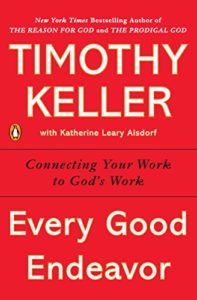
“Every Good Endeavor” by Tim Keller

“In a work world that is increasingly competitive and insecure, people often have nagging questions: Why am I doing this work? Why is it so hard? Is there anything I can do about it?” Thus the flyleaf for “Every Good Endeavor” introduces Tim Keller’s book about faith and work. This book is much more than a “how to” book regarding faith at work. It is a study of the theology of work with practical application.
While a popular view of work may be that it is a necessary evil resulting from man’s rebellion from God’s creative plan, the book quickly dispels that notion. Work is an ordained part of creation in which man is given what is known as the cultural mandate. The cultural mandate is the command to exercise dominion over the earth, subdue it, and develop its latent potential that appears in the first chapter of Genesis. In essence, mankind is given the work instructions to continue the process of creation.

Unfortunately, as a result of man’s rebellion and the fall, work became toil and in Genesis 3 we are promised thorns and thistles. Keller says, “Work exists now in a world sustained by God but disordered by sin. Only if we have some understanding of how sin distorts work can we hope to counteract its effects and salvage some of the satisfaction that God planned for our work.” This distortion shows up as work often being seen as fruitless, pointless, or selfish and as work revealing our idols.

The author provides this insight “We should be willing to be very engaged with the cultural and vocational worlds of non-Christians. Our thick view of sin will remind us that even explicitly Christian work and culture will always have some idolatrous discourse within it. Our thick view of common grace will remind us that even explicitly non-Christian work and culture will always have some witness to God’s truth in it.”

Work is a vehicle of God’s providence. Keller makes the point that a Christian worldview should naturally flow into a Christian workview. This right view should result for the follower of Jesus in a different view of work, a different set of virtues, a different view of humanity, a different source of guidance, and a different audience for our work. 1 Corinthians 10 exhorts us to “do it all for the glory of God.” Keller references the writings of Luther to point out that, no matter what our profession, our work is a ministry and we are called by God to serve in our work. We should be serving our profession, our employer, our customers, our co-workers, and even our suppliers and the broader community as we serve Jesus Christ. The author makes an important point in a discussion of dualism vs. integration. Dualism is a term used to describe a separating wall between the sacred and the secular. We see dualism most clearly in the practice of Christianity on Sunday morning or only within church activities and the rest of the week is lived with a different set of values. Integration of faith and work is the opposite of dualism where a person’s core values show up in and guide every part of their life.

I highly recommend this book for anyone who wants to grow in living their faith in every part of their life.


Developing Leadership: Self-Awareness vs. MBA

Leadership is built upon the combination of character and competency. A highly competent person that is deficient in the character traits of leadership cannot build the relationship of trust and respect to effectively lead. On the other hand, certain skills or competencies are necessary for a person of strong character to effectively develop and communicate the vision and to develop the credibility required to lead.

A recent article in the Harvard Business Review, titled “Self-Awareness Can Help Leaders More Than an MBA Can”, discussed the effectiveness of an MBA for preparing a leader with the effectiveness of self-awareness in molding a leader. This article is another argument for the necessary combination of character and competency. It makes the point that an MBA alone, or a set of competencies alone, does not prepare a person to lead. In fact, it can do the opposite when a person has low self-awareness. Without self-awareness, a person can place too much value in their skills, intelligence, or education, perhaps even becoming arrogant and unapproachable. Self-awareness provides a leader with a realistic view of who they are and how they relate. Self-awareness in itself does not make a leader but it opens the door to growth and development of the character traits necessary for effective relationships and effective leadership. Self-awareness also keeps us from thinking that we are the “cat’s pajamas.”

While the referenced article has a bit of self-promotion for the authors and their consulting practice, it is still a good read. For some further thoughts on self-awareness, see this article from a few months ago.

Are you leaning on your competencies or building your character?

A Work In Progress

At the end of a year or the beginning of the next, organizations develop plans and goals for the coming year. They define or refine their strategy, assess and adjust their priorities, and update their goals. As leaders we should do the same for our personal plans and goals for the coming year.

As human beings we are all a work in progress. We hopefully continue to develop throughout our lives but never reach that finished end state. Just as we do with our organizations, we need to step back periodically and refine, assess, adjust, or update our personal plans and goals.

As we move into a new year it might be the right time to ask ourselves some questions and work on our self-awareness, such as the following:

  • What personal challenges are inhibiting my effectiveness as a person and a leader?
  • Are there issues from my past that need to be brought into the light, examined, and dealt with proactively?
  • Are there strengths that I should be using more effectively?
  • Are there weaknesses that I need to address so that they no longer hold me back?
  • Are there relationships that need my attention and greater effort?
  • What can I do to build into my character more of the traits of leadership?
  • Am I allocating my resources of time, energy, and money in line with my life purpose statement?
  • Is my list of core values still representative of who I am and what I stand for?
  • Are my long-term goals still appropriate?
  • What are my personal, relational, and professional goals for the coming year?

If we are not moving forward, it is likely that we are slipping backwards. Therefore we should all be aware of our growth opportunities and have a personal development plan in place. An effective leader is always working on growing. Your growth plan is much different than a few New Year’s resolutions. Growth plans include specific goals and action plans with a focus on developing a more fruitful life. If you are struggling to develop such a plan or feel that you are stuck, New Horizon Partners, Inc. can provide coaching services to assist in thinking these things through and developing and implementing a growth plan.

Have you developed your growth goals for this year?

Three Tools for Personal Growth

Are you living life or does it feel like life is living you? There are three important tools that help a leader, or anyone for that matter, take control of the direction of their lives. These are a life purpose statement, a list of core values, and a personal goals document. All three of these tools work together and must have consistency and cohesion. They also all evolve over time as we grow.

The life purpose statement is also sometimes called a life mission or a personal mission statement. It states in one or two sentences what you envision as your passion or calling in life. It answers, at least in part, the question of “why am I here?” It describes how your impact will change the world. The objective of your life purpose statement is to set a stake in the ground regarding your priorities about how you will use your resources of time, energy, and money.

The core values list is the result of examining and deciding which values are most important to you. You can easily find sample lists of potential core values. Some of these lists of sample values have more than 500 values and we could agree that most of them are good values. But your core values list should be the 5-10 values that are of highest value to you. They represent your character and are the personal values that are inviolable in your mind. The objective of the core values list is to guide decision making.

The personal goals document formulates and specifies your most important goals. We often have career goals, family goals, individual goals, short-term goals, long-term goals, and life goals. This personal goals document brings these all together. It is not a long to-do list. It should be the most important things, perhaps 5-10 goals in total, that you hope to accomplish in your life, in the next five or ten years, or in the next year. The objective of the personal goals document is to set a plan in motion.

If you have these tools in place, it is good idea to periodically review them to be sure that they continue to represent who you are and what you hope to accomplish with your life and resouces. If you do not have these tools or are struggling to define them, perhaps a coach or mentor would be helpful. New Horizon Partners, Inc. serves people in leadership, executive, and life coaching and we would be glad to discuss how we might serve you.

Do you have a life purpose statement, a list of core values, and a personal goals document? How have they been helpful to you?