Perfectly Imperfect

As a leader (as opposed to a boss or a manager), we often find ourselves being affirmed for our leadership qualities. These qualities, which might be our intelligence, wisdom, common sense, decision-making skills, relational skills, strategic skills, or other qualities, lead to our ability to influence. People choose to follow leaders because they recognize the character traits, skills, and other qualities that make the leader stand out and be more effective.

When we grow accustomed to this repeated affirmation, we run the danger of becoming overly focused on it. This can lead us to believe that we cannot show any failure or weakness for fear of losing the high opinion in which we are held. Even worse, some people begin to believe their own press, believing that they are indeed pretty close to perfect. No human being is perfect, and it is both a fallacy and a weakness to believe either that you are perfect or that you need to be perfect.

Understanding and embracing our imperfections is, in fact, an important character trait that does two important things that strengthen our ability to lead. First, as we recognize our imperfections, we can be motivated to grow, addressing those imperfections and seeking to grow past them. Secondly, understanding and admitting our imperfections to others makes us more relatable. Let’s take a further look at how we can lead better by recognizing and accepting our imperfections.

Benefit of Growth

One of the traits of effective leaders is self-awareness. They know their strengths and capitalize on them. They also know their weaknesses and find ways to compensate for them and to grow past them. We can compensate for our weaknesses by drawing people around us who are able to fill the gap, so to speak, taking assignments where we might be ill-suited or providing counsel or support that shores up our weaknesses.

An effective leader is also continually striving to grow. When we are aware of weaknesses or imperfections, we first prioritize our growth needs or opportunities and then develop and execute a plan for growth to fill in these weak spots in our character or skillset. But before we can grow, it is necessary to admit our need for growth.

Benefit of Authenticity

Where some might think that allowing others to see our imperfections might weaken our leadership, the opposite is true. Authenticity is one of the character traits that draws people into relationship. If we, as leaders, try to maintain an aura of perfection, we run the risk of being unapproachable. Hiding ourselves from being known by our team members builds a relational chasm that separates us. On the other hand, authentically acknowledging that we have imperfections and weaknesses demonstrates our humanity. Humans relate best to other humans, so that this authenticity, in fact, draws others into relationship.

Admitting our imperfections does not mean that we are a failure. Since all humans have some imperfections, admitting them simply means that we are admitting to be human and not superhuman or divine.

Effective leadership is built upon a relationship of trust and respect. This relationship works best when we are able to know and be known, requiring authenticity, in other words, allowing ourselves to be perfectly imperfect.

Are you aware and able to embrace your own imperfections? Are you willing for others to see those imperfections?


Resolution or Resolve?

It is the time of year when some people make New Year’s resolutions. Resolutions are often something like “I want to lose weight” or “I want to spend more time with my kids” or “I want to improve my performance on the job to get that promotion.” The words resolution and resolve both come from the root word. However, the use of resolution has often become more like the idea of a wish. People often make a resolution without a plan or a commitment to actually accomplish it. Resolve still holds the definition shown in the Oxford Dictionary of “decide firmly on a course of action,” a sense of intentionality and purpose.

Rather than simply making a resolution that is a wish, if a person really desires to change some behavior, they need to resolve to accomplish the change. This requires following one of the models of intentional change. Here is one example of an effective intentional change model:

Step 1: Identify the current state. What is the current behavior? How can it best be accurately described? For example, how can current job performance be described? Or, what is my current weight?

Step 2: Identify the desired state. How can the desired behavior be described? What are the measures for the desired state? For example, how would the desired level of job performance be described, perhaps in some level of productivity? Or, what is my desired weight?

Step 3: Identify the gap between the current or actual state and the desired state. In what ways does the desired state differ from the current state? What needs to change from the current state to achieve the desired state? For example, how would the desired level of job performance be different than the current level of job performance? Or, what is the difference between my current weight and my desired weight?

Step 4: Set goals for change. What is a goal or a series of goals that move me from the current state towards the desired state? Using the concept of SMART goals (Specific, Measurable, Achievable, Realistic, and Time-based goals), establish some specific goals that, when achieved, move me closer to the desired state. It is generally easier to achieve a series of bite-sized goals than one large goal, so it often makes sense to set a series of sequential goals. For example, in the case of job performance, what level of productivity should I achieve in the next month? Or, how many pounds can I realistically take off in the next week or month?

Step 5: Identify the actions that will achieve the goals. What are the specific things that I need to do to reach my goals and move me toward the desired state? These actions need to be very specifically defined, including describing the actions, when they will be taken, how often, etc. For example, each morning I will close my door and work without interruption for three hours on this project. Or, I will exercise by walking two miles three days a week before breakfast.

Step 6: Develop an accountability relationship. We are more likely to remain committed and stay on track when we have someone that will encourage us and hold us accountable for actually carrying out the actions and achieving the goals. Without someone to hold us accountable, we often find excuses to postpone or cut short our action plans. A life coach is a good choice as an accountability partner; in fact, a coach can help a person with each step in this process.

Step 7: Track progress. A visual record of action taken and goals achieved helps keep the fire going.

Step 8: Celebrate success. As you achieve goals, take the time to do something concrete to mark progress. This imprints the success in our minds.

Step 9: Make the change a permanent part of your life. If this growth goal is something that you want to be a permanent part of your life, be sure that you follow the action plan long enough to build it into a habit. And then set reminders to check back and be sure that the behavior remains a habit.

Rather than simply wishing for personal growth or a change in behavior, be intentional about identifying what you want to change, achieving the change, and making that change permanent.

Are your resolutions a wish or an actual, intentional plan for change or growth?

Ask, Don’t Tell

One of the best ways for a leader to empower team members or the team is to adopt the practice of “ask, don’t tell.” This concept, sometimes called coaching for performance, moves decisions or solutions from solely the leader to a shared process between leader and team member. “Ask/ don’t tell” is a fundamental skill for coaching but also for leadership. Leaders should often wear their coaching hat when interacting with their team members to develop and to draw out their team members.

It is a human tendency, and especially true for leaders, that we tend to give solutions. We even give solutions when they aren’t requested or desired. Reference any recent discussions with your spouse or children. In the workplace, leaders are quick to give direction and solutions for a number of reasons:

  • It is a developed habit.
  • The hierarchy dictates that the answers come from above.
  • A need or desire to hold the power.
  • It seems the most expedient route to cut to the chase and provide the solution.
  • The leader believes in his/her experience and expertise to provide the “right” answer. (Call it self-awareness or call it arrogance. There is a fine line.)

Breaking the habit and switching to a practice of “ask, don’t tell” probably takes some effort and time.

To implement the “ask, don’t tell” practice means responding to requests for direction or a decision with a question like, “What are some of the options that you are considering?” or “What would you recommend in this situation?” This should lead into some follow-up questions regarding the thoughts behind the choices or the pros and cons of various options, questions like “What are the costs and benefits of these alternatives?” or “What information do you need to gather for making a decision?”

Using the “ask, don’t tell” practice doesn’t mean that the leader abdicates the responsibility for the decision. It simply means that the leader is willing to share the power. If the recommendation that results from discussion and the flow of questions is of equal value to what the leader would have decided, both parties can be satisfied. If the leader is not comfortable with the team member’s recommendation, further questions can be used to dig deeper and resolve the difference in thought. In any case, the leader maintains the responsibility for decisions from his/her team and may need to overrule.

A similar thought relates to meetings. How often do we see the attendees at a meeting posturing their comments as they attempt to determine where the leader will come down? Historically it was often only the opinion of the leader that mattered in a meeting. An effective leader turns this dynamic on its head by only asking questions, drawing out the thoughts of all attendees. Only when the entire team has weighed in and all available information is on the table, will the leader speak. Decision-making becomes a group process. Not necessarily a democracy but a process in which all participate.

The practice of “ask, don’t tell” provides several benefits to the organization and to the team:

  • It empowers team members. Sharing the power that may have been historically held by the leader lets the team members feel a greater contribution and greater control over their work and their lives. They are valued when their input and opinions are drawn out.
  • It builds a relationship of trust and respect. When team members are entrusted with the ability to think deeper and make greater decisions, they feel respected. Leadership is built upon a relationship of trust and respect, but this sort of relationship only works as a two-way street. Therefore, having greater trust and respect for team members comes back around to greater trust and respect for the leader.
  • It develops team members. One of the responsibilities is the development of their people and preparing the next generation of leadership. Drawing out their thoughts through powerful questions develops their thinking process and decision-making skills. As their input is valued, they grow in confidence.
  • It creates better decisions. The “ask, don’t tell” process generates a more robust discussion of an issue, developing different perspectives. In this process, more information is brought to the discussion and decision.
  • It provides an opportunity to evaluate talent and capability. On the other side of the relationship, the “ask, don’t tell” practice provides an opportunity for a leader to see the team members in action as they gather and present logic for decisions. Are these people ready to grow, take risks, and exercise good logic?

The “ask, don’t tell” practice is a powerful way to build the capability of a team and its members. In fact, this practice is effective in building stronger relationships in every part of our lives. It is a better alternative to the practice of constantly providing solutions.

How highly do you value your thoughts relative to those of the people around you? Are you more prone to tell or to ask?

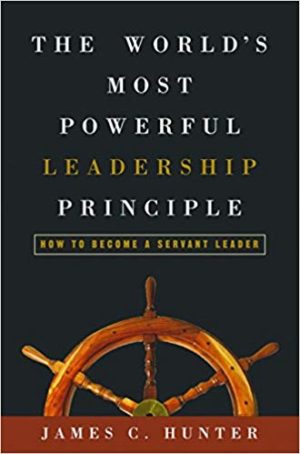
“The World’s Most Powerful Leadership Principle” by James C. Hunter

Jim Hunter’s previous book, “The Servant,” was an allegory that told the story of a business leader whose life was spiraling out of control in every arena. He attends a leadership retreat where the instructor, a former businessman now monk, leads him to realize that true leadership is not built upon power, but on influence or authority, which results from relationships, love, service, and sacrifice.

This second book from Hunter, “The World’s Most Powerful Leadership Principle: How to Become a Servant Leader,” is just that, a how-to book describing Hunter’s thoughts for growing into a servant leader.The goals that Hunter establishes for this book are to: 1) define servant leadership and 2) provide a map for implementation of servant leadership.

The author defines leadership as “the skill of influencing people to enthusiastically work toward goals identified as being for the common good.” The first few chapters discuss the concept of leadership and build out the definition of servant leadership. Leadership is not management and it is not based on power or position. True leadership is influence (the author calls it authority) that is built upon skills and character.

Love is the critical difference that underlies the relationships, service, and sacrifice of servant leadership. This love is not the warm, fuzzy feeling that today’s culture has redefined love to be; rather, it is the other-focused verb that has been the definition of love for eons. The author defines love in leadership as “the act of extending yourself for others by identifying and meeting their legitimate needs and seeking their greatest good.”

The author uses 1 Corinthians 13 to describe the characteristics of love in a servant leadership context. Leadership requires patience, kindness, humility, respect, selflessness, forgiveness, honesty, and commitment. None of these characteristics are soft or wimpy, but are strong and positive.

For most people, the practice of servant leadership requires significant character growth that makes these practices a normal part of daily habits. The author presents a simple model of change or character growth, with three steps. Step 1 is called Friction, where pain or discomfort is felt from the difference between the practices that result from current character and what might result after some character growth. Step 2 is Insight, which involves the development of an understanding of the impact that character growth can produce. Step 3 is the Will = Intention + Actions phase, in which a committed practice of new behavior is used to change character over time.

The author points out that, despite the awesome responsibility of leadership of an organization’s most important asset, many do not see the importance of investing in the development of leadership. Nor do they realize the benefit that results from good servant leadership as it better meets the needs of workers in the organization.

This is a good book that presents servant leadership well. It is always difficult to adequately describe the effort required to make the character change that is often necessary to be effective as a servant leader.

Leadership and the Peter Principle

Most people are familiar with the Peter Principle. This principle was first published in a 1969 book, The Peter Principle, by Laurence Peter and Raymond Hull. The Peter Principle observes that people in a hierarchy tend to rise to their own level of incompetence. That is, people are often promoted based on success in a previous position, until they reach a level at which they are no longer competent. Most often this is because the skills that they used to prove their competency at one level do not translate or stretch to the requirements at the next higher level.

Often the reason for reaching the Peter Principle position of incompetency is that the organization has promoted a person, who was very capable in a technical or functional role, into a management or leadership position. For example, a company might promote their best salesperson to a sales management position, such as regional manager or director of sales. Or, an organization moves their best engineer into an engineering management role. Or, the firm moves a successful accountant into a controller or other supervisory position.

The problem in these types of career moves is that the skills necessary to be successful in a functional or technical role are only a small part of the skillset needed at a higher, managerial level. Organizations often rely on the fact that the person has been successful in a functional role as one of the most important criteria for promotion. The promotion might be viewed as the reward for excellent performance at the previous level. In doing so, organizations often neglect to assess whether the candidate has the necessary capabilities to perform at a supervisory level or they fail to provide the training and development resources to prepare the candidate to be successful.

The cost of making such mistakes can be large. Take the example of promoting the best salesperson into a sales management role. Relationship skills are needed in both positions, but the relational skills needed to deal with customers can be quite different from the relational skills needed to lead a sales team. If the person fails at the higher level, the organization will frequently have lost both the best salesperson and the potential sales leader, meaning that the organization now needs to fill two important roles.

Part of this problem can be that firms have defined career paths in which the only way to move up to higher responsibilities and higher compensation is to move away from functional roles into managerial roles. Not everyone desires or is suited for such a move. Sometimes organizations have developed parallel career tracks, offering the option of moving higher in a functional role or moving into more managerial responsibilities. For example, a firm might have an engineering career track in which the highly-qualified and experienced engineers could have the option of moving into a role such as an engineering sage, in which the person becomes an internal technical consultant or resource for the engineering function.

For those star functional performers that desire moving into a managerial role, the Peter Principle highlights the need for assessment and training. The organization has a responsibility, and is a good steward of their people, when they make every reasonable effort to assure success at the next level. This means clearly understanding the capabilities of promotion candidates and comparing with the criteria for success at the next level. An important part of a leader’s responsibilities is preparing people for future success. The Peter Principle can be averted when organizations are aware and proactive in developing their people.

Does your organizational adequately invest in the future success of its people?

Gremlins

Since I am writing this on the morning of Halloween, I thought it appropriate to think about gremlins. Not the gremlins that are children dressed in costumes or the gremlins that are decorations in the neighbors’ yards. The gremlins that we are going to address here are our inner gremlins, often called saboteurs, judges, or the judging or defeating voice. A more proper name is our critical inner voice or, more simply, either the inner critic or the critical voice.

The critical voice is that subconscious voice that causes self-doubt and undermines self-confidence. It can produce feelings of shame, deficiency, low self-esteem, and depression. At the most inopportune times it whispers things like “you’re not good enough”, “you’re lazy”, “people don’t like you” or other such messages. Actually, when we hear the critical voice it usually speaks in the first person, as if you are telling yourself “I’m not good enough.” Most people have a critical voice that tells them these demeaning and defeating thoughts. Some people barely or infrequently hear their critical voice. For these people, the critical voice causes some stress and uneasiness. For other people, the critical voice is loud and incessant. When the critical voice seriously interferes with a healthy life, professional help may be required.

In his book, The Soul of Shame, author Dr. Curt Thompson labels the critical voice as shame. He attributes it to evil that is seeking to defeat us, attempting to keep us from becoming who we were created to be and accomplishing what we are called to accomplish.

While we may all hear our own critical voice, the origin of the voice is unique for each individual. Most often the critical voice is the result of internalizing a message that we heard repeatedly or in a stressful situation somewhere in our past. Perhaps the most common source is a message that we picked up in our family of origin from either parents or siblings. It might also have originated with a former boss or a person with whom we were in relationship.

The critical voice frequently shows up in stressful situations or perhaps it is the cause of the stress. For example, you are ready to walk into a meeting to give an important presentation and the critical voice says “I am never good enough. The board won’t accept my proposal.” Or you are on your way to a social gathering and the critical voice says “I am so shy. I am always embarrassed in these sorts of gatherings.” The result is an extra dose of stress in our life or perhaps even worse. Maybe it keeps us from pursuing that job opportunity or building relationships.

If your critical voice is causing stress or limiting your effectiveness, how do you overcome it? There are lots of suggested means of overcoming the effect of a critical voice. Most of them involve either quieting or embracing the inner voice. Here are some steps that are frequently helpful in quieting the critical voice:

  1. Recognize that the critical voice is a universal issue. You are not the only person that struggles against it.
  2. Understand what the voice is saying and its origin. When do you hear it and what is the message that it delivers? Where did that message first come into your life?
  3. Understand the truth or the lie that is in the critical voice. There may be a kernel of truth but, by definition, the critical voice is telling you a lie about yourself. Dig into the message and identify the lie.
  4. Understand the real truth about yourself that counters the message of the critical voice. This is an exercise in self-awareness. Once you understand the critical voice’s message, you can explore the reality of how you have been gifted, the education and experience you possess, the many instances in which you have proven the critical voice wrong, etc. Gather the evidence and know the message of truth about yourself.
  5. Understand when you typically hear the critical voice and watch for it. By its nature, the critical voice is a barely recognizable whisper that shows up in specific settings. By becoming aware of those times when it shows up, you can be prepared to identify and conquer it.
  6. Watch for the critical voice and be ready to correct or over-ride it with the truth. By identifying the critical voice as a lie and presenting the truth to yourself, over time you can quiet it and reduce the impact that it has in your life.

We all have a gremlin or critical voice that can keep us from achieving our full potential. If we recognize the voice and quiet it, the critical voice loses its power over us.

What does your gremlin or critical voice tell you? How loud is it and what are you doing to quiet it?

Keep the Change!

The best leaders continually seek to grow in order to become even more effective. They seek new skills and they seek to build their character so that tomorrow’s version is better than today’s.

As a part of growth comes change. In delving into our self-awareness, we often find traits that do not serve us well and need to be improved or replaced. These traits might be anything in our character or personality or in the way that we function. Some common examples might be a fear of conflict, a tendency towards self-criticism, some weakness in listening skills, an inability to accept feedback, lack of respect for others, being too quick to offer solutions, or many other things. (If we are not finding opportunities for growth and improvement, then we are not being truthful in our self-assessment.)

Some people relish change. Some people fear and run from change. Most of us are in the middle. We know that change is necessary and helpful in the long-run but challenging or unsettling in the short-term.

Change requires sustained effort. It is said that it typically takes six weeks to build a new habit and six months to make that new habit a lifetime change. During those first six weeks, change requires a constant awareness and intentional effort. During that period between the six weeks and the six months, we need to be on guard that we don’t revert back to the old habit in a moment of stress or weakness.

In the book, The Servant Leader, authors Ken Blanchard and Phil Hodges offer seven reactions that people often have to change:

  1. People will feel awkward, ill at ease, and self-conscious when confronted by change.
  2. People will feel alone, even if everyone around them is going through the same change.
  3. People will think first about what they will need to give up.
  4. People will think that they can only handle so much change at once.
  5. People will be concerned that they don’t have enough resources in terms of time, money, skills, energy, etc. to implement the change.
  6. People will be at different levels of readiness for any particular change.
  7. If pressure is taken off, people will revert to old behaviors.

When first identifying the need for change, we might feel a negative energy. We become aware of the trait or practice that is having a negative effect and we feel regret or a desire not to be held back or suffer the consequence of this weakness. But mostly we just want the effect to go away or to be negated. Once we come to terms with the cause and effect, we might accept that change is necessary. If so, we identify the old pattern and define a new desired behavior. Then we define a plan for change. This plan must include a way to recognize and short-circuit the old behavior and to consciously replace it with the new, desired behavior.

Change is best accomplished as a team effort. The actual change process requires resources, often the greatest of which is energy. Recruiting an accountability partner or pursuing change in a group setting, such as a peer advisory group, adds energy from others around us and holds us accountable to continue the effort necessary for change. Without such a support team, it is often too easy to give up when we are partially up the slope towards the new behavior.

Change is often uncomfortable and requires considerable effort. But if we desire to be the best that we can be, we will constantly be in a state of change as we grow.

Where do you need to grow? How can you make change effective and lasting?

Power of a Peer Group

The best leaders make a point of continually growing and working to maximize their effectiveness. They work on growing both in character and competency. Effective leaders are high in self-awareness, understanding their strengths and weaknesses. They establish personal goals for growth and work towards achieving those goals.

One effective tool for growth is participation in a peer group with other leaders. A strong peer group can help a leader recognize areas for growth and achieve his or her goals. A peer group can be effective in overcoming some of the hurdles that a leader might face in going it alone in the growth struggle.

Some of the advantages of participating in a good peer group include the following:

Escape the isolation trap of leadership. “It’s lonely at the top” is more than a cliche. Leaders can easily become isolated because they have no trusted peers within their organization with whom they can dig deep or share feelings and there are many business and leadership issues that they cannot profitably share at home. A group of peers can understand, accept, and respond appropriately to the struggles that a leader might face.

Gain different perspectives. We each see issues and challenges from a viewpoint that is based on our history of experiences and knowledge. Though a group may be composed of peers, each one will have a different perspective based on their own experiences and competencies. There is great value in hearing and considering a range of perspectives and alternative paths as we consider a decision.

Absorb emotional nutrients. Leaders are generally wired in such a way that they pour into other people’s lives. But they often are so busy doing so that they don’t have the time or else that don’t have the people that can pour into their lives. We are talking here about the emotional needs that all humans have to receive such things as acceptance, affirmation, containment, empathy, etc. The natural result of pouring out emotional support and lacking any inflow, is that our tanks run dry and we feel like we have little or nothing left to give. A group of peers can keep your tank full.

Learn from others’ competencies. With a group that has a mix of skills and backgrounds, there is much that can be gained in terms of both experience and depth of knowledge from other members of a peer group. The best groups will include people that have a range of backgrounds in their path to leadership. Exploring issues with a group that might include people who were once CFOs, sales and marketing executives, and technical experts can provide valuable advice.

Increase self-awareness. While advantages of a peer group include the combined wisdom and diverse skills and knowledge of the group, one of the greatest values of a peer group is its ability to help each individual dig deeper into themselves. This is accomplished through asking thought-provoking questions rather than providing answers and advice.

Benefit from accountability relationships. The best groups develop trusting relationships where the members can present a balance of grace and truth to each other. Committing to goals within a group that will hold us accountable makes the likelihood of achieving those goals vastly greater than our own private efforts.

Create a laboratory in which to practice. An upcoming difficult conversation can create a great deal of anxiety. We might question the right way to approach the discussion or whether we can be effective in presenting the information. In those circumstances, the chance to think through what that conversation might look like and to even practice it can reduce the anxiety and prepare for a positive and successful dialog.

Enjoy confidentiality. Leaders often deal with sensitive issues regarding the people around them. Outside input or perspective can be helpful, but leaders often have no place that they can discuss private information. A peer group that consists of trusted advisors who are able to maintain strict confidentiality is a valuable sounding board.

Receive guidance from a personal board of advisors. Organizations value a board of advisors that can become familiar with the organization and then provide suggestions and advice about future direction and decisions. In a similar way, a peer group can serve as an advisory board at the personal level for each of the group’s members. They can develop a deep knowledge of each other and provide input into the growth needs and plans of their compatriots.

The most effective peer group is a small group of committed members, perhaps 7-12, who recognize the value that each member receives and contributes to the group. The group should have a balance between homogeneity and diversity, able to relate to each other as true peers but with a range of experience, expertise, and personalities. As a business peer group, they need to not include any competitors or any other source of conflict of interest. They must all be trustworthy and able to hold confidential all of what the group shares. The most important ingredient is the desire and willingness to have a positive impact on each others’ lives.

Do you have a group of peers that are helping you maximize your growth and effectiveness? Are you interested in participating in such a group?

The Process of Growth

Growth is the ongoing, intentional process of becoming who you were created to be. This applies to growing as a person, as a leader, in relationships, in professional growth, or in other areas of life. Intentional growth is a process of asking questions, finding answers, and taking action. Where and who are you? What do you hope to become? What is the gap that needs to be filled between who you currently are and who you hope to be? What steps of learning and development begin to fill that gap? What action do you need to take? How will you be held accountable? How will you assess your progress? How will you identify the next step or area for growth?

Growth is an ongoing process because we never reach an end state on this earth. We can make continual progress (or more likely, sporadic progress) but we never reach completion or perfection. There are always opportunities to grow further or in new ways to become more of who we were created to be.

What are the areas of growth on which you need to be working? What is your process for growing?

“Emotional Agility” by Dr. Susan David

Agility can be defined as the ability to move quickly and easily or the ability to think and understand quickly. To be agile can be defined as having a quick, resourceful, and adaptable character. When we put the word agility with the concept of emotions we can see that this must be referring to the ability to effectively understand and respond to emotions.

The problem with emotions is that some people have difficulty in recognizing them, controlling them, or responding to them. For some, emotions can be puzzling, scary, or even crippling. Many emotions have a label as being negative and, therefore, might be thought of negatively. People generally do not like to deal with the negative.

People tend to respond to emotions, especially those negative emotions, in one of three ways. Some people push them away, pretending that they don’t exist or walling themselves off from them. Some people let themselves be captured by emotions, stirring them around and ruminating over them. And others recognize emotions for what they are, signals, and deal with them effectively

In her book, “Emotional Agility”, psychologist Dr. Susan David describes some ways to deal with emotions with what she terms as agility. She labels the first two types of people described above as “bottlers” – they try to put their emotions in a bottle on a shelf – and “brooders” – they keep their emotions active by focusing on them without dealing with them. She describes these people as emotionally rigid while Dr. David’s goal with this book is to equip people to deal comfortably with emotions, to help them become more agile.

The big idea in “Emotional Agility” is that people who are effective or whole do not get “hooked” by emotions. To become more emotionally agile, Dr. David describes five behaviors. No doubt there are other behaviors or thought patterns that can affect our ability to deal effectively with emotions, but her opinion is that these are the most important behaviors leading to emotional agility.

  1. Showing up. The first logical step toward emotional agility is to face your thoughts, emotions, and behaviors willingly. Some emotions are valid and appropriate, in fact, they may be there to protect or alert us. Others are old bits that are stuck in our minds and triggered by some unrelated or, more precisely, some unconsciously related, event. In either case, the first step in dealing effectively with an emotion is to recognize it and choose to understand it.
  2. Stepping out. “This next element, after facing your thoughts and emotions, is detaching from and observing them for what they are – just thoughts, just emotions.” The author refers to Victor Frankl’s position that, in order to evaluate emotions, we must first create some space so that we can view them with a non-judgmental perspective and properly evaluate them.
  3. Walking your why. Continuing with the idea of perspective, once you have recognized, accepted, and then stepped back and examined your thoughts and emotions, the next step is to compare your thoughts and emotions with your long-term values and aspirations. This assumes that you have done the work to first understand your core values. Dr. David spends quite a bit of time talking about core values and how they should guide decisions. This, of course, is a part of personal wholeness.
  4. Moving on – the tiny tweak principle. The first portion of this chapter is built on the idea that life changes are best done in incremental steps. The author talks of tweaking your mindset, tweaking your motivations, and tweaking your habits. As mentioned above, emotions have a way of triggering behaviors based on some long-buried history. In order to keep from being emotionally hijacked, we need to identify those triggers and then change the course of what happens when certain emotions arise.
  5. Moving on – the teeter-totter principle. The teeter-totter principle says that wholeness comes in part through maintaining a balance between comfort and challenge. If we spend all of our time in total comfort, we become complacent. If we spend all of our time too far on the challenge side, we become stressed, frazzled, and distracted. The author recommends that be “whelmed”, that is, not overwhelmed but with enough challenge to keep us growing and sharp.

This book was good, not great. The book is very readable and has many good thoughts. It is built on solid research. Much of it seemed to be good practices on the path to wholeness that comes from knowing yourself or what Dr. Henry Cloud describes as “Integrity.” If you are on the path to wholeness, this implies that you have emotional agility, which can be described as the ability to properly understand and collaborate with emotion in a healthy manner.