Developing a Coaching Culture

Built upon humility and valuing others, it is a subset of servant leadership.

Too often, leaders think that they are responsible for making most, if not every, decision in their organizations. Perhaps their ability to make good decisions has played a large part in advancing to a position of leadership, so they continue on that track. Perhaps they enjoy the power or control that they feel in making every decision. Or maybe they just don’t trust the people around them to make good decisions.

Often, making decisions at the top seems the most expedient thing to do. Whatever the reason, “the buck stops here (and only here)” is the way that many leaders operate.

When describing a leader’s role in his 1974 book Management, Peter Drucker listed five specific leadership roles, as follows:

  1. Setting objectives
  2. Organizing the group
  3. Motivating and communicating
  4. Measuring performance
  5. Developing people

Our task here is not to examine each of these roles, but rather to notice that making every decision is not among the five.

One responsibility that is part of the five, however, is developing people. The way leaders develop people shapes the quality of the decisions their people make. In the book Built to Last, Jim Collins describes successful companies as having talent “stacked like cordwood.” One of the best ways of developing people and building that talent pool is by incorporating coaching into leadership—in other words, build a coaching culture within the organization.

Culture within an organization can be thought of as the ways we work together and treat people both within and beyond the organization. According to Richard Daft in The Leadership Experience, culture can be defined as the set of key values, assumptions, understandings and norms that are shared by members of an organization and taught to new members as correct. Culture is not a statement but a practice throughout the organization. And culture flows downhill. Especially in small- to mid-size enterprises, the behavior of the leader(s) of the organization becomes the culture of the organization.

A coaching culture, then, is a set of behaviors in which the skills and practices of coaching become a primary means of interacting. These skills and practices include: demonstrating value placed on those people with whom we interact, practicing humility, listening to understand and asking powerful questions.

These powerful questions are not leading or judgmental, nor simply advice wrapped with a question mark. They are questions seeking to know real thoughts from the real person. This coaching culture, built upon humility and valuing others, could be considered a subset or a specific form of servant leadership.

Characteristics of a Coaching Culture

Beyond the four distinctives—valuing others, practicing humility, listening well, and asking great questions–here are some telltale signs of a coaching culture:

  • Multilevel and same-level coaching.
  • Team-oriented posture, a sense of mutual ownership; it is an “all for one, one for all” mindset.
  • Open, frequent, constructive communication from all stakeholders, both up and down the organizational structure as well as peer-to-peer.
  • Consistent, high-quality feedback, at all levels.
  • A common coaching practice and language.
  • Input sought and freely provided without regard to hierarchy.
  • Leaders that are positive role models.
  • Clear alignment and integration of human resources.
  • A pervasive attitude of servant leadership or serving one another.

A coaching culture is not nirvana nor an environment where everyone always gets along, and no one is ever unhappy. But it can grow to be an organization where all people are valued and where team members at all levels have space to grow, receive honest and helpful feedback, and pursue professional goals. And the end result is that the team members’ and the organization’s goals become more closely aligned.

There are many benefits of building a coaching culture for the organization and the people in the organization, including:

  • Empowered and engaged team members.
  • Team members feel supported and are willing to take calculated risks.
  • Increased productivity.
  • Change moves faster and with less resistance.
  • Increased buy-in or motivation as team members make or participate in decisions that they then implement.
  • High employee satisfaction and commitment.
  • Low employee turnover.
  • Being an organization that people want to join.

For many organizations, moving from status quo to a coaching culture can be daunting and difficult. And making a half-hearted or poorly executed attempt can cause serious damage to existing relationships, as the gesture can appear manipulative or improperly motivated. So, moving to a coaching culture is not for the faint of heart or those unwilling to experience substantial personal growth and change.

The best way to begin developing a coaching culture is to cultivate strong coaching skills within a small cadre of motivated leaders, remembering that culture flows downhill.

Coaching within an organization generally takes place in three modes: spontaneous, invited or structured coaching. This well-trained cadre of coaching leaders might then begin by using short, spontaneous coaching whenever they see an opportunity. This spontaneous coaching is much like the idea of providing feedback on the spot. In this case, the practice is to explore decisions and actions as we see them, in order to build and sharpen the decision process.

Eventually, people within the organization will begin to recognize this behavior as the new norm. The coaching cadre can then begin converting requests for direction or advice into invited coaching discussions. Over time, people will value the developmental advantage and begin asking for structured coaching. They will also begin following the role models they have witnessed. As this develops, it will become time to introduce a coaching vocabulary and teach coaching skills more broadly in the organization. Eventually, if done well, this new mode of behavior will work its way into most (likely not all) people in the organization, and you will begin to see the results in the way that people interact and work together.

Do you consider coaching a major part of leadership? What steps are you taking to increase the ability and capacity for coaching throughout your organization?


(This article was previously published in IndustryWeek.)
A Coaching Culture: What It Takes, Why It’s Important

Today’s workers often base their job satisfaction on three major factors:

  • Purpose – they want to know how they contribute to society.
  • Partnership – they want connections with the people around them and with the organization.
  • Plan for development – they want to know that their leaders care enough to help them grow and prepare for the future.

We can achieve these things and many other advantages by developing a coaching culture in our organizations. This recent article, published in IndustryWeek, describes what a coaching culture looks like, how it can be developed, and how it benefits the organizations.

Strategic Focus

Strategic planning has many purposes. It provides the opportunity and impetus to examine your market environment, your customers, and your competitors and to think about the past and the future in each of these areas. Strategic planning provides the opportunity to examine and refine your organization’s mission, vision, goals, and objectives. The strategic planning process provides an opportunity to refine your strategy – to define again where and how you will compete to best meet the organization’s goals and objectives. Strategic planning asks the organization to plan the specific tactics and actions that will implement the strategy and lead to achieving those goals and objectives.

But perhaps the most important purpose of a strategic plan is to focus the organization and all of its resources on the most important activities and investments that will lead to achieving the plan. The plan is both a communication tool and a sieve to keep the organization’s actions and investments pure. Peter Drucker once said, “Culture eats strategy for breakfast.” I often say that a mediocre strategy well executed is likely to create more value than the best strategy poorly implemented. Both of these statements are based on the fact that any strategic plan is only as good as the organization’s ability to rally around the plan and to work as a tight-knit, collaborative unit in pursuing the implementation without distraction. This is what we refer to as strategic focus.

Strategic focus means that the organization is diligent in examining every action and every investment to assure that they move us down the road to become what the plan defines. No one in the organization has a sacred cow, or a pet project, or an interesting opportunity that diverts any attention or resource from the strategic plan.

To achieve strategic focus, the plan needs to be clearly laid out and defined so that all parties understand and so that there are no open ends. To achieve focus, the plan needs to be communicated frequently and clearly so that all understand and buy in. There is another saying, “When you are tired of saying it, people are beginning to understand it.” The plan needs to be visible and present in every discussion that might lead to activity or allocation of resources that could possibly be relevant to the plan. Each person must see their role in achieving the plan.

There are many reasons why organizations fail to achieve focus, and therefore fail to implement or achieve their plan. Most of the time it is because they don’t see the importance of day-to-day reminding of what they hope to achieve. Too often the planning process is a sterile, one-time process of development. Sometimes it is introduced to the organization in a single meeting, where it is presented in summary without making each person’s role and the importance of achieving the plan clear. Often the plan is put on the shelf or stuffed in a drawer, never to be seen again until the next year, when we wonder why it never happened.

If you want to develop a strategic plan, it ought to be one that actually defines a plan of action and that plan of action needs to be part of the organization’s daily activities. It requires strategic focus.

Does your organization seek to implement a strategic plan that really affects the way that you compete? Do you develop strategic focus that drives your implementation?

What Is Organizational Culture?

We have all most likely heard of organizational culture. Often called company culture or corporate culture, depending on the type of organization to which we refer, culture can be considered as the environment within the organization. Organizational or corporate culture is the pervasive values, beliefs and attitudes that characterize a company and guide its practices, especially those around how we treat people, whether they are people within the organization or those with whom the organization interacts.

Businessdictionary.com offers an extensive definition of organizational culture, as follows:
“The values and behaviors that contribute to the unique social and psychological environment of an organization. Organizational culture includes an organization’s expectations, experiences, philosophy, and values that hold it together, and is expressed in its self-image, inner workings, interactions with the outside world, and future expectations. It is based on shared attitudes, beliefs, customs, and written and unwritten rules that have been developed over time and are considered valid. Also called corporate culture, it’s shown in
(1) the ways the organization conducts its business, treats its employees, customers, and the wider community,
(2) the extent to which freedom is allowed in decision making, developing new ideas, and personal expression,
(3) how power and information flow through its hierarchy, and
(4) how committed employees are towards collective objectives.”

Every organization has a culture, whether it be intentionally determined, or happenstance based on the practices and behaviors of leadership and the people within the organization. For large, multi-location organizations, the culture of each location can be a blend of an overall corporate culture and the culture of the individual office or site.

An organization’s culture is often described by the same sort of words used to describe the personality or character of people. In fact, culture generally correlates with the character and personality of the leadership. We might hear culture described as some combination of words such as the following: fast-paced, results-oriented, uncaring, quality-focused, highly political, customer-focused, committed to truth, innovative, shifty, committed to the bottom line, seeking the best for people, etc.

Culture is an important determinant of business success. Culture determines the organizational environment and, therefore, affects the organization’s productivity and performance, and provides guidelines on customer care and service, product quality and safety, attendance and punctuality, and concern for the environment.

How intentional are you regarding your organization’s culture? Is it contributing to success or inhibiting your organization’s success?

Fear of Conflict

As a leader, it is often necessary to lean into conflict. This conflict might be based on some disagreement that someone has with us or it might be a conflict between two team members.

There is great value in having divergent views and seeking truth and full information. In this effort a team might have heated discussions and disagreements. When this discussion is focused on tasks and information, it is helpful and valuable to the organization. However, when the discussion becomes personal and filled with animosity, it becomes negative conflict. This negative conflict becomes a problem for the organization because it produces the following results:

  • Strained relationships and personal animosity
  • Tense atmosphere in the team
  • Waste of energy
  • Break down of communication
  • Reduction in the exchange of ideas and information
  • Diminished trust and support
  • Eroded commitment to the team and organization
  • Decreased productivity and increased turnover

Because of the detrimental effects, an effective leader needs to prevent, resolve, diffuse, or guide the conflict into a positive outcome. This requires that a leader have both the desire and the ability to lean into the conflict.

Unfortunately, many people are unable to lean in because they have a fear of conflict. This fear of conflict can show up in a variety of forms. One reaction to conflict is to up the ante, to overpower the conflict. Another type of reaction is to submit, to attempt to placate or play nice. The most common reaction is withdrawal, to hide from or ignore conflict.

Years ago, I had a first-hand view of weak leadership in the face of conflict. The company’s executive staff was rife with conflict that frequently broke out in staff meetings. The reaction of the company president in the face of conflict was to push away from the table, fold his arms across his chest, and smirk as the conflict rolled on. Reading the body language gave some ideas of the president’s views of conflict.

This fear of conflict often rises out of past experiences. Most often the roots go back to family of origin issues in which conflict was a tool of control that became something to be feared. In many families we seldom saw healthy relationships and did not learn the skills of emotional intelligence. Conflict was allowed to become personal at great cost to those involved. Therefore we may have learned to run from conflict.

The ability to lean into conflict requires authentic emotional intelligence in all four dimensions. A person must be fully aware of their own emotions as they step into conflict, able to manage well their own emotions, aware of the emotions of others, and skilled at managing relationships. With a base of strong emotional intelligence, a leader can lean into conflict using something like the following steps:

  • Recognize the debilitating nature of personal conflict on the organization.
  • Adopt a mindset that the cost of leaning into conflict is less than the cost of letting it continue, i.e., become willing to risk moving in.
  • Confront conflict in an emotionally-healthy manner. Provide feedback that points out the negative impact and the consequences that future conflict will produce.
  • Lead discussions of resolution and relationship building.
  • Model healthy discussion of information and debate of facts without allowing personal conflict, demonstrating respect for all persons.

To get to the position where one is able to implement this plan may first require some introspection and self-awareness to understand his/her mindset regarding conflict and the roots of that mindset. The next necessary level of self-awareness is an understanding of strengths and weaknesses in emotional intelligence. From there, a development plan may be necessary to build the skills and ability to lean into conflict. The most important step is to begin to practice leaning into conflict and then continue building comfort and competency at doing so.

Are you a carrier or a resolver of personal conflict? Are you able to lean into conflict and help others build healthy relationships?

The Secret to the Best Creative Workplaces

“You should feel like yourself at work, not a worker.” So says Becky Bermont of the design firm, IDEO, in a recent article posted on Quartz Ideas. Developing and sustaining a culture of creativity, important to a design firm, but increasingly important to every company, requires vulnerability. A culture of safety and collaboration requires that the team members know and accept each other and that they value both the contributions and the uniqueness of each individual. In the introductory paragraph the author says, “…the first step in creating innovative outcomes is building trust by allowing for vulnerability, especially as a leader, beginning by allowing individual team members’ passions to show through, even if they don’t seem initially ‘work-related.’ “

Read the full article for some ideas on how team members can be encouraged to know and value both the professional and the personal parts of the other team members, thus creating the vulnerability that leads to creative collaboration.

Disagreement vs. Conflict

Call it what you will – discussion, debate, disagreement, argument, conflict, confrontation – as a leader you face the task of keeping these encounters productive for the organization and preventing them from becoming debilitating. To gain the maximum benefit, the organization wants to promote the free flow of ideas and information. To prevent damage to the organization and its people, we want to refrain from personal battles. Only with a strong culture and a lot of practice are we able to accomplish both. The leader needs to guide the organization and keep debates and disagreements from becoming conflict and confrontation.

The cardinal rule: separate the idea from the identity. It is always good to consider and build ideas; it is not acceptable to damage identities.

Culture should establish the rules of engagement. What do we as an organization believe about people and what do we believe about ideas? What is acceptable or encouraged? What is out of bounds in the way that we deal with people?

Exploring ideas, gathering the best thoughts from the organization, is generally the best route because it adds value. Gathering thoughts from a range of people provides different perspectives, perhaps even different views of truth. Building thought upon thought makes the process robust and adds value. Challenging thoughts and facts drives us to the most likely truth. Exploring together helps each participant to think deeper. And the conclusion after an energetic and full discussion is more likely to produce buy-in from the group. There may still be opposing views in the group, but everyone should be able to unite behind the group’s decision, having had their opportunity to voice their ideas and to be heard and considered by the team. Thus, a culture that values the full presentation and exploration of information without bias and hierarchy adds the greatest value to the organization.

The danger in an energetic discussion of ideas is that it can sometimes turn into a personal battle. We can lose sight of the idea under discussion and slip into the “my idea versus your idea” mode and then into a “me versus you” conflict. If we are able to separate the idea from the identity and maintain the focus on the inanimate idea, the organization wins and there are no winners and losers among the team members. If the discussion or disagreement regarding ideas moves to conflict, then someone (or both parties) falls into the winner-loser battle.

Of course, conflict is not just rooted in a discussion of ideas, it can grow out of any sort of damaged interpersonal relationship. Whatever the source, conflict needs to be resolved before it festers between the two parties and grows into conflict between their allies, departments, etc. Conflicts can sap the energy out of an organization and cause all sorts of problems throughout the organization if they are allowed to continue.

Some organizations actually have a culture which will not tolerate interpersonal conflict and pressures the participants to quickly recognize and resolve their conflict. Unfortunately, this is the great minority of organizations. There are other organizations that won’t tolerate open conflict but won’t push for identifying and resolving it. And, of course, there are organizations that relish conflict, in a “survival of the fittest” mindset.

Most organizations recognize that conflict is harmful to the organization and gets in the way of progress and productivity. Often, the responsibility for facilitating conflict resolution falls to leadership. For many people, it is scary to step into a conflict and force resolution. But avoiding conflict, a more natural human tendency, has a high cost to the organization.

An effective leader has a keen radar that identifies interpersonal conflict and steps in to encourage or force resolution. Of course, the leader, as a third party, cannot resolve the conflict. His/her role is to confront the conflict, point out that it is unacceptable, and facilitate a discussion between the parties aimed at their resolution of the issue. Stepping into conflict is not an easy task and requires courage and skill on the part of the leader to bring the parties together and to facilitate a productive discussion. Resolving conflict does not mean that the parties involved are going to be friends or like each other. But the organization suffers if the people are unable or unwilling to respect each other and to work together productively. Therefore, as a steward of the organization, the leader needs to surface conflict and see that it is resolved.

Does your organization’s culture encourage exploring and challenging ideas while protecting its people?

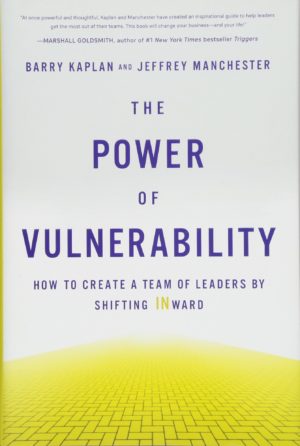
“The Power of Vulnerability” by Kaplan and Manchester

Many organizations do not achieve their true potential because they leave much of their power on the table. Organizations often have a culture that prevents people from bringing their full potential to the organization. While an organization could make changes to its strategy, its processes, its structure, or the members of management, one of the most straight-forward changes that can be made to grow in effectiveness is a change in culture.

This is the big idea in the book The Power of Vulnerability by Barry Kaplan and Jeffrey Manchester. The book describes the culture of many organizations that makes it unsafe to be authentic in corporate interactions. Since there is not safety in the relationships amongst the leadership team, people spend energy posturing and politicking. They do not feel the connection and freedom in which they can present and explore all of their best ideas. Instead, the members of what should be the leadership team are isolated, attempting to manage their own functional silos, hiding their internal struggles from the rest of the organization and squeezing the most they can from their individual responsibilities.

In fact, it is hard to refer to the top management group in such an organization as a team. They more resemble a functional workgroup, cooperating only to a minimal extent and only when forced. A leadership team should be highly related and reliant upon each other. This book is replete with case studies of organizations that came to the authors’ coaching practice with a fractured team and the process used to build them into a cohesive team.

“As opposed to a functional workgroup, a team is engaged and connected at every level – emotionally, physically, spiritually, and professionally.”

The first step in moving from a group of isolated managers into a team of leaders is to establish a relationship of safety and connection between all of the team members. With such a relationship, the team members can then grow in authenticity, able to share and explore with the team all of their ideas, along with personal struggles and emotions. This relationship also allows team members the setting to quickly short-circuit any interpersonal misunderstandings or struggles that should arise.

“The height of a team’s performance compared to its potential is directly related to the depth of connection among its members.”

The book presents some functional tools for building connection in the team, for effective meetings in a culture of safety and connection, and for interpersonal relationships. By no means is this development of a safe and connected culture an easy process. Rather it takes great effort to first turn around the culture and then a great deal of intentionality to maintain and continually grow this culture over time.

As with any cultural change, the leadership team must first buy in and practice the new culture. Over time this culture, with some encouragement, can grow throughout the organization.

“When the team ‘plays it safe,’ it avoids challenges and misses opportunities. Yet, when the team ‘INpowers’ itself to ‘safely play,’ the team’s authentic communications inspire emergence of enormous capacity.”

The concepts presented in this book are fundamentally about developing a highly effective corporate organization based on the idea of being fully present, fully connected, and fully authentic. Of course, these concepts are the key building blocks for any close relationship, including marriage, parenting, or close friendships. Anyone interested in developing deeper relationship will find it helpful.

Because this book outlines many of the same concepts that I emphasize in my coaching and consulting work, I naturally enjoyed it greatly. It is not a particularly easy read because of the style. It also is clearly written with the idea of gaining coaching clients, as it stops short of presenting the tools that the authors use to develop cultural change. Still I recommend this book.

Culture Trumps Strategy

Business guru Peter Drucker once said, “Culture eats strategy for breakfast!” By this he did not mean that strategy was unimportant but, rather, that culture is a more important determinant of the success of a company than strategy. Culture is the “set of values and attributes that shape how things get done in the organization.” Getting the culture right is a prerequisite for making the strategy work. This is because culture determines our ability to implement.

Any strategy is only as good as its implementation. Thoughts in our head or on paper do not create value. Action creates value if it is the right action. Strategy defines the action but culture energizes the action. The right culture provides the motivation, innovation, and collaboration that provide the energy for implementation. The right culture aligns the organization and its resources with its strategy so that it all works together to achieve the desired results. The best strategy in an organization with a poor culture or a culture that is not aligned with the strategy falls flat because the implementation fails.

On the other hand, a mediocre strategy from an organization that has a great culture can still lead to a very successful business. A great culture is attractive and infectious. Culture alone can draw in loyal customers. Picture a commodity business, perhaps selling gravel. There are not a lot of opportunities to innovate or differentiate the product of gravel. But a culture that delivers excellent customer service and relationships can become a competitive advantage and provide the basis for a successful strategy.

Culture and business strategy are inextricably linked. The best companies get them both right but culture can determine the success or failure of any strategy.

Which one is holding back your organization – strategy or culture? What action are you taking to move forward or develop alignment?