Defining Core Values

Our values should be the guiding lights that we use in shaping our lives and making decisions. Values, once identified, help you know yourself. Values show up in behavior, so knowing your values helps you identify behaviors that fit with your values so that you can walk the talk and operate as your most authentic self.

What values are most important to you or represent the person that you would like to be? Below is a list of potential core values commonly used by leadership institutes and programs. This list is not exhaustive, but it gives an idea of some common core values (also called personal values). The common recommendation is to select three to five core values to focus on—if everything is a core value, then nothing is really a priority.

One way to find your core values is to go through a list of potential values and circle those important to you. Again, sort through those selected to find the most important. Continue this process of winnowing until you find the three to five that are really core to who you are and to what is important to you.

Sample Values List

  • Authenticity
  • Achievement
  • Adventure
  • Authority
  • Autonomy
  • Balance
  • Beauty
  • Boldness
  • Compassion
  • Challenge
  • Citizenship
  • Community
  • Competency
  • Contribution
  • Creativity
  • Curiosity
  • Determination
  • Fairness
  • Faith
  • Fame
  • Family
  • Friendships
  • Fun
  • Growth
  • Happiness
  • Honesty
  • Humor
  • Influence
  • Inner Harmony
  • Justice
  • Kindness
  • Knowledge
  • Leadership
  • Learning
  • Love
  • Loyalty
  • Meaningful Work
  • Openness
  • Optimism
  • Peace
  • Pleasure
  • Popularity
  • Recognition
  • Religion
  • Reputation
  • Respect
  • Responsibility
  • Security
  • Self-Respect
  • Service
  • Spirituality
  • Stability
  • Success
  • Status
  • Trustworthiness
  • Wealth
  • Wisdom

See a more extensive list of potential Core Values.

This article is part of a series of articles describing the Life Planning process. To see the other articles in the series, click here. While individuals are welcome to complete this process on their own, partnering with a Life Coach is often more effective. Please contact us for more information.

“Emotional Agility” by Dr. Susan David

Agility can be defined as the ability to move quickly and easily or the ability to think and understand quickly. To be agile can be defined as having a quick, resourceful, and adaptable character. When we put the word agility with the concept of emotions we can see that this must be referring to the ability to effectively understand and respond to emotions.

The problem with emotions is that some people have difficulty in recognizing them, controlling them, or responding to them. For some, emotions can be puzzling, scary, or even crippling. Many emotions have a label as being negative and, therefore, might be thought of negatively. People generally do not like to deal with the negative.

People tend to respond to emotions, especially those negative emotions, in one of three ways. Some people push them away, pretending that they don’t exist or walling themselves off from them. Some people let themselves be captured by emotions, stirring them around and ruminating over them. And others recognize emotions for what they are, signals, and deal with them effectively
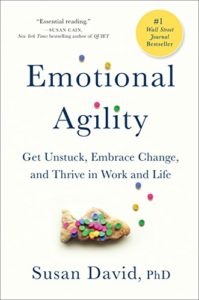
In her book, “Emotional Agility”, psychologist Dr. Susan David describes some ways to deal with emotions with what she terms as agility. She labels the first two types of people described above as “bottlers” – they try to put their emotions in a bottle on a shelf – and “brooders” – they keep their emotions active by focusing on them without dealing with them. She describes these people as emotionally rigid while Dr. David’s goal with this book is to equip people to deal comfortably with emotions, to help them become more agile.

The big idea in “Emotional Agility” is that people who are effective or whole do not get “hooked” by emotions. To become more emotionally agile, Dr. David describes five behaviors. No doubt there are other behaviors or thought patterns that can affect our ability to deal effectively with emotions, but her opinion is that these are the most important behaviors leading to emotional agility.

  1. Showing up. The first logical step toward emotional agility is to face your thoughts, emotions, and behaviors willingly. Some emotions are valid and appropriate, in fact, they may be there to protect or alert us. Others are old bits that are stuck in our minds and triggered by some unrelated or, more precisely, some unconsciously related, event. In either case, the first step in dealing effectively with an emotion is to recognize it and choose to understand it.
  2. Stepping out. “This next element, after facing your thoughts and emotions, is detaching from and observing them for what they are – just thoughts, just emotions.” The author refers to Victor Frankl’s position that, in order to evaluate emotions, we must first create some space so that we can view them with a non-judgmental perspective and properly evaluate them.
  3. Walking your why. Continuing with the idea of perspective, once you have recognized, accepted, and then stepped back and examined your thoughts and emotions, the next step is to compare your thoughts and emotions with your long-term values and aspirations. This assumes that you have done the work to first understand your core values. Dr. David spends quite a bit of time talking about core values and how they should guide decisions. This, of course, is a part of personal wholeness.
  4. Moving on – the tiny tweak principle. The first portion of this chapter is built on the idea that life changes are best done in incremental steps. The author talks of tweaking your mindset, tweaking your motivations, and tweaking your habits. As mentioned above, emotions have a way of triggering behaviors based on some long-buried history. In order to keep from being emotionally hijacked, we need to identify those triggers and then change the course of what happens when certain emotions arise.
  5. Moving on – the teeter-totter principle. The teeter-totter principle says that wholeness comes in part through maintaining a balance between comfort and challenge. If we spend all of our time in total comfort, we become complacent. If we spend all of our time too far on the challenge side, we become stressed, frazzled, and distracted. The author recommends that be “whelmed”, that is, not overwhelmed but with enough challenge to keep us growing and sharp.

This book was good, not great. The book is very readable and has many good thoughts. It is built on solid research. Much of it seemed to be good practices on the path to wholeness that comes from knowing yourself or what Dr. Henry Cloud describes as “Integrity.” If you are on the path to wholeness, this implies that you have emotional agility, which can be described as the ability to properly understand and collaborate with emotion in a healthy manner.
“Every Good Endeavor” by Tim Keller

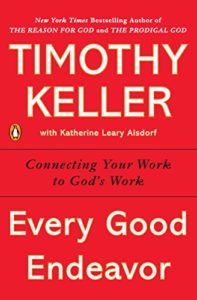
“In a work world that is increasingly competitive and insecure, people often have nagging questions: Why am I doing this work? Why is it so hard? Is there anything I can do about it?” Thus the flyleaf for “Every Good Endeavor” introduces Tim Keller’s book about faith and work. This book is much more than a “how to” book regarding faith at work. It is a study of the theology of work with practical application.

While a popular view of work may be that it is a necessary evil resulting from man’s rebellion from God’s creative plan, the book quickly dispels that notion. Work is an ordained part of creation in which man is given what is known as the cultural mandate. The cultural mandate is the command to exercise dominion over the earth, subdue it, and develop its latent potential that appears in the first chapter of Genesis. In essence, mankind is given the work instructions to continue the process of creation.

Unfortunately, as a result of man’s rebellion and the fall, work became toil and in Genesis 3 we are promised thorns and thistles. Keller says, “Work exists now in a world sustained by God but disordered by sin. Only if we have some understanding of how sin distorts work can we hope to counteract its effects and salvage some of the satisfaction that God planned for our work.” This distortion shows up as work often being seen as fruitless, pointless, or selfish and as work revealing our idols.

The author provides this insight “We should be willing to be very engaged with the cultural and vocational worlds of non-Christians. Our thick view of sin will remind us that even explicitly Christian work and culture will always have some idolatrous discourse within it. Our thick view of common grace will remind us that even explicitly non-Christian work and culture will always have some witness to God’s truth in it.”

Work is a vehicle of God’s providence. Keller makes the point that a Christian worldview should naturally flow into a Christian workview. This right view should result for the follower of Jesus in a different view of work, a different set of virtues, a different view of humanity, a different source of guidance, and a different audience for our work. 1 Corinthians 10 exhorts us to “do it all for the glory of God.” Keller references the writings of Luther to point out that, no matter what our profession, our work is a ministry and we are called by God to serve in our work. We should be serving our profession, our employer, our customers, our co-workers, and even our suppliers and the broader community as we serve Jesus Christ. The author makes an important point in a discussion of dualism vs. integration. Dualism is a term used to describe a separating wall between the sacred and the secular. We see dualism most clearly in the practice of Christianity on Sunday morning or only within church activities and the rest of the week is lived with a different set of values. Integration of faith and work is the opposite of dualism where a person’s core values show up in and guide every part of their life.

I highly recommend this book for anyone who wants to grow in living their faith in every part of their life.

Core Values Drive Choices

The process of defining and communicating the core values of a business has become more popular in recent years. But just as important is the process of defining our own personal core values. Core values are the fundamental or foundational beliefs of a person. These principles guide behavior and can help people understand the difference between what they believe to be right and wrong. Core values set priorities and guide decisions for our life.

Core values are often ingrained into who we are based on family or community values and life experiences. A small percentage of people have made the effort to think through and define their core values. Many people have some idea of what their core values are but rely on those ingrained values. Other people have a mish-mash of loosely-defined or situationally-based values, in essence not knowing or caring what their true core values really are.

As mentioned, core values guide our decisions. They make our lives more orderly or consistent in terms of where we spend our time and energy. Core values guide our priorities and serve as guideposts in life.

If you haven’t defined your core values, how might you do so? It is better not to pick out values from a list. Rather the process of identifying your core values should a process of self-discovery, with multiple steps to draw out of your inner self the values that are already there. The process of identifying your core values is not a one hour process or a one day process. As a process it requires several steps over some weeks or months. Here are some thoughts for a process. It is not necessarily a step-by-step process but following these steps in this order might be helpful.

  1. Start with an open mind. Defining your core values means searching inside for what is important and what drives you. Your values are not anyone else’s values and they may not even be obvious to you. So relax, take a deep breath, and let your mind take you to your values.
  2. Review a list of possible core values. The purpose is not to select your values but rather to start your mind on a discovery process, thinking about what values look like and which ones might be important to you. (Here is one sample list with more than 500 values.) Read the list through and then go back through and circle the values that develop some emotion in you.
  3. Think about some people who have impacted your life or whom you admired because of who they were and what values they exemplified. List some of the values that come to mind.
  4. Think about what you would like your life to exemplify. One way to do this is to picture the eulogies that you would hope to be spoken at your funeral. Another way to think about this is to picture an older you coming into your life to tell you what you did well or not so well. What values do you hear as you think about these scenarios?
  5. Think back to some meaningful moments, some times when you felt particularly satisfied with what you had done or an important decision that you made. What values were you following at that time? In the same way, think back to some times when you might have been angry or disappointed by your actions or decisions. Think about the values that you might have violated that caused your discontent.
  6. Think about your code of conduct. What are the driving values in the decisions that you make? What is important to you? What must you have in your life to be fulfilled? What would frustrate you? What are the values that show up as you consider these?
  7. If you can do so, write a list of the important values that you are discovering. If you have difficulty in developing a list, read through the list of sample core values. Are there more that need to be circled? Highlight the ones that seem really important.
  8. You may have listed or circled quite a few values but a core values statement should typically be 5-7 values, never less than three and never more than ten. If your list is longer than that (and it quite likely is), then it is time to start prioritizing. Think about the core values that you are considering and what each one means to you. Are there some that can be grouped or that simply repeat one thought? Which ones are the highest priority, in other words, the most meaningful or critical to whom you are? Watch ones are good values but not the most important to you? Work on the list, perhaps even going back to some of the previous steps, until you find the 5-7 core values that represent you and what you believe important in your life.
  9. The process is not finished yet. Once you have a draft list of core values, they each need to be tested. Study the definition of each of the ones on your list. Does it ring true? Thing about circumstances or decisions where you might need to stand up for your values or, even more difficult, violate your values. What would this feel like? As you think through each of your core values and the implications on your life and your decisions, you can either verify your list or go back and revise it until it does ring true.

While your core values are foundational to who you are and how you behave, they can change over time as you move through different stages of life or as you mature and grow. Therefore, you may need to repeat this process occasionally.

Core values clarify who we are and how we behave. Developing a set of core values that is true to our life and ourselves provides a vision where we can be content. A clear set of core values makes hard decisions much easier. Of course, if we have a list of core values that is not true, we produce frustration and discontent in our lives. So it is important that we have thought through the process well.

As Mahatma Ghandi said, “Your beliefs become your thoughts. Your thoughts become your words. Your words become your actions. Your actions become your habits. Your habits become your values. Your values become your destiny.”

Have you defined your destiny by defining your core values?

A Work In Progress

At the end of a year or the beginning of the next, organizations develop plans and goals for the coming year. They define or refine their strategy, assess and adjust their priorities, and update their goals. As leaders we should do the same for our personal plans and goals for the coming year.

As human beings we are all a work in progress. We hopefully continue to develop throughout our lives but never reach that finished end state. Just as we do with our organizations, we need to step back periodically and refine, assess, adjust, or update our personal plans and goals.

As we move into a new year it might be the right time to ask ourselves some questions and work on our self-awareness, such as the following:

  • What personal challenges are inhibiting my effectiveness as a person and a leader?
  • Are there issues from my past that need to be brought into the light, examined, and dealt with proactively?
  • Are there strengths that I should be using more effectively?
  • Are there weaknesses that I need to address so that they no longer hold me back?
  • Are there relationships that need my attention and greater effort?
  • What can I do to build into my character more of the traits of leadership?
  • Am I allocating my resources of time, energy, and money in line with my life purpose statement?
  • Is my list of core values still representative of who I am and what I stand for?
  • Are my long-term goals still appropriate?
  • What are my personal, relational, and professional goals for the coming year?

If we are not moving forward, it is likely that we are slipping backwards. Therefore we should all be aware of our growth opportunities and have a personal development plan in place. An effective leader is always working on growing. Your growth plan is much different than a few New Year’s resolutions. Growth plans include specific goals and action plans with a focus on developing a more fruitful life. If you are struggling to develop such a plan or feel that you are stuck, New Horizon Partners, Inc. can provide coaching services to assist in thinking these things through and developing and implementing a growth plan.

Have you developed your growth goals for this year?

Three Tools for Personal Growth

Are you living life or does it feel like life is living you? There are three important tools that help a leader, or anyone for that matter, take control of the direction of their lives. These are a life purpose statement, a list of core values, and a personal goals document. All three of these tools work together and must have consistency and cohesion. They also all evolve over time as we grow.

The life purpose statement is also sometimes called a life mission or a personal mission statement. It states in one or two sentences what you envision as your passion or calling in life. It answers, at least in part, the question of “why am I here?” It describes how your impact will change the world. The objective of your life purpose statement is to set a stake in the ground regarding your priorities about how you will use your resources of time, energy, and money.

The core values list is the result of examining and deciding which values are most important to you. You can easily find sample lists of potential core values. Some of these lists of sample values have more than 500 values and we could agree that most of them are good values. But your core values list should be the 5-10 values that are of highest value to you. They represent your character and are the personal values that are inviolable in your mind. The objective of the core values list is to guide decision making.

The personal goals document formulates and specifies your most important goals. We often have career goals, family goals, individual goals, short-term goals, long-term goals, and life goals. This personal goals document brings these all together. It is not a long to-do list. It should be the most important things, perhaps 5-10 goals in total, that you hope to accomplish in your life, in the next five or ten years, or in the next year. The objective of the personal goals document is to set a plan in motion.

If you have these tools in place, it is good idea to periodically review them to be sure that they continue to represent who you are and what you hope to accomplish with your life and resouces. If you do not have these tools or are struggling to define them, perhaps a coach or mentor would be helpful. New Horizon Partners, Inc. serves people in leadership, executive, and life coaching and we would be glad to discuss how we might serve you.

Do you have a life purpose statement, a list of core values, and a personal goals document? How have they been helpful to you?