Lead With Clarity

One of the important skills of leadership is our ability to communicate. Whether it be written, verbal, or through our actions, it is our communication that guides team members, draws them into the pursuit of vision and goals, and unites them into a cohesive team. A key to effective communication is clarity, the ability to communicate in such a way that our thoughts and intent is clearly presented and clearly understood by recipients.

To achieve clarity in communications sometimes requires the development of our communication skills, especially focusing on the four C’s of clarity – communication that is centered, consistent, comprehensive, and compassionate:

Clarity results from Centered communication – Our communication must be centered or focused on the highest priorities and driven by certain objectives. Our goal in communication as a leader is to set direction and priorities, to move the organization towards accomplishing goals that define success of the organization, to unify the organization in achieving these goals and moving towards the vision, to refine the way that the organization functions, etc.

Among the great mistakes of communication is providing too much or unfocused communication. In providing too much communication, the important messages can become lost. Our communication can begin to sound like Charlie Brown’s parents – “Wah, wah, wah.”

If we feel the need to instruct team members on every minute detail, we might be perceived as a control freak. Control freaks demotivate team members through their belittling practices. Most people prefer the ability to think for themselves and to make choices within the scope of their job responsibilities as they work.

Of course, there is room for our humanity in communications. In fact, it is a necessary element to demonstrate our authenticity and vulnerability from time to time. But especially with larger audiences, clarity in communication comes with focus.

Clarity results from Consistent communication – There are two elements to consistency in communication. The first is the consistency of the message. Our view of vision, goals, and priorities cannot change with the wind. A leader who sets a new direction every month, week, or day simply frustrates team members. They lose confidence in such leadership and cannot be expected to expend effort on a course that will be dropped or altered tomorrow. Therefore, the message communicated must be consistent over time or an explanation for the change in course should be provided to keep the organization on board.

The second element of consistency is the practice of communication on a consistent basis. When the organization is left in the dark without direction, it will develop its own direction. As a leader, we have the responsibility to set or build consensus on direction and then to continually reinforce that message to keep the organization on course.

Clarity results from Comprehensive communication – Half of a message can be as useless as no message at all. When a leader is communicating key messages to the organization, he/she needs to communicate based on the recipients’ perspectives. Of course, we, as the leader, know the background for a decision, we are aware of the risks and unknowns, we have some ideas of the impact on the organization. But the audience is often unaware of these things. Our communication should speak from the audience’s perspective, answering the questions that are likely to arise in the minds of those that are reading, listening, or observing. Communication that lays a solid foundation for the actions of the organization is well thought out and clearly presented.

Clarity results from Compassion in our communication – When emotions enter the picture, recipients hear, read, or observe from a perspective that is heavily influenced by those emotions. In order to hear our message clearly, we must understand and address any relevant emotions as a part of our message. To do so requires that we, as leaders, know our audience and are able to perceive the impact of our communications on a personal level. Once we are able to do so, we can address the emotional impact in a compassionate yet forthright manner as a part of our message.

***

Effective leadership relies on effective communication. We move the organization toward its vision and goals through our communication. Therefore, we cannot communicate in a haphazard manner. Our message is understood and accepted when it is presented with clarity. If you find that your communication efforts are sometimes ineffective and lacking in clarity, perhaps developing some of these skills or even doing some work on the underlying character traits might be helpful.

Does your team experience clarity in your communications with them? How are you building clarity?


Fear of Conflict

As a leader, it is often necessary to lean into conflict. This conflict might be based on some disagreement that someone has with us or it might be a conflict between two team members.

There is great value in having divergent views and seeking truth and full information. In this effort a team might have heated discussions and disagreements. When this discussion is focused on tasks and information, it is helpful and valuable to the organization. However, when the discussion becomes personal and filled with animosity, it becomes negative conflict. This negative conflict becomes a problem for the organization because it produces the following results:

  • Strained relationships and personal animosity
  • Tense atmosphere in the team
  • Waste of energy
  • Break down of communication
  • Reduction in the exchange of ideas and information
  • Diminished trust and support
  • Eroded commitment to the team and organization
  • Decreased productivity and increased turnover

Because of the detrimental effects, an effective leader needs to prevent, resolve, diffuse, or guide the conflict into a positive outcome. This requires that a leader have both the desire and the ability to lean into the conflict.

Unfortunately, many people are unable to lean in because they have a fear of conflict. This fear of conflict can show up in a variety of forms. One reaction to conflict is to up the ante, to overpower the conflict. Another type of reaction is to submit, to attempt to placate or play nice. The most common reaction is withdrawal, to hide from or ignore conflict.

Years ago, I had a first-hand view of weak leadership in the face of conflict. The company’s executive staff was rife with conflict that frequently broke out in staff meetings. The reaction of the company president in the face of conflict was to push away from the table, fold his arms across his chest, and smirk as the conflict rolled on. Reading the body language gave some ideas of the president’s views of conflict.

This fear of conflict often rises out of past experiences. Most often the roots go back to family of origin issues in which conflict was a tool of control that became something to be feared. In many families we seldom saw healthy relationships and did not learn the skills of emotional intelligence. Conflict was allowed to become personal at great cost to those involved. Therefore we may have learned to run from conflict.

The ability to lean into conflict requires authentic emotional intelligence in all four dimensions. A person must be fully aware of their own emotions as they step into conflict, able to manage well their own emotions, aware of the emotions of others, and skilled at managing relationships. With a base of strong emotional intelligence, a leader can lean into conflict using something like the following steps:

  • Recognize the debilitating nature of personal conflict on the organization.
  • Adopt a mindset that the cost of leaning into conflict is less than the cost of letting it continue, i.e., become willing to risk moving in.
  • Confront conflict in an emotionally-healthy manner. Provide feedback that points out the negative impact and the consequences that future conflict will produce.
  • Lead discussions of resolution and relationship building.
  • Model healthy discussion of information and debate of facts without allowing personal conflict, demonstrating respect for all persons.

To get to the position where one is able to implement this plan may first require some introspection and self-awareness to understand his/her mindset regarding conflict and the roots of that mindset. The next necessary level of self-awareness is an understanding of strengths and weaknesses in emotional intelligence. From there, a development plan may be necessary to build the skills and ability to lean into conflict. The most important step is to begin to practice leaning into conflict and then continue building comfort and competency at doing so.

Are you a carrier or a resolver of personal conflict? Are you able to lean into conflict and help others build healthy relationships?

The Impact of Caring Carries this Team to the Super Bowl

“Show your team you care, and they’ll give you everything they have.” This is the philosophy of Sean McVay, the coach of the Los Angeles Rams football team, who is taking his team to Sunday’s Super Bowl game largely because of this philosophy of leadership. Spend the time to know your people, both professionally and personally, and then use your knowledge of them to interact with them. When they see you commit time to building a relationship, they will understand how much you do care. This draws them into a relationship of trust and respect from which they are committed to following. Read the recent article in Inc. to learn more about Sean McVay’s leadership philosophy and the impact that it has had on the team that he leads.

Ask, Don’t Tell

One of the best ways for a leader to empower team members or the team is to adopt the practice of “ask, don’t tell.” This concept, sometimes called coaching for performance, moves decisions or solutions from solely the leader to a shared process between leader and team member. “Ask/ don’t tell” is a fundamental skill for coaching but also for leadership. Leaders should often wear their coaching hat when interacting with their team members to develop and to draw out their team members.

It is a human tendency, and especially true for leaders, that we tend to give solutions. We even give solutions when they aren’t requested or desired. Reference any recent discussions with your spouse or children. In the workplace, leaders are quick to give direction and solutions for a number of reasons:

  • It is a developed habit.
  • The hierarchy dictates that the answers come from above.
  • A need or desire to hold the power.
  • It seems the most expedient route to cut to the chase and provide the solution.
  • The leader believes in his/her experience and expertise to provide the “right” answer. (Call it self-awareness or call it arrogance. There is a fine line.)

Breaking the habit and switching to a practice of “ask, don’t tell” probably takes some effort and time.

To implement the “ask, don’t tell” practice means responding to requests for direction or a decision with a question like, “What are some of the options that you are considering?” or “What would you recommend in this situation?” This should lead into some follow-up questions regarding the thoughts behind the choices or the pros and cons of various options, questions like “What are the costs and benefits of these alternatives?” or “What information do you need to gather for making a decision?”

Using the “ask, don’t tell” practice doesn’t mean that the leader abdicates the responsibility for the decision. It simply means that the leader is willing to share the power. If the recommendation that results from discussion and the flow of questions is of equal value to what the leader would have decided, both parties can be satisfied. If the leader is not comfortable with the team member’s recommendation, further questions can be used to dig deeper and resolve the difference in thought. In any case, the leader maintains the responsibility for decisions from his/her team and may need to overrule.

A similar thought relates to meetings. How often do we see the attendees at a meeting posturing their comments as they attempt to determine where the leader will come down? Historically it was often only the opinion of the leader that mattered in a meeting. An effective leader turns this dynamic on its head by only asking questions, drawing out the thoughts of all attendees. Only when the entire team has weighed in and all available information is on the table, will the leader speak. Decision-making becomes a group process. Not necessarily a democracy but a process in which all participate.

The practice of “ask, don’t tell” provides several benefits to the organization and to the team:

  • It empowers team members. Sharing the power that may have been historically held by the leader lets the team members feel a greater contribution and greater control over their work and their lives. They are valued when their input and opinions are drawn out.
  • It builds a relationship of trust and respect. When team members are entrusted with the ability to think deeper and make greater decisions, they feel respected. Leadership is built upon a relationship of trust and respect, but this sort of relationship only works as a two-way street. Therefore, having greater trust and respect for team members comes back around to greater trust and respect for the leader.
  • It develops team members. One of the responsibilities is the development of their people and preparing the next generation of leadership. Drawing out their thoughts through powerful questions develops their thinking process and decision-making skills. As their input is valued, they grow in confidence.
  • It creates better decisions. The “ask, don’t tell” process generates a more robust discussion of an issue, developing different perspectives. In this process, more information is brought to the discussion and decision.
  • It provides an opportunity to evaluate talent and capability. On the other side of the relationship, the “ask, don’t tell” practice provides an opportunity for a leader to see the team members in action as they gather and present logic for decisions. Are these people ready to grow, take risks, and exercise good logic?

The “ask, don’t tell” practice is a powerful way to build the capability of a team and its members. In fact, this practice is effective in building stronger relationships in every part of our lives. It is a better alternative to the practice of constantly providing solutions.

How highly do you value your thoughts relative to those of the people around you? Are you more prone to tell or to ask?

“Radical Candor” by Kim Scott


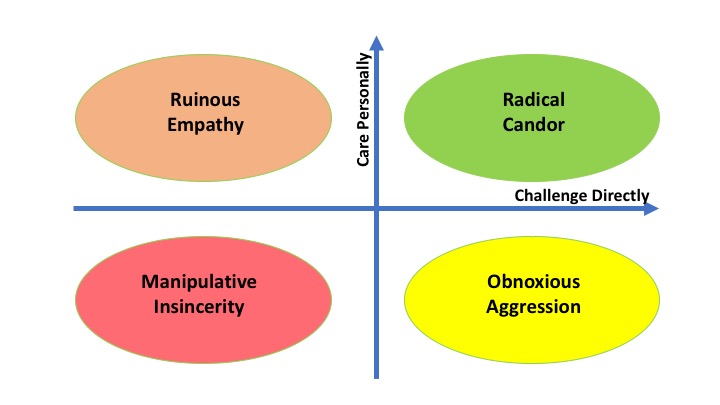
No doubt you heard the advice as you grew up: “if you can’t say anything nice, don’t say any anything at all.” Many people still operate according to that rule even when in a position of leading or directing people. While this advice may work for everyday life, it can be a disaster when adopted by managers. On the other hand, there are some people who, when they have achieved a management position, believe it is their responsibility or privilege to boss people around, demanding that their voice is the only one that matters. This attitude can also be disastrous for a manager. The book “Radical Candor” by Kim Scott proposes a model of leadership based on the idea that the best boss is the one that can “care personally and challenge directly.” When a leader can effectively combine these two skills, they are most effective at influencing, inspiring, developing, and directing their team. Only when we clearly show that we care personally can people accept our effort to challenge directly. And only when we challenge directly are people convinced that we truly do care personally.

My view is that leadership is the ability to influence built upon a relationship of trust and respect. This correlates with the concept of Radical Candor. Trust is built by caring personally. Respect is built by challenging directly.

This combination of caring personally and challenging directly is a balancing process and is modulated by our understanding of the recipient and the way in which they perceive both the caring and the challenging. Challenging, or guidance, is always meant to impact the future of recipient; therefore, it includes both praise and criticism.

When our ability to care personally and to challenge directly is out of balance, the ability to lead can be impacted adversely. Ms. Scott describes the various combinations of caring and challenging as follows:

Obnoxious Aggression is when a boss is prone to criticize without showing that they care about the recipient. The boss comes off as a “jerk” and the recipient is made to feel incompetent.

Ruinous Empathy is when a boss cares so much that they are unable to ever challenge; this is the “when you can’t say anything nice” person in action. It is ruinous because the recipient never is given feedback that will lead to growth.

Manipulative Insincerity is the result of a boss that doesn’t care enough to challenge. The worst version of leadership, this is generally the result of a boss that is only focused on him- or herself. It’s praise that is false or condescending and criticism that is neither clear nor kind.

Radical Candor is the healthy mix of caring and challenging that leads to growth and influence.

The first portion of the book defines and explains Radical Candor, building the case for why it is the best model for today’s leadership in the workplace. In fact, Radical Candor is a concept useful in any relationship or communication. In the process of describing Radical Candor, Ms. Scott further defines caring as understanding what motivates each person on the team through a process of exploration and communication. She also describes the open communication and guidance that embodies challenging directly.

The second half of the book is devoted to demonstrating what Radical Candor looks like in action, presenting advice and tools for the day-to-day practice of leading a team in a Radical Candor fashion. This includes advice on building relationships in the workplace, getting and giving guidance, building and motivating a team, and on getting stuff done, as she describes it. In the chapter on results, the book contains a GSD or Getting Stuff Done model, in which Ms. Scott describes the various types of meetings that she believes a team should utilize and the general steps for accomplishing projects. These steps are: Listen, Clarify, Debate, Decide, Persuade, Execute, Learn, and back to Listen. The advice regarding giving guidance gives some helpful advice on hiring, firing, promotions, and performance reviews. In summary, the Radical Candor model should become a philosophy of interacting with people on our team.

While this book spends considerable describing the actions or skills that result from a Radical Candor style of leadership, for many people the concept of Radical Candor is as much an urging to character growth as it is a recipe for competency. Radical Candor requires a development of relationships that may be a challenge to many people. Yet I believe that effective leadership is built upon such relationships.

I highly recommend this book and the character growth that is required to embrace and live in a Radical Candor fashion.

Are you ready to care personally and to challenge directly as you lead people? What growth do you need to undertake in order to do so effectively?

Be Slow to Anger

In two recent articles we have been examining communications and the wisdom presented in the letter from James in the Bible when we are told that “Everyone should be quick to listen, slow to speak, and slow to become angry(James 1:20b NIV). This verse reminds us of three important truths – that listening is of highest importance, that we should be thoughtful in speaking or communicating, and that we must manage our emotions so that we communicate effectively.

To be an effective leader, one must be an effective communicator. For a leader, communication is much more than the transfer of information, it is connection and inspiration. Communication is necessary for developing alignment and executing strategy. Communication is the basis for a relationship of trust and respect, the foundation of leadership.

This wisdom of becoming quick to listen, slow to speak, and slow to anger is applicable to any communication whether it be in the workplace or at home, in a one-on-one discussion or a memo to all hands. In two previous articles we looked at the importance and practice of effective listening and wise speaking (or writing). We now come to the third element of communication included in this verse – the importance of managing emotions.

The last part of this particular verse could have broader implications than just communications. It actually speaks to our need to develop our emotional intelligence. In his book, Primal Leadership, author Daniel Goldman describes emotional intelligence as being composed of four hierarchical domains:

  1. Self-awareness – understanding your own emotions
  2. Self-management – appropriate control of your own emotions
  3. Social awareness – recognizing and understanding the emotions of others
  4. Relationship management – dealing effectively with other individuals or teams

The passage from James is speaking more specifically about the need for us to appropriately manage our own emotions, mentioning anger because unchecked anger in communications can be a damaging emotion. There are instances where anger is appropriate and where there is a need to express it. There are also times when a person might feel anger without recognizing the source or might be prone to lash out at either the wrong people or in the wrong way.

More specifically addressing the theme of communication that runs through this particular verse, there is a need to use our emotional intelligence in all communications. In any conversation or communication, we need to exercise all four domains:

  1. We need to be aware of our emotions. In a conversation, what is said or the way it is presented can prompt an emotional reaction. Sometimes our emotions can creep up on us. A word or thought can trigger a memory from earlier in the day or earlier in our life. We need to develop our awareness and understanding of our emotions, recognizing and identifying the emotions that are present at any given time and understanding their source.
  2. We need to manage our emotions. If we are not strong in emotional intelligence or aware at the moment, emotions can sometimes become a runaway train. We need to train ourselves to first recognize our emotions and then to make rational decisions about whether and how to express them in communications. In the realm of neuroscience, this practice requires interrupting the limbic system that tends to control emotions and giving our prefrontal cortex a voice in interpreting and managing our emotions. The idea is that we are to manage our emotions rather than allowing them to manage us.
  3. We need to be aware of emotions in others. In a conversation, this means interpreting the words, the underlying context, and the accompanying body language of the other person for the emotions that might be present. When preparing written communications or delivering a speech, this can mean thinking from the viewpoint of the audience to infer or predict what emotions might be present and to communicate in a way that addresses those emotions. Which brings us to the fourth domain –
  4. We need to deal effectively in relationships. This means going beyond recognizing the emotions in the other party, to communicating in a way that helps them recognize and respond appropriately to the emotions that arise within them. Communication in this way resolves conflict and draws people together.

The passage from James focuses specifically on anger because anger can be so dangerous. It can turn a conversation from healthy to hurting or from logical to lethal. Anger can be destructive to relationships. Anger in a conversation has a tendency to escalate back and forth between two parties. What began as a simple conversation can turn into threats, insults, and all sorts of damage. Hence, the advice to “be slow to anger.”

Are you able to accurately recognize your emotions and manage them appropriately? How are you growing in emotional intelligence?

Be Slow to Speak

To be an effective leader, one must be an effective communicator. For a leader, communication is much more than the transfer of information, it is connection and inspiration. Communication is necessary for developing alignment and executing strategy. Communication is the basis for a relationship of trust and respect, the foundation of leadership.

The letter from James in the Bible presents important wisdom regarding communication when it tells us that “Everyone should be quick to listen, slow to speak and slow to become angry(James 1:20b NIV). This verse reminds us of three important truths – that listening is of highest importance, that we should be thoughtful in speaking or communicating, and that we must manage our emotions to communicate effectively. This wisdom is applicable to any communication whether it be in the workplace or at home, in a one-on-one discussion or a memo to all hands. In a previous article we looked at the importance and practice of effective listening. This article will now focus on the second step – speaking. In an upcoming article we will look at the importance of managing emotions to successful communications.

The idea of being “slow to speak” is not addressing the tempo of our speaking nor is it telling us to be quiet. Rather, it is a warning against reacting rashly and blurting out something we would rather not say. It is an encouragement to consider our words carefully and thoughtfully so that we may communicate effectively.

When we are confronted in a discussion, especially an emotional discussion, there is a choice as to whether we will react or respond. To react means that we reply immediately in a way that might be driven by emotions of the moment. To respond indicates that we have given adequate thought to formulate a reply that shows the proper respect for the other party and presents information in a logical fashion. Some people are skilled at responding quickly while others may take more time to properly think through the proper response. The instruction to “be slow to speak” suggests that it is better to schedule a time to continue the discussion if needed in order to properly respond rather than to react in a way that we might later regret.

For the normal flow of communication, the concept of “being slow to speak” means that we give adequate thought to our communications to make them most effective. Again, this can apply to any communication, written or verbal, to any audience. Here are some thoughts on the requirements of effective communication:

Know your audience.Before preparing any communication, first think about the audience. Who are they? What are their concerns or desires? What do they need to know or what fears need to be addressed? What is the background for this communication that needs to be considered? What questions are likely to arise that need to be addressed up front?

Speak directly to them.Whatever the format and means of communicating, from a team meeting to a memo sent halfway around the world, developing a communication that is most like a direct conversation is generally the best solution. In today’s corporate world, people are more frequently using the term “conversations” to describe communications because it conveys the proper tone for developing alignment, inspiration, or understanding. There are times when a contract is necessary but most communication should be built on a more personal language that draws in the recipient rather than pushing them off.

Be clear and candid.Stating the facts honestly and forthrightly is the best solution. Understand the audience and then present the information that they need to know. Communicate in a way and with the information that and answers their questions rather than prompts more. There is always a tension between brevity and comprehensiveness but a focus on clarity can be consistent with brevity.

Be yourself.Part of being authentic is being who you are in all contexts. Communication is most effective when it is from the heart, not just the mouth. Allow your emotion to show as long as it is respectful. For example, if you need to announce staff reductions, there is likely to be some sadness. Don’t allow yourself to be a talking head. Allowing yourself to be seen in what and how you communicate builds trust. People relate to a person, not a title or a position.

All of these practices, and others like them, reflect the same concept – thoughtful communication is effective communication. Being slow to speak requires putting the brain in gear before the mouth (or pen or keyboard) is engaged. Effective communication brings the organization together positively, aligning and inspiring the effort necessary to move forward.

Are you taking the time to effectively communicate?

Be Quick to Listen

To be an effective leader, one must be an effective communicator. For a leader, communication is much more than the transfer of information, it is connection and inspiration. Communication is necessary for developing alignment and executing strategy. Communication is the basis for a relationship of trust and respect, the foundation of leadership.

The letter from James in the Bible presents important wisdom regarding communication when it reads “Everyone should be quick to listen, slow to speak and slow to become angry(James 1:20b NIV). This verse reminds us of three important truths – that listening is of highest importance, that we should be thoughtful in speaking or communicating, and that we must manage our emotions to communicate effectively. This article will focus on the first step – being quick to listen. Future articles will look at the other two elements of effective communication – speaking wisely and managing emotions.

Why must listening come first, one might ask? Especially, perhaps, one who is so full of himself or herself that he or she thinks that only their own opinion is important. But a real leader places high value on every person, a value that is equivalent to the value he places on himself. Stephen Covey popularized the advice of “seek first to understand, then to be understood.” This philosophy demonstrates the value of the other person. It also enables our communication to be more effective. Only when we understand the position of the other person are we able to communicate in a way that is responsive to and respectful of the other person’s mindset.

Listening involves more than receiving the words or the information being relayed. Effective listening has these three elements:

  1. Receiving the information.
  2. Understanding the underlying meaning or purpose of the information.
  3. Interpreting the underlying communication from the accompanying emotion and body language.

Sometimes the communication that we receive is simply a delivery of information. But more frequently, the words are only a small part of what is actually being communicated, even when the other person might be unaware of what all is being subconsciously being communicated. An effective listener pays attention to the complete message and interprets the words based on the entire communication.

In order to fully or effectively listen, follow these steps:

  • Face the speaker and maintain eye contact.Talking to someone while they are looking elsewhere, such as scanning the room, viewing their screen, or reading, is like trying to hit a moving target. The speaker has no idea how much of the conversation is sinking in. By the listener not focusing on the conversation, the speaker can feel unimportant and frustrated. Instead, the listener should demonstrate the value of the other person and the importance of the information by focusing on the speaker.
  • Be attentive and provide feedback.As the listener, be present in the conversation and demonstrate that you are tracking with the information being communicated. This might involve a head nod or occasional comments or questions, such as “I can see how that makes your task difficult” or even a “hmmm” to verify that you are involved and receiving the message.
  • Keep an open mind.Listen without judging either the speaker or the information being presented. This is a part of demonstrating our value of other people. Don’t jump to conclusions or hijack the conversation. The speaker is presenting their thoughts and feelings and deserves to be fully heard and understood.
  • Hear the entire message.Wait until the message is fully received before forming your response. If the listener is making judgments or organizing a rebuttal while the other person is speaking, they have compromised their effectiveness as a listener and may not hear the message correctly or completely. If the speaker is asking for a solution, wait until the message is delivered and a solution is requested. As humans, and this is especially true for leaders, we can be quick to offer solutions when they are not desired or appropriate.
  • Ask clarifying questions, but without interrupting.As the listener, you want to be sure that you clearly understand the entirety of what is being communicated. To do so may require drawing out more information or developing clarity about what is being communicated, including the unsaid elements of communication. As appropriate, use pauses on the part of the speaker to ask questions or verify your understanding. It’s best not to interrupt and, by all means, do not derail the conversation or take it down a rabbit hole.
  • Pay attention to what isn’t said.An effective listener takes in and interprets the entire message. This includes the words or information presented, the underlying emotion with which those words are laced, and the body language of the presenter. This is an important part of emotional intelligence, understanding the emotions of others. It is all part of the message, and the unsaid portions can sometimes be even more valuable than the actual information communicated.

A skilled listener values the presenter and demonstrates that value in the way that they receive information. A skilled listener is also able to draw more knowledge out of a conversation by using the tools described. It is often said that we are given two ears and one mouth to demonstrate the importance of listening. The concept of being quick to listen is a reminder of its priority in communication.

Do you communicate in a way that values the other party? Are you an effective listener?

Six Steps In Effective Communication

I speak and write often on communication skills and the importance of communication driven by the perspective of the listener. I recently fell into the trap of which I warn others. I had prepared a document intended for my coaching clients. Because of its importance, I reviewed it with one of my coaches. Her first reaction was “With all of the positive things in this document, why did you open with a negative statement?” I had been so focused on what I needed to communicate that I had neglected to think about the reader. So this seems like a good time to remind myself and others of the secrets of effective communication.

To communicate effectively there are a few steps that allow a leader to present a message to ears that are more open to receive. Actually these tips go well beyond leadership in organizations, applying to communication with your children, spouse, friends, co-workers, boss, as well as those whom you lead. These tips apply to any communication whether it be a short text or email, a letter, a speech, or a conversation. To communicate effectively, you should follow these steps:

  1. Assess the emotional state of your audience. Are they celebrating with joy, stressed, angry, or questioning? What are the circumstances that they are facing and the mindset that is likely present? Before you can formulate the message, it is essential to understand the state of mind in which it will be received.
  2. Validate the emotions of your audience. Communication is most effective when it is on a personal level. Even when addressing a crowd of thousands, the best communicators keep it personal by connecting with the emotions that are present and by demonstrating empathy. On the other hand, the quickest way to block connection is to tell someone that what they are feeling is wrong.
  3. Express your gratitude or appreciation or, at least, acknowledge the circumstances. This is another part of the personal connection. People want to be acknowledged and affirmed. This is especially true when the message might contain some bad news or describe the need for some corrective action.
  4. Explain the context. As the originator of the message, we of course know the context and have spent some time thinking about the message. The receiver, on the other hand, does not know the context or logic behind the message. Sometimes even the simplest message gets lost or misunderstood without the foundation of the background or context.
  5. Deliver the message. Only when the previous steps are laid as a foundation for the communication can we expect to be effective. While these steps are absolutely essential for communicating negative news, they make any communication more easily received.
  6. Be open for feedback or discussion. Another element in making communication personal is remaining open for further discussion or explanation. If the message comes across as an edict of some sort, it is cold and the reaction of the receiver is often rejection. The very expression of openness by the presenter invites the receiver into relationship that is more accepting of the message.

Picture some scenarios to see the benefit of these steps in communication. Scenario #1: In the case of the announcement of a plant closing, the ineffective communication is a simple announcement from the CEO with a date and the formalities of the closing process while the effective communication acknowledges the disappointment of the workforce, expresses gratitude for their service over the years, describes the market conditions that led to the decision, expresses an openness in further discussion, and presents the decision as a difficult reality. Scenario #2: In the case of your son violating curfew and therefore losing driving privileges for some time, the ineffective communication is an angry announcement while the effective communication is a discussion about decision-making and consequences, acknowledging disappointment by both parties, but with the same bad news for the son.

In another recent article on communication we discussed the importance of communication being built upon clarity, candor, congruency, consistency, and connection. Leadership is influence that flows out of relationship. Effective communication is key to effective leadership because it draws people into accepting or even seeking the influence of leadership.

In your experience, what additional steps might make for effective communications?