Feedback Is Best Served Warm


Effective leaders understand the benefit of liberally providing both positive and corrective feedback. Positive feedback demonstrates appreciation for the effort and value for the person. Corrective feedback, when done well, demonstrates the desire to help the team member to grow and develop.

Here are 12 tips for building the habit of giving feedback and doing it well:

Focus on performance, not personality. Always deliver feedback in reference to specific actions or behaviors, either by expressing appreciation for an action and the resulting benefit, or discussing an action or behavior that you want to see improved. “You’re so smart” is not nearly as valuable as “I really appreciated the way that you helped the team come to that conclusion.” With the latter, the person understands the action and the benefit to the team. Regarding corrective feedback, a statement such as, “The project was not delivered on time, which resulted in a big cost penalty from our customer” can lead to a discussion of reasons and corrective action. On the other hand, “You really messed up that project, as usual” is likely to simply prompt a defensive reaction.

Emphasize facts, not feelings. “We have received seven complaints about missed deliveries” has more value than, “You really disappoint me.” Facts verify the reality behind the discussion and, again, keep the discussion from becoming a personal matter.

Focus on the individual effort. Often the workplace includes team efforts. If the feedback is about the team’s results, the discussion needs to include the team. If the feedback is for an individual on the team, the discussion needs to focus on that person’s specific actions or his/her specific contribution to the team’s effort. Unless there is evidence that one person single-handedly impacted the team’s results, it is unfair and disheartening to be confronted with the team’s performance.

Feedback is best served warm. In other words, provide feedback as soon as possible after (or even during) the activity. The longer the time gap between the action and the feedback, the harder it will be for the recipient to tie the two together. The impact or benefit is much reduced if the person has difficulty recalling all of the facts regarding the action due to lapsed time.

Be clear, direct, and specific. A discussion that is focused on specific action or behavior and the specific results leads to a more productive analysis of the cause and a better definition of the specific action plan required to improve. Speaking in generalities ends with little understanding and minimal impact on the future. Feedback takes an investment of time and attention to develop value.

Focus on the future. The goal of feedback is not to criticize a person or to gather a history. The goal is to help the recipient to grow and improve. The discussion of the situation or the past history is just to establish the need for an action plan. Therefore, the discussion should be weighted in favor of the future, with positive expectations for improvement and growth.

Be intentional. It is too easy to move quickly from one meeting to another, or from one interaction to another. Leaders need to develop the habit of noticing. They must keep their eyes open for opportunities to recognize positive actions and behaviors and to correct undesired actions and behaviors.

Use your words wisely. Feedback should be a respectful, professional discussion aimed at producing a positive outcome. Our language and behavior should be in line with this objective. Better to use the word “I” in demonstrating the impact and refrain from using the word “you,” which can sound judgmental of the person rather than the behavior.

Provide feedback in digestible doses. If you expect your feedback to have an impact on future performance, it is better for the recipient to walk away with one action item regarding one issue. Storing up several items for discussion results in a confusing mess for the recipient to sort out after the discussion.

Make it a two-way conversation. With a goal of developing an action plan for future performance, the feedback session needs to be a dialogue, not a monologue. People are more likely to implement an action plan that they have developed than one that is forced upon them. Therefore, once the issue has been identified and agreed upon, the feedback discussion works best when the leader moves to a coaching role, helping the recipient to identify and own the cause of the problem and the action plan for improvement. It goes without saying that feedback is done best face-to-face or at least person-to-person, never via text, email, or letter.

Balance negative or corrective feedback with affirmational or positive feedback. People respond more strongly to negative than positive statements. That’s why relationships are stronger when positive statements outweigh negative statements by a factor of 5:1 or even 8:1. Even when giving corrective feedback, the leader should find some positive things to say about the other person: the part of the process that was done correctly, a belief in their ability to improve, etc. When a person only hears negative comments or criticism from a boss, they lose heart and look for the door.

Develop the habit of providing feedback. Feedback is the tool with which we nudge the actions and behaviors within the organization to conform with our desired culture and vision. It takes many of these nudges to achieve the results that we hope for. We need to continually and liberally provide effective feedback.

When done well, both positive and corrective feedback can feel like positive interaction that is beneficial to the recipient and result in growth and improved performance. Done well, they both identify the behavior that is valued and expected. And they show the value that the leader places upon the team member and the desire to assist in building their future.

Do you continually watch for opportunities to provide feedback? Are you motivated by the desire to develop the people that you lead?


(This article was previously published in IndustryWeek.)
The Coach Approach – Intro

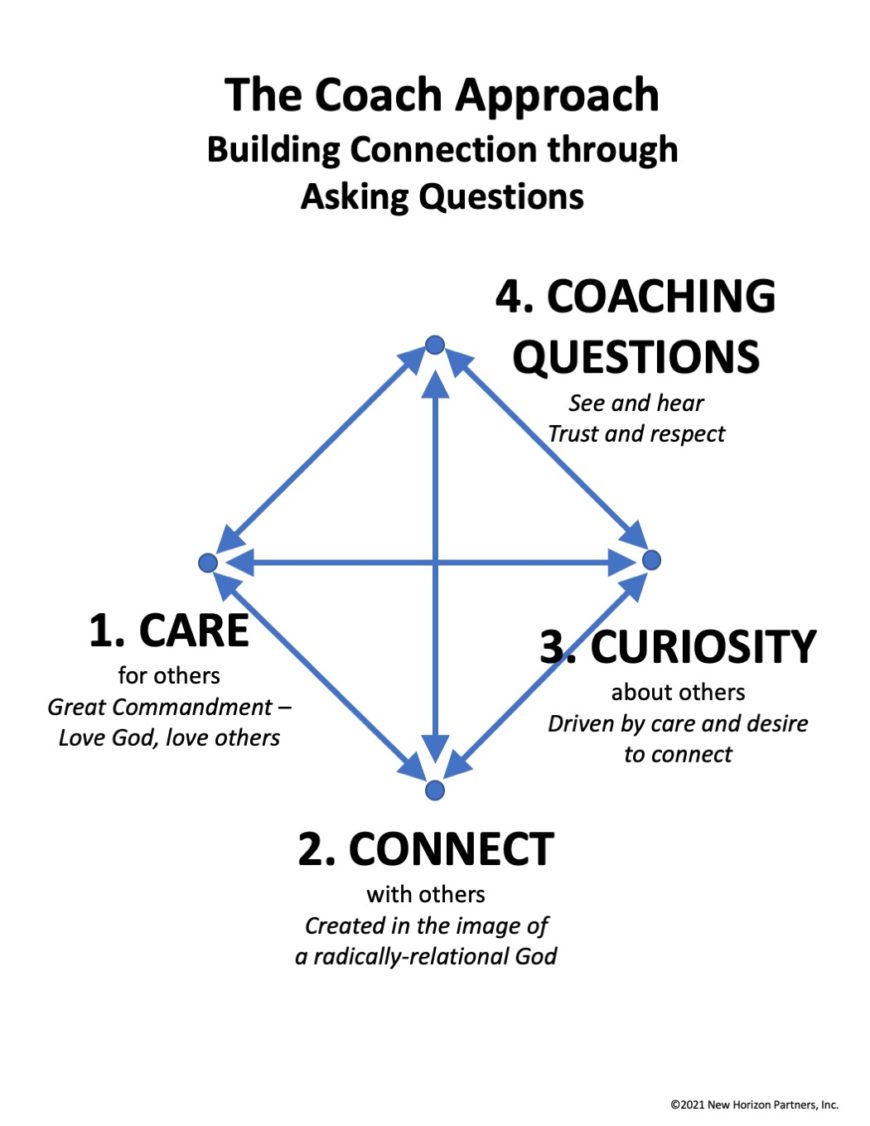
The Coach Approach© is a lifestyle or mindset of utilizing questions in conversations to build relationship and/or to help others to grow. It is an other-focused or “one another” approach to relating to the people around us. The Coach Approach could also be defined as “Making a practice of building conversations around powerful questions that are based on curiosity with the goal of building connection and demonstrating care for the people around us.”

This article is an introduction to the concept of the Coach Approach, which is then explained in a series of following articles on specific elements of the concept. The complete list of articles explaining what the Coach Approach is, why it is the best way to build relationship, and examples of the Coach Approach in action is shown later in this article. But first, here is the model of the Coach Approach in action:

Read the full series:

The Coach Approach, Part 1 – The Roadblocks

The Coach Approach, Part 2 – The Motivation

The Coach Approach, Part 3 – The Route

The Coach Approach, Part 4 – The Destination

The Coach Approach, Part 5 – The Coach Approach in Action

The Coach Approach, Part 6 – More of the Coach Approach in Action

The Coach Approach, Part 7 – Lessons from Mr. Rogers

500 Powerful Questions – Sample Questions

Correction vs. Criticism

The two words, correction and criticism, may sound similar but they can often result in very different results. Correction provides the opportunity to build up while criticism often tears down.

To begin the explanation of the difference between correction and criticism, I will provide a personal illustration. I was raised in a family in which love and acceptance was conditional based on how well or quickly the assigned chores were completed. After I married, my father-in-law demonstrated a different pattern. I recall two occasions when my actions made him angry and he confronted me. In those discussions he clearly pointed out the error in my actions. While addressing my actions, it was quite clear that his love for me and acceptance of me was beyond question. His focus was on the actions that he considered out of line and in need of correction.

This is the essence of the difference between correction and criticism. Correction flows out of care for the other in an effort to improve the future behavior. Criticism too often becomes, or at least can feel like, a personal attack that harms pride or ego.

Since leadership is built upon a relationship of mutual trust and respect, criticism damages such a relationship. On the other hand, correction has the opportunity to further build up the relationship of trust and respect.

Correction, when done well, has the following traits. To demonstrate, we will imagine a scenario in which we are on the factory floor and happen upon an associate that is assembling his or her product in an inefficient manner.

  • Instructional – Correction explains the better action or behavior and the difference between what has been observed and what is preferred. For example, we might tell the associate that, in our experience, we have found putting the parts together in a different order is easier.
  • Practical – Correction doesn’t require a lot of information, just the basic facts communicated in a way that is easy to understand. For example, we might roll up our sleeves and demonstrate the way to assemble the parts.
  • Devoid of ego – Correction is best offered when we are on equal footing. This is communicated by our words, by our tone of voice, by our facial expressions and body language, and so forth. For example, as we explain the assembly technique, we might mention that we also struggled with understanding how those parts should best go together when we first saw them.
  • Personal – Correction is best received in a context of caring communication. For example, as part of the discussion with this associate, we might ask about family or other interests.

Correction has the potential to accomplish two important purposes, to improve future behavior and to build the relationship of trust and respect that is foundational for leadership. Therefore, correction is an investment that pays dividends.

Have you developed the habit of providing correction that is devoid of pride and ego? Have you eliminated critical words and attitudes from your interactions with others?

“Ask Powerful Questions” by Will Wise

While the title of this book makes it sound like a coaching book, it is more about a lifestyle or a process of building meaningful relationships. Ask Powerful Questions: Create Conversations That Matter is a book written by Will Wise along with Chad Littlefield. The book presents guidance for “asking intentional, empathetic questions that are rooted in our natural, genuine curiosity and followed up with deep listening.” Such questions, done well, lead to deeper conversations, better understanding, and stronger relationships.

The book is structured around a pyramid of ever-deeper skills that can develop the ability to ask these powerful questions, and more importantly, to develop a mindset that prompts one to ask questions rather than providing self-centered information or opinions. The pyramid has five levels of skill development that the authors believe to be necessary in developing the skill of asking powerful questions. Beginning at the bottom, or foundational, level of the pyramid, the five levels are as follows:


Intention (The Power of Clear Intention) – “I am willing to know you”
The authors claim, “You can only unlock the true potential of your questions by first being clear about the intentions you’re setting forth both for yourself and in sharing with others.” There are two levels at which we need to consider intention. First, as a questioner, we must understand and be driven by intention that is driven by curiosity and understanding, not some subterfuge or effort at manipulation. Also, the recipient of our questions must have an understanding or comfort with the questions’ intention. This might be inferred as part of a conversation but might also be a clarifying statement by the questioner.
Rapport (The Power of Being Present) – “I see you”
Rapport means building a relationship of trust. You might be able to ask a simple, yet powerful question of a perfect stranger, let’s say the cashier as you are buying groceries. But to actually develop a meaningful conversation, a certain degree of trust is necessary. So, rapport or connection is a prerequisite, but connection is also generally the result of a conversation driven by powerful questions.
Openness (The Power of Being Open) – “I hear you”
Of course, powerful questions are open-ended questions. But this openness, as the third level in building the pyramid, refers to our approach to a question; there is a requirement to be open-minded if we are truly asking powerful questions. This means that we are willing to receive and accept any answer without judgment and without any sense of the “right” answer. At this point in the book, the authors caution against using questions that begin with the word, “why,” and also against using questions that include the word, “you.” Both of these words can easily prompt defensiveness in the recipient.
Listening (The Power of Reflective Listening) – “I get you”
There is no power in a question if we are not ready to devote all of our attention to the answer. In this chapter of the book, the authors spend some time describing deep or active listening. They provide some powerful tools for reflective listening and break them various reflective listening methods.
Empathy (The Power of Connection) – “I feel with you”
Empathy can provide power behind the connection. The authors compare empathy with apathy and sympathy and state, “Choosing empathy allows the relationship to move toward connection, allowing for compassionate action. Apathy and sympathy can have the opposite effect and actually pull people apart.”

Throughout the book, the authors identify the traps that inhibit our powerful questions, a potential antidote for the traps, and tools to overcome or avoid the traps. At the end of each chapter presenting the skill levels of the pyramid, there are practical exercises to build the skill. Throughout the book, the authors cite research to reinforce the importance of these skills and offer relational and practical wisdom.

This is an excellent book with very practical advice about asking powerful questions. These powerful questions can assist us in developing great conversations and in building stronger relationships in any part of our life.

One of the Biggest Obstacles to Genuine Communication

A frequent roadblock to effective communication is the phrase, “I already know that.” A recent article on the Idea Champions’ website speaks at length about the danger of using this phrase. This often occurs when someone begins a conversation and the recipient decides to cut it off quickly, subverting any communication and denigrating the other person through the statement, “I already know that.”

The article cites five common reasons for people cutting off a conversation with the comment “I already know that.”

  1. Impatience
  2. Limiting assumptions
  3. Concern about where the conversation might be heading
  4. Self-righteousness
  5. The listener does not trust or respect the speaker

The article suggests that the listener most often does not know the whole story. As a matter of respect for the speaker and out of an interest in understanding them, we owe it to the speaker to listen and even to pursue the conversation. To do so, the author suggests these two steps:

  1. Pause, take a breath, and become present
  2. In a gracious way, let the speaker know that you do understand what they are about to say – then give him or her a chance to express themselves more fully, citing several ways of doing so.

The article is a good read on communications, especially if you have ever caught yourself saying “I already know that” to a team member, co-worker, or spouse.

Leading by Listening – Part 2

Listening builds strong relationships. In the first part of this article, we focused on the importance of listening in team settings. Teams are more effective when the leader facilitates group discussions in which the entire team is working together to build a strong, shared knowledge base. In this second part, our focus is on the importance of listening in building interpersonal relationships, one-on-one listening.

Effective leadership is built upon a relationship of mutual trust and respect. Leadership is a gift given by followers only upon the development of this relationship of trust and respect. Listening is one of the most important tools in building such relationships; it is one of the best ways to demonstrate respect for the other.

In our busy lives, it is too easy to rush from one task to another and from one meeting to another, without spending the time to know and understand the people around you. When we rush past the people around us, be it team members, coworkers, or our spouse, we give the impression, perhaps only subconsciously, that they are not important enough to be heard or understood. (That might even be built on a character flaw of a lack of humility or respect for those around us.) On the other hand, if we truly desire to build or grow in relationship, we must develop our understanding of the other person. This includes an understanding of such things as what is important in their lives, where are their struggles, how do they think, how satisfied are they with themselves or their situation, etc. We can develop this understanding only through conversation, with an emphasis on listening to their hearts. This is a deeper listening than simply hearing their words but requires perceiving or drawing out their thoughts and emotions.

Even on a day-to-day basis, drawing out input from individuals on suggestions, conditions, and so forth, even just a “hey, how are you doing?” conversation, provides a feeling of inclusion and being valued. Such conversations build relationship and job satisfaction.

The basic ingredient in these efforts to build relationship is listening. This listening requires the following ingredients:

  • Investing the time. It does take time to stop and have a meaningful conversation with the people around us but, if it is considered an investment, it will pay back with interest over time.
  • Demonstrating a sincere interest. This interest is driven by positive character traits such as recognizing the value of each individual and considering relationship and the development of people as highly important.
  • Listening to understand. Effective listening requires the development of specific skills in which we seek to explore and discover the deeper meanings behind the thoughts and words of the other.

Do you consider listening to others to be of importance? What skills or tools have you developed, or do you need to develop, to do so effectively?


See another article on a similar subject, “Be Quick to Listen.”

Leading by Listening – Part 1

Listening builds more effective teams. Listening is a key skill of leadership and the best leaders learn to listen well.

Two of the presidents of the USA, that many consider the best, are great examples of leading by listening. George Washington, during the time that he served as commanding general of the Continental Army during the American Revolution, consistently called together his staff and leading generals, to consider the strategic moves of the army. Only after hearing from all of those around the room would Washington express his opinion and guide the group to a decision. When he became the first president of the United States, Washington continued this practice with his cabinet, drawing out their collective input on policies and decisions that he needed to make.

Abraham Lincoln serves as another great example of leading by listening. Upon his election as the 16thpresident of the United States, Lincoln asked his major political rivals to serve on his cabinet. Thus, he was able to hear and consider a wide range of opinions and benefit from the wisdom of some of the best thinkers of his time. (For more about Lincoln and his cabinet, see Doris Kearns Goodwin’s excellent book, “Team of Rivals: The Political Genius of Abraham Lincoln.”)

Too often we see people in leadership positions (not necessarily fitting the definition of being a leader), who believe that they are in that position because of their intelligence or their ability to force their will on those around them. Rather than become a leader, these people become a dictator or a “know-it-all.” Rather than building their team, they cripple their team. When the leader’s voice is the only one that matters, the team can simply defer to whatever the leader says or become a group of “yes men.”

Leading by listening can be described as the practice of always seeking the input of those around us in every important discussion or decision. Leading by listening requires that the leader draw out the thoughts of those around them. Leading by listening is not just a matter of hearing but often requires active listening skills to draw out deeper thoughts.

The benefits of leading by listening are many, including the following:

Better information – Leading by listening provides better information. One of the goals of most teams is to combine the intelligence of the group and draw out and meld together the knowledge of each team member. By doing so, the team is more likely to define truth in the area of interest. The habit of listening makes it standard practice to seek every bit of information that can benefit the group’s discussion.

Better perspectives – Leading by listening can reduce bias and provide a well-rounded understanding of any given issue. For example, a team member with a financial background might provide information from a cost/benefit perspective while a team member with a HR background might think in terms of the impact on people. The practice of listening reduces the risk of decisions that aren’t well thought out.

Better buy-in – Leading by listening means that each team member has at least had a voice in the discussion. If the discussion is handled skillfully, each team member has an opportunity to contribute and can, at least, see the logic behind a decision, even when that decision is not in line with their choice. Having participated in the discussion provides a higher likelihood of buy-in, even when one has argued for a different path.

Better collaboration – Leading by listening draws the team together, providing greater unity and increasing the collaboration within the team. When the team has had the opportunity to fully participate in the discussion and decision-making, they are more likely to support the decision through the people and resources available to each of them. Of course, this collaboration and support is also dependent upon the culture of the organization.

Better development of people – Leading by listening provides opportunities for team members to develop and present information and to participate in the decision-making process. These opportunities lead to the development of valuable skills and growth for these team members, opening opportunities for advancement and further development in the future.

Better relationships – Leading by listening provides opportunities for engaging and developing understanding of the people around us, thus leading to relationship growth. More on this in Part 2 of this article, in which we focus on listening in one-on-one exchanges.

Leading by listening does not make decision-making a democratic process where the majority rules. In the end, the results of any decision are the responsibility of the leader, so the leader must have the final say in making the decision. At times the wisdom and experience of the leader might lead to a decision counter to the majority of the team or against much of the evidence presented in the discussion. The effective leader is able to make such a decision and to explain the rationale behind it in light of the group discussion. But leading by listening results in better decisions and a more effective team.

As a leader, how much effort do you put in to listening to your team? Is your team in the habit of deferring to you or waiting to “see which way the wind blows” before they speak?


See other similar articles such as “Leaders Speak Last” or “The Smartest Person in the Room?

Caution: Be Sure Brain Is in Gear Before Engaging Mouth

One of the most common causes of failures in communication is allowing our mouths to take action prior to our brain having its say. This happens most often in highly emotional interactions but can happen in any conversation if we are too casual in speaking.

That old saying of “look before you leap” has its parallel, “think before you speak” in conversations.

The all-too-common scenario in emotionally-charged conversations goes like this: We are approached by someone with a complaint or criticism, who makes an angry or derisive statement. The limbic system of our brain, the portion responsible for reflexes, wants to charge ahead in protective mode, by making a reaction in a similar or greater level of anger. The reaction is likely to simply be a verbal counterattack on the other person. A reflexive reaction is not likely to be a thoughtful response to the issue presented but, rather, a personal attack or a defensive counter argument.

Even without the high emotions, our conversations can cause damage. Think of some possible scenarios of commenting without giving it much thought:

  • As someone finishes a crash project requiring several hours of hard work, we mention that there would have been a much simpler and better solution.
  • Someone seems distracted in a meeting, so we point out that we need everyone’s attention, without remembering that the person is facing a crisis in an extended family situation.
  • During a conversation with several participants contributing thoughts, we, as the leader, suddenly blurt out, “Here’s what we’ll do.”

“We are masters of the unsaid words, but slaves of those we let slip out.” – Winston Churchill

It is important to think before we speak because our words can have various effects. We want to manage our words for maximum positive effect. Here are just of the few ways that words can affect others and our relationship with them:

  • Words can energize or demotivate.
  • Words can draw people in or push them away.
  • Words can open up thoughts or shut them down.
  • Words can heal or harm.
  • Words can invite gentleness or harshness.
  • Words can build or tear down.
  • Words can inspire, encourage, comfort, edify, soothe, teach, instruct, guide, admonish, explain, provide insight, pass on wisdom, etc. Words can also tear down, destroy, diminish, minimize, criticize, demean, abuse, intimidate, accuse, blame, defame, etc.

Think before you speak. There are three questions that are useful in guiding our thought process and shaping the words that we speak.

Is it true? While most of us do not intentionally tell lies, we can often catch ourselves saying things that are not fully factual. Asking this question should weed out rumors, gossip, exaggeration of facts to satisfy our ego, opinions about people, etc. It also forces the question about authenticity in our communication, are we speaking from who we truly are?

Is it necessary? Asking this question, forces us to examine the value added through the words we are about to speak. This screens out complaining, whining, negative comments, and insults. (See articles on effective feedback for tips on providing suggestions or expectations regarding needed improvement.) The comment under consideration may also be necessary but not for the given time, place, or audience.

Is it kind? Do the words that you are about to say convey respect, compassion, empathy, and graciousness to the audience? Even in communicating reproof or correction, the phrasing and tone that we use can convey compassion. This question should stop us short of making comments intended to hurt or belittle, even in a highly emotional discussion.

Only when we have thought through these questions should we speak or respond. With continual practice, these questions can become a pattern of communication. With such a pattern, we can reinforce rather than damage a relationship of trust and respect that is vital to effective leadership.

Do you make it a habit to speak wisely and graciously to those around you? Are your words based on thought to produce positive effect?

Here are some previous articles on similar topics:

  • React or Respond” speaks about the difference between a quick emotional reaction and a thoughtful, gracious response.
  • Press the Pause Button” speaks about hearing, understanding, and responding in discussions.
  • Leaders Speak Last” is a caution about allowing the powerful voice of a leader to drown out the voices of the team members.

The Smartest Person in the Room?

As a leader, if you are the smartest person in the room, you need to find some smarter people.

It’s true that intelligence is important for effective leadership. It is helpful in making good decisions. It is helpful in building strong, positive relationships. It is helpful in identifying the right questions to ask. But does the leader need to be the smartest person in the room? Even if he or she is, they are best off if they don’t always show it.

Constantly being the smartest person in the room robs your team of effectiveness. There are three common scenarios for trap of the leader as the font of knowledge:

One common driver of knowledge from on high is expediency. A leader might feel that discussion or seeking input from others is simply a waste of valuable time. “Why not just get to the bottom line and move on?” Therefore, the leader is quick to offer his/her opinion.

A second common scenario is based on volume. If the leader tends to continually have the loudest (literally or figuratively) or most important voice in the room, then other voices deem themselves to be unimportant and are therefore mute. If there is only one voice that has importance, then it must be the smartest voice in the room.

A third scenario is the leader that is driven by ego. To admit that other voices might have greater knowledge or even any relative value would be an affront to the ego-driven self-importance. Therefore, this leader must only value his/her own voice. In fact, this sort of person often belittles other voices in the room to soothe his/her own ego.

There are lots of reasons why any of these scenarios are damaging to the organization. Here are just a few:

  • Not valuing the knowledge of others will drive away capable and intelligent people. The organization is then left with less capability in its people.
  • Even if they don’t leave, overpowering the voice of people leaves them disengaged and dissatisfied. Therefore, people will be less productive.
  • We should all be seeking to learn and grow. One of the ways to do so is to consistently seek to share in the knowledge of others.
  • There is knowledge and wisdom in the group. By sharing, discussing, even debating ideas, the team is likely to find greater or better answers than even the smartest person in the room could provide on their own.
  • By encouraging discussion and by valuing equally all members of the team, the cohesiveness of the team grows. The strength of the team leads to unity and collaboration, resulting in higher performance of the overall organization.
  • Effective leadership is built on a relationship of trust and respect. One of the character traits that leads to this relationship is humility. Obviously, the leader who only values his/her own intelligence is not demonstrating the humility required to effectively lead.

Research has shown that the most effective leaders tend to be above average in intelligence but not extremely so. Perhaps this is because those extreme eggheads often have a difficult time relating to others. They too quickly fall into the traps described above.

The lesson for leaders here is not so much a matter of knowledge or intelligence. Rather, the lesson is about character and relationships. Effective leaders value and respect others; they demonstrate this respect in the humility that guides their interactions. Effective leaders want to grow themselves but have an even greater desire to help others to grow and develop. Therefore, the best leaders draw out the knowledge of others and make it a point to not consistently appear as the smartest person in the room.

Is your intelligence a strength or a weakness in your leadership? Do you strive to be the smartest person in the room or are you comfortable drawing out the knowledge of those around you?


Press the Pause Button

Dealing with Negative Emotions Maturely

We are created with emotions for a purpose. At any point in time, there are a variety of emotions operating in the background. We might have joy about the development of our children, concern about our relationship with our spouse, fear about the meeting we must lead today, anger about something someone said yesterday, etc. All of these emotions can be active at the same time, if they are operating at a low level. When our body notices significant stimuli, one emotion might become prominent and might take control of our bodily reflexes.

Emotions are designed to provide us with three elements –

  • Arousal – emotions grab our attention and prompt us to take notice of things around us or within us that are impacting our lives.
  • Motivation – emotions prompt us to take action. In the case of positive emotions, we might be prompted to write a note, buy a gift, etc. In the case of what are termed negative emotions, such as anger or fear, we are designed to take immediate protective action.
  • Feelings – emotions add texture to our lives.

When we are confronted with significant negative emotions (so called because they sense danger, not because the emotion itself is negative), our bodies are designed to be self-protective. When the body (actually the limbic system of our brain) senses a threat, be it a flying projectile, a slip of a foot on ice, or a verbal threat, the limbic system takes control of our brain and our bodies. Heart rate increases, blood flows to our legs, muscles tense up, all intended to prepare for the fight or flight response. In order to concentrate energy and speed up response time, our thinking brain, the cortex, actually shuts down. If you have ever said or heard, “I was so angry, I couldn’t think straight,” that is entirely true.

If we are actually in a life-threatening situation, such as walking down a sidewalk when a vehicle careens out of control, or tripping on an uneven surface, we are thankful that our limbic system takes control because it is possible that our thinking brain could not have responded quickly enough to safeguard us. But there are other situations where this reflexive call to action can actually do us harm.

In the workplace or in any relationship, a similar process can happen when we hear angry words or someone makes a comment that we view as a threat to our authority or position. If there is an actual threat to our physical safety, we can be glad for the reflexive response. However, if we are simply facing a verbal confrontation, allowing the limbic system of our brain to take control and shut down our thinking process is likely to result in a heated exchange or in a statement that you regret later. Allowing our limbic system to control our response is likely to damage a relationship. As a leader, our goal is to build understanding and to build relationship. Therefore, when we encounter a discussion of high emotion, we need to intentionally quiet our reflexive limbic system and fully engage our thinking cortex system.

To keep our reflexive or reactive system quiet in an emotional discussion, we might train ourselves to respond in the following steps, intentionally forcing our thinking brain into gear:

  • Hear the words or observe the action clearly.
  • Ask yourself what sorts of emotions you are feeling because of this discussion. Before we can understand or manage our emotions, we must first name them.
  • Seek to understand the source of these emotions. Something about the comment may have brought up a subconscious memory from your family of origin or from some other prior life experience that resulted in high emotions, and you are being triggered.
  • Ask yourself what story you are telling yourself about what is happening in this discussion. Our brain is continually creating subconscious stories to make sense of the inputs it receives. Those stories are influenced by our mindset and past experiences. We frequently respond based on an assumption of the story without ever understanding the true story.
  • Once you understand the biases that you hold because of your emotional response and the story playing in your brain, you may be ready to engage in the conversation.
  • Seek clarification by asking questions like, “Tell me more.” Use the responsive listening techniques of reflecting, rephrasing, and reframing. Seek to understand both the words and the background, the story, for this discussion.
  • Provide a thoughtful response, even if it is only a statement such as, “I understand your concerns.” If we can truly understand, this willingness and desire to do so will go a long way towards building or maintaining a relationship.

While these seven steps sound complicated, we need to develop the habit of approaching an emotional discussion with such a process. In many such conversations, we need to do this process in a matter of seconds. Therefore, these steps need to be developed as a new reflex.

When we step into an emotional discussion, we are faced with a decision whether to react or respond. Reaction will typically damage a relationship. Responses will build the relationship. As a leader, we influence through a relationship or trust and respect. Our relationships are vital to our leadership and, in the heat of the moment, our response will set the course for our relationships.

Are you able to lean into difficult conversations? Do strong emotions frighten you or are you able to face them maturely?