
Ask Questions Instead of Giving Answers

Bosses give answers; leaders ask questions. Many people, when placed in a position of leadership, view it as either their privilege or their responsibility to provide answers. This might be in the form of directing those around them, or their arrogance may convince them that they are the fount of all truth. They may also view providing answers as expedient.

The problem with being the largest or only voice in the room is that the people around us shrink to their most basic selves. Team members feel less connected, less important, less engaged, and less satisfied in their role, thus the organization suffers through lower performance.

Rather than providing all the answers, a better leadership practice is to ask questions. Whenever possible, tell less and ask more. The questions that we ask can and should cover a wide range of topics. They might be technical or functional questions, such as “How does that work?” or “Are there other ways of doing this that we should consider?” They might be business process questions, such as “What can the organization do to better support you?” or “What are some ways that we could be more efficient?” They might be personal questions, such as “What skills would you like to be developing?” or even “What do you need from me today?” Questions most often should be open-ended, requiring more than a single-word response. The best questions necessitate some thought to answer and open the door to follow-up questions or discussion.

Asking questions develops people, benefits the organization, and builds leadership relationships. Take a look at some of the results of the practice of asking powerful questions:


  • Empowers people – Sometimes we are faced with the same flawed thinking from team members in the form of “You’re the boss; just tell us what to do.” In these situations, people are disempowered. It could be a situation where they work with a problem every day and haven’t put much thought into solutions. By asking questions, people are empowered. If we ask questions well, with a genuine interest in hearing their thoughts, we might hear some great input.
  • Reduces hierarchical differences – Too often the hierarchy is allowed to interfere with communications, a psychological barrier for people at a lower level in the organization to voice opinions or add value to a discussion. Asking questions may be a necessity in order to promote the flow of information. The process of asking team members for input tends to put us on more equal ground.
  • Bridges relational gap – Leadership is built upon a relationship. Asking questions allows leaders a route to understanding individuals, demonstrating respect, and building those relationships.
  • Prompts inquisitiveness and innovation – Asking questions that help people think deeper opens up new thoughts and can prompt more logical and analytical responses. By doing so, people are more likely to question assumptions and more deeply examine their thoughts, often leading to innovative solutions.
  • Builds engagement – People are more eager to buy into ideas in which they have participated or contributed. Questions draw out thoughts that become part of the solution and contributors to the solution are more easily engaged in implementation.
  • Develops competence – One of a leader’s responsibilities is the development of team members. Asking questions expresses confidence, helps to develop thought processes, and encourages team members to develop their own expertise.
  • Networks intelligence – Asking questions in a team setting allows for the possibility of the team building one idea upon another. This promotes collaboration within the team and builds interrelationships that strengthen it. The exchange of ideas will lead to more optimal solutions.
  • Grow more informed – Of course, one of the values of asking questions is getting answers. The process of questions allows the leader to gather information from a range of sources. Along the way, the leader also can learn a great deal about each team member.

As the leader it is your responsibility to somewhat guide the ensuing discussion, to weigh the value of the answers, to see that each team member is heard, and to prevent the quashing or domination by certain team members. The leader is responsible for managing the decision process, whether it be consensus development or executive privilege, but the future of the organization is largely built upon the ability of leadership to ask powerful questions.

What is your ratio of asking questions versus providing answers? Do you see the value in asking questions?


(Note: This article, or one very similar, was originally published in a monthly leadership blog that I wrote for PolymerOhio Manufacturing Solutions.)
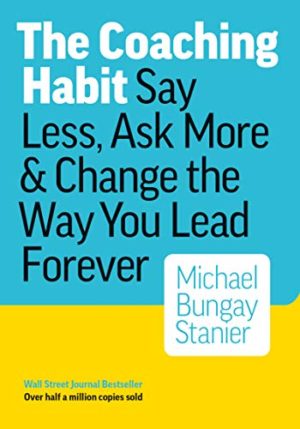
“The Coaching Habit” by Michael Bungay Stanier

The book, The Coaching Habit: Say Less, Ask More & Change the Way You Lead by Michael Bungay Stanier, is a toolbox for coaching individuals. The book is written for managers or leaders of organizations, but it has applicability to those in the coaching profession and to people that simply desire to incorporate coaching principles into any of their relationships.

The premise of the book is stated within the first few chapters:

  • Coaching is simple.
  • You can coach someone in ten minutes or less.
  • Coaching should be a daily, informal act, not an occasional, formal “It’s Coaching Time” event.
  • You can build a coaching habit, but only if you understand and use the proven mechanics of building and embedding new habits.

The book is built around a suggested framework for a coaching conversation that includes seven questions, including the bookends of a starting (kickstart) question and a wrap-up or summary (learning) question.

Seven Essential Coaching Questions:

  1. The Kickstart Question: “What’s on your mind?”
  2. The AWE Question: “And what else?”
  3. The Focus Question: “What’s the real challenge here for you?”
  4. The Foundation Question: “What do you want?”
  5. The Lazy Question: “How can I help?”
  6. The Strategic Question: “If you’re saying yes to this, what are you saying no to?”
  7. The Learning Question: “What was most useful to you?”

For each of these questions, the author provides some rationale and some advice on application. Also, interspersed with these questions are tips on effective communication in the coaching process and a process for building these questions into habits. In the introductory chapters and throughout the book, the author speaks about the human tendency to be quick to offer advice, so the habit-building exercises are intended to break our advice-giving tendencies and replace them with the habit of asking powerful questions.

The last paragraph in the book might be the most important as the author summarizes and urges us on:

“But the real secret sauce here is building a habit of curiosity. The change of behavior that’s going to serve you most powerfully is simply this: a little less advice, a little more curiosity. Find your own questions, find your own voice. And above all, build your own coaching habit.”

A coaching habit can be of great benefit in building strong relationships and helping those around us to grow. But the prerequisite is to have or to build in ourselves the necessary positive character traits such as humility, curiosity, and respect for others.

The book is an easy read with lots of good content. Recommended reading for anyone that desires to have a positive impact on other people in their lives. One caution that I would voice is that, while the author offers alternative wording for each, the seven questions can seem too much of a script for a coaching conversation. Coaching works best when it is a relaxed conversation within a caring relationship. Therefore, each person needs to take the concepts of The Coaching Habit and make it a part of their own coaching conversations.


Lead by Coaching

One of the primary responsibilities of a leader is to guide and encourage the growth and development of the team that they lead and the team members. An effective skill for developing people is coaching.

ICF, the International Coaching Federation, defines coaching as “partnering with clients in a thought-provoking and creative process that inspires them to maximize their personal and professional potential.” Tony Stoltzfus, in his book, Leadership Coaching, defines coaching as “practicing the disciplines of believing in people in order to empower them to change.” A simple description of the coaching process is that of using powerful questions to draw out of an individual their beliefs, values, and inner thoughts and goals and their motivation and path to grow or change. Through the coaching process we, as leaders, help individuals to identify and commit to the path or future that they most desire. Allowing or facilitating the person to think deeply and define their own path to growth and development provides much more ownership and commitment than they might show to someone else’s guidance.

The coaching process, using powerful questions to draw out inner thoughts, can be useful in many areas of leadership. It is certainly appropriate in defining goals and action plans for personal growth. An individual is much more likely to be committed to a plan that they have developed. Coaching can be an effective part of the feedback process. The recipient of feedback is more likely to internalize the impact of their actions or behavior when they have played a major role in identifying the impact and defining expectations for the future. The project planning process draws greater commitment when the individual plays an active role in defining the process as opposed to simply receiving an assignment.

These powerful coaching questions can have many different purposes, including the following:

  • Draw out new perspectives, ideas, or solutions from team members.
  • Aid a team member in developing self-awareness.
  • Help a team member to more fully explore or develop a thought or potential course of action.
  • Probe for or ensure buy-in or commitment to an action plan.

On a higher level, the coaching process is useful in building relationship. A communication process built upon questions demonstrates the value and respect that the leader has for the team member. The ability to think deeply and openly share those thoughts builds trust and respect on the part of the team member. This relationship of trust and respect is foundational for leadership.

How often do you ask questions relative to give direction or instruction? Are your questions powerful and empowering or disrespectful and manipulative?