The Link between Character and Emotional Intelligence

Character and emotional intelligence can be considered as two layers of our leadership capability, the two layers that are foundational to our leadership effectiveness. Character can be defined as the virtues, values, and traits that underlie our thoughts and actions. Emotional intelligence can be defined as the awareness and management of emotions, both our own and others’, to build positive relationships.

In the literature on leadership we often see character and emotional intelligence (EQ) treated as one and the same. Many of those writers that are focused on emotional intelligence (for example, Daniel Goleman) fold basic character traits into EQ. Similarly, those that are focused on character-based leadership treat EQ as a part of their definition of character. As an example, I facilitate a leadership development program using materials from Drs. Henry Cloud and John Townsend. They define character as ”that set of capacities the leader needs to meet the demands of reality.” Those capacities cover the combination of virtues, values, traits, and EQ behaviors.

character-emotional-intelligence-ohio

On the other hand, I generally think of character and emotional intelligence as two closely-linked but separate layers of leadership. Both character and EQ are a part of who we are as leaders. But emotional intelligence behaviors are built on top of the foundation of our character virtues, values, and traits. For example, respect for others is a character value that motivates our desire for relationship and drives us to further develop our empathy or our ability to work in a team.

This then is the basis for my analogy of a structure for leadership, where character (the virtues, values, and traits) is the foundation and emotional intelligence is the framework of our leadership. Those two ingredients are fundamental (or prerequisites) for making our leadership competency work. We can understand all the skills of leadership yet struggle if we have not yet built the strong foundation and framework upon which to build our leadership voice. Building our character and emotional intelligence is more than reading a few books, it is an experiential process since we build these into who we are and how we think. “We lead from who we are.”

What is your definition of character in leadership?

What are you doing to build the foundation and framework for your leadership?
What Is Character?

Character is the most important ingredient of leadership. I often use the analogy of a structure in describing leadership where character is the foundation. Without a strong foundation of character our leadership can be weak. We often describe leadership as the combination of character and competency. Without strong, positive character our competency can seem like a rudderless boat adrift.

character-development-reputatoin

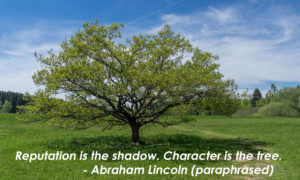
While character is a frequent focus of the discussion about leadership, there is no consensus on exactly how we should define it. Some definitions of character are quite broad while others are more narrow. All of the definitions refer to the inner values and behaviors that guide the way we think and operate. John Wooden said “The true test of a man’s character is what he does when no one is watching.” Character is sometimes described as the sum of virtues, values and traits.

Here are some dictionary definitions of character:

  • the way someone thinks, feels, and behaves – from Merriam-Webster’s Dictionary
  • the mental and moral qualities distinctive to an individual – from the Oxford Dictionary
  • the particular combination of things about a person or place, esp. things you cannot see, that make that person or place different from others – from the Cambridge Dictionary
  • the complex of mental and ethical traits marking a person – from Webster’s English Dictionary

The broader definitions of character often fold together character traits and emotional intelligence behaviors. Daniel Goleman’s writings on EQ often do so. Drs. Henry Cloud and John Townsend define character as “that set of capacities the leader needs to meet the demands of reality. A person of character is one who connects well; is clear in her responsibilities; can handle problems and negative realities; and understands her role and mission.” A similar definition of character is “the stable and distinctive qualities built into an individual’s life which determine his or her response regardless of circumstances.”

Character is the guiding light for how we engage with those around us, with whom we choose to interact, the quality of our relationships, the way that we make decisions, the priorities that we set, what we value, the tradeoffs we are willing to make, etc. Character affects everything we do and say. Our character determines whether those around us accept our leadership or influence. Our character is the basis of our leadership.

How would you describe character?
How would you describe your own character?

What’s Your EQ?

Leadership is defined as influence. Our ability to influence is dependent upon the quality of the relationships that we build with our constituency. The quality of these relationships is largely a result of our effective use of our emotional intelligence.

emotional-intelligence-eq-domain-relationships

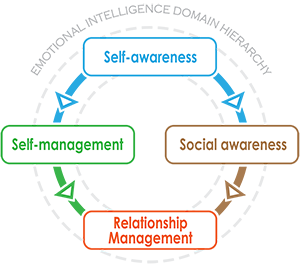
Emotional intelligence or EQ skills fall into four categories or domains – self-awareness, self-management, social awareness, and relationship management. Each of these domains contain a few skills that help a leader (or any person, for that matter) relate to others. We don’t necessarily need to master all of the skills within emotional intelligence, but we need a good representation from each of the domains. There is, in fact, a hierarchy among the domains where strong self-awareness is a prerequisite for both self-management and for other or social awareness and both self-management and social awareness are prerequisites for relationship management.

I recently wrote an article for PolymerOhio Manufacturing Services describing EQ and its importance as part of effective leadership. That article goes into more depth as to the various skills within emotional intelligence and the relationship between the four domains.

As leaders we should be cognizant of our strengths and weaknesses in the area of emotional intelligence and working to strengthen our ability to relate effectively with those that we hope to influence. What’s your EQ?

Leadership and Humility

While effective leaders are often intelligent and high-functioning, humility is a key character trait of the best leaders. Humility draws in people while arrogance drives them away.

No doubt we have all seen people in leadership positions who had either high IQ or great expertise, but they struggled as leaders because of a weakness in character or emotional intelligence. They struggled to build relationships or gain influence because of their arrogance and pride.

On the other hand, effective leaders demonstrate humility and it shows up in the way that they lead. The Merriam-Webster dictionary defines humility as “the quality or state of not thinking you are better than other people.” Tim Keller’s definition is more descriptive when he says that humility is not thinking less of yourself, it is thinking of yourself less. So effective leaders think of themselves less and think of others more.

Effective leaders are committed to their people, helping them learn and grow, looking for ways to help them develop on the job and as people. And speaking of growth, effective leaders are committed to their own growth, recognizing that they never know it all. Humble leaders readily admit mistakes. In fact, they are quick to distribute credit for positive things and accept blame for negative things. Because they value their people, they are not seeking the limelight but shine it on others.

In his book, “Good Boss, Bad Boss”, Robert Sutton explains, “Wise bosses have the confidence to act on what they know and the humility to doubt their knowledge.” They are ready to admit mistakes and accept input from others. In accepting input, they are quick to demonstrate that they value others and their knowledge and gifts. Humble leaders seek feedback to assure that they are on track.

Humble leaders are able to admit mistakes, accept and admit limitations, and demonstrate vulnerability. They are ready to embrace and promote a spirit of service. People quickly see through and move away from a self-promoting leader.

Effective leaders show their humility by remaining thankful. They are also quick to forgive, a result of thinking of others before themselves.

The effect of a humble leader is a workforce that feels they are valued and empowered. This leads to a more productive, more innovative, and more collaborative team.

If you think that you have this humility thing down pat, you probably don’t. On the other hand, if you are a leader who thinks of others first, acknowledges their wisdom and contributions, are aware of your strengths and weaknesses, can readily admit your failures, and seeks to continually grow, then you might be well along in developing humility.