Example of a Great Business Strategy

A fever for growth and volume was driving this company toward bankruptcy until they developed a great strategy that turned them around, resulting in consistent value creation.

Under previous owners a manufacturing company with which I am fairly familiar was growing by grabbing any piece of business they could find. They were heavily dependent on the automotive industry, faced a large number of similar competitors, and were rapidly going broke. The management team bought the company just before bankruptcy and proceeded to define a new business strategy that made more sense.
strategy-development-ken-vaughan

Their new business strategy had five elements that defined where and how they would compete. First, it defined the sorts of products that they thought they could produce well, secondly it defined the kinds of markets that they hoped to serve, and then it described what the expectations would be of their target customers and the skills that they would need to offer. There were two primary markets that they wanted to serve and they were narrowly defined, both expensive equipment markets. They knew that the producers of this sort of high-priced equipment would have high expectations for quality and that suited the company just fine. By the nature of these equipment markets, they expected that customers would demand short runs and much smaller quantities than the norm that they had dealt with before their business had collapsed. Also these customers would demand quick order turnaround.

One of the benefits of defining this strategy and pursuing these market niches was a change in the competitive dynamics; the number of truly capable competitors would shrink from thousands to a mere handful and it would be difficult for international competitors to meet the delivery requirements. Another advantage would be that the relative cost of the components that this company would produce would be a tiny fraction of the purchased components for their target customers. The target customers would have limited choices and would willingly pay for the value that the company could provide. As they shrank the business and shifted to this new strategy, sales declined by more than 60% as they “fired” customers but profit margins shot upwards and the net result was very advantageous.

The new business strategy provided a guide for where they should seek business. Not every piece of new business meets all five of the criteria, but the company is never tempted to chase an order just to gain volume. Customers who need the value offering that is provided are willing to pay a reasonable price with reasonable margins. There are still a few competitors with a similar value offering but the business for which they now compete is not subject to cutthroat pricing.

Once they established the market to be pursued and the value offering to be provided, the new business strategy met the other purpose of a strategy statement: it began to drive every decision and every action. They asked themselves, “What core competencies do we need to build to produce these particular types of parts at an extremely high level of quality?” and “What core competencies do we need to develop to provide efficient processes for short runs and quick order turnaround?” So the strategy began to drive every decision – the people to hire, the machines to install, the skills to learn, the technologies to develop, the orders to pursue or not pursue, the way to organize, the services to offer, which capabilities must be in-house, processes and procedures, etc. Everyone in the company marches to the same tune; they know the strategy and what makes the company unique and successful.

More than 20 years later this company still uses this same business strategy. It has continued to build the core competencies that enable it to produce their selected parts at very high levels of quality and work as a job shop in a high-volume industry. They consistently generate strong margins and growing sales revenue. The right business strategy saved them from the fate of many of their former competitors and built them into a strong and successful supplier.

Does your organization have a business strategy that sets it apart from the competition, drives the company’s decisions, and builds long-term value?

The Purpose of Business Strategy

The purpose of business strategy is to define how the organization should allocate resources in order to meet its goals and objectives and move toward its vision. Business strategy describes where and how the organization competes. This strategy is set in the context of customer needs, core competencies of the company, and the value offering relative to that of the competitors.

purpose-business-strategy

When I think of strategy, I focus on for-profit businesses because that is my experience and my audience for consulting. These same concepts apply to other types of organizations with some minor translation.

The primary goal of a business is to achieve a return on investment for those providing resources to the business. In the long run that return is a function of the value that they offer to customers compared to the perception of value of the offering in the eyes of customers.

Businesses provide some combination of goods and service to their prospective customers. This combination of goods and services is their value offering. Customers make choices about the value of each prospective supplier’s offering based on the customer’s needs. What level and array of service has value and how much? What features and benefits of products has value and how much? There are generally an array of prospective customers with varying needs and an array of potential suppliers with varying value offerings.

The ability of the organization to generate profits is a function of identifying customers with needs that match the organization’s ability to supply a value offering that is either produced more economically or a value offering that has unique value attributes (or some combination) compared to competitors. It is easy to see the extreme examples. Customers who buy sand often want the least expensive sand whereas customers who buy rocket engines probably have a unique set of desired features and benefits.

Organizations have a variety of capabilities to supply their package of goods and services. When certain of these capabilities are able to provide unique value to customers, we call this capability a core competency. Core competency might be proprietary technology that allows a unique design or manufacturing process resulting in some superior value to certain customers. It might be unique knowledge of a market or a customer’s needs. It might be unique access to lower-cost resources. It might be anything that differentiates us and adds value for the customer.

The purpose of strategy is to identify where and how to compete and to guide the allocation of resources. (For another interesting perspective of how strategy should allocate resources see this article in HBR by Michael D. Watkins.) Strategy identifies core competencies the organization is building that will enhance its value offering, the how to compete. Strategy identifies the types of customers that will most highly value the offering, the where to compete. Where to compete might include definition of region, demographics, end applications, specific names of customers, or many other attributes.

The strategy statement then should be a clear and concise statement of this where and how to compete. The organization should be able to look to the strategy statement in the midst of every decision and answer the question, “does this decision support and build our strategy?” The action plan is a natural outflow as we attempt to implement the strategy to build core competencies and achieve our objectives. These are all part of an overall strategic management system for the organization.

Every organization has a strategy, whether it is explicitly stated or implicit in the way that they operate, and whether it is well-defined or a murky mystery. How would you describe your organization’s strategy?

Tactics and Action Plan

The tactics and action plan describe the activities of the organization to implement the business strategy and achieve the strategic objectives. The action plan is the final piece of a strategic management system that translates mission and vision into goals and objectives which then drive business strategy which then unfolds into action plans.

strategy-tactics-action-2

While the business strategy presents a long-term description of where and how the organization intends to compete, the tactics and action plan are focused on specific outcomes, the short-term time frame, and discrete steps. They describe the activity that will take place to further enhance the organization’s core competencies, build a sustainable competitive advantage, and deliver superior value to customers.

Tactics are programs, initiatives, and projects to implement the strategy, to incrementally change the organization in the direction of the vision, goals, and objectives. As such, tactics are at a higher level and are then composed of a variety of specific actions.

The action plan describes the specific tasks that will be performed in order to carry out the tactics, implement the strategy, and achieve the goals and objectives. These action plans need specific definition of the task, the responsible person, the completion date, and any resources required. These action plans are then constantly monitored to assure that the organization is progressing in the implementation of its strategy.

In a previous article we gave an example goal that might be “Develop a more capable and stable workforce.” One of the supporting objectives might then be “Reduce annual non-retirement turnover to less than 8% of the total workforce by January of 2020.” With this objective, a tactic might be a program to change the culture of the organization. One of the actions might then be to develop and roll out a comprehensive employee communication plan. The action plan will identify the responsible person, the resources required, and the milestone dates.

All organizations are constrained by limited resources – limited number of people, limited available funds, limited time, etc. The other purpose of the action plan is to prioritize the allocation of these resources towards the highest leverage activities. To achieve the organization’s objectives, we need to assure that we are investing our resources on the activities that will build value and generate the highest return.

Does your organization have a clear, effective strategy supported by a good action plan? What do you see as the biggest challenge regarding your action plan?

12 Practical Descriptors for Business Strategy

Business strategy is the linchpin between vision and action plans. With a good statement of strategy organizations are on the fast track to success. Without a good statement of strategy organizations can feel like they’re wandering in the desert. Some time ago we described a strategic management system that led from mission and vision through goals and objectives to strategy and on to tactics and action plans. Strategy is the critical element that bridges from what the organization hopes to be to the actions that will get it there.

Business strategy describes where and how the organization will compete. A good statement of strategy looks like the following: “We are an injection molder of large, flat parts for high-quality applications such as medical or business equipment where customers need short runs and quick turnaround of orders.

Here are some descriptors of business strategy:

  • First of all, a business strategy is a statement. It is not be a document or a book. It may be part of a strategic planning document. It may result from a strategic planning process. But a business strategy is simply a statement of where and how to compete.
  • The best strategies are concise, stated in one sentence. Certainly a strategy shouldn’t be more than a short paragraph, perhaps three sentences.
  • A strategy statement is an internal communication tool to align the organization and its activities with the vision and objectives. It assures that we are all working towards the same objectives in the same way.
  • Strategy is built on a knowledge of markets, customers, and their needs. It describes the unique value that we offer to customers based on this knowledge of their needs.
  • A strategy statement is a confidential communication about our competitive position. Strategy describes how we intend to differentiate our organization and its value offering from that of competitors. To broadcast the strategy outside of the organization and its strategic partners would open the door for competitors to gain the same knowledge and follow the same path.
  • Strategy describes the core competencies the organization intends to exploit to provide superior value to your customers. In our example we can see that core competencies might be capabilities for high-quality manufacturing, efficient production of low volumes, and the ability to quickly respond to orders.
  • Strategy defines a path to a sustainable competitive advantage. A core competency should be more than “just as good” as the competition.
  • Strategy guides decisions and our allocation of resources. Will hiring this person or investing in this piece of equipment enable us to enhance the core competencies that set us apart from competitors?
  • Strategy enables prioritizing our business opportunities. It describes our target market or target customers. Who are the customers that will most value the products or services that we’re offering? Every potential business opportunity can be vetted by the strategy. This might not mean bypassing every opportunity that doesn’t exactly match the ideal, but it enables us prioritize various business opportunities and focus our efforts on business that will be most profitable.
  • Strategy is the driver for all tactics and action plans. The action plans are simply the implementation of the strategy. Any action that does not support the strategy is wasted energy.
  • And finally, a business strategy must be realistic, not a pipe dream. The strategy should challenge the organization to a higher level of performance but not represent an impossibility.

What other descriptors would you have for a good business strategy?
Does your organization have a clear, concise statement that defines your business strategy?
Is it guiding your decisions and likely to take you towards your vision?

Goals and Objectives

goals-strategy-ohio-developmentGoals and objectives provide direction, inspiration, and a standard for measurement of performance for an organization. Goals define direction or destination while objectives set specific targets or milestones for performance measurement.
In a previous article we defined a strategic management system that began with mission and vision for an organization built upon core values and principles. The management system then defined a process for driving action plans that would achieve the vision. While vision is a long-term view of what we want the organization to someday become, goals and objectives set targets within the planning horizon along the path towards the organization’s vision. Once we establish goals and objectives, they should become a call to action for the organization.

Goals are qualitative statements that set direction into the future. They become the rallying points for the organization to move forward. Since goals set priorities for the organization, we can only have a limited number of them and they must be congruent with each other.

Objectives set the targets or milestones for moving forward. Objectives are quantitative and must always be SMART which means they are –

  • Specific – the terms or definition is clear and well understood within the organization
  • Measurable – there is an accepted and defined means of quantifying performance
  • Achievable – the organization must have the power and authority to take the necessary steps required to achieve the objective
  • Relevant – the objective must be a critical target that moves the organization towards its goals and vision
  • Time-based – there must be a stated target date for achievement of the objective

There is always the ability to state a definite yes or no as to the achievement of our objectives.

As an example of goals and objectives, let’s imagine an organization where its performance is highly reliant on the skills of its workers. A goal might be “Develop a more capable and stable workforce.” One of the supporting objectives might then be “Reduce annual non-retirement turnover to less than 8% of the total workforce by January of 2020.”

As we step through the management system from mission to action, each step gets more specific towards defining the critical action steps that must be taken to move the organization forward. Without clear goals and objectives, we have no way to judge the value of our actions.

Does your organization have clear goals and objectives? Do they align with your vision and prompt appropriate action?

The Funnel: From Mission to Action

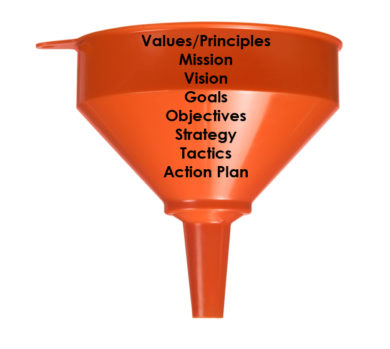
There are certain fundamental elements of a management system required to move a business or organization forward and keep it on track. These elements are the thoughts or documents required to align what we do each day with where we want to go as an organization. The essential elements are as follows, where one leads into the next:

Different people have slightly different definitions or uses for these various terms, for example, some regard objectives as the more general and goals as the specific, quantified targets. This article quickly defines each of these elements as I use them when consulting with clients. As they are described you will see that they blend together and move from a very broad view to very specific statements of action, hence the analogy of the funnel.

Values/Principles are the fundamental beliefs that the organization has about certain things, most frequently in regard to how it treats or deals with its various stakeholders. These values may be implicit in the way that the organization is managed or they may be explicitly stated.

Mission is a statement of the purpose of the business or organization. It describes what it is. We can view it as the statement to the world of what the organization does. Think of it as the sign on the front lawn.

Vision is a statement of what the organization wants to be. In my mind this is a private view of the hopes and dreams of the business. This might be the statement that one would use to draw in a potential investor.

Goals are statements of where the business wants to be or what they want to achieve in the future. Goals are qualitative statements that further define the vision. In a planning process we might set out some goals early as general targets that later become more specific objectives.

Objectives are the specific, quantified targets that further define the goals. They have associated dates and are milestones on the future pathway of the organization. Depending on the organization and the environment, the timeframe could be expressed in weeks, months, years, or decades. For most businesses these objectives will be 3 or 5 years in the future and often consist of targets for sales revenue, profits, market share, etc.

Strategy describes where and how the business will compete. It is the path to the goals and objectives. For a business this strategy is set in the context of customer needs, core competencies of the company, and the value offering relative to that of the competitors.

Tactics are programs, initiatives, and projects to implement the strategy, to incrementally change the organization in the direction of the vision, goals, and objectives.

The action plan describes the specific tasks that will be performed in order to carry out the tactics, implement the strategy, and achieve the goals and objectives. These action plans need specific definition of the task, the responsible person, the completion date, and any resources required.

Hopefully it is obvious that the elements of the management system must be in perfect alignment. When they are not aligned, we simply confuse the organization. There are certain actions that are a requirement of maintaining a business such as paying taxes and fixing a leaky roof. Other than these required tasks, all of our actions should be related to the higher levels of our system – the strategy, the objectives, and the vision. In developing this strategic management system the important measurement is not the weight of the documents but rather the clarity, logic, and consistency of communication.

As leaders of an organization, we are tasked with developing and communicating this management system and providing the guidance and resources to accomplish the vision.