Competitive Advantage

Competitive advantage is what makes one supplier better than other suppliers. It is an advantage over competitors gained by offering consumers greater value, either by means of lower costs or by providing greater benefits and service that justifies higher prices. The objective in strategy is to develop a sustainable competitive advantage, one that cannot be easily replicated by competitors. If it can be quickly replicated by competitors, then it is not an advantage.

If a business is unable to develop a sustainable competitive advantage, it is doomed to be a commodity supplier, able to compete only on price but without a cost advantage to back it up. Without a defined, sustainable competitive advantage, businesses will generally be low profit, low return companies and constantly struggling to compete.

Companies may develop a competitive advantage that is based on either a cost advantage or a differentiation advantage. The cost or differentiation advantage might apply to an overall market or to a specific segment of a market (i.e., a focus strategy). These advantages can be built upon various elements.

A cost advantage can be built upon the following:

  • Operational excellence or expertise – An organization might have the ability to design processes and manage their operation in such a way that their costs are below what competitors are able to achieve.
  • Access to lower cost inputs – An organization can be positioned, located, or associated with some source that provides lower cost raw materials, capital, or labor.
  • Know how – A company might have special knowledge, either patented or trade secrets, that enable it to produce at a lower cost than competition.

A differentiation advantage is always based on better meeting customer needs and can be built upon a wide variety of elements that might include the following:

  • A technology advantage that enables a company to provide product or service benefits that other competitors are unable to offer.
  • An innovation advantage that enables a company to stay one step ahead of the offerings of competitors.
  • An agility or adaptability advantage that enables a company to react more quickly to changing customer needs.
  • An information or market awareness advantage that enables a company to more fully comprehend the needs of customers and provide a package of products and services that is more highly valued.
  • A brand name or market image that provides an advantage over competitors.

Companies develop a competitive edge when they produce attributes that allow them to outperform their competitors. As mentioned above, a competitive advantage must represent a benefit to customers, meeting their needs, and represent a value beyond that available from competitors. The strength of a sustainable competitive advantage determines the ability of a business to achieve a stable or growing market position and a price that contains a level of profit that other competitors are unable to achieve.

Does your strategic planning process identify your business’ sustainable competitive advantage and how to achieve it?

Case Study in Strategy Effectiveness

I define business strategy as a description or statement of where and how an organization intends to compete. A longer version of this definition would be business strategy is a description of where and how an organization intends to compete, using the organization’s core competencies to meet customers’ needs and provide a compelling value to the customer. Sometimes it can be difficult to translate this rather academic definition into a real-life strategy. A case study of what strategy is and how it can transform a business can be helpful in developing our understanding.

Some years ago, two of my friends bought a business and transformed it simply by defining and implementing a great strategy. Of course, it took some effort to first define a great strategy and then to implement it by changing the way the business operated. On the other hand, the investment was primarily in thought and discipline.

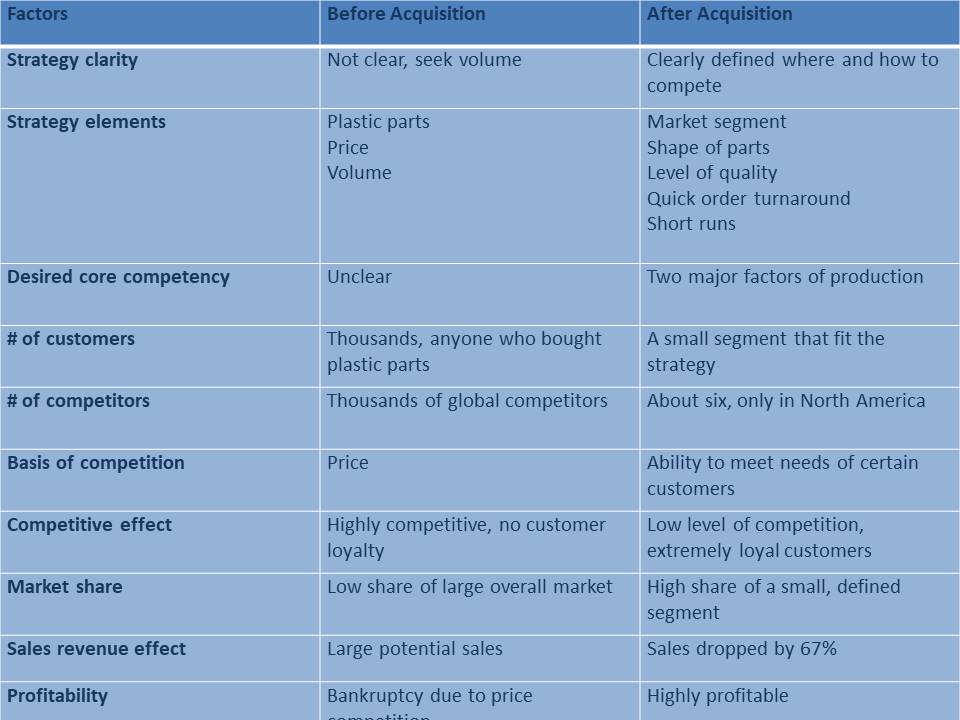
The business happened to be an injection molding business. Before the acquisition, the company was a fairly large molder of plastic parts mainly for the automotive industry. While every business has a strategy of some sort, either explicit or implicit, it is hard to describe just what the strategy was before the acquisition. As with many of the thousands of injection molding businesses, the strategy could be described as “find and pursue any business that they could make.” That would be the where of strategy. The how of their strategy might be described as competing on price with a hope of building volume. Without any clear core competency or competitive advantage, the company competed mainly on price. And without anything to set it apart, it competed with hundreds or thousands of other companies with similar capabilities. Therefore, the company faced stiff price competition and customers that had no loyalty but would quickly switch suppliers for a lower price. Since they continually needed to give price concessions to keep their volume, it was not surprising that the business went into bankruptcy.

As my friends acquired the business out of bankruptcy, they defined a strategy for success. The impetus of the strategy was to utilize the productive capacity of the acquired company while developing some particular core competencies. The immediate impact of the new strategy was to fire most of the previous company’s customers and focus on a new set of customers, resulting in an immediate shrinking of the company to one-third of the sales revenue. However, the one-third of the revenue was more profitable than the previous company had ever been.

Their new business strategy had five elements that defined where and how they would compete. First, it defined the sorts of products that they thought they could produce well. Secondly, it defined the kinds of markets that they hoped to serve, and then it described what the expectations would be of their target customers and the skills that they would need to offer. There were two primary markets that they wished to serve, and these were narrowly defined, both expensive equipment markets. They knew that the producers of this sort of high-priced equipment would have high expectations for quality and that suited the company just fine. By the nature of these equipment markets, they expected that customers would demand short runs and much smaller quantities than the norm that they had dealt with before their business had collapsed. Also, these customers would demand quick order turnaround.

The newly-defined strategy was targeted at meeting a clear set of needs for a specific set of customers. By providing a clearly superior value to these customers, the strategy led to satisfied customers. More importantly, the strategy defined a market and way to compete that eliminated most of the potential competitors. For this particular set of customers and their needs, there were not many competitors who were able or willing to develop the capability to serve this segment.

The new strategy provided focus for the re-organized company. It identified the customers that they would and, by default, would not serve. It defined the products that they would and would not produce. Most importantly, it defined the two core competencies that they would pursue – 1) the ability to consistently make this type of part at the necessary levels of quality and 2) the ability to efficiently produce short runs with fast turnaround. With the strategy in place, they knew precisely what capabilities they needed to develop. The strategy then guided the equipment in which they invested, the skills and technology that they would develop, the employees that they would hire and promote, and other decisions that shaped the company. With a clear strategy that focused and guided all of their decisions, they became a very successful and profitable operation. Most importantly, the strategy defined the value that they would offer to their select set of customers so that they developed strong and stable relationships with their customers.

Does your organization have a clear and compelling strategy that guides your decisions and defines how you will succeed?

SWOT Analysis

Most people in the business world are familiar with SWOT analysis – Strengths, Weaknesses, Opportunities, and Threats. SWOT analysis is useful in many life and business decision-making situations. It is an important part of the strategic planning process. Despite being familiar to most people, it is not always used effectively in the planning process. This article presents a reminder of how SWOT should be used in the strategic planning process.

The Strengths and Weaknesses portion of SWOT is an inward view. They present the advantages or disadvantages of the organization, Strengths providing the advantages and Weaknesses describing the disadvantages. They are considered relative to the capabilities of competitors and in the context of customer needs. As an example, a new building or a certain manufacturing process is not a strength. Being more efficient because of a new, more organized building or a new manufacturing process could be a strength if it provided an advantage of faster delivery or lower costs, assuming that this was important to customers. The strength is actually then faster delivery or lower costs due to ….. Or another example, the ability to make our product a brighter blue is only an advantage or a Strength if customers actually would prefer a brighter blue. If any shade of blue is acceptable or if the customer would not pay more or switch suppliers for a brighter blue or if competitors already have a brighter blue, then there is no advantage or Strength.

Sometimes in evaluating Strengths and Weaknesses, organizations might ask the question “What do we do well or not so well?” But this question is too vague. In identifying Strengths it is better dig deeper and to answer questions such as the following. Imagine just the opposite to understand Weaknesses.

  • What would our customers say is our strength or advantage?
  • Why do we get the order?
  • What resources do we have or have access to that give us an advantage?
  • What knowledge or intellectual property do we have that others might not have?
  • What processes are we skilled at that give us an advantage?
  • What do we have, know, or do that our competitors wish they had?
  • What are the major reasons for our profitability or market share?

The Strength or Weaknesses needs to precisely defined, such as a $10 cost advantage due to specially-designed production advantage or 20% advantage in signal attenuating performance due to patent #99999.

Opportunities and Threats are the result of external factors. Opportunities are elements in the market environment that could be exploited. Threats are elements in the market environment that could present risk or cause trouble for the business. The market environment in Threats and Opportunities must be thought of broadly. It is more than current customers or current markets. Threats and Opportunities are affected by the entire value chain, by world politics and economics, by social changes, by environmental or resource impacts, by technologies of various sorts, etc. as well as factors impacting customers and competitors.

The questions that might be asked relative to identifying Opportunities are endless but here are a few examples:

  • Do our customers have unmet needs relative to our products or services?
  • Are there similar customers or markets that have similar needs to our markets or customers?
  • Are there particular segments of the market that are underserved or where competition is thin?
  • Are there competitors that might be exiting the market or leaving opportunities for us?
  • Are there potential changes in economics, politics, societal norms, regulations, or technologies that could result in opportunities for our products or services?
  • Are there changes in technologies or other factors that could present opportunities to improve or greatly change the way that we produce products?

Similarly, there could be a long list of questions regarding threats. Here is a sampling:

  • How healthy are our customers and is there risk of an industry shakeout?
  • How likely is the potential for new competitors entering our market?
  • What current or potential activities could lead to more aggressive action from our competitors?
  • Is there a potential for changes in the value chain that could adversely affect our customers or their need for our product or services?
  • Are there potential changes in economics, politics, societal norms, regulations, or technologies that could present risks for the market for our products or services?
  • Are there changes in technologies or other factors that could threaten our ability to produce products?

To get the full value of SWOT analysis in the planning process requires a rigorous effort. The items listed should be precise and definable. The list in each section should be realistic and prioritized. The analysis communicates best with only a short list of the most important factors. The purpose of the SWOT analysis is to increase the understanding of the business and to drive the implications into strategy and action plans.

Once you understand how to compile a good SWOT analysis, the results should provide a deeper view of your business. The SWOT analysis tool provides a means to explore new opportunities and improve your decision-making process.

Is your SWOT analysis clear enough to impact your strategic direction?

Strategic Segmentation

Most people are familiar with the concept of market segmentation, dividing the market for a company or product into various buckets that can then be further analyzed and understood. In consumer products the market is often segmented based on demographic factors such as age, income, education level, gender, ethnicity, or other distinguishing factors. In business-to-business markets, segmentation is often done based on factors like size of customer, end market, distribution channels, region, or other identifying traits. Market segmentation in this fashion is all well and good. It allows the supplier to examine various portions or segments of the market to identify trends or performance issues such as variability in market growth, market penetration, market share, profitability, etc. The information learned from these sorts of market segmentation studies can provide evidence for adjusting sales and marketing efforts, distribution programs, product offerings, and many other things.

There is another type of segmentation, often referred to as strategic segmentation, which is more valuable than simply slicing up the market to understand trends in various portions of the market. Strategic segmentation is the process of identifying the particular group of customers whose buying needs most closely match the value offering of the supplier. The purpose for strategic segmentation is to identify the characteristics of the segment to then make it easier for the organization to focus its efforts on the segment that is more likely to appropriately value the organization and its offering.

Identifying the means to segment strategically is not always easy. Buyers generally don’t post their buying needs on their website or on a sign on their front lawn. Sometimes this segment can be identified by their existing suppliers when there are competitors that provide a very similar value offering. Otherwise, the process of strategic segmentation requires developing an understanding of the characteristics of customers that correlate with that group that values the organization’s product offering.

For large and diverse markets, strategic segmentation is critically important. Understanding performance measures such as market share, brand recognition, or customer satisfaction in the strategic segment is generally more important than overall measures for a large market. Understanding the growth or changing needs of the strategic segment is more important than the growth or changing needs of an overall market.

The bottom line regarding segmentation is to not settle for some easy way to do market segmentation but rather do the work required to understand the strategic segmentation of the market. Focusing the organization’s efforts on the right segment brings a greater return.

Does your organization understand what defines your target or strategic segment?

Five Perceptions of Strategy Development

Plan, path, pattern, position, or perspective – which is your perception of the development of business strategy? Depending upon the way that your organization develops and utilizes your strategy, you may have a different perception of how strategy is developed. The definition of strategy does not change based on this perception. It is still defined as a statement of where and how the organization competes. But different organizations experience different routes to their current statement of strategy.

Strategy development as a plan is often the expectation. Organizations often go through a periodic process of analyzing the external or market environment and their own internal position. Based on this analysis, a certain preferred business strategy is chosen from a set of alternatives. It is chosen because it is perceived to be the optimal route to maximizing value. Then a series of actions are laid out and implemented with the intent of growing the firm into what the strategy defines. The organization is following a plan to move from where they are to perhaps a more effective strategy.

Strategy development as a path is often the actual process, especially for smaller business. Along the path, the organization adapts to new business opportunities and changing internal capabilities as it evolves. Over time then there becomes an emergent strategy, which can be quite different at various stages in the life cycle of the firm. If this evolution is managed wisely, the firm grows in capabilities and continually moves to higher value opportunities. Or the firm has a growing awareness of the market environment or evolving customer needs and is opportunistic in moving forward and adapting its strategy to greater opportunities.

Strategy development as a pattern is built around an inward view of the organization. This is a behavioral pattern based on some beliefs about why the particular organization exists or a vision of what the firm should be. For example, a company that sells luxury goods may have several business units but all follow some type of high-end strategy. Its pattern is one of operating in exclusive realms and the strategy it develops is constrained by the pattern that it perceives as appropriate for itself.

Strategy development as a position is built around a market or downward view by the organization. Its reason for existing is to serve some type of market or customer need. For example, there are several companies that are an agglomeration of various restaurant chains. The parent company perceives its strategy as providing a dining experience to certain segments of the consumer market, then acquiring or building various restaurant concepts to do so. The business strategy grows out of the position that the firm expects to occupy.

Strategy development as a perspective is more of an outward or upward view by the organization. The organization’s goal is loftier, such as a technology company that wants to apply technology to improve the consumer’s daily life. The perspective most likely comes from a desire to serve mankind or to make the world a better place. This vision then drives the development of the organization’s strategy.

What is the driving force behind your organization’s strategy? What route have you followed as your organization developed and evolved?

Why Strategic Planning Fails

Strategic planning is a key process for driving change, growth, and value creation in an organization. Business strategy defines where and how to compete. The strategic planning process provides a discipline for understanding customer needs, the market and competitive environment, the competitive position of the firm, the strategy and the core competencies required, and the actions necessary to develop the core competencies and implement the strategy. It is the tool for changing the firm from what it is to what it aspires to be.
Some organizations struggle with the strategic planning process. They may have made some effort at planning without realizing any noticeable benefit. Some organizations go through the motions of strategic planning and then put the resulting document on a shelf and dust it off the next time they get around to planning again. Without a clear understanding of the process and purpose, strategic planning can be frustrating or intimidating.

The strategic planning process need not be burdensome. But there is a certain amount of discipline required to plan effectively. There are nine major reasons why organizations fail to achieve the appropriate value from the strategic planning process, as follows:

Failure to understand customer needs. The reason for any firm’s existence is to serve the customer and meet their needs. Unfortunately, some organizations have lost sight of this. Instead their focus is on generating revenue or profits or simply producing products. An important element of the strategic planning process is understanding the customer and their needs. Competition is all about providing value as perceived by the customer, which means meeting their needs. Only when a firm understands those customer needs are they ready to identify a plan to provide a value offering with a competitive advantage.

Failure to recognize the market environment correctly. The strategic plan should identify the path to competitive advantage over other suppliers in providing value to the customer. Underestimating or failing to understand the capabilities of competitors can allow the firm to head down a path that is already crowded with similar suppliers. Or failing to see a logical evolution in market structure or the market environment can leave a firm without a tenable market position. The organization needs to have confidence that the plan, when achieved, will provide a great future for the constituents of the firm. Being blindsided by industry or market changes similarly reduces the value of the plan. It is impossible to be totally prescient but the planning effort needs to take a close look at the market and competitive environment and provide a path to competitive advantage with appropriate contingencies for high risk scenarios.

Failure to see the reality of the firm’s position. Too often organizations spend a good part of their planning efforts patting themselves on the back. Sometimes firms stumble for the opposite reason, a “woe is me” attitude without thinking creatively about what are or could be competitive strengths. Instead the company should realistically assess strengths and weaknesses as compared to competitors in light of customer needs. Only after developing a clear understanding of where they stand today is a firm able to plan the path towards what they wish to become.

Failure to define a strategy that is strategic. A common failure is developing a statement of strategy that prompts no action. The central part of the strategic planning process is developing a business strategy that will build and leverage core competencies to meet customer needs. A previous article described what this strategy statement is not; it is not buzzwords, a set of goals, a long-range forecast, or a few random actions for the future. Instead it is a clear description of where and how to compete. The strategy prompts action to build the capability to do compete effectively.

Failure to determine the action plan required. The strategic planning process provides the framework for prioritizing all of the actions that will create competitive advantage and provide value to the customer. Most strategic plans will have an action plan. The big error that occurs is in not identifying the critical actions required to build or enhance the firm’s core competencies and pursue the strategy and instead including a list of random actions. This stage of the planning process requires the firm to focus its efforts and resources on the actions that will create value for the firm over the long term.

Failure to do the implementation. It is not enough to list actions, they must be accomplished. Too often these are considered long-term actions and the organization forgets about them and goes about its day-to-day activities. This is why the action plan should always list the responsible parties and the milestone dates. Since these are the actions that determine how effectively the firm will compete in the future, these should be the highest firm’s priority actions and receive appropriate attention.

Failure to communicate the plan with clarity. The strategic plan is more than a planning tool. It is the means to organize, prioritize, and energize the organization and transform it from what it is today to what it must be in the future. The strategic plan needs to be communicated broadly and clearly within the organization to motivate people and change the organization. One common error is producing an overly complex document. The information required for strategic planning is the information that the leadership team should be considering every day. The plan itself then should be the most critical information that guides the decisions and actions of the firm.

Failure to get buy-in from the organization. Sometimes a committee or even an individual is assigned the task of strategic planning. Or the executive team goes off for a two-day planning session. Then the plan is revealed to the organization. Without any ownership or involvement much of the organization then ignores what is being communicated. Rather it is better to plan in stages and seek input broadly throughout the organization. The greater the ownership, the greater the participation in implementation.

Failure to use the plan to drive day-to-day decisions. Perhaps the most common cause of failure, too often the strategic planning process is viewed as an annual process with little relevance to daily operations. The purpose of strategic planning is to guide the firm into a successful future based on building the capability to better meet customer needs and provide an advantage over competitors in doing so. A myopic focus on shipping today’s product while ignoring the future competitiveness of the firm is short-sighted. Business strategy and the strategic plan should set the priorities and guide every decision. Therefore, the strategic plan should impact the annual operating plan, the budgeting process, the performance management process, the weekly staff meetings, and every other decision-making process.

Strategic planning is about the options and the choices. It needs to be comprehensive but does not need to be complex. The strategic planning process needs to answer a few questions, such as – Which customers are we best suited to serve? What are their needs? What factors in the market environment present threats or opportunities? Which competitors do we face and what are their strengths and weaknesses? How do we best compete and deliver value to our customers? What differentiates us from our competitors? What actions do we need to take in order to better meet customer needs and distance ourselves from our competitors? With the answers to such questions the organization has a direction for the future.

Is your strategic planning process building the organization for the future? Do you see other modes of failure of the planning process?

Strategy Focuses Effort

One of the primary benefits of business strategy is providing focus for the organization. Without strategy to serve as the mantra, the organization can wander into chaos as people pull in different directions or as a stream of new priorities emerge.

Business strategy is a statement of where and how the organization will compete. It defines the competitive advantage that the organization seeks to develop in meeting the needs of a defined set of customers. It then serves as a screen for the decision-making process of the organization. As such, the business strategy statement must be crisp and clear. (See a previous article that describes what strategy is not.)

Without a clear business strategy chaos can ensue within the organization. For example, the engineering function may want to differentiate based on technology while the sales function wants to compete on price while the marketing function wants to offer customized products while the manufacturing operations gears up to only provide standardized products. Another trap for chaos is a leadership team that pursues a new priority every day. This can often be a weakness of an entrepreneurial founder.

A business strategy that is well thought out, clearly defined, and enjoys the buy-in of the leadership team focuses the organization. The strategy becomes the banner behind which the organization marches together. Moving the organization forward in the pursuit of the strategy is the permanent number one priority of the organization. The leadership team can refer to the strategy in every decision to assure consistency.

There can be danger in too much focus on the established business strategy. If the strategy becomes groupthink that prevents the organization from recognizing changes in the business environment or customer needs, then the process has failed. The organization needs peripheral vision to stay aware of the world outside and it needs to be open to occasional changes in strategy when clearly necessary.

A crisp, clear, and consistent business strategy focuses efficient allocation of resources and drives a sense of urgency to move forward in building the core competencies that lead to competitive advantage. This focus alone can be an advantage over competitors who are wandering in chaos without a clear strategy.

Does your organization have a clear strategy that provides focus?

Strategy Sets Direction

One of the main purposes of business strategy is setting direction. The strategy defines the course of the organization required to achieve its goals and objectives and move cohesively forward.

Business strategy is a statement of where and how the organization will compete. It defines the competitive advantage that the organization will utilize in providing value to a defined set of customers. It serves as a directional signpost for the decision-making processes of the organization. As such, the business strategy statement must be crisp and clear.

A good business strategy is visionary. It looks forward, describing how the organization will compete in the future in a way that is more effective than today or is responsive to foreseen changes in the market environment. Since a strategy is visionary or dynamic, it drives movement or action.

By defining where and how to compete, the strategy naturally defines the priorities for the organization. The strategy prompts the question “what do we need to do in order to compete effectively as the strategy describes.” These priorities then are the driving force behind the tactics and actions in a strategic plan. This is the direction that the organization needs to be moving.

There is a danger in becoming so fixated on a given direction that the organization does not see the cues that tell of a change in the market or of a need to re-think or revise the strategy. A healthy organization steps back occasionally to question assumptions and refine their strategy.

If the organization has a clear business strategy it sets direction for all business decisions and the allocation of resources. A good strategy statement keeps the organization on the path towards achieving its goals and objectives.

Is your organization’s business strategy clear enough to set the direction for resources and actions?

Generic Strategies

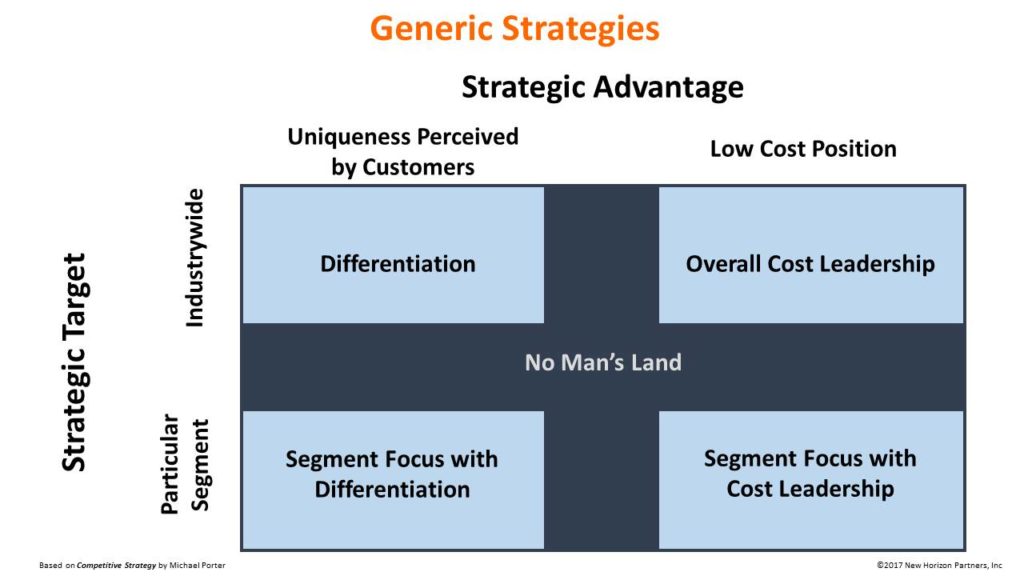
The concept of generic strategies was popularized by the book “Competitive Strategy” from Michael Porter in 1980. These are not business strategies in the sense that they do not provide clarity and definition of the strategic direction of a business. Business strategy describes where and how the firm intends to compete in order to gain a competitive advantage. The purpose of a business strategy is to provide a clear guide for all decisions regarding priorities and allocation of resources. Generic strategies do not provide the clarity and definition required to guide all decisions.

What generic strategies do provide is an approach to strategy or a general description of strategic direction. These can be useful in the firm’s early stages of strategy selection or in providing a general description of competitors’ strategies. Porter listed three generic strategies – overall cost leadership, differentiation, and focus. I prefer to think of them as four general choices, as shown in the graphic. In essence, however, they all describe a method of differentiation based on either cost or features and benefits which are targeted at either the total market or the customer needs in a select segment.

The graphic is useful in demonstrating that strategy is a matter of choice. It is not possible for a single organization to choose more than one of these general directions. Firms must choose whether they will pursue a low cost position or a strategy of differentiation by offering features and benefits in either product or service that meet customer needs in a way superior to competition. Of course, the buying decision on the part of customers is based on an evaluation of the value offerings of the various competitive suppliers and evaluating each offering based on the entire list of customer needs. This means that even with a differentiation strategy, the economic value of the features and benefits must justify the price. Likewise, pursuing a low cost position still requires some fundamental offering of features and benefits. But a firm cannot compete with one foot in each camp of chasing the lowest cost position while trying to outdo competitors in features and benefits.

In a similar way, firms also sometimes struggle by attempting to be all things to all people. If the firm’s decision is to serve the entire market, the choice of features and benefits must be driven by the general requirements of customers across the industry. In some markets it is difficult to identify an industry-wide position and, by necessity, the firm must choose a segment or segments for which to target their product/service offering. Unlike the cost vs. differentiation choice, it is possible to target more than one segment for a focus strategy. However, firms should be cautious about compromising their competitive position by either mixing the features and benefits requirements of various segments or not clearly communicating with customers regarding the appropriate product/service. (Some firms address this issue by using different brands for different segments.)

A market focus with a low cost position, again, is a matter of defining the fundamental needs of a segment, which may differ from the overall market, and then pursuing the lowest cost position for serving that segment. By definition, the focus with low cost means that features and benefits are limited to the segments basic requirements.

The concept of generic strategies is an important tool for use in building a consensus within the firm regarding a general direction of business strategy. When it is understood and accepted that this decision is about choices, the leadership team can then be united in pursuing a full definition of the firm’s business strategy.

Is your business strategy firmly planted in one of the generic strategy boxes? Does your strategy have enough definition and clarity to drive the organization’s decisions?

Strategic Differentiation

The purpose of any business is to provide goods or services that offer benefits which fulfill the needs of customers. The value offering of a company is the package of benefits that it provides to its customers, which includes all of the benefits resulting from the goods and services provided. Customers pay for the benefits provided in a supplier’s value offering. If a company’s value offering is very similar to that of other competitors, then the suppliers can be forced into a price war to gain business.

Research shows that the most successful and profitable businesses are those that are able to differentiate themselves from their competitors. Differentiation can be defined as distinguishing one company’s value offering from those of competitors by providing unique or more benefits. Differentiation is sometimes referred to as product differentiation but we must not be too restrictive. Customer needs can encompass a broad range of benefits including those directly related to the product as well as many dimensions of support. In our days of lean organizations, customers might rely on suppliers for engineering or R&D, so a supplier could differentiate based on their technical expertise while producing a product that is similar to competitors’. One of our clients produces what is clearly a commodity product but is very successful because their customer service is head and shoulders above all of their competitors.

Differentiation can be based on a broad range of benefits but it is always based on the customer’s needs and their perception of the benefit. It can be based on the benefits received from a product (or in the case of a service company, the service) including such things as functional performance, quality or durability, fit and finish, etc. It can be based on the services that surround the product such as delivery, accuracy, return policies, accessibility, or many other things. It can be based on brand perception or personal relationships. In any case, it is always in the eyes of the customer who makes the judgement of the true value of a supplier’s value offering.

Since differentiation is based on the customer’s needs and perception of value, the value will be different for different customers. In the case of our client with commodity products and superior service, the customers that most highly valued the service levels were industrial distributors. Other customers would not have assigned the same value to the level of service provided. A supplier seeking to differentiate must find the group of customers that are willing to pay for the differentiation. And when thinking about needs, it is not looking for a customer that needs a widget. Rather it is in the details of the needs – a widget with these certain characteristics or a supplier of widgets who will also provide these services.

A good differentiation strategy makes a supplier stand out from the competition when customers assign value to the benefits in the value offering. For suppliers that have a substantial benefit, either based on an economic advantage in providing it or even based on being the only supplier to recognize and fulfill a particular need, a price premium can be obtained, resulting in superior levels of profitability. A good differentiation strategy can also lead to gain in market share and high levels of customer retention.

To pursue a differentiation strategy, first identify a core group of customers that have a specific benefit in their list of needs. Then identify and build the capability to meet that need in either a unique way or a more economical fashion than competitors. And, of course, be sure to tell prospective customers about this differentiating benefit.

See this article by Chris Zook and James Allen in HBR for more detailed thoughts on differentiation.

Is your company satisfied with a “me too” strategy? What can you do to stand out from the crowd and increase the value delivered to your core customers?