Fear of Conflict

As a leader, it is often necessary to lean into conflict. This conflict might be based on some disagreement that someone has with us or it might be a conflict between two team members.

There is great value in having divergent views and seeking truth and full information. In this effort a team might have heated discussions and disagreements. When this discussion is focused on tasks and information, it is helpful and valuable to the organization. However, when the discussion becomes personal and filled with animosity, it becomes negative conflict. This negative conflict becomes a problem for the organization because it produces the following results:

  • Strained relationships and personal animosity
  • Tense atmosphere in the team
  • Waste of energy
  • Break down of communication
  • Reduction in the exchange of ideas and information
  • Diminished trust and support
  • Eroded commitment to the team and organization
  • Decreased productivity and increased turnover

Because of the detrimental effects, an effective leader needs to prevent, resolve, diffuse, or guide the conflict into a positive outcome. This requires that a leader have both the desire and the ability to lean into the conflict.

Unfortunately, many people are unable to lean in because they have a fear of conflict. This fear of conflict can show up in a variety of forms. One reaction to conflict is to up the ante, to overpower the conflict. Another type of reaction is to submit, to attempt to placate or play nice. The most common reaction is withdrawal, to hide from or ignore conflict.

Years ago, I had a first-hand view of weak leadership in the face of conflict. The company’s executive staff was rife with conflict that frequently broke out in staff meetings. The reaction of the company president in the face of conflict was to push away from the table, fold his arms across his chest, and smirk as the conflict rolled on. Reading the body language gave some ideas of the president’s views of conflict.

This fear of conflict often rises out of past experiences. Most often the roots go back to family of origin issues in which conflict was a tool of control that became something to be feared. In many families we seldom saw healthy relationships and did not learn the skills of emotional intelligence. Conflict was allowed to become personal at great cost to those involved. Therefore we may have learned to run from conflict.

The ability to lean into conflict requires authentic emotional intelligence in all four dimensions. A person must be fully aware of their own emotions as they step into conflict, able to manage well their own emotions, aware of the emotions of others, and skilled at managing relationships. With a base of strong emotional intelligence, a leader can lean into conflict using something like the following steps:

  • Recognize the debilitating nature of personal conflict on the organization.
  • Adopt a mindset that the cost of leaning into conflict is less than the cost of letting it continue, i.e., become willing to risk moving in.
  • Confront conflict in an emotionally-healthy manner. Provide feedback that points out the negative impact and the consequences that future conflict will produce.
  • Lead discussions of resolution and relationship building.
  • Model healthy discussion of information and debate of facts without allowing personal conflict, demonstrating respect for all persons.

To get to the position where one is able to implement this plan may first require some introspection and self-awareness to understand his/her mindset regarding conflict and the roots of that mindset. The next necessary level of self-awareness is an understanding of strengths and weaknesses in emotional intelligence. From there, a development plan may be necessary to build the skills and ability to lean into conflict. The most important step is to begin to practice leaning into conflict and then continue building comfort and competency at doing so.

Are you a carrier or a resolver of personal conflict? Are you able to lean into conflict and help others build healthy relationships?

Feedback Is Always Positive

Oh, don’t misunderstand the title of this article. Feedback is sometimes affirmational and sometimes corrective. Feedback identifies specific actions or behaviors and then asks (or directs) the recipient to provide either more of, less of, or the same amount of such action or behavior in the future. Sometimes we are providing a positive reaction or affirmation to a team member’s action or behavior and sometimes we are providing a negative reaction to the action or behavior. Sometimes our feedback says, “Yes, keep it up!” and sometimes it says, “Cut it out!”, all within the guidelines for providing effective feedback, of course.

But, as leaders, we prefer that the process of providing feedback always be a positive experience, whether it be affirmational feedback or corrective feedback. There are two primary motivations for providing feedback. One purpose of feedback is to guide the actions and behaviors of team members to align with organizational vision, values, and goals. A second purpose of feedback is to develop team members in both character and competency, as a means of building both the person’s future and the organization’s future. It is this second purpose especially that guides all feedback to be a positive experience.

Effective leaders develop a strong relationship with their team members in which it is clear that the leader has the best interests of the team member at heart. While we want to achieve the organization’s current objectives and we value the current contributions towards those objectives, we never lose sight of the value of the person and their longer-term potential. This vision for the person is not constrained within our organization but is viewed through the lens of what is best for this person.

This view or desire to play a role in the positive development of each team member becomes then the context in which we provide feedback. Of course, we want our team to work well together. Of course, we want the organization to accomplish its objectives. But, if we truly value the people that we lead, their personal development and ultimate success is viewed as equally, if not greater, in importance.

When a leader is guided by his/her value of people and desire for their development and success, this becomes a foundation for a strong relationship of mutual trust and respect. In such a relationship, the frequent communication that takes place continually reflects this desire. Feedback is just a part of this positive relationship and its ongoing communication. Naturally, affirmational feedback has a positive feel. But even when it necessary to say, “That behavior does not serve the team well and it does not serve you well”, such corrective feedback can and should be both given and received as a part of an effective leader’s desire and practice of developing a person.  While we may be pointing out actions or behaviors that should not be repeated, we are doing so out of a desire to help the team member grow or move in a direction that will benefit them personally in the future. If we have done our job of expressing our belief in the person and desire for their development, all feedback should be viewed as positive, in other words, in the best interest of both the feedback provider and the recipient.

Are you developing the kind of relationship that produces feedback that always feels positive?

Leaders Speak Last

In a team setting, leaders should generally wait to speak last.

A boss might feel the need to speak first, as a statement of his/her power and position. Or they might be a control freak, afraid to not have everything go their way. In a weak team, the team might consistently defer to the leader, looking for direction and guidance from above.

The danger of speaking early in a discussion is the potential to stifle input from team members. Unless there is a strong culture of openness and equality, team members might refrain from offering additional valuable input or simply acquiesce to the leader’s opinions. Without a range of input, the team runs the risk of making suboptimal decisions, not fully informed by the combined knowledge of the team members.

An effective leader, on the other hand, is committed to building the team and each of the members of the team and to making the best decisions. An effective leader recognizes the value of speaking last, with these advantages:

  1. By waiting to speak last, the leader is intentional about gaining input from each member of the team. He/she recognizes the value of diverse perspectives and seeks truth and openness. This requires an investment of time and sometimes requires drawing out the thoughts of quieter team members.
  2. By waiting to speak last, the team members can discuss, debate, and draw out additional input from team members. The leader’s thoughts can too often be viewed as the final word, ending the discussion.
  3. By waiting to speak last, the team can weigh various facts or opinions, beginning its own movement towards consensus.
  4. By waiting to speak last, a leader has the opportunity to assess team members, especially their thought patterns, decision-making skills, and powers of persuasion.
  5. By waiting to speak last, a leader has the opportunity to identify developmental needs of team members.
  6. By waiting to speak last, the leader can focus his/her efforts on moving the team towards consensus in which they all feel a part.

The leader always has the right to overrule the team consensus, however, doing so on a frequent basis is likely to make the team members feel that seeking their input was merely perfunctory and that the leader is prone to ramrodding their own agenda. On the other hand, the team discussion may draw out information that can change the leader’s view from a preconceived notion.

An effective team has a sense of equality and connection. They value each other and their knowledge and opinions. By following the practice of the leader speaking last, the team can build a culture of openness.

How effective is your team? Are you getting the maximum benefit from all the team members?

The Context for Feedback

Imagine a situation where the only time that your boss said anything to you was when he/she pointed out what you had done wrong. How motivated would you be? Would you look forward to seeing your boss again soon? Would you value the feedback that you received? Too often in the workplace, this is exactly what happens.

Feedback needs to take place within the context of open communication. We need to have a relationship of open and positive (in the sense of caring and truthful) communication before team members are willing and able to take in and act upon the feedback that we provide. This communication needs to include both performance conversations and personal conversations. And the communication needs to flow in both directions – as a leader, we need to be open, even seeking, feedback from team members.

The personal conversations are aimed at developing the relationship of trust and respect that defines leadership. These are conversations about background, interests, dreams and aspirations, and family. In these conversations we hope to learn about the person, not just about the worker.

The performance conversations that need to take place on a consistent basis should fall into six main categories, as follows:

  • Career conversations – one of the responsibilities of a leader is to assist in the personal and career development of team members. Towards this end, there need to be conversations in the area of career that develop an understanding of previous experience, general interests, and career goals. From these conversations flows a specific definition of career growth plans and developmental opportunities.
  • Goal-setting conversations – each team member needs to have a defined set of goals that include achievement goals, performance goals, and learning and development goals. Many organizations utilize a performance management system that calls for annual goal setting, but the timing should be flexible and should cover all of these areas.
  • Check-in conversations – these are the conversations in which goals and progress can be reviewed but the most important objective is identifying and addressing the relevant challenges and opportunities. The purpose here is to raise awareness and solve problems midstream that might stand in the way of achieving goals or call for revising them.
  • Performance review conversations – at some point there needs to be a conversation that addresses the level of achievement of goals. This is generally a part of an organization’s performance management system. If we have done an adequate job of check-ins, there should be no surprises come review time.
  • Compensation conversations – this one is obvious and generally a part of most organization’s performance management system. It is best to have two separate conversations, one regarding a review of performance and a separate one regarding compensation.
  • Feedback conversations – when we have established a pattern of open, caring conversations and built a relationship of trust and respect, feedback conversations are a natural part of the relationship. In another article we have described effective feedback in some detail, so here we provide a quick review. Feedback conversations should sometimes point out specific actions or behaviors that we value and encourage repeating and sometimes point out specific actions or behaviors that are not beneficial to the organization and should not be repeated. When we give corrective feedback, it is good practice to begin with a positive comment. Feedback always refers to specific action or behavior, our reaction to it, and the results to the organization from it.

All of these conversations can generally be accomplished in a few minutes each. It is better to build a pattern of frequent, focused, on-the-spot conversations than to hold a long meeting covering everything that should have been addressed long ago. With a larger organization, it is impossible to have these conversations with everyone; therefore, make it a practice with direct reports, and have some of these conversations with people at the next level while coaching your direct reports to adopt the practice. With a pattern of communication and a relationship of trust and respect, feedback becomes a natural part of the ongoing dialogue.

How well are you communicating with your team members? Are you developing the culture of open communications throughout your organization?

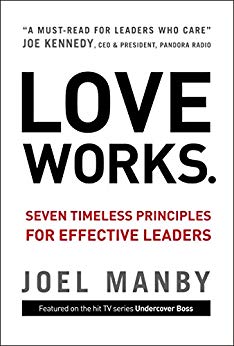
“Love Works” by Joel Manby

As you may suspect from the title, the big idea in the book “Love Works” is about leading an organization based on love. Joel Manby spent the first half of his career in the automotive business, in companies where leadership was based on the command and control model. But when he became the president and CEO of Herschend Family Entertainment, he found a whole different culture built upon the mantra of “Leading with Love,” which guides the way the company treats employees and customers. This book is all about servant leadership, even though that phrase only shows up once in the book, and then only in a graphic about HFE’s culture.

The idea of love is easily misunderstood in today’s modern, American culture. In the second chapter the author talks of the four different Greek words for love – eros, philos, storge, and agape. For sure, when we speak of love in leadership, we are not speaking of the emotion of love, which would describe the first of those three Greek words. The word that guides leadership is agape, the love that is an action which stems from our regard for the other person and seeks the best for them.

Manby then describes HFE’s model of leadership based on seven principles that are paraphrased from 1 Corinthians 13, the “love chapter” in the Bible, which is used so often in marriage ceremonies. The words that he uses are “Love is … patient, kind, trusting, unselfish, truthful, forgiving, and dedicated.”

  • Patient– have control in difficult situations. Here the author speaks mainly of patience in the feedback process. The advice is not to be patient with poor performance but, rather, to be patient with how you respond to that poor performance. Praise more than you admonish and praise in public, admonish in private.
  • Kind– show enthusiasm and encouragement. The customer’s experience is impacted greatly by the attitudes of employees, so extending kindness and demonstrating enthusiasm to your team results in kindness and enthusiasm shown to your customers. Provide words and notes of recognition and appreciation to encourage and validate positive behaviors.
  • Trusting– place confidence in others. The author speaks here of the decision-making process and the need to get input and keep the appropriate people informed. This includes delegating and listening. He states, “Listening carefully is a sign of trust. Interrupting people is a sign of distrust.”
  • Unselfish– thinking of yourself less and focusing on others. Here he speaks of giving of your time, talent, and treasure to help others and describes many ways to do so. The HFE organization has an employee-funded foundation to help fellow employees through difficult circumstances.
  • Truthful– define reality corporately and individually. Honesty is always the best policy. The author describes the need for candor in all discussions and the importance of also being open to the truth as a leader.
  • Forgiving– release the grip of the grudge. Manby states, “The longer you hold a grudge, the longer the grudge has a hold on you.” He urges leaders to forgive people who have wronged the organization as well as people who have wronged us personally.
  • Dedicated– stick to your values in all circumstances. This is the concept that we have termed as integrity or as congruity, the idea that our values are firmly rooted and guide us unswervingly.

For sure, every company needs to have financial goals. Leaders are stewards of the organization and profitability is how we assure that the organization survives and thrives in its mission of serving customers and employees. But Manby and the HFE organization makes a strong case that being a good financial steward and the culture of “leading with love” fit hand in glove in achieving true success.

The Secret to the Best Creative Workplaces

“You should feel like yourself at work, not a worker.” So says Becky Bermont of the design firm, IDEO, in a recent article posted on Quartz Ideas. Developing and sustaining a culture of creativity, important to a design firm, but increasingly important to every company, requires vulnerability. A culture of safety and collaboration requires that the team members know and accept each other and that they value both the contributions and the uniqueness of each individual. In the introductory paragraph the author says, “…the first step in creating innovative outcomes is building trust by allowing for vulnerability, especially as a leader, beginning by allowing individual team members’ passions to show through, even if they don’t seem initially ‘work-related.’ “

Read the full article for some ideas on how team members can be encouraged to know and value both the professional and the personal parts of the other team members, thus creating the vulnerability that leads to creative collaboration.

Fostering a Culture of Collaboration

“Leadership is about solving problems and unlocking the potential in others.” In an article, titled “Redefining Leadership”, in the Stanford Social Innovation Review, Carly Fiorina, the former CEO of Hewlett-Packard, describes some of the traits that she thinks important for today’s successful leaders and how they solve problems and empower others. Ms. Fiorina has always been a big promoter of the value of diversity and she makes that point here. But the two characteristics that she describes as most important for developing this culture of collaboration are humility and empathy, two of the most important traits of servant leadership.

She states, “success requires that you make a proactive, conscious commitment to a culture of humility, and you should take steps to explicitly and implicitly reinforce those ideas for yourself and your team.” Humility is best described as the recognition of the importance of others and the author points out that today’s popular culture of instant gratification and self-promotion is just the opposite of humility.

The author then describes empathy as a natural outflow from humility. She describes empathy as “identifying with what someone else is going through and has gone through—feeling what they are feeling, relating to them, and understanding their motivations.” By understanding where people are and where they come from the leader is able to help them reach their maximum potential.

See the full article for more detail.

The Value of Feedback

Feedback, from an engineering perspective, is the process in which part of the output of a system is returned to its input in order to regulate its further output. In the workplace, the term ‘feedback’ is used to describe the helpful information about prior action or behavior from an individual, communicated to another individual (or a group) who can use that information to adjust and improve current and future actions and behaviors.

As a leader, we need to cultivate the habit of providing frequent feedback to those around us. Some people fail to provide feedback because of a fear of stepping into what might be negative emotions. Others neglect providing feedback because of the time required to do so, even though a feedback conversation can often be accomplished in just a couple of minutes. Those that fail to provide adequate feedback fail to see the value, not recognizing that feedback is an investment in the future that provides a great return on the investment.

Here are a few of the reasons that feedback is important:

Builds communications – Providing consistent feedback builds a habit of comfortable, candid conversations. When we build that relationship with people, it makes it easy for both parties to present and hear the truth. This eliminates the potential for surprises or hidden information in the future.

Demonstrates value and respect – The investment of time and effort into providing frequent feedback demonstrates that you as a leader care about the other person and that you are committed to their growth and success.

Communicates vision, goals, and expectations – The feedback process of pointing out actions and behaviors and the results produced, either positive results or undesirable results, provides an opportunity to clarify and communicate specifically the organization’s expectations. The feedback discussion can tie expectations to organizational vision and goals.

Leads to better decisions – Consistent feedback leads to better decisions on both sides of the relationship. Providing feedback provides guidance and development for the individual in decision-making. It also provides insights for the leader, both into the person and into the process.

Provides feeling of belonging and engagement – When a person receives individual feedback, the risk of perceiving oneself as simply a cog in the machinery of the organization is eliminated. The person develops an appreciation for their contribution to the mission of the firm.

Continuous learning and development – Leaders should be building talent for the future. Studies show that one of the important elements for employee satisfaction is the availability of career development opportunities. Feedback is one way to provide guidance for growth.

“The deepest principle of human nature is the craving to be appreciated.” – William James

Motivates people – Of course, people like to hear that their efforts are valued or appreciated. Perhaps surprisingly, studies show that people crave corrective feedback even more than positive feedback. The important conclusion is that feedback is highly desired and is a great motivator.

Improves performance – This almost goes without saying. A consistent flow of feedback identifies the actions and behaviors that produce positive results and identifies the opportunities for correction or improvement. Feedback guides future behavior towards positive results.

Develops acceptance of leadership – Leaders that do a good job of providing feedback are perceived to be more effective leaders. Therefore, the leader/follower relationship is stronger when consistent and effective feedback is provided.

Promotes innovation and change – Providing feedback promotes the exchange of ideas and energizes people. This atmosphere leads to creativity and innovation.

For each of these, you can easily imagine the opposite where there is a failure to engage and provide feedback. The result is poor communication, lack of motivation and engagement, and an organization stuck in a quagmire of the past.

Instead, with a culture of consistent and effective feedback, the organization experiences increased satisfaction, higher retention, a stronger team, higher productivity, and a positive future. Benefits accrue to the giver of feedback, the receiver of feedback, and to the organization.

Want to know more about giving feedback? See the ten tips for giving feedback or check out the whole series of articles on effective feedback.)

Are you giving your team members enough feedback? Is it effective or how could you improve?

The Impact of Caring Carries this Team to the Super Bowl

“Show your team you care, and they’ll give you everything they have.” This is the philosophy of Sean McVay, the coach of the Los Angeles Rams football team, who is taking his team to Sunday’s Super Bowl game largely because of this philosophy of leadership. Spend the time to know your people, both professionally and personally, and then use your knowledge of them to interact with them. When they see you commit time to building a relationship, they will understand how much you do care. This draws them into a relationship of trust and respect from which they are committed to following. Read the recent article in Inc. to learn more about Sean McVay’s leadership philosophy and the impact that it has had on the team that he leads.

Separation Should Not Be Surprising

Firing with respect and compassion

Call it what you may – dismissal, discharge, layoffs, workforce reduction – firing a team member is not an easy task. This is the reason that it is often not done well. People want to sidestep the issue until it is unavoidable and then want to get it done quickly and move on. But separation should not be surprising. The entire process should be done with compassion and respect, no matter the circumstances.

There are three broad reasons for separating an employee:

  • Firing for cause
  • Reduction in force
  • Dismissal due to performance

Let’s look at these three categories and examine how we might do them with respect and compassion.

Firing for cause is generally the result of behavior on the job that is illegal, unethical, immoral, or in violation of company policy. In these instances, it is clear that disciplinary action is required, therefore there is no surprise to the team member. To not step up to our responsibility as a leader can be detrimental to the organization. When we suspect that some activity has met this criterion, we need to gather facts and then have a conversation with the person or persons involved. If, in fact, the person has stepped out of bounds, immediate dismissal is often the most appropriate outcome. In doing so, the discussion needs to be about the behavior and the implications or results of the behavior, both to the organization and to the individual. Rather than a response in anger, some compassionate guidance regarding the choice’s made might be helpful to the person’s future.

A reduction in force is often due to a downturn in business and the need to cut costs. These circumstances seldom crop up overnight, so our responsibility as a leader is to present the facts to the organization and communicate the need to cut expenses. With strong communications and culture, some organizations have voluntarily taken an across the board pay cut and rallied around other cost-cutting rather than seeing a workforce reduction. Some people might argue against presenting the facts of a downturn to the workforce as causing fear, but remember that clarity, not secrecy, drives out fear. If the team understands the situation, when staff reductions are necessary, they are not caught by surprise.

Dismissal due to performance is the most common and the most difficult firing situation for most people. It is important to remember that this situation is frequently as much the leader’s responsibility as it is the individual team member’s. It can result from putting the wrong person in a position or not clearly defining the expectations. And this is the situation where employees are most often caught by surprise due to a lack of clear communication.

Effective leaders provide feedback, both positive and corrective, to their team members on a consistent basis. If a person is not meeting the performance standard, here are three steps to deal with the situation in a positive and compassionate fashion:

  • The first step should be feedback to point out the deficiency, the effect of the deficiency, and to develop a plan of action for improvement. This feedback session should be a dialogue in which the action plan is jointly agreed upon targeted at bringing performance up to standard. (For more thoughts on effective feedback, see this series of articles.)
  • Performance and progress on the plan of action should be reviewed periodically. It is possible that the action plan may need to be adjusted or reinforced.
  • When it seems impossible or improbable for this team member to meet the performance standard, an alternative course should be discussed. If they had been promoted from a previous position in which they were successful, would they prefer to move back to that position? Are there other positions in the organization where they are more likely to be successful? (This should not be a case of pawning off the problem to a different manager.)
  • If the person is unable to meet the performance standard and if another more appropriate position is not available, then it is time for dismissal. To do so with compassion may require offering some transition assistance. This might include extending employment for a short time while allowing time for a job search, providing outplacement assistance, or helping with connections and referrals.

Firing with compassion and respect is the right thing to do because it demonstrates respect for the person. It may one of the best ways to demonstrate the character of the leader and the culture of the organization.

Are you able to lean in and act with compassion when someone needs to be fired?