The Link between Character and Emotional Intelligence

Character and emotional intelligence can be considered as two layers of our leadership capability, the two layers that are foundational to our leadership effectiveness. Character can be defined as the virtues, values, and traits that underlie our thoughts and actions. Emotional intelligence can be defined as the awareness and management of emotions, both our own and others’, to build positive relationships.

In the literature on leadership we often see character and emotional intelligence (EQ) treated as one and the same. Many of those writers that are focused on emotional intelligence (for example, Daniel Goleman) fold basic character traits into EQ. Similarly, those that are focused on character-based leadership treat EQ as a part of their definition of character. As an example, I facilitate a leadership development program using materials from Drs. Henry Cloud and John Townsend. They define character as ”that set of capacities the leader needs to meet the demands of reality.” Those capacities cover the combination of virtues, values, traits, and EQ behaviors.

character-emotional-intelligence-ohio

On the other hand, I generally think of character and emotional intelligence as two closely-linked but separate layers of leadership. Both character and EQ are a part of who we are as leaders. But emotional intelligence behaviors are built on top of the foundation of our character virtues, values, and traits. For example, respect for others is a character value that motivates our desire for relationship and drives us to further develop our empathy or our ability to work in a team.

This then is the basis for my analogy of a structure for leadership, where character (the virtues, values, and traits) is the foundation and emotional intelligence is the framework of our leadership. Those two ingredients are fundamental (or prerequisites) for making our leadership competency work. We can understand all the skills of leadership yet struggle if we have not yet built the strong foundation and framework upon which to build our leadership voice. Building our character and emotional intelligence is more than reading a few books, it is an experiential process since we build these into who we are and how we think. “We lead from who we are.”

What is your definition of character in leadership?

What are you doing to build the foundation and framework for your leadership?

Leaders Are Learners

Effective leaders are committed to constantly learning and growing. This desire to grow is driven by their character. Effective leaders have the following character traits:

  • Confident but not arrogant, they know they have been greatly blessed with talent but recognize room for growth.
  • Humble but not meek, they know that they have areas to improve and room to grow to be more effective.
  • Driven but not obsessive, they want to accomplish more, both for themselves and for those that they serve.

These character traits convince leaders that they can continually increase their effectiveness by continually learning. Much like the areas described in Goleman’s book, “Focus”, of inner, other, and outer focus, effective leaders seek to grow in these inner, other, and outer dimensions. They are especially focused on learning in the following areas:

leaders-learners-development-ken-vaughan

  • Character
  • Competency
  • Constituents
  • Context

Leadership is built on competency and character, with character as a foundational element. Leaders know that they need to continually build their character in order to be more effective. Character growth is more than reading and attending seminars, it requires intentional change and growth of our inner self. To do so usually requires some experiential learning like participation in a cohort leadership development program.

Leaders desire to grow in competency, developing skills to enhance and expand their capabilities. This might include leadership skills such as communications or culture development, but also technical or functional skills. In the earlier part of careers these might be in our functional area but, as we grow in responsibility, would include the expansion of our knowledge in other functional areas. To do so requires extensive reading, study, seminars or conferences, etc.

A third area for learning is constituents. Effective leaders know their people, how to motivate them, how to develop them, and how to help them be more effective. To do so requires that we be students of the people with whom we work.

Leaders also need to grow in context or their outer focus. They need to learn about other areas of technology, markets, business practices, etc. A broad base of knowledge can expand the leader’s perspective, enhance creativity, or identify new ways of thinking or doing business. To do so means we need to be on the lookout broadly for places to learn.

What are you doing to learn and grow? What is your plan for personal development?

What Is Character?

Character is the most important ingredient of leadership. I often use the analogy of a structure in describing leadership where character is the foundation. Without a strong foundation of character our leadership can be weak. We often describe leadership as the combination of character and competency. Without strong, positive character our competency can seem like a rudderless boat adrift.

character-development-reputatoin

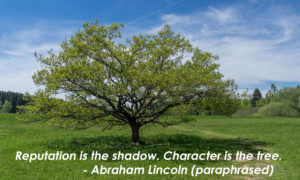
While character is a frequent focus of the discussion about leadership, there is no consensus on exactly how we should define it. Some definitions of character are quite broad while others are more narrow. All of the definitions refer to the inner values and behaviors that guide the way we think and operate. John Wooden said “The true test of a man’s character is what he does when no one is watching.” Character is sometimes described as the sum of virtues, values and traits.

Here are some dictionary definitions of character:

  • the way someone thinks, feels, and behaves – from Merriam-Webster’s Dictionary
  • the mental and moral qualities distinctive to an individual – from the Oxford Dictionary
  • the particular combination of things about a person or place, esp. things you cannot see, that make that person or place different from others – from the Cambridge Dictionary
  • the complex of mental and ethical traits marking a person – from Webster’s English Dictionary

The broader definitions of character often fold together character traits and emotional intelligence behaviors. Daniel Goleman’s writings on EQ often do so. Drs. Henry Cloud and John Townsend define character as “that set of capacities the leader needs to meet the demands of reality. A person of character is one who connects well; is clear in her responsibilities; can handle problems and negative realities; and understands her role and mission.” A similar definition of character is “the stable and distinctive qualities built into an individual’s life which determine his or her response regardless of circumstances.”

Character is the guiding light for how we engage with those around us, with whom we choose to interact, the quality of our relationships, the way that we make decisions, the priorities that we set, what we value, the tradeoffs we are willing to make, etc. Character affects everything we do and say. Our character determines whether those around us accept our leadership or influence. Our character is the basis of our leadership.

How would you describe character?
How would you describe your own character?

Character Beats IQ 53-5 in Thrilling Leadership Bowl

OK, it is the middle of November and as the college football season moves towards the playoffs it gets more interesting, so I couldn’t resist the playful title. But there is a real point to this article. It is that leadership is more dependent upon character than it is on cognitive ability (what we know as IQ).

In an article that I wrote recently on the relationship between IQ and leadership, I made the case that intelligence was helpful to being a good leader but was not the most critical factor. Our IQ enables us to see opportunities for growth and to take the steps to develop our leadership, but leadership is built first on a foundation of character and emotional intelligence. Our IQ enables us to use our character and EQ for the greatest effect. But when someone has a strong IQ without the base of character and EQ, that strong IQ can be a detriment to building the types of relationships in which we are able to effectively influence those around us. We are no doubt all familiar with highly intelligent people who can be obnoxious because they are weak in certain character traits and cannot relate to people effectively, therefore rather than building relationship they instead intimidate or disdain those who they do not regard as equals.

In a recent article in HBR by Tomas Chamorro-Premuzic scientific evidence is provided to corroborate this view. The article states that people who have the character traits of being “more adjusted, sociable, ambitious, and curious are much more likely to become leaders. (53% of the variability in leadership emergence is explained by these personality factors.)” Of course, “higher levels of cognitive ability (IQ) also increase an individual’s likelihood to emerge as a leader, though by less than 5%.” The article goes on to describe how positive character traits and strong emotional intelligence enable a leader to be more effective. Much of this HBR article is based on a meta-analysis of correlations between personality or character traits and leadership.

There are those who would argue that an intelligent person can fake it. But people look for authenticity and transparency in leaders before they are willing to trust. And people must first trust before they are ready to accept the influence of a leader.

What is your experience regarding the relative importance of character versus leadership?

Middling Leaders Give Answers, Good Leaders Ask Questions

When someone on our team brings us as leader a question, often the best response is “What do you think?” Some people think that asking questions shows weakness. Some leaders do not have the ability to say “I don’t know.” Or they might think that the leader is expected to always know best. Even when we do know, asking a question might be the better choice.

Some of the advantages of asking questions:

  • Values the thoughts and input of those around us.
  • Builds the individual.
  • Builds the team.
  • Coaching opportunity.
  • Demonstrates humility.
  • Helps others develop their thought process.
  • Gets buy-in.
  • Multiple perspectives give better results.
  • Provides an opportunity to evaluate potential.

When we are quick to give answers we might:

  • Disempower those around us.
  • Elevate ourselves over the team.
  • Build dependency.
  • Lead to possible tunnel vision.
  • Not get the best answer.
  • Miss great opportunities to help others grow.

Now this doesn’t mean we never give answers, or that we should simply accept the answers that our people give us. As leaders we are responsible for the organization making good decisions, so we may need to guide people through a thought process or we may need to overrule the input of others if we are convinced that we have the better solution. But the opportunity to build the organization for the long-term is often just as or even more important than an immediate answer.

What do you see as the benefits of asking questions? Or the risks of providing quick answers? Are you comfortable not being the “guru on the mountaintop”?

Transparency and Trust

Transparency and trust are inextricably linked in leadership – transparency on the part of the leader to warrant trust from the constituent. Trustworthiness is a critical character trait for those that want to lead. People only accept the leadership or influence of those that they trust. Research consistently shows that trust is one of the most highly demanded traits that people expect from a leader. And this is logical; as a matter of self-protection we are not likely to follow someone that we are not sure can be trusted.

character-trust-transparency

Stephen M. R. Covey describes 13 behaviors of leaders that build trust:

  1. Talk Straight
  2. Demonstrate Respect
  3. Create Transparency
  4. Right Wrongs
  5. Show Loyalty
  6. Deliver Results
  7. Get Better
  8. Confront Reality
  9. Clarify Expectation
  10. Practice Accountability
  11. Listen First
  12. Keep Commitments
  13. Extend Trust

The most important behavior, it would seem, is transparency. In a recent article on Leadership and Character I wrote about the inner realm and the outer realm of character, that is, the character within us and the character that is apparent or demonstrated to constituents. People make decisions of trust based on what they see and experience. And if they sense that the inner realm and the outer realm are not congruent, they are not likely to trust.

Some of the components of leadership transparency include:

  • Communication – consistent communications so that constituents do not feel they are in the dark
  • Candor – open communications that includes the good news and the bad
  • Visibility – see and be seen, let them see you operate
  • Consistency – always the same so that they know what to expect, what is real
  • Explain decisions – no pronouncements from on high, show them the thought process
  • Admit mistakes – let them know that you are human and humble
  • Engagement – build relationships that extend beyond the day-to-day tasks

Of course, the assumption is that through transparency we show high quality character that can be trusted, traits such as integrity, passion, vision, etc.

Are you building relationships of trust? Are there other important elements of transparency?

Dealing with Discouragement

The natural response when we encounter someone that is facing discouragement is often to double down. It is a human tendency to back away from negative emotions. When we interact with discouragement, there are two common responses: the cheerleader or the fixer.

emotional-intelligence-leadership

  • The cheerleader says something like “You shouldn’t be discouraged. It’s not that bad.” And the discouraged person is now also discouraged by the feeling that their discouragement is a sign of weakness.
  • The fixer says something like “Have you tried……?” And the discouraged person is now also discouraged by the feeling that it should be easy to recover from their discouragement.

Why do we back away from negative feelings? First, there is a neuroscience explanation. The limbic system in our brain responds to negative feelings by telling us that we should flee, fight, or freeze because negative feelings could indicate danger. Add to this the fact that many people are raised in an environment where they are told “Don’t feel sad, don’t feel angry, don’t feel any negative emotion.” We learn to either run from or hide from negative emotions.

Negative emotions, while not as enjoyable, are as natural as positive emotions. All of us have occasions when we experience negative emotions. As a leader we need to learn to lean into negative emotions rather than flee from them. By doing so we can help our constituents deal with these negative emotions in an effective way. To deal with discouragement or disappointment, we first need to validate that those feelings are real and rational. People must effectively process the negative emotion before they are able to move on to recovery.

If someone has failed, had a loss, or just feels that they are not where they had hoped to be, we can often help them best by accepting or validating those feelings. We do that best by accepting their discouragement or allowing them to vent. We can also validate their feelings by identifying with them, relating a short story of our own similar discouragement. Another way to validate is to express empathy, to feel discouragement along with them. (For a helpful explanation of empathy and how it differs from sympathy, see Brené Brown’s video.) Often the best course when we encounter someone that is discouraged or disappointed is to simply ask “What do you need from me?” If they are looking for a cheerleader or a fixer, we can go there. If they are still processing their negative emotions, we may be able to help them do so more effectively by validating them. Sharing our feelings with others is an effective way of processing them.

And the same should hold true for us as leaders. When we have our own disappointments or discouragement, we should ask the safe people around us for the validation that we need to deal effectively with our own negative emotions. “I’m feeling discouraged by ____ and here is what I really need right now.”

Are you able to lean into negative emotions? What are you doing to develop this capacity?

Invitation to a Taste of TLP

Effective leadership is built upon competency and character. The Townsend Leadership Program (TLP) has been proven successful as a cohort leadership program that results in both personal and leadership growth. Ken Vaughan, through New Horizon Partners, is now offering TLP in both Cleveland and Columbus. If you (or someone you know) could increase your effectiveness through some resources and the small group experience, join us to learn more about TLP and how effective character-based leadership is developed.

leadership-development-in-ohio

On October 18th we will host two introductory events to demonstrate the value of the Townsend Leadership Program. There will be a continental breakfast and presentation from 7-8:30AM and an after-work event from 5:30-7:00PM with appetizers and presentation. The 30-minute presentation (at 7:15AM and at 6:00PM) will include teaching from Dr. John Townsend (via video), a short talk on character-based leadership by Ken Vaughan, and a description of the Townsend Leadership Program. Following the presentation there will be an opportunity for Q&A and further discussion. Both events will take place at the Holiday Inn on Rockside Road, 6001 Rockside Rd, Independence, OH 44131.

To attend either of these events and learn more about TLP, please RSVP by email to rsvp1@newhorizonpartners.com or phone (440-248-9814).

What’s Your EQ?

Leadership is defined as influence. Our ability to influence is dependent upon the quality of the relationships that we build with our constituency. The quality of these relationships is largely a result of our effective use of our emotional intelligence.

emotional-intelligence-eq-domain-relationships

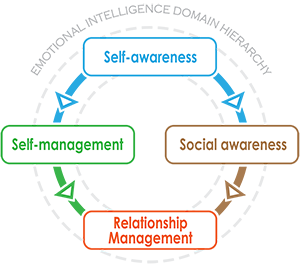
Emotional intelligence or EQ skills fall into four categories or domains – self-awareness, self-management, social awareness, and relationship management. Each of these domains contain a few skills that help a leader (or any person, for that matter) relate to others. We don’t necessarily need to master all of the skills within emotional intelligence, but we need a good representation from each of the domains. There is, in fact, a hierarchy among the domains where strong self-awareness is a prerequisite for both self-management and for other or social awareness and both self-management and social awareness are prerequisites for relationship management.

I recently wrote an article for PolymerOhio Manufacturing Services describing EQ and its importance as part of effective leadership. That article goes into more depth as to the various skills within emotional intelligence and the relationship between the four domains.

As leaders we should be cognizant of our strengths and weaknesses in the area of emotional intelligence and working to strengthen our ability to relate effectively with those that we hope to influence. What’s your EQ?

Employee Engagement

employee-engagement-heroEmployee engagement can be a natural outcome of effective leadership. The result of employee engagement is generally a positive company culture and high levels of customer satisfaction. How do we achieve strong employee engagement?

Here are some key skills to use for strong employee engagement:

  • Commitment – the organization must be convinced of the benefit of engagement; a half-hearted effort will result in reduced morale.
  • Connect – employees want to know that their leaders know and care about them.
  • Collaborate – employees are more engaged when they are part of a team effort.
  • Career – leaders need to demonstrate that there are opportunities to grow and develop.
  • Clarity – leaders must communicate a clear vision that shows a plausible future.
  • Convey – another part of communication, leaders must clarify their expectations of employees.
  • Congratulate – leaders need to give recognition more often than they provide correction.
  • Contribute – employees want to know that their input matters and that they are contributing to the organization’s success.
  • Credibility – leaders must maintain both the organization’s reputation and their own reputation for integrity and ethical standards.

I also write a blog with articles targeted at small- and medium-sized manufacturers. A few months ago I wrote a short series of articles focused on employee engagement and company culture which includes an interesting case study of successful development of employee engagement.