Dealing with Conflict

One of the important elements of an organization’s culture is how it deals with conflict. Most often the way that the organization deals with conflict is a reflection or a result of the way that leadership deals with conflict. Conflict is often viewed as negative but it does not need to be. There are three general ways in which organizations deal with conflict: they allow negative conflict, they avoid conflict, or they strive to keep conflict positive. The difference between these three is the way in which conflict is managed and modeled by leadership.

Conflict culture leadership Ken Vaughan

Negative conflict is the type with which we are most familiar, filled with tension and anger. In fact, many of the definitions of conflict describe it in this way: 1) “hostile encounter: fight, battle, or war” or 2) “the pursuit of incompatible goals, such that gains to one side come about at the expense of the other.” Conflict becomes negative as it becomes an emotional, interpersonal battle where one party must win and the other must lose.

Negative conflict is destructive conflict. By its nature it fractures relationships. The results of negative conflict include such things as:

  • tension and stress in the organization
  • atmosphere of negativity
  • damaged group dynamics as people take sides
  • less commitment to organizational goals
  • loss of productivity as energy is spent on conflict rather than productive tasks
  • breakdown in communication
  • reduced exchange of ideas and information
  • diminished trust and support
  • development of lasting animosities
  • lower job satisfaction
  • potential loss of disgruntled employees.

A culture of negative conflict often develops when either the leader is prone to making personal attacks himself or when the leader is afraid of conflict and is unable to step in to resolve or diffuse it. Both of these leadership practices are signs of a character weakness in the leader that needs to be addressed.

Some organizational cultures attempt to prevent negative conflict by avoiding conflict altogether, most often because their leader cannot deal with any conflict. Conflict-avoidant leaders are unable to effectively face conflict, generally because of something within their character that tells them to withdraw and protect themselves rather than leaning in to deal with it positively. The culture of conflict-avoidant organizations says that conflict is unacceptable and cannot be tolerated. Such a stance does not resolve conflict but rather drives it underground where it often festers and grows.

The effect on the conflict-avoidant organization is similar to the effect caused by negative conflicts, except that many of the effects take place below the surface. Therefore there is even less likelihood of resolution. Since conflict is underground in such organizations the effects can include quiet alliances, organizational subterfuge and sabotage, loss of energy and productivity, and loss of employees due to the negative work environment.

Both negative conflict and conflict avoidance are generally interpersonal struggles. Even when they begin with a business issue they often denigrate into a win/lose battle between individuals or groups. This interpersonal nature is the cause of the negative consequences.

There is a third way of dealing with conflict, the positive conflict. Positive conflict’s main feature is that it invites discussion and opposing views in business discussions without becoming personal attacks. The leader builds a culture that is safe and trusting for its people while encouraging a thorough review of business facts and issues. Rather than a destructive personal attack and a win/lose battle, positive conflict values the contribution of everyone in the business discussion with the expectation that various perspectives can drive better decisions. The culture of such an organization says that people and their input are always valued as we seek the best solutions.

With a culture that encourages positive conflict the outcome is more often:

  • stimulate involvement in the discussion
  • enhance creativity and imagination
  • facilitate employee growth
  • increase movement toward goals
  • create energetic climate
  • build more synergy and cohesion within teams
  • foster new ideas, alternatives, and solutions
  • test positions and beliefs
  • improved quality of decisions.

Coworkers who are able to successfully use positive conflict management strategies to solve problems in the workplace tend to become a more cohesive and unified work group. When a group of people works together through the process of resolving a disagreement in a constructive manner, the group is likely to be more committed to the decision that is reached as well as to the group itself. Working through conflict can create fresh insights that result in unique solutions. Often, the solutions that arise from conflict are better and more creative solutions than would have developed if everyone had been in agreement from the beginning. Effective conflict management can result in both enhanced overall productivity in addition to the accomplishment of goals.

How can an organization make conflict positive? In positive conflict the discussion should focus on the problem, not the person and on the future, not the past. When resolving conflicts, focus on finding ways that will allow all people to “win.” Negative conflict results in one side “winning” at the expense of another. Conflict becomes unhealthy when it is avoided or approached on a win/lose basis, where one side is the winner and one is the loser. The responsibility of both leaders and team members is to ensure that this situation doesn’t occur, because it has negative effects for both the winner and loser. Instead, strive to build a culture that is safe and trusting where each person is valued and the team works together for a common goal of finding the best solutions. To do so, build these values and practices:

  1. Commit to the value of every individual
  2. Do not manipulate others
  3. Do not use threats or bluffs to achieve goals
  4. Try to understand personal needs and the needs of others accurately
  5. Openly and honestly communicate with other people
  6. Attempt to pursue a common goal rather than individual goals
  7. Evaluate ideas and suggestions on their own merits regardless of the source
  8. Attempt to find solutions to problems
  9. Strive for group cohesiveness.

As a leader, it is necessary to have the character traits and emotional intelligence that allows perceiving when conflict begins to become personal and leaning in to protect the individual and focus on the issue.

Does your organization use conflict in a positive manner? Are you comfortable leaning in to make conflict positive and productive?
“Boundaries for Leaders” by Henry Cloud

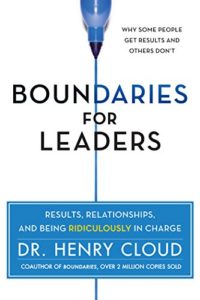
Leaders are “can do” people and, therefore, can sometimes take on responsibilities for many things, including responsibilities that could easily be managed by the people around them. A basic principle for success in leadership and life is maintaining a reasonable ratio of responsibilities to personal resources. When the responsibilities that we take on substantially exceeds our personal resources, we are spread too thin to be effective in all that we wish to accomplish. In the book “Boundaries for Leaders: Results, Relationships, and Being Ridiculously in Charge” by Dr. Henry Cloud outlines seven areas in which leaders need to maintain boundaries in order to maximize our effectiveness as a leader.

Boundaries for Leaders New Horizon Partners

This book is one in a series of books that began with “Boundaries” by Dr. Cloud and Dr. John Townsend, published in 1992. The series includes books regarding boundaries in marriage, parenting, and other areas. The basic premise of boundaries is to clearly define where our responsibilities end and other peoples’ responsibilities begin. We are personally effective when we manage and protect those responsibilities within our boundaries and allow others’ to manage their responsibilities that are outside of our boundaries.

Leaders must accomplish the organization’s goals with and through the people around them. Leaders are responsible for providing things like direction and empowerment, setting the stage for the team’s efforts, but their accomplishments are the sum total of what is achieved by those within their sphere of influence. Therefore, leaders need to focus on the things that are within their vital responsibilities and they need to enable and allow team members to manage their own responsibilities. Boundaries for leaders can be defined as what leaders create and what they allow. The seven areas of boundaries that Dr. Cloud describes as necessary for leaders to be most effective are summarized below:

  1. Boundaries that focus attention on what is crucial and inhibit distractions from everything non-crucial, while keeping the crucial ongoing and current.
    Dr. Cloud refers to the executive functions of the brain, i.e., to focus on the specific thing to be accomplished, to not get off track by losing or shifting focus, and to continuously be aware of relevant information. In the same way, the leader needs to guide the organization.
  2. Boundaries that build a positive emotional climate that leads to high performance brain functioning.
    This boundary is about creating positive relationships while maintaining high expectations. Negative emotions lead to a flee, fight, or freeze response while positive emotions broaden peoples thinking and responses. Yet a leader needs to expect, even demand, a high level of performance. The integrated leader is able to be “hard on the issue, soft on the person.”
  3. Boundaries that keep people connected to each other and inhibit fragmentation, compartmentalization and isolation of people, teams, departments, or business units.
    Organizations function most effectively when its people are working together. People function most effectively when they share connection with those around them. Dr. Cloud lists the ingredients of shared connection as shared purpose, awareness, nonverbal cues, collaboration, coherent narrative, conflict resolution, emotional regulation, emotional reflection, emotional repair, and listening. It is the leader’s responsibility to manage these ingredients in order to enable team effectiveness.
  4. Boundaries that steward the dominant thinking paradigms that rule the organization, keeping the dominant thinking optimistic and proactive as opposed to pessimistic and powerless. No negative or victim thinking patterns allowed to take root.
    Leaders need to continually audit their own thinking and the organization’s thinking to identify and root out any negative thinking. Helplessness thinking has a way of progressing from personal to pervasive to permanent. Instead of allowing this, the leader needs to change the paradigm to positive thinking by reframing or identifying incremental steps of progress.
  5. Boundaries that align people with the behaviors that they can actually control and that specifically lead to results, empowering them to do the activities that actually “move the needle” of measureable results, as opposed to focusing on what they cannot control and/or is not directly related to real results. Aligning them with the true drivers of measureable results.
    Neuroscience has shown that the more experiences people have of being in control, the better their “thinking brain” functions. Leaders who continually help their team focus on what they individually and collectively can control and accomplish are most effective.
  6. Boundaries that structure teams around well-defined purposes with values and behaviors which lead to high performance through defined roles, activities, and mutual accountability, along with the ability to diagnose, correct and fix what is not working quickly.
    A team is not just a group of people but it is a group that has a shared purpose or goal. It has an identity, a culture, and a set of values and behaviors. A key element for team effectiveness is trust within the team. Only after defining or creating these things can it operate as a unit to accomplish its purpose.
  7. Boundaries on themselves that keep them from being a closed system, missing and repeating patterns, not getting honest feedback, falling into problematic thinking patterns, leading out of fear, avoiding necessary organizational change, not quarantining weaknesses, and losing control of their time and energy.
    Leaders can allow the reality of the circumstances or mission to define them. They can become reactive and spend all of their time and energy on the urgent while ignoring the vital. Leaders also need to lead themselves. This requires strong self-awareness and seeking feedback and outside input. With self-awareness, it then requires setting boundaries on fears, weaknesses, patterns, and the use of their personal resources.

I am a big fan of Dr. Henry Cloud because we are generally on the same page in many respects. Every interaction that I have with Henry tends to expand my thinking or encourage greater depth of thought. Nevertheless, I thought that this book was somewhat forced in trying to piggyback on the “Boundaries” franchise that Drs. Cloud and Townsend have created. I like the boundaries concept and there are a lot of good thoughts about leadership in “Boundaries for Leaders” but I would more highly recommend Dr. Cloud’s book “Integrity” as a better representation of his leadership thinking.

Humility, Confidence, and Arrogance

Humility and confidence are two of the most important character traits of an effective leader. Healthy humility and confidence based on reality are both important in building a relationship of influence. The more complete our humility and confidence, the better will be our ability to influence as a leader. What does not fit as a part of leadership is the character trait of arrogance, which is opposite of humility and confidence.

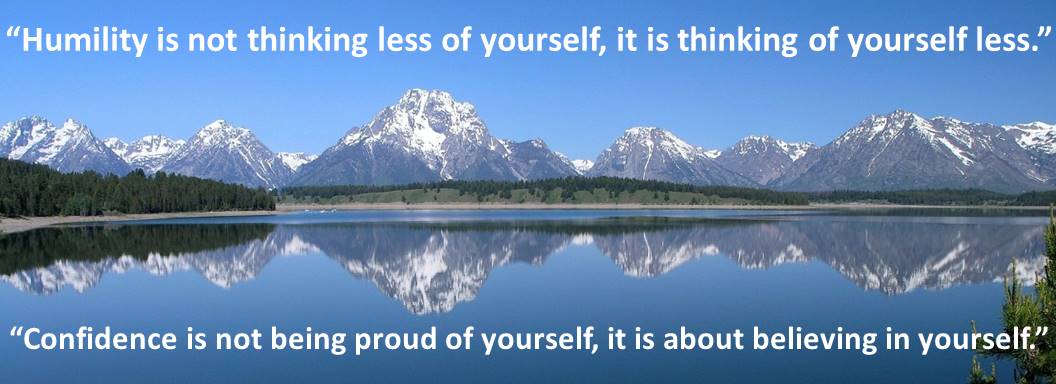
Humility is not meekness or weakness. It is not a low view of oneself, but rather a low view of one’s importance relative to other people. The Merriam-Webster dictionary defines humility as “the quality or state of not thinking you are better than other people.” Healthy humility is a character trait that is built upon the character value of believing in the importance of every person. Leadership is influence and influence is built upon relationships. William James said that “The deepest craving of human nature is the need to be appreciated.” This healthy humility invites the other person into relationship because the value that is placed on the other person is evident. Healthy humility then draws people into relationship where they feel valued and appreciated and therefore open to the influence of leadership.

Humility character development New Horizon Partners

Confidence is not pride or arrogance. The Merriam-Webster dictionary defines confidence as “a feeling or belief that you can do something well or succeed at something.” It is the self-assurance arising from one’s appreciation of one’s own abilities or qualities. Healthy or well-placed confidence is based on a firm grip on reality, the self-awareness of clearly understanding one’s capabilities as well as strengths and weaknesses. Confidence is not based on the magnitude of our abilities but on the accuracy of our self-awareness. This confidence shows up in the leadership relationship as strength or self-assurance upon which people can rely. This strength or confidence also draws people into relationship because they see the strength and feel able to trust it.

Humility and confidence have a positive relationship with each other. These two character traits have no need to be balanced because by nature they balance each other. With a clear understanding of our capabilities and our strengths and weaknesses, we can be comfortable with who we are and what we are able to do. Therefore, with strong confidence we are able to be humble, valuing those around us for what they can contribute. If we truly are humble and place high value in others, we can be secure in our own capabilities, knowing that we have no need to outshine others or puff ourselves up.

Arrogance is also a character trait, although not an attractive one in leadership. Arrogance is largely the result of not having healthy humility or of not having confidence based on reality. The Merriam-Webster dictionary defines arrogance as “an attitude of superiority manifested in an overbearing manner or in presumptuous claims or assumptions.” In other words, arrogance is an attitude of self-importance or pride. Where humility is based on a belief in the importance of others, arrogance is based on a belief in the importance of self, polar opposites in attitude. Arrogance can often be the result of an effort to compensate either for a lack of capability or a lack of confidence. Without confidence, a person could feel the need to puff oneself up and pretend to be superior or arrogant.

Where humility and confidence draw those around us into a relationship where we are able to influence, arrogance has the opposite effect. Arrogance creates a lack of trust and respect, driving people away from relationship, undermining the potential for influencing as a leader. Thus there is no room for arrogance in effective leadership.

How do we build healthy humility and confidence based on reality? Growing humility is a matter of character growth, building our belief in the value of other people and coming to terms with a lower level of self-importance relative to others. Growing in confidence is a matter of further developing our own self-awareness and self-acceptance. Character growth is not a matter of learning a new skill but is a matter of retraining our brain to incorporate new values and traits into the way that we think and behave.

Do you possess healthy humility and confidence rooted in reality? Are you growing in character?

“Know-How” by Ram Charan

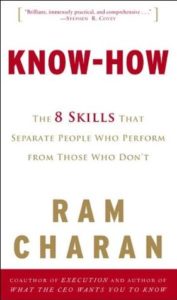
There is certainly a correlation between certain personal attributes and the ability of a person as a leader in contributing to the business success of their organization. In Know-How: The 8 Skills That Separate People Who Perform from Those Who Don’t, the author, business consultant Ram Charan, draws from his personal experience to make those connections. He moves quickly through the danger of looking only at the surface when evaluating a leader, then mentions briefly the character traits of effective leaders. The heart of the book expands on eight skills that Dr. Charan deems crucial for high-level leaders, especially those in large organizations

leadership skills coaching

The book begins by pointing out the fallacy of selecting leaders based on superficial information, describing these superficial traits and characteristics as the following:

  • The seduction of raw intelligence (similar to a point made in one of my recent articles)
  • A commanding presence and great communication skills
  • The power of a bold vision
  • The notion of a born leader (a reference to charisma on its own)

Instead Dr. Charan urges people to look at what he calls “the whole person” (and in my words the character of the person) when selecting a leader. He especially identifies the following character traits as those he sees most often in effective leaders:

  • Ambition – a desire to achieve something visible and noteworthy, when it is combined with integrity.
  • Drive and tenacity – an inner motor that pushes people to get to the heart of an issue and find solutions, when it is combined with a clear view of reality.
  • Self-confidence – the ability to know and speak your mind and act decisively, combined with humility and social awareness
  • Psychological openness – the willingness to allow yourself to be influenced by others and to share your ideas openly, promoting candor and communication
  • Realism – a healthy balance of optimism and pessimism, which causes one to seek the truth and clarity
  • Appetite for learning – seeking to improve from new information and experiences

All of these traits interact with each other and all can have their dark side when carried to extreme or not adequately balanced by the other traits.

With these traits in a proper combination, Dr. Charan’s experience in consulting with many leading global companies has led to the conclusion that the most effective leaders excel in the following eight skills.

  1. Positioning and Repositioning: finding a central idea for business that meets customer demands and that makes money.
    Positioning encompasses the strategic decisions in understanding customer needs and defining where and how to compete to provide value to those customers. This skill is the ability to see the whole system and to adapt to changes in the business environment.
  2. Pinpointing External Change: detecting patterns in a complex world to put the business on the offensive.
    In a world where change is more rapid and abrupt, this is the skill to use an outer focus to understand the threats and opportunities that lie down the road. The best leaders are the ones who understand the changes and their implications before anyone else and have the foresight and confidence to move based on their intuition.
  3. Leading the Social System: getting the right people together with the right behaviors and the right information to make better, faster decisions and achieve business results.
    Social systems is the term Dr. Charan uses for the way that people in an organization work together to manage the business. To make the social system effective the leader needs to be sure that information flows properly, that conflicts are surfaced and resolved, and that the proper trade-offs are made for the benefit of the long-term health of the organization.
  4. Judging People: calibrating people based on their actions, decisions, and behaviors and matching them to the non-negotiables of the job.
    Leading an organization requires achieving results through the people around the leader, so the focus of the leader needs to be on finding the right people and developing them to maximize the contribution that the people can make to the organization’s success. This requires insight into both the requirements of the various positions and the capability and potential of the people under consideration.
  5. Molding a Team: getting highly competent, high-ego leaders to coordinate seamlessly.
    Leaders seek to surround themselves with very capable people but then must mold the group of people into a strong team. To do so requires building buy-in to a vision that represents the whole organization and supersedes any individual’s interest. The team must utilize the capabilities of all members and operate as a unit, and it is the leader’s responsibility to develop this unity.
  6. Setting Goals: determining the set of goals that balances what the business can become with what it can realistically achieve.
    The leader needs to select goals that will provide leverage for the future. Among the many potential goals, finding the select few is the challenge. And then the goals need to be set at a level that is achievable while still being motivational, providing a challenge to the organization that will make it stronger.
  7. Setting Laser-Sharp Priorities: defining the path and aligning resources, actions, and energy to accomplish the goals.
    There are always more things that could be done than should be done. The leader needs to set priorities based on what is important, what is urgent, what is long-term versus short-term, and what is realistic versus visionary. Then the high priorities need to be provided with resources to be accomplished.
  8. Dealing with Forces beyond the Market: anticipating and responding to societal pressures you don’t control but that can affect your business.
    An effective leader needs to have an outer focus that is aware of both threats and opportunities to the business that come from the world outside of the organization and its markets. In this respect the leader needs to continually develop within the organization the capability of responding to these societal forces.

There is a chapter devoted to each of these eight skills, each with a wealth of examples of leaders who practiced these skills well (and some that did not). Having had the opportunity some years ago to work alongside Dr. Charan, I have a great respect for his intellect and insight. He makes the point that he believes these eight skills are the key differentiators of high-performing leaders.

My view of the book is that it is good but not great. The downsides are that these skills and most of the examples that are provided are based on the large, multi-national companies where Dr. Charan spends most of his time. Smaller business need a different mix of skills. Also, leadership can never be boiled down to eight skills. It requires a much broader set of skills, all built upon strong character, i.e., the competency + character model of leadership.

Self-Awareness Is Foundational to Leadership

The traits of leadership are often listed as characteristics such as integrity, confidence, vision, communicator, etc. Seldom do we see on these lists of important characteristics the trait that is foundational to them all – self-awareness. Self-awareness is defined as the conscious knowledge of one’s own capabilities, character, feelings, motives, and desires. It can also be described as the ability to know oneself deeply and to act from that knowledge.

Leadership self awareness New Horizon Partners

The self-awareness that we are speaking of here is personal self-awareness. One of the domains of emotional intelligence is termed emotional self-awareness. EQ self-awareness is a subset of personal self-awareness, which is a broader knowledge of who we are.

Self-awareness can be considered on a spectrum or scale. We probably have met people and later thought that “they haven’t a clue” because they seem so unaware of themselves or aren’t in touch with reality. On the other end of the spectrum are those people that are very comfortable in their own skin, those who are highly self-aware. We cannot be perfectly self-aware because everyone has a few blind spots or things that are buried deep inside them. Even though we can never be completely mindful, highly effective leaders are highly self-aware.

What does it mean to be self-aware? The people who have a clear perception of themselves can agree to a great extent with most of the following statements:

  • I know my strengths in the areas of intelligence, skills, and technical and functional knowledge.
  • I know my weaknesses in the areas of intelligence, skills, and technical and functional knowledge.
  • I am aware of my emotions and able to manage them.
  • I know my emotional triggers.
  • I understand my interpersonal strengths and weaknesses.
  • I can differentiate myself and what I am feeling from those around me.
  • I understand the boundaries where my responsibilities end and the responsibilities of others’ begin.
  • I am aware of my intuition and know the situations where I can trust it.
  • I am able to understand and accept the reality of my personal situation.
  • I am able to understand the cause and effect of circumstances in my life.
  • I am clear on my motives and desires in life, in relationships, in work, etc.
  • In addition to my own perspective, I am able to see myself as others see me.
  • I know roughly where I am on the scale from “haven’t got a clue” to completely self-aware.
  • I recognize most of my blind spots and areas for development.
  • I am continually striving to become more self-aware.

(Download our self-awareness assessment worksheet to evaluate your own self-awareness.)

High self-awareness is a strong predictor of success as a leader. This mindfulness lies beneath a person’s self-confidence, ability to be vulnerable, skill at managing relationships, ability to delegate, self-discipline, and many other elements of effective leadership character and competency. The less clarity we have about ourselves, the more likely that we will stumble along the way.

How does a person grow in self-awareness? To develop a thorough understanding of ourselves requires that we are consistently looking inside ourselves and asking the question, why? We are seeking to know what lies within us and what drives us. To answer these types of questions, assessment tools such as Myers-Briggs, DISC, etc. can be helpful. Seeking the input of those around us with tools such as EQ360 can help to see through the blind spots or provide perspective. Journaling can be helpful in thinking through the “why” question as a person tries to understand themselves more fully. A trusted friend, advisor, therapist, or peer group can help us in digging deeper into who we are and why we operate or behave in certain ways. To be self-aware means to be continually developing our self-awareness, so these tools should be frequently re-visited.

What might be other descriptors of self-awareness? How are you growing in your own self-awareness?

Positive Thinking May Not be the Most Positive Thing

Realistic pessimism may be more helpful than deluded optimism. Tomas Chamorro-Premuzic makes the point that “our species’ ability to suffer is an essential trigger of change.” Too much positive thinking can inhibit our desire to change and grow. See this interesting article on the downside of positive thinking.

I Am the Problem

When working with married couples who are struggling or just want to grow in their relationship, we often encourage them to adopt the mindset of “In this relationship I am the biggest problem.” This is not an attitude of self-condemnation. And it is not saying that the other person is without any faults. It is rather the realistic acceptance that we are responsible for our own thoughts and behaviors. We are not likely to be successful when our goal is changing the other person.

relationship leadership Ken Vaughan

In leadership situations where we have relational struggles, the same mindset is also appropriate. Leadership is influence and influence is only achieved through positive relationships. So what should be our response when we wish to lead someone with whom we have some conflict or someone who might be obstinate or have some social skill challenges?

If our focus is on trying to change the other person, some outcomes might be as follows:

  • We might be so focused on the other person’s issues that we fail to see our own faults. (Everyone has some weaknesses.)
  • We might appear arrogant, driving the other person away.
  • We might fail to recognize or understand what is bothering the other person.
  • We might not recognize our own contributions to the conflict or lack of communication.
  • There might be some resentment developed in the other person.
  • We might drive a further wedge or build a higher wall in the relationship with our attitude.

On the other hand, if we adopt the mindset that “I am the problem in this relationship” we will search for ways to bridge the gap and heal or grow the relationship. Even if we are convinced that the other person has a relational problem, we should look for the ways that we can grow as an individual or that we can adapt to work with the other person. With this mindset we might see outcomes as follows:

  • If we’re focusing on our part we are probably growing in some way.
  • We might show vulnerability that we are human and have weaknesses, making ourselves approachable.
  • We might see things from the other person’s perspective.
  • We might show humility thus inviting others into relationship.
  • We might discover some solutions that actually work to bridge the gap.
  • We might develop some empathy for the other person and the struggles that they face.
  • We are more likely to build a positive relationship where we are able to influence.

Of course it is ideal when both parties adopt this mindset, but one needs to take the initiative. Be the change. Focus on your own behavior, not immediate results or change in the other person. Know that you are doing the right thing by doing your part. Find people who will hold you accountable and encourage you to persevere. Recognize and affirm changes you see in the other person. You will probably be surprised by the changes you see, either in yourself or in the other person.

Do you have a relationship that is struggling? What behaviors do you need to adopt to bridge the gap?

Leaders and Managers

In business literature we often see the terms leader and manager used interchangeably. However the role of a leader and the role of a manager are different, even though there may be a fuzzy gray line between the two roles in certain aspects. If we understand the requirements of each role, we are better able to identify or develop people to serve in these roles.

leaders and managers Ken Vaughan Ohio

It is ideal when we have people who are capable in both leadership and management. At any level within an organization there is a mix of task, management, and leadership responsibilities but the relative mix changes. Entry level workers are generally responsible for tasks. As their capabilities and responsibilities grow they transition to more responsibility for management of resources, whether it be materials, people, or other resources. As they move to higher levels in the organization they transition to more leadership responsibilities. Of course, since leadership is influence, we can find opportunities to influence no matter what our role in life is. But in general, as a person moves to higher levels in an organization, the expectation is that they move through a process of growth from task to management to leadership.

Managers are very much stewards. They marshal resources and apply them to accomplish tasks or produce output. They are focused on

  • planning,
  • organizing,
  • and controlling.

Peter Drucker described the role of a manager as the following:

  • Setting objectives and planning. The manager translates vision and mission into goals for the group, and decides what work needs to be done to meet those goals.
  • Organizing. The manager divides the work into manageable activities, and selects people to accomplish the tasks that need to be done.
  • Motivating and communicating. The manager creates a team out of his people, through decisions on pay, placement, promotion, and through his communications with the team. This integrates the team to optimize productivity.
  • Measuring performance. The manager establishes appropriate targets and yardsticks, and analyzes, appraises and interprets performance.
  • Developing people. The manager develops the people in the group to optimize performance and prepare for upcoming tasks and goals.

Leaders are very much developers or builders. Their role is to develop people and the organization for the future. In the book, The Leadership Challenge, Kouzes and Posner describe the role of leadership as follows:

  • Model the way
  • Inspire a shared vision
  • Challenge the process
  • Enable others to act
  • Encourage the heart

In another article that I wrote recently, I describe the role of leaders as follows:

  • Leaders build – themselves, the people around them, their teams, and their organizations.
  • Leaders inspire – a strategic direction and vision for the future.
  • Leaders communicate – using candor and clarity to keep their people united.
  • Leaders challenge – both people and the organization to change and grow.
  • Leaders enable – people by delegating and removing constraints.
  • Leaders encourage – by building relationships where people are valued and motivated.

This then describes a sort of hierarchy in which leaders guide the development of vision and capability for the future, managers steward resources for today’s step forward, and workers accomplish the tasks required along the way.

Are you a leader or manager? What are your plans for growth to the next level?

Leaders Lean In

The natural response to negative situations is to back away. Human nature is wired to be self-protective and so when confronting the negative the common response is to flee, fight, or freeze. But effective leaders learn to lean into the negative or difficult circumstances in order to either turn them around, power through, or to learn or build something for the future. There are a variety of situations where leaders should learn to lean in.

lean-in-character-development

Lean into conflict. Conflict can be positive when it is directed at fully exploring issues or decisions. Conflict is negative when it becomes personal attacks or driven by anger. Effective leaders step into conflict to resolve, diffuse, or guide the conflict towards a positive outcome.

Lean into mistakes. Admitting your own mistakes demonstrates vulnerability and builds relationship and trust by showing that you are human and humble. Look for opportunities to learn and teach from your mistakes.

Lean into reality. Some people perceive the world the way they would prefer it to be. In business this can mean perceiving customers to need what you supply, or perceiving markets to be growing when they have reached maturity, etc. On a personal level, people can overlook weaknesses or overestimate capabilities. Leaders are able to perceive and accept the realities that they face whether it is professionally, relationally, or personally. When we accept reality we can identify a path of overcoming or compensating for the situation.

Lean into adversity. Often people can become quickly discouraged when the path is not easy. Adversity clarifies thoughts and develops resolve. Leaders are persistent in their efforts to achieve reasonable goals.

Lean into truth. When truth is scary, some people are more comfortable bending or creating their own version of truth. Leaders stand on their values at the risk of disappointing others.

Lean into negative emotions. People are uncomfortable with negative emotions such as anger, sadness, jealousy, etc. and often move away from these. A leader faces into these emotions and helps those that are expressing them, be it themselves or others, to understand them and to appropriately process them.

Lean into failure. When facing a failure either on the part of the organization or an individual, the tendency might be to bury it. Leaders use failures as learning experiences by asking “What might have been done differently? What did we learn? How did we grow?”

Lean into relationships. Relationship building is not a negative thing, but can get crowded out by other activities. Leadership is influence and influence is achieved through relationship. Leaders work at building relationships were they demonstrate the value of the other and build trust and shared vision and goals.

The ability to lean in when it is not the natural thing to do or when it requires intentionality is a function of a leader’s character. They must have or develop within themselves the long-term view and the perspective to look for and appropriately react to opportunities to build and grow themselves and their people.

Do you have what it takes to lean in? How are you growing this in your character?

Leaders Are Communicators

Good leaders are good communicators. In order to build a team with a shared vision that works in a collaborative fashion, leaders must be great communicators. Three elements of communication are essential for leaders – clarity, candor, and connection.

leadership-development-communication

Clarity – leaders must communicate consistently and clearly.

  • Be proactive, people left in the dark wander from the vision and waste energy speculating.
  • Understand the purpose of every communication, define the objective.
  • Make it simple and concise, understandable to the audience and focused on the objective, communicate specifics not ambiguity.
  • It’s not just the “what” but also the “how” of communicating, appropriate to the purpose, with authority.

Candor – leaders need to be trusted to be followed.

  • Speak the truth, transparency builds trust.
  • Be honest and authentic, communicate from the heart.
  • Admit mistakes; people don’t relate to those pretending to be perfect, they relate to those that are human and humble.
  • Be willing to embrace the negative, both to admit it and to hear it.

Connection – communication is more than speaking and writing, leaders need to know and relate to their audience.

  • Communication includes listening to understand and perceiving emotions and attitudes.
  • In individual communication, read body language.
  • Speak to the concerns of the listener, know the context.
  • Promote two-way communication, solicit feedback.

Leadership is defined as influence; influence is based on relationship. This relationship is built on trust and transparency. This trust and transparency can only be achieved with open, clear, and consistent communications. Constituents need to be a part of the team. Without good communications there is likely to be either confusion or suspicion, depleting or deflecting the energy of the organization and interfering with teamwork and collaboration.

How well are you communicating? What is holding you back?