Leadership with the Aroma of Christ

One can find many definitions of leadership. At its most basic, leadership is the ability to influence others. Peter Drucker said, “The only definition of a leader is someone who has followers.” John Maxwell, in a similar way, says, “Leadership is influence – nothing more, nothing less.” In an article in Forbes some years ago, Kevin Kruse provided this definition, “Leadership is a process of social influence, which maximizes the efforts of others, towards the achievement of a goal.”

Peter Drucker described five major roles of leadership as the following:

  • setting objectives
  • organizing the group
  • motivating and communicating
  • measuring performance
  • developing people

Again, we see here the importance of influence.

Our Faith Guides Our Leadership

As a Christ-follower who is also a leader, our influence should bear the aroma of Christ in all that we do.

But thanks be to God, who in Christ always leads us in triumphal procession, and through us spreads the fragrance of the knowledge of him everywhere. For we are the aroma of Christ to God among those who are being saved and among those who are perishing, to one a fragrance from death to death, to the other a fragrance from life to life. Who is sufficient for these things? For we are not, like so many, peddlers of God’s word, but as men of sincerity, as commissioned by God, in the sight of God we speak in Christ.” – 2 Cor 2:14–17, ESV

In the 3rd chapter of 2 Corinthians, we are then told that we are being transformed into the image of Christ. These two descriptions then should be our guide as we seek to “love our neighbors as ourselves.” We are to love as Christ does and as He instructed us in Matthew 22 and Mark 12, when He spoke of the Great Commandment(s). The Greek word used here is agapaõ, or agape love. This word is generally thought of as unconditional love, or we can refer to Paul Tripp’s definition of love as “Love is willing self-sacrifice for the good of another that does not require reciprocation or that the person being loved is deserving.”

Further important principles of leadership that we find in Scripture might include the Fruit of the Spirit: love, joy, peace, patience, kindness, goodness, faithfulness, gentleness, and self-control (Gal 5:22–23) or the “One Another” commands. Of course, there are many books that further describe the Bible’s description of leadership and the importance that is placed on leading well.

The Traits of Leadership

Leadership is not a position or a title. Leadership is not about doing; it is about being. Leadership can be considered a reward from those we lead, a result of who we are and how we interact with those who we seek to influence.

As a leader, our team members observe and make decisions regarding who we are and the degree to which they are willing to be influenced based on our character and competencies. While competencies may be more visible, the strength of our relationship or influence is most dependent on our character.

If, as a leader we hope to influence others, we must demonstrate the character of leadership. Character can be defined as that set of capacities the leader needs to meet the demands of reality. Character is important for effective leadership because positive character traits draw other people into relationship. When we first meet someone or as we interact, our brain subconsciously asks the questions, “Is this a person that I could respect?” and “Is this a person that I could trust?” Negative or weak character traits in an individual cause people to disrespect or distrust the individual. Positive traits draw us into relationship. This relationship can be one of influence.

A wide range of positive character traits are considered to be important for effective leadership. Some of the most important character traits for developing a relationship of trust and respect in a leader are the following:

  • Forward-looking / Vision
  • Positive outlook / Confident / Inspiring
  • Flexible / Resilient
  • Openness / Approachable / Personable
  • Principled / Integrity
  • Authenticity
  • Humility
  • Empathetic / Caring / Compassionate
  • Results-oriented
  • Honesty

Our character shows up in the big things and the little things. One might carefully craft a presentation or speech with all the right words to attempt to demonstrate character, but all of what we say and do add up to truly demonstrate our character. In fact, it is often the little things that we do without thinking that really show our character. After all, character is sometimes described as “who we are when no one is looking.”

As an example, the author at one time met a young man who was dating our daughter. Of course, he was on his best behavior and tried to show himself well. During our time together, we went on a short trip. As he got out of the car, he dropped a tissue. Rather than pick it up he simply kicked it under the car, thinking he was unnoticed. This became a part of my judgment of his character, which eventually proved to be accurate. When my daughter came to know him better, she wisely “kicked him to the curb.”

The other part of who we are as leaders are our competencies. Competencies are the skills, abilities, or experiences that a leader demonstrates in performing their duties. Followers want to know that their leader is knowledgeable and capable as a counterpart to character for a relationship of respect and trust. A leader has credibility based on competencies. The major competencies of leadership include the following:

  • Communication skills – presenting, inspiring, negotiating
  • Problem solving and decision-making skills – prioritizing, weighing options, thinking deeply, considering risks
  • Skills in developing and coaching others – identifying potential, encouraging
  • Planning, organizing, and executing skills – project management, delegation, supervision
  • Interpersonal and relational skills – team building, relating, being vulnerable, openness, empathizing, understanding, and managing emotions
  • Strategic thinking and visioning skills – forward-thinking, integrating information
  • Functional and technical skills – skills within a functional area, expands at higher levels of an organization

There is a common saying, “Hire for character, train for skills.” Competencies play a role in building a relationship of trust and respect but do not have the same weight as character. The other reason for seeking character first is that character is a defining part of the person; they define what a person is. Character can grow or change but requires much effort to do so. Skills are more easily added to a leader’s personal portfolio. In fact, character traits often are foundational to skills. For example, communication skills are one of the important competencies of a leader, but communication is only effective when it is built upon character traits such as compassion, openness, humility, and vision.

Integrating Our Faith and Leadership

As we review the character traits of effective leaders, we see a picture of Christ’s character. As we are being transformed into the image of Christ, we naturally grow in the character traits of leadership. This “aroma of Christ” should or must be evident in all our actions if we are to influence others towards their own relationship with Christ.

So, how does our understanding and desire to represent Christ mesh with the character and competencies of leadership. Let us examine some example scenarios.

As we provide feedback to associates, do we have a critical attitude or a constructive attitude? Do we even place an importance on providing consistent and frequent feedback? We are told in 1 Thes 5:11 to “Therefore encourage one another and build one another up.” Providing coaching and feedback are two of the most important tools of effective leaders, useful in developing or building up others. Is it our natural inclination to build up associates by stepping in and taking time to do so?

Similarly, do our performance reviews “speak the truth in love” or do they speak otherwise? We must present a clear understanding of the truth regarding performance, but we must be clear that we are on the same team, seeking development and success of the associate. Even when this might entail sending the associate off to find a more suitable opportunity elsewhere, we can do so with encouragement and support.

We can go on with more examples. Do our conversations, including both the words and underlying attitudes, bear the aroma of Christ? Do we consistently treat others with respect and care? Do we “do what we say and say what we do” consistently? Are we open and personable with all? Do we love our neighbors or associates as ourselves? In a meeting or discussion, who is the most important person?

In short, do our organizations seek to follow, to be influenced, by us? And as they are influenced, do they sense the aroma or see the image of Christ?


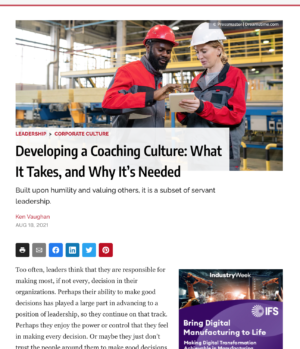
Developing a Coaching Culture

Built upon humility and valuing others, it is a subset of servant leadership.

Too often, leaders think that they are responsible for making most, if not every, decision in their organizations. Perhaps their ability to make good decisions has played a large part in advancing to a position of leadership, so they continue on that track. Perhaps they enjoy the power or control that they feel in making every decision. Or maybe they just don’t trust the people around them to make good decisions.

Often, making decisions at the top seems the most expedient thing to do. Whatever the reason, “the buck stops here (and only here)” is the way that many leaders operate.

When describing a leader’s role in his 1974 book Management, Peter Drucker listed five specific leadership roles, as follows:

  1. Setting objectives
  2. Organizing the group
  3. Motivating and communicating
  4. Measuring performance
  5. Developing people

Our task here is not to examine each of these roles, but rather to notice that making every decision is not among the five.

One responsibility that is part of the five, however, is developing people. The way leaders develop people shapes the quality of the decisions their people make. In the book Built to Last, Jim Collins describes successful companies as having talent “stacked like cordwood.” One of the best ways of developing people and building that talent pool is by incorporating coaching into leadership—in other words, build a coaching culture within the organization.

Culture within an organization can be thought of as the ways we work together and treat people both within and beyond the organization. According to Richard Daft in The Leadership Experience, culture can be defined as the set of key values, assumptions, understandings and norms that are shared by members of an organization and taught to new members as correct. Culture is not a statement but a practice throughout the organization. And culture flows downhill. Especially in small- to mid-size enterprises, the behavior of the leader(s) of the organization becomes the culture of the organization.

A coaching culture, then, is a set of behaviors in which the skills and practices of coaching become a primary means of interacting. These skills and practices include: demonstrating value placed on those people with whom we interact, practicing humility, listening to understand and asking powerful questions.

These powerful questions are not leading or judgmental, nor simply advice wrapped with a question mark. They are questions seeking to know real thoughts from the real person. This coaching culture, built upon humility and valuing others, could be considered a subset or a specific form of servant leadership.

Characteristics of a Coaching Culture

Beyond the four distinctives—valuing others, practicing humility, listening well, and asking great questions–here are some telltale signs of a coaching culture:

  • Multilevel and same-level coaching.
  • Team-oriented posture, a sense of mutual ownership; it is an “all for one, one for all” mindset.
  • Open, frequent, constructive communication from all stakeholders, both up and down the organizational structure as well as peer-to-peer.
  • Consistent, high-quality feedback, at all levels.
  • A common coaching practice and language.
  • Input sought and freely provided without regard to hierarchy.
  • Leaders that are positive role models.
  • Clear alignment and integration of human resources.
  • A pervasive attitude of servant leadership or serving one another.

A coaching culture is not nirvana nor an environment where everyone always gets along, and no one is ever unhappy. But it can grow to be an organization where all people are valued and where team members at all levels have space to grow, receive honest and helpful feedback, and pursue professional goals. And the end result is that the team members’ and the organization’s goals become more closely aligned.

There are many benefits of building a coaching culture for the organization and the people in the organization, including:

  • Empowered and engaged team members.
  • Team members feel supported and are willing to take calculated risks.
  • Increased productivity.
  • Change moves faster and with less resistance.
  • Increased buy-in or motivation as team members make or participate in decisions that they then implement.
  • High employee satisfaction and commitment.
  • Low employee turnover.
  • Being an organization that people want to join.

For many organizations, moving from status quo to a coaching culture can be daunting and difficult. And making a half-hearted or poorly executed attempt can cause serious damage to existing relationships, as the gesture can appear manipulative or improperly motivated. So, moving to a coaching culture is not for the faint of heart or those unwilling to experience substantial personal growth and change.

The best way to begin developing a coaching culture is to cultivate strong coaching skills within a small cadre of motivated leaders, remembering that culture flows downhill.

Coaching within an organization generally takes place in three modes: spontaneous, invited or structured coaching. This well-trained cadre of coaching leaders might then begin by using short, spontaneous coaching whenever they see an opportunity. This spontaneous coaching is much like the idea of providing feedback on the spot. In this case, the practice is to explore decisions and actions as we see them, in order to build and sharpen the decision process.

Eventually, people within the organization will begin to recognize this behavior as the new norm. The coaching cadre can then begin converting requests for direction or advice into invited coaching discussions. Over time, people will value the developmental advantage and begin asking for structured coaching. They will also begin following the role models they have witnessed. As this develops, it will become time to introduce a coaching vocabulary and teach coaching skills more broadly in the organization. Eventually, if done well, this new mode of behavior will work its way into most (likely not all) people in the organization, and you will begin to see the results in the way that people interact and work together.

Do you consider coaching a major part of leadership? What steps are you taking to increase the ability and capacity for coaching throughout your organization?


(This article was previously published in IndustryWeek.)

Life Planning Goals & Action Plans

Having established the direction of your Life Plan by examining and determining your Core Values, defining your Life Purpose, examining the current realities of your life with the Wheel of Life, and envisioning what impact you desire from your life in your Life Vision Statement, you are now ready to begin moving forward with defining how your plan turns into action, the most important step.

Too often in both business and in our personal lives, we are guilty of crafting a plan but then putting it on the shelf to think about some other day. A plan only has value when it prompts movement or change. Good intentions in the plan will have little effect on the course of your life without establishing Goals and Action Plans to move your life toward where you want it to be.

We can develop and gather these goals into two major categories, both of which are driven by the prior steps in your Life Plan. There will be some goals and action plans specifically defined to align your life with where you want it to go, in other words, plans to extract yourself from things that do not fit with your Life Plan and distract your attention and energy from the important things. The other category will be those goals and action plans that are defined to move you further along or accelerate your development in the vision that you have defined for your life.

Elsewhere much is available on developing goals and action plans, so here we will give a very brief overview. Individuals are sometimes capable of developing these goals and actions on their own, but it is often more effective to find a partner or a coach who is able to help you think more deeply about developing the best goals and actions and to help you achieve them through an accountability relationship.

One of the effective tools for defining Goals is the use of the SMART acronym. Goals should be specific, measurable, attainable, relevant, and time-specific. In other words, in setting goals we must be able to judge our achievement of them. Of course, one of the challenges in setting goals in the Life Plan process is defining and prioritizing the many goals that might be possible. Often, the Wheel of Life exercise is a big help in this defining and prioritizing process.

Similarly, Action Plans must be specific and sell-defined. We can’t fall into the trap of thinking about doing “something sometime.” Action Plans must be carefully crafted to identified who, what, where, and when. And accountability is often helpful in seeing these actions through, so a partner or coach can be very helpful.


This article is the last in a series of articles describing the Life Planning process. To see the other articles in the series, click here. While individuals are welcome to complete this process on their own, partnering with a Life Coach is often more effective. Please contact us for more information.

Life Purpose Statement

A Life Purpose Statement is a succinct and specific description of your “why”, your purpose for being on this earth. It describes your reason for getting out of bed in the morning. It translates who you are into what you do. It converts your values into your actions.

Your Life Purpose Statement serves as a year-by-year, day-by-day, minute-by-minute signpost to help you prioritize opportunities and responsibilities in your life. In 7 Habits, Covey writes about distinguishing between the urgent and the important. Your Life Purpose Statement helps you identify your “important.” It sets direction, helps determine goals, and defines action.

For a person of faith, we believe that God has designed and developed us each uniquely with gifts and talents that best enable us to serve Him and the world in certain ways. The process of developing our Life Purpose Statement involves examining who we are and finding the purpose for which we have been prepared. Most often, when we understand our purpose, it is the path that energizes us and brings us satisfaction and contentment. It aligns what we do with who we are.

A Life Purpose Statement differs slightly from a Life Vision Statement. You might choose to think of them as one, but in our process the Life Purpose Statement is designed to guide the day-to-day while the Life Vision Statement defines our lifetime goals or objectives.

Developing a life purpose statement is seldom a one and done process. It requires a great deal of thought and introspection. And it can evolve over time.

Here are the major steps in writing your purpose statement:

  1. Identify your values and passion. The Core Values process is a precursor as it forces us to identify the most important values that drive us. Other parts of this step might be thinking about such things as your history and examining where you have found joy and fulfillment.
  2. Identify your strengths and skills. Think about how you have been gifted and where you are energized and most in your element. Some people choose to do a personal SWOT analysis. Gathering input from people who know you well can be helpful in this entire process, but especially in this step.
  3. Begin to think about desired results. This might be lifetime results (as in the Life Vision Statement) but more appropriate here are the results that you have seen and hope to see as you live out your Life Plan.
  4. Begin an iterative process of drafting and refining a Life Purpose Statement that is probably one sentence but contains your what, how, and why. In other words, what is your purpose, how are you equipped or being developed for this, and how will you impact the world, a certain field or area, or certain people or types of people, etc.

As with all of the Life Plan, your Life Purpose Statement (or Mission Statement) will require much thought to develop. Then it must become ingrained into your mind and life. And it must be periodically examined as both a reminder and an opportunity to refine and evolve it.


This article is part of a series of articles describing the Life Planning process. To see the other articles in the series, click here. While individuals are welcome to complete this process on their own, partnering with a Life Coach is often more effective. Please contact us for more information.

The Life Planning Process

“So teach us to number our days that we may get a heart of wisdom.” – Psalm 90:12 (ESV)

Some people drift through life, simply going with the flow and reacting to or accepting the various twists and turns along the way. Other people live in a very purposeful way, thinking through who they are and who they want to be. These people picture the life they want to live. They then set goals and take action steps to actually live the life to which they believe that they have been called. This process of defining the life that one desires to live and becoming the person for which you have been created, is called Life Planning. While we are not in charge of all that happens in our life, we are able, perhaps even responsible, for trying to find and live out the purpose for which we have been placed on this earth in this time and space.

The elements of Life Planning:

  • Life Vision Statement – how do you want to be remembered?
  • Life Purpose Statement – what is the purpose for which you live?
  • Core Values – what values are most important to you?
  • Wheel of Life – in the various areas of life, where are you and where do you want to be?
  • Goals – what are some of the goals that move you to where you want to be and to how you want to be remembered? These will include long-term goals, mid-term goals, as well as short-term goals, such as annual, quarterly, and monthly goals. Which three to five goals are you going to work on right now?
  • Action Plans – what are the actions that you will take to achieve these goals?

The above list is in a hierarchy of the way these elements might fit together and the order that we might review them periodically. It is most likely that you will develop your life plan in a different order. Often the development of a life plan turns out to be an iterative process in which we re-visit a previous step to revise or clarify. Life plans are also living documents, requiring periodic review, rethinking, and revising as life changes and we progress in our growth and development. The most effective way to develop your first life plan is to focus on these elements in this order:

  1. Core Values
  2. Life Purpose Statement
  3. Wheel of Life
  4. Life Vision Statement
  5. Goals
  6. Action Plans

This article is the first in a series of articles describing the Life Planning process. Click on any of the linked elements to learn more about the process. While individuals are welcome to complete this process on their own, partnering with a Life Coach is often more effective. Please contact us for more information.

Leading Up, Down, and Sideways

Leadership is not based on position or title. And we don’t need to have subordinates on an organizational chart to lead. Leadership is the ability to influence people with whom we come in contact based on a combination of our character and competency. No matter where we are on the organizational chart, we have the opportunity to lead those around us. This might involve leading up, down, or sideways. Read the IndustryWeek article

Ditch the Annual Performance Review

Over the years, many organizations have adopted a form of annual performance review that includes scripted questions and rating scales for various measures of job performance. In many ways, these performance reviews are a bureaucratic means of compensating for the lack of leaders or the lack of a leadership development process in the organization.

True leaders do not need a system to force conversations about job performance, expectations or satisfaction. These are a part of the normal interactions between a skilled and effective leader and his/her team members. Leaders often guide and develop the performance of team members through three regular conversations:

  • Effective feedback
  • Constructive check-ins
  • Powerful progress reviews

Of course, there are other conversations that take place between a leader and team member in the normal course of business, such as project reviews, planning sessions and the normal personal conversations that play a part in relationship-building.

Effective leadership is based upon a relationship of mutual trust and respect, built through the everyday interactions that take place. But the following three specific one-to-one conversations are an intentional part of leadership and guiding the performance and development of our team members.

Feedback is the day-to-day series of conversations that nudge performance of team members toward the expected or desired actions and behaviors that are in line with the organization’s culture, values, mission and vision. Feedback requires, first of all, that we notice the actions and behaviors of team members and that we take the time, typically two to five minutes, to discuss them with the person. Feedback itself consists of three essential elements. First, a recognition of a specific action or behavior so that the recipient realizes what we are speaking about. Second, an identification of the impact of the action or behavior so that the recipient understands why we are having this conversation. Third, a communication of expectations for future actions or behaviors in terms of more of or less of the behavior identified. With these three elements, feedback is an important part of guiding the behavior or performance of the team member and developing them into a more productive or effective part of the organization.

The Check-in is the periodic conversation to track performance over the short term. This conversation, typically 30-60 minutes in length, might take place as frequently as daily or as seldom as monthly, depending on the responsibilities and capabilities of the team member and the context in which we are operating. Meeting too frequently can seem like micro-managing; while meeting too seldom can leave people feeling isolated or undervalued. The conversation in the check-in is primarily about tasks or status on assigned responsibilities and priorities and plans for the next day, week, or month. As with much of leadership, coaching is a large part of the check-in, so it is not just an exchange of facts, but building a deeper understanding and guiding the recipient in growth. The conversation might have branches built off of questions such as the following:

  • “Tell me about last week. What progress? What challenges?”
  • “What about this week? What are your plans and priorities? What hurdles or challenges do you face?”
  • “What’s one thing that worked last week and one thing that didn’t? What did you learn?”
  • “What feedback do you have for me? How can I support or encourage you more effectively?”

The Periodic Progress Review is a conversation about the bigger picture, covering both the team member and leader’s views about satisfaction, expectations, attitudes, goals and whatever else appropriate. It might be considered an opportunity to clear the air, develop a deeper understanding, and make sure that you are both on the same page. This conversation should take place at least once a year but, more appropriately perhaps, quarterly or monthly. It might be urgently needed in the face of changing roles, problematic attitudes, or signs of discord or dissatisfaction. This conversation should probably take an hour and might be done over a relaxing lunch. Again, this conversation is largely a coaching session, where the conversation branches out from questions such as the following.

  • “What do you find most challenging about this organization (or the team, or your job responsibilities)?”
  • “What are your strengths and how well are you able to use them in your current role?”
  • “What are your hopes or dreams for the future? How can we help you achieve them?”
  • “What do you see as goals or priorities for the next month, quarter, or year?”
  • “What do you find most irritating about my leadership style or the way that I interact with people? What should I do more of or less of?”

In each of these conversations, we should take the opportunity to connect on a personal level. Each of them has a component of guiding performance and providing development, with feedback more heavily focused on performance and the progress review more heavily focused on development.

Our ability to carry out these conversations effectively is largely a function of the quality of our leadership. Do we care about the people on our team; have we invested in a relationship of trust and respect; have we established a pattern of clear and frequent communication? If so, these conversations should be a natural part of our leader/follower interaction.

How effective are you at guiding the development of your team members? Do you have a shared view of how they are performing and how they might best improve? Do you have a pattern of consistent communication?

See the article “A Leadership View of Performance Reviews” for more content on this subject.

The Power of Peer Groups

It’s lonely at the top is not just a cute saying, leaders often do feel isolated. It is difficult to find a safe and helpful place for deep conversations about the challenges that we face in leadership. One of the best tools for personal growth as a leader is a peer group. A good peer group can provide accountability, encouragement, advice, and a perspective that helps a leader recognize strengths, weaknesses, and areas for growth. See the article for nine ways that peer groups help leaders overcome the challenges that they often face.

A Coaching Culture: What It Takes, Why It’s Important

Today’s workers often base their job satisfaction on three major factors:

  • Purpose – they want to know how they contribute to society.
  • Partnership – they want connections with the people around them and with the organization.
  • Plan for development – they want to know that their leaders care enough to help them grow and prepare for the future.

We can achieve these things and many other advantages by developing a coaching culture in our organizations. This recent article, published in IndustryWeek, describes what a coaching culture looks like, how it can be developed, and how it benefits the organizations.

Feedback Is Best Served Warm


Effective leaders understand the benefit of liberally providing both positive and corrective feedback. Positive feedback demonstrates appreciation for the effort and value for the person. Corrective feedback, when done well, demonstrates the desire to help the team member to grow and develop.

Here are 12 tips for building the habit of giving feedback and doing it well:

Focus on performance, not personality. Always deliver feedback in reference to specific actions or behaviors, either by expressing appreciation for an action and the resulting benefit, or discussing an action or behavior that you want to see improved. “You’re so smart” is not nearly as valuable as “I really appreciated the way that you helped the team come to that conclusion.” With the latter, the person understands the action and the benefit to the team. Regarding corrective feedback, a statement such as, “The project was not delivered on time, which resulted in a big cost penalty from our customer” can lead to a discussion of reasons and corrective action. On the other hand, “You really messed up that project, as usual” is likely to simply prompt a defensive reaction.

Emphasize facts, not feelings. “We have received seven complaints about missed deliveries” has more value than, “You really disappoint me.” Facts verify the reality behind the discussion and, again, keep the discussion from becoming a personal matter.

Focus on the individual effort. Often the workplace includes team efforts. If the feedback is about the team’s results, the discussion needs to include the team. If the feedback is for an individual on the team, the discussion needs to focus on that person’s specific actions or his/her specific contribution to the team’s effort. Unless there is evidence that one person single-handedly impacted the team’s results, it is unfair and disheartening to be confronted with the team’s performance.

Feedback is best served warm. In other words, provide feedback as soon as possible after (or even during) the activity. The longer the time gap between the action and the feedback, the harder it will be for the recipient to tie the two together. The impact or benefit is much reduced if the person has difficulty recalling all of the facts regarding the action due to lapsed time.

Be clear, direct, and specific. A discussion that is focused on specific action or behavior and the specific results leads to a more productive analysis of the cause and a better definition of the specific action plan required to improve. Speaking in generalities ends with little understanding and minimal impact on the future. Feedback takes an investment of time and attention to develop value.

Focus on the future. The goal of feedback is not to criticize a person or to gather a history. The goal is to help the recipient to grow and improve. The discussion of the situation or the past history is just to establish the need for an action plan. Therefore, the discussion should be weighted in favor of the future, with positive expectations for improvement and growth.

Be intentional. It is too easy to move quickly from one meeting to another, or from one interaction to another. Leaders need to develop the habit of noticing. They must keep their eyes open for opportunities to recognize positive actions and behaviors and to correct undesired actions and behaviors.

Use your words wisely. Feedback should be a respectful, professional discussion aimed at producing a positive outcome. Our language and behavior should be in line with this objective. Better to use the word “I” in demonstrating the impact and refrain from using the word “you,” which can sound judgmental of the person rather than the behavior.

Provide feedback in digestible doses. If you expect your feedback to have an impact on future performance, it is better for the recipient to walk away with one action item regarding one issue. Storing up several items for discussion results in a confusing mess for the recipient to sort out after the discussion.

Make it a two-way conversation. With a goal of developing an action plan for future performance, the feedback session needs to be a dialogue, not a monologue. People are more likely to implement an action plan that they have developed than one that is forced upon them. Therefore, once the issue has been identified and agreed upon, the feedback discussion works best when the leader moves to a coaching role, helping the recipient to identify and own the cause of the problem and the action plan for improvement. It goes without saying that feedback is done best face-to-face or at least person-to-person, never via text, email, or letter.

Balance negative or corrective feedback with affirmational or positive feedback. People respond more strongly to negative than positive statements. That’s why relationships are stronger when positive statements outweigh negative statements by a factor of 5:1 or even 8:1. Even when giving corrective feedback, the leader should find some positive things to say about the other person: the part of the process that was done correctly, a belief in their ability to improve, etc. When a person only hears negative comments or criticism from a boss, they lose heart and look for the door.

Develop the habit of providing feedback. Feedback is the tool with which we nudge the actions and behaviors within the organization to conform with our desired culture and vision. It takes many of these nudges to achieve the results that we hope for. We need to continually and liberally provide effective feedback.

When done well, both positive and corrective feedback can feel like positive interaction that is beneficial to the recipient and result in growth and improved performance. Done well, they both identify the behavior that is valued and expected. And they show the value that the leader places upon the team member and the desire to assist in building their future.

Do you continually watch for opportunities to provide feedback? Are you motivated by the desire to develop the people that you lead?


(This article was previously published in IndustryWeek.)