A Primer on Emotional Intelligence

“What did people do before there was emotional intelligence?” I was asked at a leadership workshop a short time ago. The term emotional intelligence has grown in popularity and become an important concept in leadership over the past twenty years. But before we began using the term, emotional intelligence was a skill of great leaders. We can see references to emotional intelligence from the ancient Greek philosophers and from King Solomon in Proverbs. One of the reasons why Abraham Lincoln is considered to be one of our greatest presidents is because he seems to have had strong emotional intelligence. Dale Carnegie’s classic book, How to Win Friends and Influence People, is full of emotional intelligence.
While emotional intelligence (“EI”) has existed forever, it’s just in the last 20-30 years that it has been labeled, studied, and grown in awareness of its importance in all sorts of social interaction. The term “emotional intelligence” seems to have first been used by Michael Beldoch in a scientific paper in 1964. In 1983, Howard Gardner’s Frames of Mind: The Theory of Multiple Intelligences was an introduction to a different way of thinking about intelligence, including the idea of intrapersonal intelligence and interpersonal intelligence. The doctoral thesis of Wayne Payne, A Study of Emotion: Developing Emotional Intelligence, was published in 1985. In 1989 Salovey and Mayer published a model of emotional intelligence, as did Stanley Greenspan. All of these papers were academic works in the area of psychology and sociology.

The work that really ignited interest in emotional intelligence was Daniel Goleman’s 1995 book, Emotional Intelligence – Why it can matter more than IQ, which reached the mass audience and achieved best-seller status. This book was prompted by the previous academic papers and by the growing ability of neuroscience to actually see and measure the emotional activity of the brain. It spread the idea that emotional intelligence can be important in developing positive relationships, and therefore can impact the quality of any type of social interaction.

Goleman’s book opened the floodgate for a stream of books by many authors and scientific studies and papers postulating and examining the impact of EI. While measuring and comparing EI in individuals is not an exact science (one of the criticisms), it is generally recognized that emotional intelligence contributes to more effective relationships and therefore, better results. Goleman claims that 67 percent of all abilities associated with strong job performance were related to emotional intelligence. Travis Bradberry, the author of Emotional Intelligence 2.0, claims that 90% of top performers at work are also high in emotional intelligence while just 20% of bottom performers at work are high in emotional intelligence. He also claims that 58% of job performance is due to EI. A 2010 meta-analysis conducted by Virginia Commonwealth University and published in the Journal of Organizational Behavior found that emotional intelligence was very important to job performance. Some results from specific studies are as follows:

  • Restaurant managers with higher EQ create 34% greater annual profit growth, increased guest satisfaction, higher employee retention.
  • In a study with naval officers, emotional intelligence proved to be more powerful at predicting leadership efficacy than either IQ or managerial competence.
  • Of the leaders with high emotional self-awareness, 92% created positive workplace climates.
  • After supervisors in a manufacturing plant received training in emotional competencies, lost-time accidents were reduced by 50%, formal grievances were reduced from an average of 15 per year to 3 per year, and the plant exceeded productivity goals by $250,000.
  • Plant efficiency increases by 9.4% during major EQ initiative focused on managers and the creation of vital teams.

Emotional intelligence consists of skills and traits relating to understanding and managing emotions. The various models of EI fall into two camps: the ability model that defines emotional intelligence as a cognitive ability and the mixed model that defines it as a combination of cognitive and learned personal aspects.

The Mayer and Salovey model was the earliest model and defined emotional intelligence in the following four branches:

  1. The ability to perceive emotions in oneself and others accurately.
  2. The ability to use emotions to facilitate thinking.
  3. The ability to understand emotions, emotional language, and the signals conveyed by emotions.
  4. The ability to manage emotions so as to attain specific goals.

The most popular of the later, mixed models are those described by Goleman in Primal Leadership or by Bradberry in Emotional Intelligence 2.0. Goleman labels these as domains, with traits and skills in each domain. Bradberry labels these as skills, with specific strategies in each skill.

  1. Self-awareness
  2. Self-management
  3. Social awareness
  4. Relationship management

In other publications Goleman has used five domains: self-awareness, self-regulation, motivation, empathy, and social skill. Both the Mayer and Salovey model and the Goleman model are hierarchical in that the lower levels are prerequisites for the higher levels.

While some models describe emotional intelligence as a cognitive ability, it is clear that emotional intelligence can be developed and grown through specific effort. The intentional change theory of Richard Boyatzis, referenced in Primal Leadership, is one method. A related tool for growing EI is a cohort leadership group where the group members can provide input into each others’ lives and growth. The general idea behind growing in emotional intelligence is retraining the brain, or developing new neural networks that provide the pathway to responding to emotional triggers in a different, more preferable manner. There are a variety of assessment tools that provide relative measures of emotional intelligence.

Mayer and Salovey defined emotional intelligence as “the ability to monitor one’s own and others’ feelings and emotions, to discriminate among them and to use this information to guide one’s thinking and actions.” Other definitions of EI include “the ability to identify, assess, and control one’s own emotions, the emotions of others, and that of groups” or “the ability to recognize, understand and manage our own emotions and to recognize, understand and influence the emotions of others.”

Since emotional intelligence impacts social interaction and relationships, the development of EI skills can contribute to more effective leadership, marriages, parenting, politics, community, or any other scenario requiring personal interactions. Those with low EI will struggle in awareness or control of their own emotions or will find it difficult to comprehend and deal with emotions in others. On the other hand, those with high EI can function at a higher level in terms of their own emotions and understanding and building effective relationships with those around them.

How effective is your emotional intelligence? How are you growing?

11 Brutal Truths About Emotions

11 Brutal Truths About Emotions That You Really Need to Hear

Interesting article about emotional intelligence by Justin Bariso in Inc.com. Here are the major points that he makes:

Emotional Intelligence Ken Vaughan

  1. Emotional intelligence begins when you ask the right questions.
  2. You can’t control your feelings. But you can control the reactions to your feelings.
  3. Others see you much differently than you see yourself.
  4. Empathy can greatly increase the value of your work.
  5. It’s all about the long game.
  6. Criticism is a gift.
  7. It’s vital to gain trust before delivering negative feedback.
  8. Remember that “negative” emotions can be just as beneficial as “positive” ones.
  9. Raising your EQ isn’t all fun and games. But it can be…sometimes.
  10. EQ and EI aren’t the same thing.
  11. Emotional Intelligence can be used for evil.

Read the whole article to see his explanation of each “truth” and find links to other articles by Justin Bariso on EI and EQ.

The Link between Character and Emotional Intelligence

Character and emotional intelligence can be considered as two layers of our leadership capability, the two layers that are foundational to our leadership effectiveness. Character can be defined as the virtues, values, and traits that underlie our thoughts and actions. Emotional intelligence can be defined as the awareness and management of emotions, both our own and others’, to build positive relationships.

In the literature on leadership we often see character and emotional intelligence (EQ) treated as one and the same. Many of those writers that are focused on emotional intelligence (for example, Daniel Goleman) fold basic character traits into EQ. Similarly, those that are focused on character-based leadership treat EQ as a part of their definition of character. As an example, I facilitate a leadership development program using materials from Drs. Henry Cloud and John Townsend. They define character as ”that set of capacities the leader needs to meet the demands of reality.” Those capacities cover the combination of virtues, values, traits, and EQ behaviors.

character-emotional-intelligence-ohio

On the other hand, I generally think of character and emotional intelligence as two closely-linked but separate layers of leadership. Both character and EQ are a part of who we are as leaders. But emotional intelligence behaviors are built on top of the foundation of our character virtues, values, and traits. For example, respect for others is a character value that motivates our desire for relationship and drives us to further develop our empathy or our ability to work in a team.

This then is the basis for my analogy of a structure for leadership, where character (the virtues, values, and traits) is the foundation and emotional intelligence is the framework of our leadership. Those two ingredients are fundamental (or prerequisites) for making our leadership competency work. We can understand all the skills of leadership yet struggle if we have not yet built the strong foundation and framework upon which to build our leadership voice. Building our character and emotional intelligence is more than reading a few books, it is an experiential process since we build these into who we are and how we think. “We lead from who we are.”

What is your definition of character in leadership?

What are you doing to build the foundation and framework for your leadership?

Dealing with Discouragement

The natural response when we encounter someone that is facing discouragement is often to double down. It is a human tendency to back away from negative emotions. When we interact with discouragement, there are two common responses: the cheerleader or the fixer.

emotional-intelligence-leadership

  • The cheerleader says something like “You shouldn’t be discouraged. It’s not that bad.” And the discouraged person is now also discouraged by the feeling that their discouragement is a sign of weakness.
  • The fixer says something like “Have you tried……?” And the discouraged person is now also discouraged by the feeling that it should be easy to recover from their discouragement.

Why do we back away from negative feelings? First, there is a neuroscience explanation. The limbic system in our brain responds to negative feelings by telling us that we should flee, fight, or freeze because negative feelings could indicate danger. Add to this the fact that many people are raised in an environment where they are told “Don’t feel sad, don’t feel angry, don’t feel any negative emotion.” We learn to either run from or hide from negative emotions.

Negative emotions, while not as enjoyable, are as natural as positive emotions. All of us have occasions when we experience negative emotions. As a leader we need to learn to lean into negative emotions rather than flee from them. By doing so we can help our constituents deal with these negative emotions in an effective way. To deal with discouragement or disappointment, we first need to validate that those feelings are real and rational. People must effectively process the negative emotion before they are able to move on to recovery.

If someone has failed, had a loss, or just feels that they are not where they had hoped to be, we can often help them best by accepting or validating those feelings. We do that best by accepting their discouragement or allowing them to vent. We can also validate their feelings by identifying with them, relating a short story of our own similar discouragement. Another way to validate is to express empathy, to feel discouragement along with them. (For a helpful explanation of empathy and how it differs from sympathy, see Brené Brown’s video.) Often the best course when we encounter someone that is discouraged or disappointed is to simply ask “What do you need from me?” If they are looking for a cheerleader or a fixer, we can go there. If they are still processing their negative emotions, we may be able to help them do so more effectively by validating them. Sharing our feelings with others is an effective way of processing them.

And the same should hold true for us as leaders. When we have our own disappointments or discouragement, we should ask the safe people around us for the validation that we need to deal effectively with our own negative emotions. “I’m feeling discouraged by ____ and here is what I really need right now.”

Are you able to lean into negative emotions? What are you doing to develop this capacity?

What’s Your EQ?

Leadership is defined as influence. Our ability to influence is dependent upon the quality of the relationships that we build with our constituency. The quality of these relationships is largely a result of our effective use of our emotional intelligence.

emotional-intelligence-eq-domain-relationships

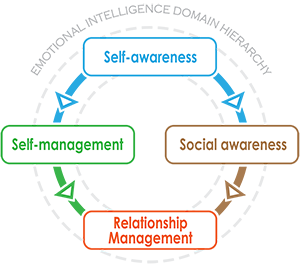
Emotional intelligence or EQ skills fall into four categories or domains – self-awareness, self-management, social awareness, and relationship management. Each of these domains contain a few skills that help a leader (or any person, for that matter) relate to others. We don’t necessarily need to master all of the skills within emotional intelligence, but we need a good representation from each of the domains. There is, in fact, a hierarchy among the domains where strong self-awareness is a prerequisite for both self-management and for other or social awareness and both self-management and social awareness are prerequisites for relationship management.

I recently wrote an article for PolymerOhio Manufacturing Services describing EQ and its importance as part of effective leadership. That article goes into more depth as to the various skills within emotional intelligence and the relationship between the four domains.

As leaders we should be cognizant of our strengths and weaknesses in the area of emotional intelligence and working to strengthen our ability to relate effectively with those that we hope to influence. What’s your EQ?

The Structure of Leadership

Effective leadership is built upon strong character, emotional intelligence, cognitive intelligence, and subject-matter expertise. In my workshops and talks on leadership I often use the analogy of the structure of a house where character is the foundation, emotional intelligence (EQ) is the framework, IQ gives leadership its function, and expertise provides leadership with curb appeal.

3D rendering of a house project on top of blueprints, showing different design stages

Character is foundational because people will follow only when they see positive character traits such as integrity, transparency, and vulnerability. EQ is the strength or framework because leadership requires relationships and relationships are the result of EQ behaviors and skills. IQ gives leadership its function, much like a plumbing system or electrical system makes a house work, because IQ lets the leader use character and EQ effectively. Expertise gives leadership its appeal because it lets the leader relate effectively with those that are carrying out the tasks.

In the leadership articles that I write for PolymerOhio Manufacturing Services’ blog, I have a series that describes this “structure” of leadership. The series then describes further each of the four elements – character, emotional intelligence, cognitive intelligence, and subject-matter expertise – and how they build into effective leadership.