The Coach Approach, Part 3 – The Route

In the previous segment of this series, we proposed that human beings are both designed for and are called to care for each other and to connect with each other. The positive side of our humanity is built and demonstrated through caring and connection. Society functions well when its members care for or serve each other and have positive, healthy relationships or connections with each other.

It is difficult to care for and connect with another person from across the room. To care and connect requires that we begin to know and understand the other person. This desire or calling to care and connect, therefore, must prompt in us a natural curiosity. As we move towards the other, we ask ourselves, “Who is this person?”, “What motivates them?”, “What are their hopes and dreams?”, “Where do they struggle?”

That curiosity, in turn, prompts us to ask questions from which we develop this understanding of the other person. In fact, the only way (or at least the most likely way) that we can connect is by asking questions. For the sake of alliteration in our Coach Approach model, we will call these coaching questions, which also differentiates them from simple, fact-focused questions.

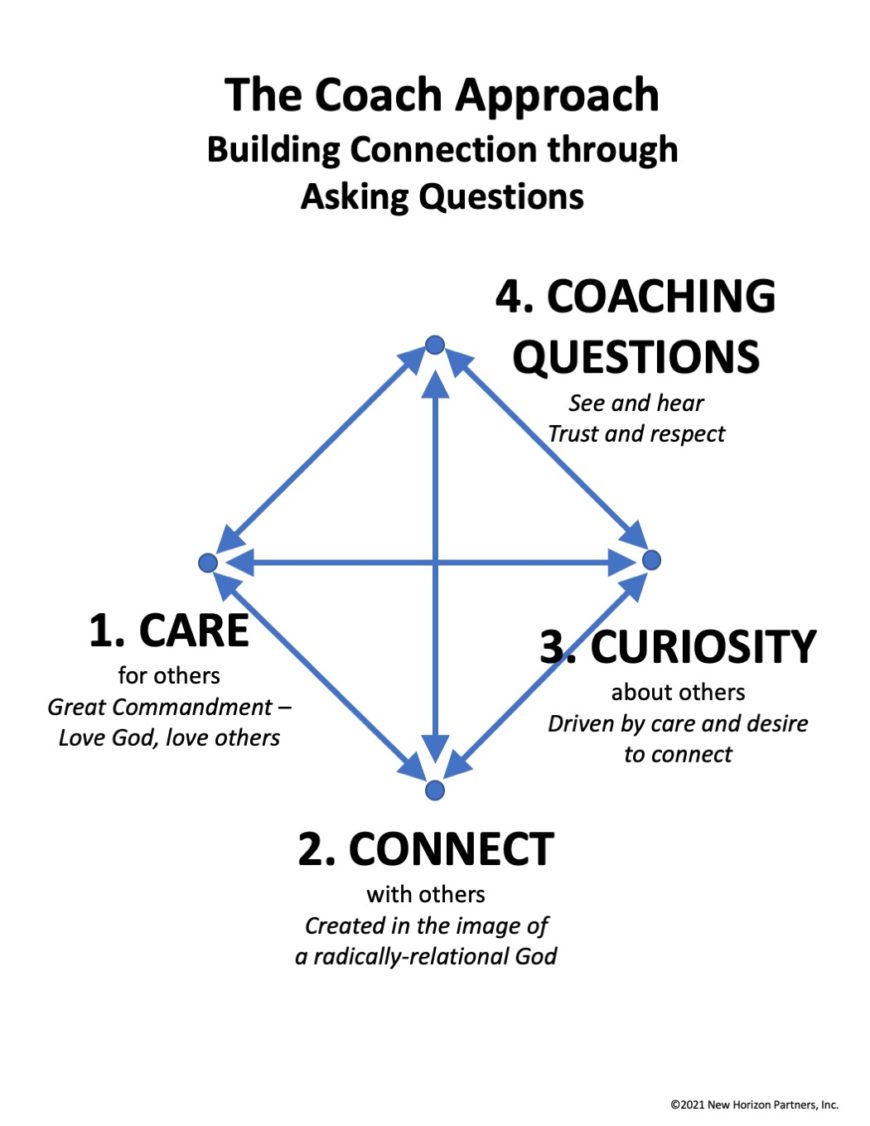
Again, by definition the Coach Approach is a lifestyle or mindset (we could also call it a habit) of utilizing questions to create meaningful conversations, build relationships, or help others grow. And here is the model that we use to understand and motivate us to build within ourselves the Coach Approach:

You will notice that the model has arrows that interconnect all of the Four C’s. This is because the Four C’s are not sequential, but they are all interconnected. For example, connection is foundational in that we are designed to be connected with each other and we are called to do so. Yet we are not able to really connect until we know and understand one another, which means that coaching questions are a prerequisite for connection. All of the Four C’s in the Coach Approach model are interconnected in this same way.

Our motivation to build this habit of the Coach Approach in our lives comes first from the fact that we are designed for and expected to care and connect for each other. We are also motivated by the important benefits achieved through exercising this habit of using questions to know and understand the other:

  • Create meaningful conversations – Conversations at a deeper level of intimacy.
  • Build relationships – People feel valued when we seek to understand and know them.
  • Help others grow – More likely to retain and act upon what comes from heart and out through mouth than what goes in ears.

Here are some coaching questions to think about: Are you comfortable asking questions at a deeper level of intimacy, questions that help you know the real person? What might you do to become more comfortable in doing so?

This article is part of a series on the Coach Approach. For an overview, see the Intro article. Or move on to Part 4 to learn about the Powerful Questions that are central to the Coach Approach.

The Coach Approach, Part 2 – The Motivation

In the first part of this series on developing a Coaching Mindset, we mentioned briefly the role that questions play in building connections with other people and then discussed some of the roadblocks to asking questions. People often lose that childlike curiosity and they become more self-focused. In general, people are more likely to provide answers rather than ask questions, seeking to serve themselves rather than build connections or serve others.

Why is it important to build (or rebuild) that curiosity about other people and seek to develop connections with people? What is our motivation for learning to ask powerful questions?

As a Christ-follower, my tendency is to answer these questions in Biblical terms. If you have a different belief system, I hope that you will read on and see that this discussion comes around to common sense wisdom for interpersonal relationships.

Called to care about each other

As human beings, we are called to love, or care for, other people. The most straightforward statement is in the gospel of John, chapter 13, where Jesus says, “A new commandment I give to you, that you love one another: just as I have loved you, you also are to love one another.” (ESV, John 13:34, Crossway Bibles). A similar thought shows up in the Greatest Commandment, which can be paraphrased as “Love God and love people.”  Throughout the Bible we are told to love one another, the answer to how people can coexist peacefully in this world.

In today’s culture the word love is more often used as a noun referring to a feeling, that emotion that comes with attraction, romance, or desire. This is not the historical or Biblical definition of love. My favorite definition of love comes from Dr. Paul David Tripp. It’s in his book on marriage, What Did You Expect?, and in other writings. His definition is as follows: “Love is willing self-sacrifice for the good of another that does not require reciprocation or that the person being loved is deserving.” Love is a verb. It is a word that denotes action or a decsion. This action is most often serving the other person. In Scripture, love for our neighbor comes to life in the many “one another” commands, which instruct us to care for one another.

In summary, the world functions best when we care about each other. When we do not care for the other person, we are self-serving, putting ourselves in competition or enmity with those around us. Only when we care about the other person are we able to build connection or relationship with them.

Called to connect with each other

As human beings, we are called to connect with each other. Created in the image of a highly relational God, we are created for relationship. Within Genesis 2:18 are the words, “It is not good that the man should be alone.” (ESV, Gen 2:18a, Crossway Bibles) While this verse is often used in regard to marriage, its application is much broader. God is highly relational as evidenced by the Trinity, as evidenced by the earthly life of Jesus, and as evidenced by God’s relationship with those that choose to follow Him. As a result of being created in His image, people function better when they have strong relationships with other people. In Scripture, we are described as all being part of one body, connected to each other through Christ.

In summary, there is a desire within each person to be seen, heard, and valued by other people. In isolation, a person tends to collapse in upon themselves or to wither away. As a creature of God and a member of society, we are called to connect with other people.

The interactions between people are simply perfunctory when they consist of simply an exchange of facts and clichés. When people exist as isolated beings, lives lack the richness and meaning that results from when being connected and caring for each other. We are called to care for and connect with those around us. Individually we function better when we care and connect with others and when others care and connect with us. Society functions well only when it is composed of people who care for each other and connect with each other.

In summary, we are designed to care and connect with each other and it is our Creator’s expectation that we will do so.

Here are some coaching questions to consider: What actions on the part of others makes me feel that others care about me and desire to connect with me? What actions do I take to care for and connect with others?

This article is part of a series on the Coach Approach. For an overview, see the Intro article. Or move on to Part 3 to learn more about the motivation behind the Coach Approach.

The Coach Approach, Part 1 – The Roadblocks

Most people recognize that asking questions is a large part of coaching others. If fact, asking questions is an important skill that goes beyond coaching. Asking questions is a core skill to connecting with others, building relationships, and to carrying on what we might call meaningful conversations. Yet we often have difficulty making questions a large part of our conversations. Before we discuss why questions are important and how to ask powerful questions, let us first understand the hurdles that we must overcome to incorporate questions into our lifestyle.

I like to think of communications along a continuum. Towards one end of this communication continuum, is the telling dynamic where communication is very one-sided. Communication here can be commands, a monologue, there is one voice that is important. The speaker spews out information or gives commands while the recipient simply takes in (or ignores) the information being given out. The next type of communications on the continuum would be presentations and instruction.

Somewhere around the middle of the communications continuum is the talking dynamic, the point where dialogue takes place. In this place, the speaker and hearer or recipient frequently trade roles. Both parties contribute to the conversation, with one dishing out information and the other taking it in, followed by a switch in roles from speaker to hearer and vice versa. In dialogue, the conversation often (though not always) builds one statement on top of another. In this part of the continuum are polite conversations and exchanges of facts.

Towards the other end of the communications continuum, is the question-answer dynamic. Towards this end of the continuum there can actually be two very different dynamics. One is the interrogation, in which the questioner is working to elicit, or perhaps drag, information, largely facts, out of the recipient. The other question-answer dynamic is driven by curiosity, in which the questioner asks questions, perhaps powerful, thought-provoking questions, in an effort to understand and connect with the recipient. Also on this end of the continuum would be the heart-to-heart communications, where two people might exchange feelings, dreams, or other deeper topics.

It is a part of our nature to spend more time telling rather than asking. On the communications continuum, most of us are most comfortable telling, some people are fairly good at dialogue, but few of us have developed the desire or the skill for asking, especially for asking, especially for seeking personal or more intimate information.

And why is it that we are more inclined towards telling? There seem to be two major reasons.

By nurture. If you have ever spent time with a two- or three-year old, you will know that they are full of questions. Various studies have shown that children between the ages of two to five ask a question every two minutes and 36 seconds and ask anywhere between 40,000 to 438,000 questions in those three years. But this part of our nature, the strong curiosity, seems to get pushed out or trained out as we mature.

Our education system is one culprit in breaking our habit of asking questions. You don’t score well on the SAT by asking good questions, but by providing the best answers. Throughout our school experience, the emphasis is on providing the right answers. Even better if you can be the fastest one to provide answers. So, we are trained to provide answers, but we receive very little training in asking questions.

For most of us, our jobs reward us for knowing and providing answers. This is especially true in the early years of a career. Only a few careers develop our ability to ask questions of people, driven by curiosity.

So, over the years, both our education and our careers reinforce the tendency to provide information and push out our natural curiosity about other people’s lives and our inclination to ask questions.

By nature. We mentioned above that, as a child, curiosity is a strong part of our human nature. But as we mature, our tendency is to become more egocentric, more self-focused, more self-centered. This plays out in a desire to be seen as intelligent, as one who has knowledge or the answers.

As we mature, our listening skills become more focused on hearing information that pertains to us. Our brains are wired to listen with a me-centered focus to defend, to fix, to win, to gain approval, etc. Also, our competitive reflex grows stronger, that part of us that wants to “one up” someone else’s story.

Another part of our nature is seeking expediency. Providing information often takes less time than asking questions and being curious. We tend to not invest time or effort in things that don’t have a short-term benefit for ourselves, another facet of our self-focus.

In general, people are more likely to provide answers rather than ask questions, seeking to serve themselves rather than build connections or serve others. Also, we tend to spend much effort in posturing, that is, portraying how we would like to be perceived rather than presenting our authentic selves. We fear vulnerability and we flee from deeper levels of intimacy.

In his book, The Seven Levels of Intimacy, Matthew Kelly lists the seven levels at which we communicate as the following:

  1. Cliché
  2. Facts
  3. Opinions
  4. Hopes & dreams
  5. Feelings
  6. Faults, fears, and failures
  7. Legitimate needs

People general operate within the first two levels, with clichés or facts. They fear moving beyond these two levels because the deeper levels present the reality of who we are. People tend to avoid revealing this reality for fear of not being accepted or being deemed unlovable.

So, there we have it. Most of our interactions are statements of clichés or facts. We are not likely to reveal much beyond that. And we are reticent to ask questions that demonstrate an interest in anything beyond clichés and facts.

Here are some coaching questions to consider: How much of my interactions with other people consists of clichés and facts? What keeps me from revealing or seeking to hear deeper thoughts? How much of my time in conversation is spent either in talking or thinking about myself and how much is spent in learning about and understanding the other person?

This article is part of a series on the Coach Approach. For an overview, see the Intro article. Or move on to Part 2 to learn about the motivation behind the Coach Approach.

The Coach Approach – Intro

The Coach Approach© is a lifestyle or mindset of utilizing questions in conversations to build relationship and/or to help others to grow. It is an other-focused or “one another” approach to relating to the people around us. The Coach Approach could also be defined as “Making a practice of building conversations around powerful questions that are based on curiosity with the goal of building connection and demonstrating care for the people around us.”

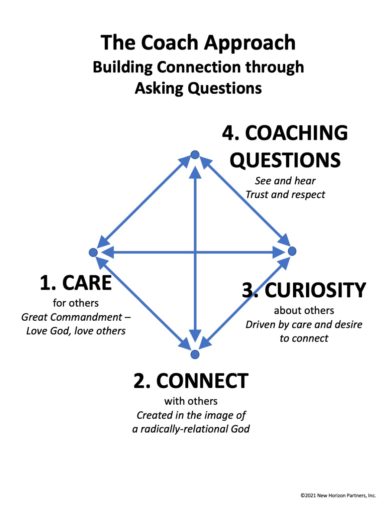
This article is an introduction to the concept of the Coach Approach, which is then explained in a series of following articles on specific elements of the concept. The complete list of articles explaining what the Coach Approach is, why it is the best way to build relationship, and examples of the Coach Approach in action is shown later in this article. But first, here is the model of the Coach Approach in action:

Read the full series:

The Coach Approach, Part 1 – The Roadblocks

The Coach Approach, Part 2 – The Motivation

The Coach Approach, Part 3 – The Route

The Coach Approach, Part 4 – The Destination

The Coach Approach, Part 5 – The Coach Approach in Action

The Coach Approach, Part 6 – More of the Coach Approach in Action

The Coach Approach, Part 7 – Lessons from Mr. Rogers

500 Powerful Questions – Sample Questions

Correction vs. Criticism

The two words, correction and criticism, may sound similar but they can often result in very different results. Correction provides the opportunity to build up while criticism often tears down.

To begin the explanation of the difference between correction and criticism, I will provide a personal illustration. I was raised in a family in which love and acceptance was conditional based on how well or quickly the assigned chores were completed. After I married, my father-in-law demonstrated a different pattern. I recall two occasions when my actions made him angry and he confronted me. In those discussions he clearly pointed out the error in my actions. While addressing my actions, it was quite clear that his love for me and acceptance of me was beyond question. His focus was on the actions that he considered out of line and in need of correction.

This is the essence of the difference between correction and criticism. Correction flows out of care for the other in an effort to improve the future behavior. Criticism too often becomes, or at least can feel like, a personal attack that harms pride or ego.

Since leadership is built upon a relationship of mutual trust and respect, criticism damages such a relationship. On the other hand, correction has the opportunity to further build up the relationship of trust and respect.

Correction, when done well, has the following traits. To demonstrate, we will imagine a scenario in which we are on the factory floor and happen upon an associate that is assembling his or her product in an inefficient manner.

  • Instructional – Correction explains the better action or behavior and the difference between what has been observed and what is preferred. For example, we might tell the associate that, in our experience, we have found putting the parts together in a different order is easier.
  • Practical – Correction doesn’t require a lot of information, just the basic facts communicated in a way that is easy to understand. For example, we might roll up our sleeves and demonstrate the way to assemble the parts.
  • Devoid of ego – Correction is best offered when we are on equal footing. This is communicated by our words, by our tone of voice, by our facial expressions and body language, and so forth. For example, as we explain the assembly technique, we might mention that we also struggled with understanding how those parts should best go together when we first saw them.
  • Personal – Correction is best received in a context of caring communication. For example, as part of the discussion with this associate, we might ask about family or other interests.

Correction has the potential to accomplish two important purposes, to improve future behavior and to build the relationship of trust and respect that is foundational for leadership. Therefore, correction is an investment that pays dividends.

Have you developed the habit of providing correction that is devoid of pride and ego? Have you eliminated critical words and attitudes from your interactions with others?

Empty Praise Has Empty Value

Praise or affirmation is often confused with feedback, but they can be quite different. Praise or affirmation is generally a statement meant to pick someone up or make them feel appreciated. Praise is often something like “Atta boy/girl!” or “Nice job!” Praise can be like the slap on the back that a coach gives a player in the midst of the game. There may be little time for anything else, but it is a bit of recognition. Praise can have more to it than just a simple affirmation statement, growing towards real feedback. Before it can be called feedback, however, it must have these three elements:

  • Identify the specific action, behavior, event, or process.
  • Describe the impact of the action.
  • Set the expectations for future action, behavior, events, or processes as more of, less of, or keep on.

Surely there are times when a simple affirmation or “Attaboy!” is called for and is sufficient, just as the coach in the middle of a game. The danger comes when that is the extent of the recognition that is provided. One quick affirmation statement now and then when part of a context of clear communication and effective feedback is fine. Maybe two in a row is OK. But when that is all that is provided, those praise statements can soon be seen as empty. And when they are empty praise, they have no value. In fact, the habit of empty praise can soon become an anachronism or an irritant.

Empty praise as a habitual pattern communicates some mix of the following to the team member:

  • You’re not noticing my contribution. If the praise is simply an “Attaboy!”, one must wonder whether there was any recognition of a certain behavior that is being called out. Or is it just words that are said out of habit and without meaning. Do you actually see me?
  • You do not care about performance. If the praise is simply given in passing, it might not communicate the impact of the behavior, either personally or organizationally. Am I part of the team?
  • You do not care about my development or growth. Real feedback is always focused on the future, providing guidance for both the performance and the development of the person. An empty bit of praise provides little in terms of direction. Do I have a future here?

Sometimes we can be in such a hurry that we rush past the need to communicate. Empty praise takes little time and little thought. Providing effective feedback is a form of strong communication and takes some effort. The result of providing effective feedback, however, is a stream of dividends.

Are you taking the time and making the effort to communicate and develop your team members?

“The COACH Model” by Keith Webb

These days there are many books on coaching. Some of them are targeted for the professional life coach, some for the manager or leader who realizes the value of coaching to build relationships and develop team members, and others for the person who wants to build coaching skills as a part of relationship building. We have read and reviewed a number of books from each of these categories over the years. Another good coaching book that I would recommend is The COACH Model for Christian Leaders by Keith E. Webb. It has a subtitle of “Powerful leadership skills for solving problems, reaching goals, and developing others.” From the title and subtitle it’s clear that this is a book targeted at building coaching skills for the leader or manager. But it also presents some great tips for the individual that wants to build a coaching mindset for everyday life. Also, while the book is described as a resource for Christian leaders and is built upon some Scriptural wisdom, the concepts apply to anyone.

According to the author, most of us suffer from what he calls “know-it-all-ism”, the desire to give our opinion, solution, or knowledge. But coaching is quite the opposite. Coaching involves listening to others, asking questions to deepen thinking, allowing others to find their own solutions, and doing it in a way that makes people feel empowered and responsible enough to take action. To interact with another person in a coaching role requires a mindset, a skill set, and a tool set. The first three chapters of the book provide a nice description of the coaching mindset. While the book’s primary objective is to equip leaders for coaching team members, this description of coaching could be especially helpful to people who simply want to incorporate the coaching mindset into all of their relationships.

The central part of this book is a coaching process for leaders to use as they seek to develop people within their sphere of influence. The process is the COACH Model, which includes the following steps:

  • Connect – the connect step has two components. First, engaging or re-engaging with the coachee and second, following up on action items and previous discussions.
  • Outcome – the second step sets expectations for the outcome from the present conversation. This allows both the coach and coachee to know the path that the conversation is expected to follow and for them both to measure along the way to assure that they are on track.
  • Awareness – this step is the heart of the conversation wherein together, with the coach asking questions and the coachee reflecting and discovering, they seek insights, connections, and perspectives surrounding the topic and desired outcome.
  • Course – Having explored and reflected, the fourth step is the development of an action plan. Given what the coachee has discovered through the conversation, what are the steps for growth and development between today and the next discussion?
  • Highlights – the final step is a summary, but it has a greater purpose than just documenting the coaching session. By effectively summarizing, the discussion is consolidated into learning that is more likely to be retained and have impact.

While this might seem like a script for a coaching meeting, throughout the five chapters on this process the author builds further on the coaching mindset and provides practical advice on using these various steps in different situations. He wraps up the book with advice on incorporating these coaching tools in every relationship and in every part of our life. In describing the benefit of using the coaching mindset in all of our relationships, the author says the following:

“In our fast-paced world we too often cut short conversations that require exploration. We’re looking for easy answers that don’t create more work. Instead, encourage exploration by asking questions that will cause the other person to reflect more deeply. Then you’ll find underlying issues, meaning, and new learning.”

The Power in Powerful Questions

Today, the concept of coaching is familiar to most people and many people might describe coaching as a conversation built around questions. But there are questions and then there are powerful questions. If, in coaching, we hope to help others think deeply and find answers within themselves, we must first ask powerful questions.

Powerful questions are those open-ended questions that get to the heart of the topic and cause the other person to really stop and think. A silent pause in response to a question indicates that either our question made no sense, or it made perfect sense, but requires some contemplation and processing to answer.

Powerful questions can be thought of as having two dimensions.

First, powerful questions have a relational foundation:

  • They demonstrate our respect for the other person. Powerful questions are framed in such a way as to show that we think highly of the other person, respecting them in every way as a capable, intelligent, well-functioning creation of God.
  • They demonstrate our care for the other person. One favorite definition of love is “seeking the best for the other, regardless of whether it is deserved or reciprocated.” A powerful question is presented in way that seeks the best for the other.
  • They demonstrate our curiosity about the other person. Powerful questions seek to understand deeply the other person; what makes them tick. For example, they are not looking for external facts but the internal impact of those external facts.

Secondly, powerful questions have a developmental objective:

  • They seek to prompt reflection. The process of considering the question might prompt conclusions and connections that are not evident on the surface.
  • They might lead to discovery. In thinking deeply about a powerful question, they often result in discovering underlying beliefs, values, convictions, or capabilities that the other person had not yet found. The generation of ideas from within is a goal of coaching questions.
  • They should result in ownership. As the other person, considers these powerful questions, they develop conclusions or form a plan of action that is uniquely their’s. Such conclusions or action plans have greater value than any that might be imposed upon or suggested to them.

Three principals also help in structuring powerful questions:

  • Them or Me? Is this question for my benefit or the other person’s? The coaching mindset is a form of servant leadership, where we are seeking the best for the other.
  • Forward or Backward? Is this question focused on the past or moving forward? Coaching is about the future.
  • Building or Correcting? Does this question try to correct the other or help them build? Coaching is about growth and development.

The coaching mindset means that we build these dimensions and principals into the way we think and the way that we interact with the people around us. Whenever appropriate, we serve others by asking powerful questions.

Do you have the character required to ask powerful questions? What are you doing to build that character? What would it require from you to grow in this practice?


Here are some other articles on a similar topic: “Ask, Don’t Tell“, “Tell Me More About…“, “Ask Questions Instead of Giving Answers

Ask Questions Instead of Giving Answers

Bosses give answers; leaders ask questions. Many people, when placed in a position of leadership, view it as either their privilege or their responsibility to provide answers. This might be in the form of directing those around them, or their arrogance may convince them that they are the fount of all truth. They may also view providing answers as expedient.

The problem with being the largest or only voice in the room is that the people around us shrink to their most basic selves. Team members feel less connected, less important, less engaged, and less satisfied in their role, thus the organization suffers through lower performance.

Rather than providing all the answers, a better leadership practice is to ask questions. Whenever possible, tell less and ask more. The questions that we ask can and should cover a wide range of topics. They might be technical or functional questions, such as “How does that work?” or “Are there other ways of doing this that we should consider?” They might be business process questions, such as “What can the organization do to better support you?” or “What are some ways that we could be more efficient?” They might be personal questions, such as “What skills would you like to be developing?” or even “What do you need from me today?” Questions most often should be open-ended, requiring more than a single-word response. The best questions necessitate some thought to answer and open the door to follow-up questions or discussion.

Asking questions develops people, benefits the organization, and builds leadership relationships. Take a look at some of the results of the practice of asking powerful questions:


  • Empowers people – Sometimes we are faced with the same flawed thinking from team members in the form of “You’re the boss; just tell us what to do.” In these situations, people are disempowered. It could be a situation where they work with a problem every day and haven’t put much thought into solutions. By asking questions, people are empowered. If we ask questions well, with a genuine interest in hearing their thoughts, we might hear some great input.
  • Reduces hierarchical differences – Too often the hierarchy is allowed to interfere with communications, a psychological barrier for people at a lower level in the organization to voice opinions or add value to a discussion. Asking questions may be a necessity in order to promote the flow of information. The process of asking team members for input tends to put us on more equal ground.
  • Bridges relational gap – Leadership is built upon a relationship. Asking questions allows leaders a route to understanding individuals, demonstrating respect, and building those relationships.
  • Prompts inquisitiveness and innovation – Asking questions that help people think deeper opens up new thoughts and can prompt more logical and analytical responses. By doing so, people are more likely to question assumptions and more deeply examine their thoughts, often leading to innovative solutions.
  • Builds engagement – People are more eager to buy into ideas in which they have participated or contributed. Questions draw out thoughts that become part of the solution and contributors to the solution are more easily engaged in implementation.
  • Develops competence – One of a leader’s responsibilities is the development of team members. Asking questions expresses confidence, helps to develop thought processes, and encourages team members to develop their own expertise.
  • Networks intelligence – Asking questions in a team setting allows for the possibility of the team building one idea upon another. This promotes collaboration within the team and builds interrelationships that strengthen it. The exchange of ideas will lead to more optimal solutions.
  • Grow more informed – Of course, one of the values of asking questions is getting answers. The process of questions allows the leader to gather information from a range of sources. Along the way, the leader also can learn a great deal about each team member.

As the leader it is your responsibility to somewhat guide the ensuing discussion, to weigh the value of the answers, to see that each team member is heard, and to prevent the quashing or domination by certain team members. The leader is responsible for managing the decision process, whether it be consensus development or executive privilege, but the future of the organization is largely built upon the ability of leadership to ask powerful questions.

What is your ratio of asking questions versus providing answers? Do you see the value in asking questions?


(Note: This article, or one very similar, was originally published in a monthly leadership blog that I wrote for PolymerOhio Manufacturing Solutions.)

Effective Leaders Know Their Team Members

Building relationships is a skill possessed by effective leaders and it should be utilized first and foremost with the leader’s own team members. Trust and respect are not easily given away by most people, but they are the very relationship traits that must be earned by leaders and team members alike. Only once that relationship of mutual trust and respect has been earned will team members accept the influence of a leader. To achieve mutual trust and respect, both parties must know and be known by the other.

Knowing your team members is much more than recognizing a face or knowing a name. Knowing a person in the work setting means that you understand who they are, what motivates them, their strengths and weaknesses, and some of their personal story. The unfortunate reality is that often managers only learn this type of information through an exit interview. Only after it is too late, do we discover that we failed to motivate a person, or that we never recognized a skill or passion that some new employer will tap into, or that the team member had a personal struggle that conflicted with their ability to perform to our expectations.

In the day-to-day activities of an organization, a manager might not recognize the importance of knowing their team members and building relationships. They spend their time dealing with issues, schedules, meetings, staffing, production, reports, and other tasks that seem pressing. Or they simply haven’t recognized the importance of building relationships as a prerequisite for influence.

A true leader recognizes that you manage things, but you lead people. And you lead people by developing such relationships. One somewhat popular philosophy is MBWA—or “management by walking around”—in which a leader prioritizes the time to observe and interact. A part of MBWA is engaging in casual conversations with people in the organization to develop relationships and a knowledge of the team members. Some organizations have actually incorporated a “stay interview” into their management systems so that they do not wait for the exit interview to develop a knowledge of their team members. It seems that caring personally about the people in our organization should not require the creation of a bureaucratic system. It should be a part of normal human interaction.

The first step to getting to know your team members is to recognize the importance of it and place a priority on doing so. In a small business, the leader might build a knowing relationship with everyone in the organization. In larger organizations, the leader certainly wants to know well all of their direct reports and have a good knowledge of the people at the next level in the organization. Building this knowledge is best done through a series of casual conversations that might be a part of periodic one-on-one meetings or could be intentionally more casual.

In developing our knowledge of our team members through casual conversations, we might want to ask questions such as these examples:

  • What makes you excited about coming to work in the morning?
  • What do you enjoy most about your current work situation?
  • If you won the lottery, what would you miss the most about coming to work every day?
  • If you had a magic wand, what would you change about your current job?
  • What is bothering you most about your job these days?
  • What did you love about your last (or a previous) position that you are missing these days?
  • How would you describe an ideal boss?
  • What would make you most proud and how would you want to be recognized for achieving it?
  • What are the reasons that you might use to persuade a friend to come to work here? Or to not come to work here?
  • Outside of work, what makes you happiest or most proud?
  • What are you typically thinking about on your way to work? And on your way home?

These are just examples and the range of discussion can be broad. Throughout this conversation, a follow-up of “And why is that?” or “Tell me more” builds real depth and value. Obviously, for such a conversation to be effective requires that there is already a relationship of authenticity and trust between both parties. If you are reading questions from a form and writing verbatim responses, then your heart is not in it and it is probably a waste of time. There is also a fine line between developing an understanding of the person relative to the job and digging into personal information where a leader has no business. A leader can offer caring support for personal struggles but must guard against developing emotional attachments that are out of bounds.

The obvious benefit of knowing our team members is that we, as leaders, can help them be both more productive and more satisfied on the job. We can give the new project to the person who hungers for challenges and ask the person who loves the routine to manage the administrative or routine tasks. We can tailor our leadership style to be responsive to both those who desire more autonomy and those who are uncomfortable with the unknown. In the end, we all win through the building of authentic and trusting relationships.

How well do you know your team members? Could you predict some or most of the answers to the questions above?


(Note: This article, or one very similar, was originally published in a monthly leadership blog that I wrote for PolymerOhio Manufacturing Solutions.)