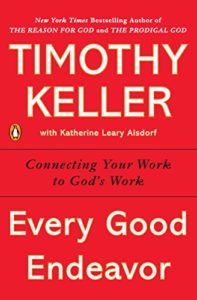
“Every Good Endeavor” by Tim Keller

“In a work world that is increasingly competitive and insecure, people often have nagging questions: Why am I doing this work? Why is it so hard? Is there anything I can do about it?” Thus the flyleaf for “Every Good Endeavor” introduces Tim Keller’s book about faith and work. This book is much more than a “how to” book regarding faith at work. It is a study of the theology of work with practical application.

While a popular view of work may be that it is a necessary evil resulting from man’s rebellion from God’s creative plan, the book quickly dispels that notion. Work is an ordained part of creation in which man is given what is known as the cultural mandate. The cultural mandate is the command to exercise dominion over the earth, subdue it, and develop its latent potential that appears in the first chapter of Genesis. In essence, mankind is given the work instructions to continue the process of creation.

Unfortunately, as a result of man’s rebellion and the fall, work became toil and in Genesis 3 we are promised thorns and thistles. Keller says, “Work exists now in a world sustained by God but disordered by sin. Only if we have some understanding of how sin distorts work can we hope to counteract its effects and salvage some of the satisfaction that God planned for our work.” This distortion shows up as work often being seen as fruitless, pointless, or selfish and as work revealing our idols.

The author provides this insight “We should be willing to be very engaged with the cultural and vocational worlds of non-Christians. Our thick view of sin will remind us that even explicitly Christian work and culture will always have some idolatrous discourse within it. Our thick view of common grace will remind us that even explicitly non-Christian work and culture will always have some witness to God’s truth in it.”

Work is a vehicle of God’s providence. Keller makes the point that a Christian worldview should naturally flow into a Christian workview. This right view should result for the follower of Jesus in a different view of work, a different set of virtues, a different view of humanity, a different source of guidance, and a different audience for our work. 1 Corinthians 10 exhorts us to “do it all for the glory of God.” Keller references the writings of Luther to point out that, no matter what our profession, our work is a ministry and we are called by God to serve in our work. We should be serving our profession, our employer, our customers, our co-workers, and even our suppliers and the broader community as we serve Jesus Christ. The author makes an important point in a discussion of dualism vs. integration. Dualism is a term used to describe a separating wall between the sacred and the secular. We see dualism most clearly in the practice of Christianity on Sunday morning or only within church activities and the rest of the week is lived with a different set of values. Integration of faith and work is the opposite of dualism where a person’s core values show up in and guide every part of their life.

I highly recommend this book for anyone who wants to grow in living their faith in every part of their life.

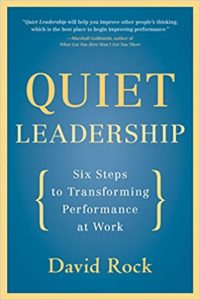
“Quiet Leadership” by David Rock

Thinking drives emotions that drives behaviors that then produce results. Managers spend their time trying to control results and to some extent behaviors. Leaders should apply their effort to impacting thinking, with a greater and longer-lasting effect on results. This is the big idea that David Rock sets forth in his book, “Quiet Leadership: Help People Think Better – Don’t Tell Them What to Do!

The book begins with a short discussion of neuroscience and how the brain hardwires patterns of thinking. Yet the brain has a great deal of neuroplasticity, making it able to learn and adapt new ways of thinking. David Rock encourages leaders to understand and take advantage of this ability of the brain as they encourage the growth of the people that they lead. To do so, the author lays out a six-step process of transforming performance of the people that we lead.

Step 1 – Think About Thinking
This step goes back to the subtitle of the book. Rather than providing direction and instructions, leaders should guide and develop the thinking process of their people. We do this by asking thinking questions. Discussions should focus on solutions rather than problems and accentuate the positive. Conversations or meetings can easily get sidetracked. The author provides a tool that is termed “Choose Your Focus” to be used in guiding conversations, with five mental frames: vision, planning, detail, problem, and drama. He suggests that the parties in a conversation refer to these to be sure that all are on the same page.

Step 2 – Listen for Potential
David Rock suggests listening with the expectation that the person speaking can and will solve their own dilemmas. Listening for potential means using the advantage of an outside or distant perspective to help the speaker see their own insights, possibilities, and future.

Step 3 – Speak with Intent
The author suggests that quiet leaders are succinct, specific, and generous when speaking with others. They use few words to communicate the core of the idea that they desire to transmit. They speak so that the listener can clearly understand and relate. And the leaders objective is develop thinking.

Step 4 – Dance Toward Insight
Leaders are accustomed to giving advice and answers. It seems to be part of their DNA and they have been trained over years to do so. People come to them for answers. David Rock suggests a different response in this, what he calls the central thought of quiet leadership. It describes the conversation where the leader prompts the person toward finding the insight within themselves. This is done through a process consisting of seeking permission to dig into the dilemma, anchoring the conversation to define what is going to be accomplished, then questioning and clarifying in such a way as to help the other person clearly understand the dilemma. Of course, the questioning and clarifying process is delicate so that it draws out the other person rather than stifling them. See the book for details here.

Step 5 – Create New Thinking
Following on to the insight regarding the dilemma, the author describes a process for discovering a desired outcome through what he terms a CREATE model – Current Reality, Explore Alternatives, and Tap Energy. The concept is to guide the person through this model to build a thinking process and find their own best path to a solution.

Step 6 – Follow Up
Rock returns to neuroscience in this sixth step to emphasize that hardwiring the brain requires repeated and intentional practice. The follow up step reminds and embeds the thinking process. The author recommends his FEELING model to assure that the person has completely embraced the process. The FEELING model includes following up with a discussion that includes Facts, Emotions, Encouragement, Learning, Implications, and a New Goal.

This book is basically an instructional manual on how to coach people in developing their thinking capability. Since all leaders should be continually coaching their people, the book presents useful tools. These tools are not just for the workplace or for a leader working with subordinates. These tools can make the reader a more effective communicator and improve relationships of influence in any part of life. In this book David Rock encourages us to move away from giving quick answers towards building relationships of understanding and developing people.

“The Advantage” by Patrick Lencioni

The big idea from Patrick Lencioni’s book, “The Advantage“, is summed up in the subtitle, “Why Organizational Health Trumps Everything Else in Business.” The book weaves together company culture, business strategy, and leadership philosophy to describe the path to organizational success. Lencioni makes the case that without health, organizations are prone to confusion, politics, and frustration that saps energy and makes them far less effective than their potential. The book makes the case that the best strategy, the best products, or the best people are all crippled within organizations that have not developed organizational health. With organizational health, the people within the organization are focused and efficient, therefore achieving higher goals more quickly.

Lencioni defines organizational health as integrity within the organization, “when it is whole, consistent, and complete, that is, when its management, operations, strategy, and culture fit together and make sense.” Another way to describe organizational health is a united leadership team with a clear business description and direction. He describes two fundamental requirements for success of an organization, when it is smart (demonstrated by effective strategy, marketing, finance, and technology) and healthy (demonstrated by minimal politics, minimal confusion, high morale, high productivity, and low turnover). His view is that most organizations spend the bulk of their effort on the smart requirement and very little effort on the organizational health requirement. This despite the belief that organizational health is far more important.

To achieve the advantage of organizational health, the book describes four disciplines, as follows:

  1. Build a Cohesive Leadership Team.
    This leadership team is defined as “a small group of people who are collectively responsible for achieving a common objective for their organization.” The key to building a healthy organization is in building cohesiveness in the leadership team, where the team members sacrifice their personal desires or interests for the benefit of the team. Lencioni lists five behavioral principles that must be embraced to build cohesiveness, as follows:
  • Building trust
  • Mastering positive conflict
  • Achieving commitment
  • Embracing accountability
  • Focusing on results
  1. Create Clarity.
    Too often we find organizations that exist as a group of silos, each with their own view of what is best for the organization or simply focused on their own departmental interests. A healthy organization is based on the leadership team rallying around a clear and consistent description of their business and its direction. Lencioni defines these six critical questions to provide the organization with what he terms clarity, describing the organization and its goals and direction:
  • Why do we exist?
  • How do we behave?
  • What do we do?
  • How will we succeed?
  • What is most important, right now?
  • Who must do what?

These questions define the business, its strategy, and the tactical priorities for achieving success. In Lencioni’s view, these six questions sum up the rallying points that bring the organization together.

  1. Overcommunicate Clarity.
    Of course, the author could have said that organizations need to communicate the answers to the six questions that provide clarity. But too often leadership sees this communication as a one-time activity rather than a continuous requirement. People in the organization will easily forget or become distracted unless leadership continually reinforces these critical elements of clarity. So that everyone in the organization is working toward the same goals, they all need to be reminded consistently and the leadership team needs to be sure that they are all giving the same message. Some organizations think that presenting the plan to all employees once should be enough to get buy-in. Other organizations never communicate; they just want people to do their jobs without any understanding of their employer and what needs to be accomplished to be successful. Instead, Lencioni suggests that organizations overcommunicate using every means possible so that everyone is focused on the same priorities.
  2. Reinforce Clarity.
    The fourth discipline that Lencioni describes as a necessity for building organizational health is through all of the human systems of the organization. For example, the hiring process needs to be structured so that candidates are screened first by their ability to fit with the values of the organization and then secondly for technical skills and past accomplishments. Similarly, the onboarding or orientation process should be considered a prime opportunity to communicate the answers to the six clarity questions. In the same way, the clarity questions should play a part in performance management, recognition, and compensation. Employees that do not fit with the values should be managed out of the organization, since they will cause a distraction to the rest of the organization

A theme throughout the book is simplicity. Bureaucracy and complicated systems defeat the purpose of uniting the entire organization with clarity. After describing the four disciplines of a healthy organization, Lencioni spends a final chapter describing his view of effective meetings consistent with the concept of a healthy organization.

Most of Patrick Lencioni’s books are written as business fables in which he focuses on elements of company culture and demonstrates failures and successes in building a successful organization. “The Advantage” is a practical guide that incorporates many of the concepts from Lencioni’s other books. While he tends to be a bit dogmatic, this book has a lot of great advice for building a healthy organization and healthy organizations outperform the rest of the world.

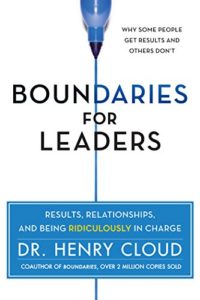
“Boundaries for Leaders” by Henry Cloud

Leaders are “can do” people and, therefore, can sometimes take on responsibilities for many things, including responsibilities that could easily be managed by the people around them. A basic principle for success in leadership and life is maintaining a reasonable ratio of responsibilities to personal resources. When the responsibilities that we take on substantially exceeds our personal resources, we are spread too thin to be effective in all that we wish to accomplish. In the book “Boundaries for Leaders: Results, Relationships, and Being Ridiculously in Charge” by Dr. Henry Cloud outlines seven areas in which leaders need to maintain boundaries in order to maximize our effectiveness as a leader.

Boundaries for Leaders New Horizon Partners

This book is one in a series of books that began with “Boundaries” by Dr. Cloud and Dr. John Townsend, published in 1992. The series includes books regarding boundaries in marriage, parenting, and other areas. The basic premise of boundaries is to clearly define where our responsibilities end and other peoples’ responsibilities begin. We are personally effective when we manage and protect those responsibilities within our boundaries and allow others’ to manage their responsibilities that are outside of our boundaries.

Leaders must accomplish the organization’s goals with and through the people around them. Leaders are responsible for providing things like direction and empowerment, setting the stage for the team’s efforts, but their accomplishments are the sum total of what is achieved by those within their sphere of influence. Therefore, leaders need to focus on the things that are within their vital responsibilities and they need to enable and allow team members to manage their own responsibilities. Boundaries for leaders can be defined as what leaders create and what they allow. The seven areas of boundaries that Dr. Cloud describes as necessary for leaders to be most effective are summarized below:

  1. Boundaries that focus attention on what is crucial and inhibit distractions from everything non-crucial, while keeping the crucial ongoing and current.
    Dr. Cloud refers to the executive functions of the brain, i.e., to focus on the specific thing to be accomplished, to not get off track by losing or shifting focus, and to continuously be aware of relevant information. In the same way, the leader needs to guide the organization.
  2. Boundaries that build a positive emotional climate that leads to high performance brain functioning.
    This boundary is about creating positive relationships while maintaining high expectations. Negative emotions lead to a flee, fight, or freeze response while positive emotions broaden peoples thinking and responses. Yet a leader needs to expect, even demand, a high level of performance. The integrated leader is able to be “hard on the issue, soft on the person.”
  3. Boundaries that keep people connected to each other and inhibit fragmentation, compartmentalization and isolation of people, teams, departments, or business units.
    Organizations function most effectively when its people are working together. People function most effectively when they share connection with those around them. Dr. Cloud lists the ingredients of shared connection as shared purpose, awareness, nonverbal cues, collaboration, coherent narrative, conflict resolution, emotional regulation, emotional reflection, emotional repair, and listening. It is the leader’s responsibility to manage these ingredients in order to enable team effectiveness.
  4. Boundaries that steward the dominant thinking paradigms that rule the organization, keeping the dominant thinking optimistic and proactive as opposed to pessimistic and powerless. No negative or victim thinking patterns allowed to take root.
    Leaders need to continually audit their own thinking and the organization’s thinking to identify and root out any negative thinking. Helplessness thinking has a way of progressing from personal to pervasive to permanent. Instead of allowing this, the leader needs to change the paradigm to positive thinking by reframing or identifying incremental steps of progress.
  5. Boundaries that align people with the behaviors that they can actually control and that specifically lead to results, empowering them to do the activities that actually “move the needle” of measureable results, as opposed to focusing on what they cannot control and/or is not directly related to real results. Aligning them with the true drivers of measureable results.
    Neuroscience has shown that the more experiences people have of being in control, the better their “thinking brain” functions. Leaders who continually help their team focus on what they individually and collectively can control and accomplish are most effective.
  6. Boundaries that structure teams around well-defined purposes with values and behaviors which lead to high performance through defined roles, activities, and mutual accountability, along with the ability to diagnose, correct and fix what is not working quickly.
    A team is not just a group of people but it is a group that has a shared purpose or goal. It has an identity, a culture, and a set of values and behaviors. A key element for team effectiveness is trust within the team. Only after defining or creating these things can it operate as a unit to accomplish its purpose.
  7. Boundaries on themselves that keep them from being a closed system, missing and repeating patterns, not getting honest feedback, falling into problematic thinking patterns, leading out of fear, avoiding necessary organizational change, not quarantining weaknesses, and losing control of their time and energy.
    Leaders can allow the reality of the circumstances or mission to define them. They can become reactive and spend all of their time and energy on the urgent while ignoring the vital. Leaders also need to lead themselves. This requires strong self-awareness and seeking feedback and outside input. With self-awareness, it then requires setting boundaries on fears, weaknesses, patterns, and the use of their personal resources.

I am a big fan of Dr. Henry Cloud because we are generally on the same page in many respects. Every interaction that I have with Henry tends to expand my thinking or encourage greater depth of thought. Nevertheless, I thought that this book was somewhat forced in trying to piggyback on the “Boundaries” franchise that Drs. Cloud and Townsend have created. I like the boundaries concept and there are a lot of good thoughts about leadership in “Boundaries for Leaders” but I would more highly recommend Dr. Cloud’s book “Integrity” as a better representation of his leadership thinking.

“The Soul of Shame” by Curt Thompson

“Shame is something we all experience at some level, more consciously for some than for others.” People tend to overlook or underestimate the presence or power of shame; in the process they fail to recognize the loss of a part of their potential. Shame shows up as that critical voice that invades the narrative of your life which is continually being re-written in the back of your mind. Shame strives to make you ineffective as a leader or whatever your endeavor. “The Soul of Shame: Retelling the Stories We Believe about Ourselves” by Curt Thompson, MD helps us understand the source of shame and how we can manage or quiet that critical voice. Different from many other books on the subject, Dr. Thompson weaves together neuroscience, psychology, and Biblical theology to provide a grass-roots understanding of shame, how it endeavors to defeat us, and the means to quiet or control that voice.

Shame is a word that makes many people uncomfortable but we know shame as the “critical voice”, the “internal judge”, the “saboteur”, or other names. Some people hear shame loudly and some hardly recognize that it is there. But everyone has occasion to hear that voice in the back of the mind that says “You are not enough.” It might say that you are not ____ (smart, hard-working, beautiful, sexy, caring, worthwhile, perfect, talented, lovable, etc.) enough or it might criticize you in some other way. Shame differs from guilt. Guilt says “I did something that was bad” while shame says “I am bad.” Shame can grow on the platform of guilt but it doesn’t really need any basis or root in reality. Shame not only colors our current perceptions but also our view of the past and our expectations of the future.

soul of shame

In “The Soul of Shame” the author explains how shame is a part of who we are as human beings. In doing so Dr. Thompson presents these four major additions to our understanding of shame:

  • Shame plays a part and provides some explanation of the redemption story described in Scripture.
  • As humans, we have a constant narrative in our minds about ourselves and the life around us which shame is constantly attempting to subvert.
  • While shame is often seen as an individual thing, individual shame affects the relational dynamics of groups such as church, community, and work.
  • In fact, groups also have a group narrative and there can be a group shame that attempts to defeat the group purpose.

In the introduction to the book, Dr. Thompson writes, “From the beginning it has been God’s purpose for this world to be one of emerging goodness, beauty, and joy. Evil has wielded shame as a primary weapon to see to it that that world never happens…….It is the emotional weapon that evil uses to (1) corrupt our relationships with God and each other, and (2) disintegrate any and all gifts of vocational vision and creativity.”

Humans are created for relationship. We have an innate desire to know and be known. In healthy relationships we are accepted just as we are and we can be vulnerable so that we become more fully known. Shame tells us that if we are known we will be found to be flawed and not enough, therefore we must hide our flawed self. Hence, shame attempts to isolate us, hiding us from the very need, vulnerable relationship, that can inoculate us against shame.

Dr. Thompson spends chapters two and three explaining the brain, the mind (a higher level concept of who we are), and the neuroscience behind shame. He references Daniel Siegel’s nine domains of the mind. To become a more complete and creation-designed person requires continual further integration of these nine domains. Shame, on the other hand, seeks to disintegrate these domains at the same time that it is disintegrating us from relationships. Throughout the rest of the book, Dr. Thompson refers back to what he terms IPNB, interpersonal neurobiology, and the functions of the brain. One of shame’s tactics is to short-circuit our effort to use our thinking brain, the prefrontal cortex, and instead keep the limbic system of the brain involved in flee, fight, or freeze modality.

In the book Dr. Thompson personifies shame by calling it the shame attendant, the voice that is whispering in our ear. He traces this voice back to the experience of Adam and Eve, who had a perfect relationship with their Creator yet felt that they were not enough. As a result they went from “naked and unashamed” to finding their fig leaves, hiding in the garden, and blaming each other and the Creator for their decisions. Later in the book the author spends time explaining how Jesus, by taking on a human body, experiences and conquers shame (especially the time of temptation in the wilderness), and completes the redemption story by hanging “naked and unashamed” on the cross. Throughout the book there are enlightening discussions of Scripture as it relates to relationships and shame.

Shame is both ubiquitous and shape-shifting. As we go through a day there is a subconscious narrative that takes place in our minds. We are often trying to make sense of what is going on inside of us and of what is going on around us. These narratives have different paths and purposes and there can be multiple paths overlapping. It might be as simple as “I wonder if that police officer is clocking me?” to trying to understand how we are being perceived by our spouse in our actions and words. Shame is looking for opportunities to subvert these narratives to undermine our relationships and integration. Shame can find its fertile ground most anywhere. It can twist words and imagine intent from people near or far in relationship to us. “Shame, as it turns out, lives in the smallest of details, the commonest of life’s moments, and that is exactly where it wants to remain.” Shame wants not to be known and, in so doing, wants us not to be known. In that way we remain less than the integrated, creative beings that we were made to be. Shame interrupts or disturbs our relationships both with those around us and with God.

“We will not be rid of shame this side of the new heaven and earth; rather, we grow in our awareness of shame in order to scorn it.” We cannot fully defeat shame but we can turn the table on shame, shaming it instead by knowing it and making it known. We do this in large part by taking the bold step of finding or developing healthy relationships of vulnerability where we can be known and accepted for who we are. We were created with a need for vulnerable relationships and a part of that need is to expose and shame shame. Other elements of quieting the voice of shame include developing our understanding and awareness of shame and contrasting it with what we were created to be.

Throughout the book Dr. Thompson provides helpful case studies where the presenting problem seemed clear but the causal roots were actually found in underlying or hidden shame. He explains Scripture with the story of shame and he explains the story of shame with Scripture. He demonstrates how ubiquitous shame can be and provides guidance for finding it and guarding against it in our family relationships, in our churches, communities, and workplaces, in all the places where shame might seek to defeat us or those around us.

This is a great book and I highly recommend it. For another, more extensive review of this book, see Leslie Vernick’s summary. Also, for more on the subject of shame, see the books by Brené Brown.

Is shame, by whatever name you call it, isolating you and hijacking your effectiveness?
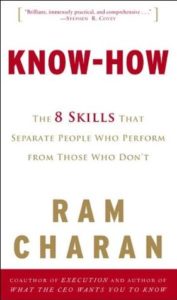
“Know-How” by Ram Charan

There is certainly a correlation between certain personal attributes and the ability of a person as a leader in contributing to the business success of their organization. In Know-How: The 8 Skills That Separate People Who Perform from Those Who Don’t, the author, business consultant Ram Charan, draws from his personal experience to make those connections. He moves quickly through the danger of looking only at the surface when evaluating a leader, then mentions briefly the character traits of effective leaders. The heart of the book expands on eight skills that Dr. Charan deems crucial for high-level leaders, especially those in large organizations

leadership skills coaching

The book begins by pointing out the fallacy of selecting leaders based on superficial information, describing these superficial traits and characteristics as the following:

  • The seduction of raw intelligence (similar to a point made in one of my recent articles)
  • A commanding presence and great communication skills
  • The power of a bold vision
  • The notion of a born leader (a reference to charisma on its own)

Instead Dr. Charan urges people to look at what he calls “the whole person” (and in my words the character of the person) when selecting a leader. He especially identifies the following character traits as those he sees most often in effective leaders:

  • Ambition – a desire to achieve something visible and noteworthy, when it is combined with integrity.
  • Drive and tenacity – an inner motor that pushes people to get to the heart of an issue and find solutions, when it is combined with a clear view of reality.
  • Self-confidence – the ability to know and speak your mind and act decisively, combined with humility and social awareness
  • Psychological openness – the willingness to allow yourself to be influenced by others and to share your ideas openly, promoting candor and communication
  • Realism – a healthy balance of optimism and pessimism, which causes one to seek the truth and clarity
  • Appetite for learning – seeking to improve from new information and experiences

All of these traits interact with each other and all can have their dark side when carried to extreme or not adequately balanced by the other traits.

With these traits in a proper combination, Dr. Charan’s experience in consulting with many leading global companies has led to the conclusion that the most effective leaders excel in the following eight skills.

  1. Positioning and Repositioning: finding a central idea for business that meets customer demands and that makes money.
    Positioning encompasses the strategic decisions in understanding customer needs and defining where and how to compete to provide value to those customers. This skill is the ability to see the whole system and to adapt to changes in the business environment.
  2. Pinpointing External Change: detecting patterns in a complex world to put the business on the offensive.
    In a world where change is more rapid and abrupt, this is the skill to use an outer focus to understand the threats and opportunities that lie down the road. The best leaders are the ones who understand the changes and their implications before anyone else and have the foresight and confidence to move based on their intuition.
  3. Leading the Social System: getting the right people together with the right behaviors and the right information to make better, faster decisions and achieve business results.
    Social systems is the term Dr. Charan uses for the way that people in an organization work together to manage the business. To make the social system effective the leader needs to be sure that information flows properly, that conflicts are surfaced and resolved, and that the proper trade-offs are made for the benefit of the long-term health of the organization.
  4. Judging People: calibrating people based on their actions, decisions, and behaviors and matching them to the non-negotiables of the job.
    Leading an organization requires achieving results through the people around the leader, so the focus of the leader needs to be on finding the right people and developing them to maximize the contribution that the people can make to the organization’s success. This requires insight into both the requirements of the various positions and the capability and potential of the people under consideration.
  5. Molding a Team: getting highly competent, high-ego leaders to coordinate seamlessly.
    Leaders seek to surround themselves with very capable people but then must mold the group of people into a strong team. To do so requires building buy-in to a vision that represents the whole organization and supersedes any individual’s interest. The team must utilize the capabilities of all members and operate as a unit, and it is the leader’s responsibility to develop this unity.
  6. Setting Goals: determining the set of goals that balances what the business can become with what it can realistically achieve.
    The leader needs to select goals that will provide leverage for the future. Among the many potential goals, finding the select few is the challenge. And then the goals need to be set at a level that is achievable while still being motivational, providing a challenge to the organization that will make it stronger.
  7. Setting Laser-Sharp Priorities: defining the path and aligning resources, actions, and energy to accomplish the goals.
    There are always more things that could be done than should be done. The leader needs to set priorities based on what is important, what is urgent, what is long-term versus short-term, and what is realistic versus visionary. Then the high priorities need to be provided with resources to be accomplished.
  8. Dealing with Forces beyond the Market: anticipating and responding to societal pressures you don’t control but that can affect your business.
    An effective leader needs to have an outer focus that is aware of both threats and opportunities to the business that come from the world outside of the organization and its markets. In this respect the leader needs to continually develop within the organization the capability of responding to these societal forces.

There is a chapter devoted to each of these eight skills, each with a wealth of examples of leaders who practiced these skills well (and some that did not). Having had the opportunity some years ago to work alongside Dr. Charan, I have a great respect for his intellect and insight. He makes the point that he believes these eight skills are the key differentiators of high-performing leaders.

My view of the book is that it is good but not great. The downsides are that these skills and most of the examples that are provided are based on the large, multi-national companies where Dr. Charan spends most of his time. Smaller business need a different mix of skills. Also, leadership can never be boiled down to eight skills. It requires a much broader set of skills, all built upon strong character, i.e., the competency + character model of leadership.

“Integrity” by Dr. Henry Cloud

When we hear the word integrity in the context of character we think of the definition of being honest and having strong moral principles. In his book, “Integrity”, Dr. Henry Cloud uses another definition of integrity, that of being whole or undivided, as in integral or intact. The idea here is wholeness of the person or the character of the person. Character is the most important ingredient of leadership, more important than talent, brains, education, training, or any other component of success. An integrated character determines a leader’s potential to succeed and to avoid the pitfalls that can befall those of lesser character.

character based leadership Ohio

The measure of character is described by Cloud as the “wake” that is left behind us. What do those with whom we interact see us leave behind in terms of tasks and relationships? How positive is our “wake”? Do people feel that they have grown and accomplished much because of us? Or are they glad that they survived with minimal damage?

Character guides our thoughts and behaviors. Dr. Cloud defines character as the ability to meet the demands of reality, a broader definition than sometimes used. Speaking of the various capabilities required to lead, he says that “while you don’t need all the gifts that exist in the world, you do need all the aspects of character while you are putting your gifts to work.” The book is focused on the aspects of wholeness or integrity of character that Dr. Cloud says are critical for effective leadership, as follows:

  1. “The ability to connect authentically (which leads to trust).
  2. The ability to be oriented toward the truth (which leads to finding and operating in reality).
  3. The ability to work in a way that gets results and finishes well (which leads to reaching goals, profits, or the mission).
  4. The ability to embrace, engage, and deal with the negative (which leads to ending problems, resolving them, or transforming them).
  5. The ability to be oriented toward growth (which leads to increase),
  6. The ability to be transcendent (which leads to enlargement of the bigger picture and oneself).”

Dr. Cloud makes the point that the integrity of character means that all of these aspects must work together. “Strengths turn into weaknesses without the other parts of a person to balance them out.” While no one has a perfect balance of these abilities, the gap is their need and opportunity for growth.

Trust is an essential element of a leadership relationship. Without trust leaders cannot influence. Trust is built through connecting, through extending favor, and through vulnerability. Connection is based on empathy. Entering into another person’s reality, validating it, and treating it with respect builds connection. Invalidation destroys connection. Another element of building trust is through extending favor. This is described as being for the other person’s best interest without being dependent upon anything. Trust is also dependent upon a certain degree of vulnerability that represents strength that one can depend on but vulnerable enough that one can identify with. Effective leaders need to have a balance of transparency that people can see their vulnerabilities and how they are feeling about things.

An orientation toward reality is a requirement for integrity of character. Leaders “must be in touch with what is, not what they wish things were or think things should be or are led by others to believe they are.” People who are oriented toward reality have a hunger for the truth, whether it be about themselves, their organization, their markets, other people, their relationships, or whatever. They prefer to seek the truth and to then deal with it effectively. They seek feedback from others. They understand themselves and can then work effectively with others to utilize their strengths and work effectively to shore up their weaknesses. They are able to assimilate and accommodate.

People of integrated character have an orientation toward getting results. They understand the concept of ready, aim, fire in decision making and the importance of each step. They are ready to move forward. When things don’t go well, that is another reality that they will deal with and overcome. Even more than that, they are able to let go of things that are good so that they can move on to the best.

The ability to embrace the negative is part of the integrated character. “The ones who succeed in life are the ones who realize that life is largely about solving problems.” Therefore they seek the negatives and seek to resolve them. They do not see the negatives as something painful but as opportunities to make things better and move forward. “Integrated characters are able to recover motivation, hope, judgment, clear thinking, drive, proactivity, and the other faculties needed to move something forward after something bad happens.” They are able to differentiate between themselves and things external. They are also able to confront well when others are causing the negative and to rally the others to work together against the problem.

People with integrated character are oriented toward increase. Previous aspects spoke about results but this aspect is focused on personal growth, both of themselves and those that surround them. One principle of growth is that what is put to use, grows. Leaders need to be open and to hunger for growth. They look for both opportunities and for mentors or coaches that can contribute to their growth. If they think they know it all or do not expose themselves to new experiences and sources for growth, then they will experience disintegration, not growth. Another characteristic of people oriented toward growth is that they want others to grow as well. Those of character balance hunger and gratitude. They value the present without settling for the status quo.

People of integrated character are oriented toward transcendence. “To live and flourish, we must bow to the things larger than us.” “A person with integrated character is a person who possesses the awareness that it is not all about him or her, and the ability and willingness to make the necessary adjustments to the things that transcend him or her at any given juncture.” The mature character stands by his or her values and meets the demands of life.

The integrated character that Dr. Cloud describes is somewhat ideal. Every human being is to some degree unintegrated. None of us have the complete array of the character aspects but, if we wish to maximize our effectiveness, we should be working to grow in all aspects. The book ends by urging us to identify our gaps and growth plans and to move forward.

This is a great book and a must-read in the area of character-based leadership.

What is the nature of your “wake”? How complete is your integrated character and what are your growth plans?

“Crucial Conversations” by Patterson, Grenny, McMillan, and Switzer

If you work or live with or near other people you probably have occasions when crucial conversations need to take place. A crucial conversation is defined as a discussion between two or more people where stakes are high, opinions vary, and emotions run strong. These conversations, if handled well, can deepen a relationship. If handled poorly, they can damage a relationship. The difficulty is that, since these conversations are full of emotion, they can easily spiral out of control. Or the fear of them spiraling out of control can prevent them from ever happening, even though they are often necessary for resolving an issue or building a relationship.

crucial-conversations

Crucial Conversations: Tools for Talking When Stakes Are High” by Kerry Patterson, Joseph Grenny, Ron McMillan, and Al Switzer is a popular book on communication in challenging circumstances. The authors point out that there are three choices when we face crucial conversations:

  • We can avoid them.
  • We can face them and handle them poorly.
  • We can face them and handle them well.

Too often the result is one of the first two outcomes, not because that is our choice but because people often don’t have the tools to handle these conversations well. The book presents a process for achieving a positive outcome based on research that the authors conducted, examining the practices of people who were able to handle crucial conversation extremely well.

The book begins with an explanation of why crucial conversations can easily spiral out of control. When stakes are high and emotions begin to rise, there are natural responses built into our bodies. Adrenaline rises, blood flow is altered, muscles tense, etc. These are all part of the natural fight or flight responses that are built into our physical system as a matter of survival. These responses begin when we face tense situations, often beginning even before we realize that the situation could present challenges.

In order to understand the recommended process for handling crucial conversations, we need a little background in neuroscience. There are two major areas of brain activity relevant for our discussion. The prefrontal cortex is the area where we store and process facts and information, identifying relationships between facts, and developing logical conclusions. The other major part of the brain is the limbic system which is composed of various brain structures where various reflexive or reactive brain activities take place. The fight or flight response and other emotional responses come from the limbic system.

The tools defined in this book, “Crucial Conversations”, are all focused on engaging the prefrontal cortex and keeping the limbic system quiet during such a conversation. By keeping the conversation logical and safe for all parties, the parties can more clearly communicate. If we stray into a highly emotional discussion, the limbic system can highjack the conversation and prevent the logical input that we would desire from the prefrontal cortex. The book outlines seven steps to a positive crucial conversation, as follows, all aimed at keeping the conversation in the prefrontal cortex and out of the limbic system:

  1. Start with Heart – This step is aimed at understanding the desires of the various participants by asking, “What do I really want for myself, for others, for the relationship?” The other component here is refuting what the authors call the Fool’s Choice of thinking that the only choices are silence or an emotional discussion with a bad outcome, by identifying what would be the best outcome.
  2. Learn to Look – This step is focused on maintaining safety for all involved so that we keep the conversation in the prefrontal cortex and away from the limbic system. The participants watch for signs of stress in themselves and others and bring all parties back to safety rather than moving toward fight or flight or what the book calls silence or violence.
  3. Make It Safe – This step provides tools for bringing the dialogue back to safety including apologize, contrast to explain, and getting back to the mutual purpose.
  4. Master My Stories – Part of the reason that crucial conversations go bad is that people imagine stories behind others’ actions. This step asks what might be a logical explanation rather than inferring the worst.
  5. State My Path – Using a concept of path to action, this step Shares facts, Tells story, Asks for others’ paths, Talks tentatively, and Encourages testing.
  6. Explore Others’ Paths – Using some strong communication tools, this step seeks to understand the others’ view. The book uses Ask to seek out, Mirror emotions to show safety, Paraphrase to show understanding, and Prime to get the information flowing. Then to build common ground use Agree, Build, and Compare.
  7. Move to Action – The last step is designed to ensure that the issue is settled by defining a decision process and timeline.

“Crucial Conversations” presents a process that can be used in the workplace (with superiors, co-workers, or subordinates), in family relationships, or in any other circumstances that fit the definition of a dialogue where stakes are high, opinions vary, and emotions run strong. Rather than let an emotional dialogue damage a relationship, we can learn to conduct a crucial conversation in a way that produces a positive outcome. I thought this book was quite good and would give it a 9 out of 10.

“Focus” by Daniel Goleman

focus-goleman-mindfulness

High-performers need three kinds of focus: inner, other, and outer – this is the big idea from “Focus: The Hidden Driver of Excellence” by Daniel Goleman. Inner focus is self-awareness – knowing and understanding yourself, seeing yourself realistically, seeing yourself as others see you. Other focus is seeing others and understanding where they are emotionally. The outer focus has two aspects – seeing what is going on around us and seeing what is happening in the future.

Self-awareness includes the ability to understand yourself, including seeing the underlying factors or causes of how you think and act. Included in here we can talk about the ability to focus our attention appropriately, which sometimes means to block out anything that interferes with a goal or task. At other times it is appropriate and productive to let our minds freely wander. In fact, this is often the source of innovation or invention and can sometimes be an important part of decision making.

Other focus includes the ability to read and properly react to the actions and emotions of others. It also includes social sensitivity which would cover the dynamics of groups and understanding cultural differences. Goleman talks here also about the empathy triad in which he differentiates between cognitive empathy, emotional empathy, and empathic concern. Cognitive empathy lets us take other people’s perspectives, comprehend their mental state, while at the same time managing our own emotions. With emotional empathy we join the other person in feeling along with them; our bodies resonate in whatever joy or sorrow that person may be going through. Empathic concern goes further, leading us to care about the other person, mobilizing us to help if need be.

Outer focus provides a view of the bigger picture. This includes the ability to see not just a certain discrete action but to comprehend the larger system or pattern. It also allows us to integrate widely diverse information to understand the potential interaction or affect somewhere else. In this respect, the ability to think further out in the dimension of time is another part of outer focus.

In these current times with the bombardment of information, Goleman warns against a decline in people’s ability to pay attention to a given thought for an extended time. In order to resolve big issues, we need to be able to think them through thoroughly. The information age and all of our electronic devices are creating habits of bouncing from one piece of information to another. There are times in our lives when we want to scan broadly but there remain times that we need to focus.

Goleman spends some time talking about mindfulness, studies of neuroscience, and practices to increase our ability to focus in various dimensions. The downside of the book is the amount of time spent on what could be considered the author’s social rants.

All in all, a good read with some interesting perspectives but not a must read. I give it a B- or a 6 out of 10.

“… a failure to focus inward leaves you rudderless, a failure to focus on others renders you clueless, and a failure to focus outward may leave you blindsided.” – Daniel Goleman