“The Go-Giver” by Bob Burg and John David Mann

This book, The Go-Giver: A Little Story About a Powerful Business Idea, is a short, quick read. Written by Bob Burg and John David Mann in a fable style, it tells the story of person who was struggling to reach his sales quota until he finds a new way to do business. This new way is to first build personal relationships that open up possibilities for business opportunities.

You might surmise correctly from the title that the idea of a Go-Giver is in direct contrast to a Go-Getter. What we consider a go-getter is quite often a person focused on him- or herself, looking out for “Number 1.” The go-getter is often out to win at any cost. While they may speak of win-win situations, the important thing in their mind is what they are going to get out of the transaction. And life is very much based on just that – transactions, without much consideration of relationships. The Go-Giver, on the other hand, is focused first on the other person. The important thing to the go-giver is providing value to the other and developing a relationship. Transactions are the reward that might result from serving the other.

And this is the big idea of the book, that what the authors term as the “Five Laws of Stratospheric Success” can lead to business growth and success. The five laws as listed in the book are as follows:

  • The First Law – The Law of Value – Your true worth is determined by how much more you give in value than you take in payment.
  • The Second Law – The Law of Compensation – Your income is determined by how many people you serve and how well you serve them.
  • The Third Law – The Law of Influence – Your influence is determined by how abundantly you place other people’s interests first.
  • The Fourth Law – The Law of Authenticity – The most valuable gift you have to offer is yourself.
  • The Fifth Law – The Law of Receptivity – The key to effective giving is to stay open to receiving.

These laws are, for the most part, in line with the Biblical commands to “one another”, that is to serve, love, help, etc. one another. And the “one another” is anyone that comes across our path, not just the ones that are deemed strategic opportunities. These laws and the “one another” commands should be guideposts for the way that we live and do business. The part of the book that is misleading is that everyone in the fable who lives out these five laws becomes a multi-millionaire. This is not realistic, and the book implies that this goal of generating great wealth is the one and only motivation for following such laws. I would submit that the true motivation should be “one anothering,” or caring for each other and providing value to all with whom we interact. Even with this major flaw, this book is an interesting and thought-provoking read.
“Ask Powerful Questions” by Will Wise

While the title of this book makes it sound like a coaching book, it is more about a lifestyle or a process of building meaningful relationships. Ask Powerful Questions: Create Conversations That Matter is a book written by Will Wise along with Chad Littlefield. The book presents guidance for “asking intentional, empathetic questions that are rooted in our natural, genuine curiosity and followed up with deep listening.” Such questions, done well, lead to deeper conversations, better understanding, and stronger relationships.

The book is structured around a pyramid of ever-deeper skills that can develop the ability to ask these powerful questions, and more importantly, to develop a mindset that prompts one to ask questions rather than providing self-centered information or opinions. The pyramid has five levels of skill development that the authors believe to be necessary in developing the skill of asking powerful questions. Beginning at the bottom, or foundational, level of the pyramid, the five levels are as follows:
Intention (The Power of Clear Intention) – “I am willing to know you”
The authors claim, “You can only unlock the true potential of your questions by first being clear about the intentions you’re setting forth both for yourself and in sharing with others.” There are two levels at which we need to consider intention. First, as a questioner, we must understand and be driven by intention that is driven by curiosity and understanding, not some subterfuge or effort at manipulation. Also, the recipient of our questions must have an understanding or comfort with the questions’ intention. This might be inferred as part of a conversation but might also be a clarifying statement by the questioner.
Rapport (The Power of Being Present) – “I see you”
Rapport means building a relationship of trust. You might be able to ask a simple, yet powerful question of a perfect stranger, let’s say the cashier as you are buying groceries. But to actually develop a meaningful conversation, a certain degree of trust is necessary. So, rapport or connection is a prerequisite, but connection is also generally the result of a conversation driven by powerful questions.
Openness (The Power of Being Open) – “I hear you”
Of course, powerful questions are open-ended questions. But this openness, as the third level in building the pyramid, refers to our approach to a question; there is a requirement to be open-minded if we are truly asking powerful questions. This means that we are willing to receive and accept any answer without judgment and without any sense of the “right” answer. At this point in the book, the authors caution against using questions that begin with the word, “why,” and also against using questions that include the word, “you.” Both of these words can easily prompt defensiveness in the recipient.
Listening (The Power of Reflective Listening) – “I get you”
There is no power in a question if we are not ready to devote all of our attention to the answer. In this chapter of the book, the authors spend some time describing deep or active listening. They provide some powerful tools for reflective listening and break them various reflective listening methods.
Empathy (The Power of Connection) – “I feel with you”
Empathy can provide power behind the connection. The authors compare empathy with apathy and sympathy and state, “Choosing empathy allows the relationship to move toward connection, allowing for compassionate action. Apathy and sympathy can have the opposite effect and actually pull people apart.”

Throughout the book, the authors identify the traps that inhibit our powerful questions, a potential antidote for the traps, and tools to overcome or avoid the traps. At the end of each chapter presenting the skill levels of the pyramid, there are practical exercises to build the skill. Throughout the book, the authors cite research to reinforce the importance of these skills and offer relational and practical wisdom.

This is an excellent book with very practical advice about asking powerful questions. These powerful questions can assist us in developing great conversations and in building stronger relationships in any part of our life.

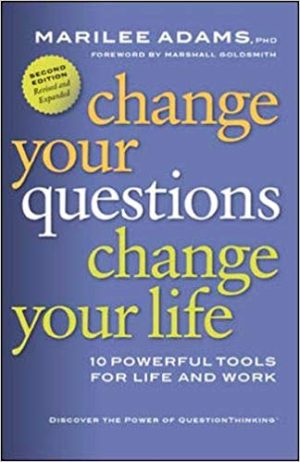
“Change Your Questions, Change Your Life” by Marilee Adams

There is a constant stream of questions running through the back of our mind. Something we see, something we hear, a memory that pops up – all of these things are likely to prompt some questions. Most of the time we pay no attention to these questions; they are just a part of the background processing that takes place in our brain. Sometimes, however, these questions are loud enough that we hear them as questions that we are asking ourselves. Sometimes we feel compelled to ask them of someone in a conversation. These questions can have a powerful influence on the way that we think and the way that we interact with others.

The big idea in the book, “Change Your Questions, Change Your Life” by Marilee Adams, is that these questions, the ones that are loud enough for us to pay attention to, are often what the author calls Judger questions. The problem with Judger questions is that they are either self-defeating (when we are asking them of ourselves) or they damage relationships (when we ask them about others). Instead of Judger questions, the author urges us to develop the practice of asking Learner questions.

It is human nature to be in Judger mode. Judger mode is protective, looking for risk or danger. When we ask Judger questions of ourselves, they sound much like the inner critic: “What’s wrong with me?” or “Why bother?” When we ask them about other people, either silently to ourselves or aloud, they are searching for ill motives or weaknesses in the other person: “What’s wrong with him/her?” or “What are they trying to do here?” Sometimes Judger questions are aimed at winning or gaining something: “How do I prove I’m right?” or “What should I do to get out of this situation?

The author maintains that, while we all operate in the Judger mindset occasionally, the better choice is to develop a more robust Learner mindset and to operate from that mode. When we hear ourselves asking Judger questions, switch to Learner mindset by asking, “Am I in Judger?, Will it get me what I really want?, Where would I rather be?

The Learner mindset asks question from an accepting, open, responsive stance. When we are asking questions of ourselves, these might be questions such as “What do I value about myself?”, “What’s possible?”, or “What are the best steps forward?” When we are observing another person, Learner might ask “What is he/she thinking, feeling, and wanting?” or “What do they need in this situation?

The book is written in the form of a fable, in which the main character has risen through the organization by operating as the “answer man.” Now in a leadership position, his team is failing because he always falls back on giving answers, making the team disrespect him and fail to coalesce and collaborate. Through a leadership coach he learns the value of asking powerful questions, changing the way that he leads and then building a successful team.

Leadership tools are often relationship tools, and that is the case here. The book demonstrates how much more effective questions are at building relationships, rather than always providing answers or dealing with each other from a Judger mindset.

Since an organization’s culture generally reflects the character of the leader, there is a chapter on building Learner teams and keeping them from becoming Judger teams. There is also a chapter on Q-Storming, a process similar to brainstorming but relying on questions only. The book also includes a workbook section that might serve as a substitute for coaching in developing the Learner mindset.

“Poor leaders rarely ask questions of themselves or others. Good leaders, on the other hand, ask many questions. Great leaders ask the great questions.” – Michael Marquardt

On her website, Marilee Adams cites a study in which leaders judged to be the poorest in leadership ability made statements 90% of the time and asked questions only 10% of the time. Those rated as the best leaders used questions 70% of the time. In general, this book teaches valuable tools for becoming an effective leader who operates from a Learner mindset and asks powerful questions.

“Untangling Emotions” by Alasdair Groves and Winston Smith

Emotions are complex and often confusing. Emotions are our mind and our body’s way of advising us about what is happening in regard to the things that we love. Some of us fear emotions, some are ruled by emotions. The book, “Untangling Emotions”, written by J. Alasdair Groves and Winston T. Smith, is a fascinating dive into understanding emotions and developing a positive path for dealing with them.

The big idea in this book is that emotions provide us with an insight as to what we consider important, i.e., what we love or worship. Some people love their comfort, excitement, themselves, their family, success, reputation, wealth, and so on. The things that we love drive our emotions and the way that we act upon our emotions. Offering a Christian perspective rooted in Scripture, the book encourages us to examine whether the things that we love, those things that drive our emotions, are in line with the things that God loves.

The authors describe the following purposes of emotions:

  • Communicate: emotions communicate value
  • Relate: emotions help us connect
  • Motivate: emotions motivate us
  • Elevate: emotions turn us toward God

Some people react to emotions with a “spit it up” attitude, believing that emotions are everything and others adopt a “suck it up” attitude, preferring to ignore their emotions. Instead, the authors encourage us to engage our emotions to better understand them and to respond in a healthy fashion to them.

Because we have many things in our life that are important to a greater or lesser extent, our mind and body are constantly feeling a variety of emotions. At any point in time, one or several of those emotions might rise in its impact. When this occurs, we might engage in the emotion by asking questions such as the following:

  • Identify – Am I feeling some particular emotion? What am I feeling?
  • Examine – Why am I feeling this emotion? How is this emotion making me want to behave?
  • Evaluate – What does this emotion tell me about what is important to me? Is this emotion and this level of importance consistent with who I am and what I want to be important in my life?
  • Act – How might I respond to this emotion? How will I respond to this emotion?

Using this framework, the authors then walk the reader through the process of engaging the hardest emotions – fear, anger, grief, and guilt and shame. For example, many people are quick to react to anger. Ephesians 4:29 tells us “Be angry and do not sin” (ESV), which indicates that it is natural to sometimes be angry, but cautions us regarding how we react to that anger. The authors point out that there is both righteous anger unrighteous anger. Righteous anger is a reaction to something like God being mocked or someone attacking someone that we love. More often we feel unrighteous anger in which someone interferes with our little kingdom of self. The process of engaging that anger allows us to examine the root, make a judgment call on its righteousness, and take action or not based on a clear assessment.

Each chapter finishes with a few questions to ponder, with some for the reader for their own processing and some for the reader that desires to help others. The book is a good read for those that want to think deeper about emotions and their impact on our lives and our relationships.

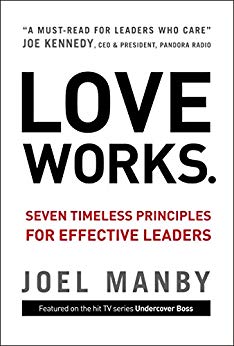
“Love Works” by Joel Manby

As you may suspect from the title, the big idea in the book “Love Works” is about leading an organization based on love. Joel Manby spent the first half of his career in the automotive business, in companies where leadership was based on the command and control model. But when he became the president and CEO of Herschend Family Entertainment, he found a whole different culture built upon the mantra of “Leading with Love,” which guides the way the company treats employees and customers. This book is all about servant leadership, even though that phrase only shows up once in the book, and then only in a graphic about HFE’s culture.

The idea of love is easily misunderstood in today’s modern, American culture. In the second chapter the author talks of the four different Greek words for love – eros, philos, storge, and agape. For sure, when we speak of love in leadership, we are not speaking of the emotion of love, which would describe the first of those three Greek words. The word that guides leadership is agape, the love that is an action which stems from our regard for the other person and seeks the best for them.

Manby then describes HFE’s model of leadership based on seven principles that are paraphrased from 1 Corinthians 13, the “love chapter” in the Bible, which is used so often in marriage ceremonies. The words that he uses are “Love is … patient, kind, trusting, unselfish, truthful, forgiving, and dedicated.”

  • Patient– have control in difficult situations. Here the author speaks mainly of patience in the feedback process. The advice is not to be patient with poor performance but, rather, to be patient with how you respond to that poor performance. Praise more than you admonish and praise in public, admonish in private.
  • Kind– show enthusiasm and encouragement. The customer’s experience is impacted greatly by the attitudes of employees, so extending kindness and demonstrating enthusiasm to your team results in kindness and enthusiasm shown to your customers. Provide words and notes of recognition and appreciation to encourage and validate positive behaviors.
  • Trusting– place confidence in others. The author speaks here of the decision-making process and the need to get input and keep the appropriate people informed. This includes delegating and listening. He states, “Listening carefully is a sign of trust. Interrupting people is a sign of distrust.”
  • Unselfish– thinking of yourself less and focusing on others. Here he speaks of giving of your time, talent, and treasure to help others and describes many ways to do so. The HFE organization has an employee-funded foundation to help fellow employees through difficult circumstances.
  • Truthful– define reality corporately and individually. Honesty is always the best policy. The author describes the need for candor in all discussions and the importance of also being open to the truth as a leader.
  • Forgiving– release the grip of the grudge. Manby states, “The longer you hold a grudge, the longer the grudge has a hold on you.” He urges leaders to forgive people who have wronged the organization as well as people who have wronged us personally.
  • Dedicated– stick to your values in all circumstances. This is the concept that we have termed as integrity or as congruity, the idea that our values are firmly rooted and guide us unswervingly.

For sure, every company needs to have financial goals. Leaders are stewards of the organization and profitability is how we assure that the organization survives and thrives in its mission of serving customers and employees. But Manby and the HFE organization makes a strong case that being a good financial steward and the culture of “leading with love” fit hand in glove in achieving true success.

“The Servant Leader” by James A. Autry

This book, “The Servant Leader: How to Build a Creative Team, Develop Great Morale, and Improve Bottom-line Performance,” by James A. Autry, is very much a how-to book, describing the way to implement servant leadership in many aspects of leading an organization. James Autry was president of the magazine group for Meredith Corporation and later a business consultant and speaker.

The author begins with a list of five attributes that describe servant leadership. A servant leader must –

  • Be Authentic – be real or be who you are in every situation. This includes the concept of honesty and integrity, not fudging or giving yourself some wiggle room around the truth.
  • Be Vulnerable – being honest with your feelings in the context of your work, being open with your doubts and concerns about an idea, and being able to own and admit your mistakes.
  • Be Accepting – assigning value to and accepting every person around you regardless of style or personality. This doesn’t require accepting every idea or never disagreeing, but refers to accepting of the person.
  • Be Present – be fully available and attentive in human interactions. Be centered rather than distracted or attempting to multitask.
  • Be Useful – in other words, be a servant. Be a resource for your people, helping them to be productive and successful.

With this foundation defining servant leadership, the rest of the book applies these traits to the daily practice of leadership. An overarching principle of the book is that servant leaders guide their team or organization to also practice servant leadership principles. Therefore, the team members, following the example of the leader, serve each other.

The book is divided into four parts, with the first devoted to describing servant leadership as noted above. The second part describes how servant leadership shows up in the daily activities of the leader such as hiring people that will fit with the culture of servant leadership, building servant leadership practices into the organization, and managing performance through job descriptions, performance standards, and performance appraissals in a way consistent with the principles.

The third part of the book suggests methods consistent with servant leadership principles in dealing with issues that arise in leadership. This includes dealing with organizational issues such as firing people, closing or relocating operations, or re-focusing a business; personal issues such as dealing with illnesses, either of employees or within their families; or legal issues such as lawsuits and harassment.

The fourth part of the book deals with the circumstances in which servant leadership can be put to the greatest test such as during economic or market downturns, in dealing with the balance between work and family, and dealing with conflict. In discussing conflict the author presents a number of tools for identifying, preventing, and encouraging resolution of conflict.

The servant leader is a steward of both the organization and the people within the organization. As such, he/she is frequently in the position of weighing the interests of various parties versus policies and practices of the organization. The author makes the point that dealing positively with people is most often the best choice for the long-term health of the organization. A servant leader leads in such a way as to build community of service within the organization that leads to a healthy and productive team.

This is a good book on the subject of servant leadership with lots of practical advice and examples of application.

“The World’s Most Powerful Leadership Principle” by James C. Hunter

Jim Hunter’s previous book, “The Servant,” was an allegory that told the story of a business leader whose life was spiraling out of control in every arena. He attends a leadership retreat where the instructor, a former businessman now monk, leads him to realize that true leadership is not built upon power, but on influence or authority, which results from relationships, love, service, and sacrifice.

This second book from Hunter, “The World’s Most Powerful Leadership Principle: How to Become a Servant Leader,” is just that, a how-to book describing Hunter’s thoughts for growing into a servant leader.The goals that Hunter establishes for this book are to: 1) define servant leadership and 2) provide a map for implementation of servant leadership.

The author defines leadership as “the skill of influencing people to enthusiastically work toward goals identified as being for the common good.” The first few chapters discuss the concept of leadership and build out the definition of servant leadership. Leadership is not management and it is not based on power or position. True leadership is influence (the author calls it authority) that is built upon skills and character.

Love is the critical difference that underlies the relationships, service, and sacrifice of servant leadership. This love is not the warm, fuzzy feeling that today’s culture has redefined love to be; rather, it is the other-focused verb that has been the definition of love for eons. The author defines love in leadership as “the act of extending yourself for others by identifying and meeting their legitimate needs and seeking their greatest good.”

The author uses 1 Corinthians 13 to describe the characteristics of love in a servant leadership context. Leadership requires patience, kindness, humility, respect, selflessness, forgiveness, honesty, and commitment. None of these characteristics are soft or wimpy, but are strong and positive.

For most people, the practice of servant leadership requires significant character growth that makes these practices a normal part of daily habits. The author presents a simple model of change or character growth, with three steps. Step 1 is called Friction, where pain or discomfort is felt from the difference between the practices that result from current character and what might result after some character growth. Step 2 is Insight, which involves the development of an understanding of the impact that character growth can produce. Step 3 is the Will = Intention + Actions phase, in which a committed practice of new behavior is used to change character over time.

The author points out that, despite the awesome responsibility of leadership of an organization’s most important asset, many do not see the importance of investing in the development of leadership. Nor do they realize the benefit that results from good servant leadership as it better meets the needs of workers in the organization.

This is a good book that presents servant leadership well. It is always difficult to adequately describe the effort required to make the character change that is often necessary to be effective as a servant leader.

“The Power of Vulnerability” by Kaplan and Manchester

Many organizations do not achieve their true potential because they leave much of their power on the table. Organizations often have a culture that prevents people from bringing their full potential to the organization. While an organization could make changes to its strategy, its processes, its structure, or the members of management, one of the most straight-forward changes that can be made to grow in effectiveness is a change in culture.

This is the big idea in the book The Power of Vulnerability by Barry Kaplan and Jeffrey Manchester. The book describes the culture of many organizations that makes it unsafe to be authentic in corporate interactions. Since there is not safety in the relationships amongst the leadership team, people spend energy posturing and politicking. They do not feel the connection and freedom in which they can present and explore all of their best ideas. Instead, the members of what should be the leadership team are isolated, attempting to manage their own functional silos, hiding their internal struggles from the rest of the organization and squeezing the most they can from their individual responsibilities.

In fact, it is hard to refer to the top management group in such an organization as a team. They more resemble a functional workgroup, cooperating only to a minimal extent and only when forced. A leadership team should be highly related and reliant upon each other. This book is replete with case studies of organizations that came to the authors’ coaching practice with a fractured team and the process used to build them into a cohesive team.

“As opposed to a functional workgroup, a team is engaged and connected at every level – emotionally, physically, spiritually, and professionally.”

The first step in moving from a group of isolated managers into a team of leaders is to establish a relationship of safety and connection between all of the team members. With such a relationship, the team members can then grow in authenticity, able to share and explore with the team all of their ideas, along with personal struggles and emotions. This relationship also allows team members the setting to quickly short-circuit any interpersonal misunderstandings or struggles that should arise.

“The height of a team’s performance compared to its potential is directly related to the depth of connection among its members.”

The book presents some functional tools for building connection in the team, for effective meetings in a culture of safety and connection, and for interpersonal relationships. By no means is this development of a safe and connected culture an easy process. Rather it takes great effort to first turn around the culture and then a great deal of intentionality to maintain and continually grow this culture over time.

As with any cultural change, the leadership team must first buy in and practice the new culture. Over time this culture, with some encouragement, can grow throughout the organization.

“When the team ‘plays it safe,’ it avoids challenges and misses opportunities. Yet, when the team ‘INpowers’ itself to ‘safely play,’ the team’s authentic communications inspire emergence of enormous capacity.”

The concepts presented in this book are fundamentally about developing a highly effective corporate organization based on the idea of being fully present, fully connected, and fully authentic. Of course, these concepts are the key building blocks for any close relationship, including marriage, parenting, or close friendships. Anyone interested in developing deeper relationship will find it helpful.

Because this book outlines many of the same concepts that I emphasize in my coaching and consulting work, I naturally enjoyed it greatly. It is not a particularly easy read because of the style. It also is clearly written with the idea of gaining coaching clients, as it stops short of presenting the tools that the authors use to develop cultural change. Still I recommend this book.

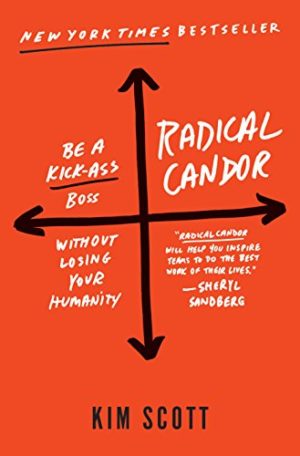
“Radical Candor” by Kim Scott


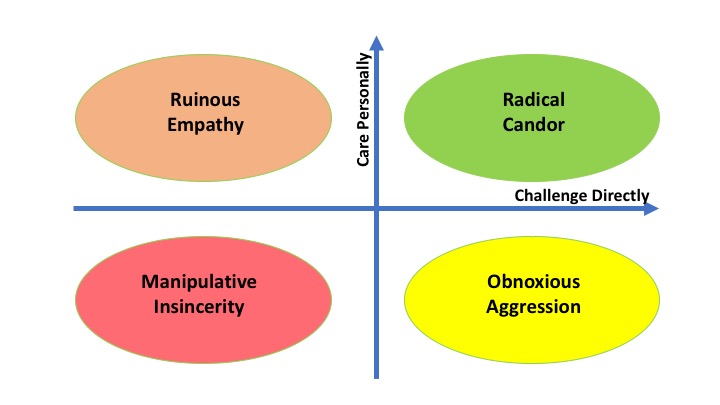
No doubt you heard the advice as you grew up: “if you can’t say anything nice, don’t say any anything at all.” Many people still operate according to that rule even when in a position of leading or directing people. While this advice may work for everyday life, it can be a disaster when adopted by managers. On the other hand, there are some people who, when they have achieved a management position, believe it is their responsibility or privilege to boss people around, demanding that their voice is the only one that matters. This attitude can also be disastrous for a manager. The book “Radical Candor” by Kim Scott proposes a model of leadership based on the idea that the best boss is the one that can “care personally and challenge directly.” When a leader can effectively combine these two skills, they are most effective at influencing, inspiring, developing, and directing their team. Only when we clearly show that we care personally can people accept our effort to challenge directly. And only when we challenge directly are people convinced that we truly do care personally.

My view is that leadership is the ability to influence built upon a relationship of trust and respect. This correlates with the concept of Radical Candor. Trust is built by caring personally. Respect is built by challenging directly.

This combination of caring personally and challenging directly is a balancing process and is modulated by our understanding of the recipient and the way in which they perceive both the caring and the challenging. Challenging, or guidance, is always meant to impact the future of recipient; therefore, it includes both praise and criticism.

When our ability to care personally and to challenge directly is out of balance, the ability to lead can be impacted adversely. Ms. Scott describes the various combinations of caring and challenging as follows:

Obnoxious Aggression is when a boss is prone to criticize without showing that they care about the recipient. The boss comes off as a “jerk” and the recipient is made to feel incompetent.

Ruinous Empathy is when a boss cares so much that they are unable to ever challenge; this is the “when you can’t say anything nice” person in action. It is ruinous because the recipient never is given feedback that will lead to growth.

Manipulative Insincerity is the result of a boss that doesn’t care enough to challenge. The worst version of leadership, this is generally the result of a boss that is only focused on him- or herself. It’s praise that is false or condescending and criticism that is neither clear nor kind.

Radical Candor is the healthy mix of caring and challenging that leads to growth and influence.

The first portion of the book defines and explains Radical Candor, building the case for why it is the best model for today’s leadership in the workplace. In fact, Radical Candor is a concept useful in any relationship or communication. In the process of describing Radical Candor, Ms. Scott further defines caring as understanding what motivates each person on the team through a process of exploration and communication. She also describes the open communication and guidance that embodies challenging directly.

The second half of the book is devoted to demonstrating what Radical Candor looks like in action, presenting advice and tools for the day-to-day practice of leading a team in a Radical Candor fashion. This includes advice on building relationships in the workplace, getting and giving guidance, building and motivating a team, and on getting stuff done, as she describes it. In the chapter on results, the book contains a GSD or Getting Stuff Done model, in which Ms. Scott describes the various types of meetings that she believes a team should utilize and the general steps for accomplishing projects. These steps are: Listen, Clarify, Debate, Decide, Persuade, Execute, Learn, and back to Listen. The advice regarding giving guidance gives some helpful advice on hiring, firing, promotions, and performance reviews. In summary, the Radical Candor model should become a philosophy of interacting with people on our team.

While this book spends considerable describing the actions or skills that result from a Radical Candor style of leadership, for many people the concept of Radical Candor is as much an urging to character growth as it is a recipe for competency. Radical Candor requires a development of relationships that may be a challenge to many people. Yet I believe that effective leadership is built upon such relationships.

I highly recommend this book and the character growth that is required to embrace and live in a Radical Candor fashion.

Are you ready to care personally and to challenge directly as you lead people? What growth do you need to undertake in order to do so effectively?

“Emotional Agility” by Dr. Susan David

Agility can be defined as the ability to move quickly and easily or the ability to think and understand quickly. To be agile can be defined as having a quick, resourceful, and adaptable character. When we put the word agility with the concept of emotions we can see that this must be referring to the ability to effectively understand and respond to emotions.

The problem with emotions is that some people have difficulty in recognizing them, controlling them, or responding to them. For some, emotions can be puzzling, scary, or even crippling. Many emotions have a label as being negative and, therefore, might be thought of negatively. People generally do not like to deal with the negative.

People tend to respond to emotions, especially those negative emotions, in one of three ways. Some people push them away, pretending that they don’t exist or walling themselves off from them. Some people let themselves be captured by emotions, stirring them around and ruminating over them. And others recognize emotions for what they are, signals, and deal with them effectively

In her book, “Emotional Agility”, psychologist Dr. Susan David describes some ways to deal with emotions with what she terms as agility. She labels the first two types of people described above as “bottlers” – they try to put their emotions in a bottle on a shelf – and “brooders” – they keep their emotions active by focusing on them without dealing with them. She describes these people as emotionally rigid while Dr. David’s goal with this book is to equip people to deal comfortably with emotions, to help them become more agile.

The big idea in “Emotional Agility” is that people who are effective or whole do not get “hooked” by emotions. To become more emotionally agile, Dr. David describes five behaviors. No doubt there are other behaviors or thought patterns that can affect our ability to deal effectively with emotions, but her opinion is that these are the most important behaviors leading to emotional agility.

  1. Showing up. The first logical step toward emotional agility is to face your thoughts, emotions, and behaviors willingly. Some emotions are valid and appropriate, in fact, they may be there to protect or alert us. Others are old bits that are stuck in our minds and triggered by some unrelated or, more precisely, some unconsciously related, event. In either case, the first step in dealing effectively with an emotion is to recognize it and choose to understand it.
  2. Stepping out. “This next element, after facing your thoughts and emotions, is detaching from and observing them for what they are – just thoughts, just emotions.” The author refers to Victor Frankl’s position that, in order to evaluate emotions, we must first create some space so that we can view them with a non-judgmental perspective and properly evaluate them.
  3. Walking your why. Continuing with the idea of perspective, once you have recognized, accepted, and then stepped back and examined your thoughts and emotions, the next step is to compare your thoughts and emotions with your long-term values and aspirations. This assumes that you have done the work to first understand your core values. Dr. David spends quite a bit of time talking about core values and how they should guide decisions. This, of course, is a part of personal wholeness.
  4. Moving on – the tiny tweak principle. The first portion of this chapter is built on the idea that life changes are best done in incremental steps. The author talks of tweaking your mindset, tweaking your motivations, and tweaking your habits. As mentioned above, emotions have a way of triggering behaviors based on some long-buried history. In order to keep from being emotionally hijacked, we need to identify those triggers and then change the course of what happens when certain emotions arise.
  5. Moving on – the teeter-totter principle. The teeter-totter principle says that wholeness comes in part through maintaining a balance between comfort and challenge. If we spend all of our time in total comfort, we become complacent. If we spend all of our time too far on the challenge side, we become stressed, frazzled, and distracted. The author recommends that be “whelmed”, that is, not overwhelmed but with enough challenge to keep us growing and sharp.

This book was good, not great. The book is very readable and has many good thoughts. It is built on solid research. Much of it seemed to be good practices on the path to wholeness that comes from knowing yourself or what Dr. Henry Cloud describes as “Integrity.” If you are on the path to wholeness, this implies that you have emotional agility, which can be described as the ability to properly understand and collaborate with emotion in a healthy manner.