What’s Your EQ?

Leadership is defined as influence. Our ability to influence is dependent upon the quality of the relationships that we build with our constituency. The quality of these relationships is largely a result of our effective use of our emotional intelligence.

emotional-intelligence-eq-domain-relationships

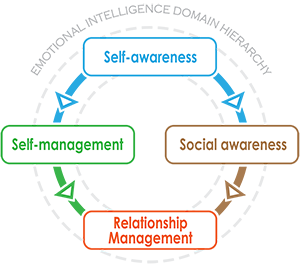
Emotional intelligence or EQ skills fall into four categories or domains – self-awareness, self-management, social awareness, and relationship management. Each of these domains contain a few skills that help a leader (or any person, for that matter) relate to others. We don’t necessarily need to master all of the skills within emotional intelligence, but we need a good representation from each of the domains. There is, in fact, a hierarchy among the domains where strong self-awareness is a prerequisite for both self-management and for other or social awareness and both self-management and social awareness are prerequisites for relationship management.

I recently wrote an article for PolymerOhio Manufacturing Services describing EQ and its importance as part of effective leadership. That article goes into more depth as to the various skills within emotional intelligence and the relationship between the four domains.

As leaders we should be cognizant of our strengths and weaknesses in the area of emotional intelligence and working to strengthen our ability to relate effectively with those that we hope to influence. What’s your EQ?

Goals and Objectives

goals-strategy-ohio-developmentGoals and objectives provide direction, inspiration, and a standard for measurement of performance for an organization. Goals define direction or destination while objectives set specific targets or milestones for performance measurement.

In a previous article we defined a strategic management system that began with mission and vision for an organization built upon core values and principles. The management system then defined a process for driving action plans that would achieve the vision. While vision is a long-term view of what we want the organization to someday become, goals and objectives set targets within the planning horizon along the path towards the organization’s vision. Once we establish goals and objectives, they should become a call to action for the organization.

Goals are qualitative statements that set direction into the future. They become the rallying points for the organization to move forward. Since goals set priorities for the organization, we can only have a limited number of them and they must be congruent with each other.

Objectives set the targets or milestones for moving forward. Objectives are quantitative and must always be SMART which means they are –

  • Specific – the terms or definition is clear and well understood within the organization
  • Measurable – there is an accepted and defined means of quantifying performance
  • Achievable – the organization must have the power and authority to take the necessary steps required to achieve the objective
  • Relevant – the objective must be a critical target that moves the organization towards its goals and vision
  • Time-based – there must be a stated target date for achievement of the objective

There is always the ability to state a definite yes or no as to the achievement of our objectives.

As an example of goals and objectives, let’s imagine an organization where its performance is highly reliant on the skills of its workers. A goal might be “Develop a more capable and stable workforce.” One of the supporting objectives might then be “Reduce annual non-retirement turnover to less than 8% of the total workforce by January of 2020.”

As we step through the management system from mission to action, each step gets more specific towards defining the critical action steps that must be taken to move the organization forward. Without clear goals and objectives, we have no way to judge the value of our actions.

Does your organization have clear goals and objectives? Do they align with your vision and prompt appropriate action?

Employee Engagement

employee-engagement-heroEmployee engagement can be a natural outcome of effective leadership. The result of employee engagement is generally a positive company culture and high levels of customer satisfaction. How do we achieve strong employee engagement?

Here are some key skills to use for strong employee engagement:

  • Commitment – the organization must be convinced of the benefit of engagement; a half-hearted effort will result in reduced morale.
  • Connect – employees want to know that their leaders know and care about them.
  • Collaborate – employees are more engaged when they are part of a team effort.
  • Career – leaders need to demonstrate that there are opportunities to grow and develop.
  • Clarity – leaders must communicate a clear vision that shows a plausible future.
  • Convey – another part of communication, leaders must clarify their expectations of employees.
  • Congratulate – leaders need to give recognition more often than they provide correction.
  • Contribute – employees want to know that their input matters and that they are contributing to the organization’s success.
  • Credibility – leaders must maintain both the organization’s reputation and their own reputation for integrity and ethical standards.

I also write a blog with articles targeted at small- and medium-sized manufacturers. A few months ago I wrote a short series of articles focused on employee engagement and company culture which includes an interesting case study of successful development of employee engagement.

The Structure of Leadership

Effective leadership is built upon strong character, emotional intelligence, cognitive intelligence, and subject-matter expertise. In my workshops and talks on leadership I often use the analogy of the structure of a house where character is the foundation, emotional intelligence (EQ) is the framework, IQ gives leadership its function, and expertise provides leadership with curb appeal.

3D rendering of a house project on top of blueprints, showing different design stages

Character is foundational because people will follow only when they see positive character traits such as integrity, transparency, and vulnerability. EQ is the strength or framework because leadership requires relationships and relationships are the result of EQ behaviors and skills. IQ gives leadership its function, much like a plumbing system or electrical system makes a house work, because IQ lets the leader use character and EQ effectively. Expertise gives leadership its appeal because it lets the leader relate effectively with those that are carrying out the tasks.

In the leadership articles that I write for PolymerOhio Manufacturing Services’ blog, I have a series that describes this “structure” of leadership. The series then describes further each of the four elements – character, emotional intelligence, cognitive intelligence, and subject-matter expertise – and how they build into effective leadership.

Mission and Vision

mission-vision-management

Mission describes what you are and vision describes what you want to be. Both of these should be clear and concise statements focused on clearly communicating to the organization’s various stakeholders.

Organizations sometimes have long, convoluted statement that mix values, mission, and vision. Or they write statements that are so general that it’s impossible to determine what they actually are or do. There is little value to a statement such as “Be the worldwide leader in excellence” or “Exceed our customers’ expectations.” Both mission and vision statements need to be specific and unambiguous.

The mission statement describes why the organization exists. It should be written from the perspective of speaking especially to prospective customers and should answer the following questions:

  • What do we do?
  • How do we do it?
  • For whom do we do it?
  • Where do we do it?

Most often a mission statement is a single sentence, certainly not more than 2 or 3 sentences. Think of the mission statement as the elevator speech for the organization – if you had 15-30 seconds to explain what your organization is or does, what would you want to say? Another way to think of mission statement is what you might put on a sign in front of your building to invite prospective customers – not an advertising slogan, by the way, but a descriptive statement.

Where the mission statement describes the current state of the organization, the vision statement describes the desired future state. Where the mission statement speaks primarily to the prospective customer, the vision statement often speaks primarily to the organization’s employees.

The vision statement describes the aspirations of the organization, what it hopes to be in 5 or 10 years. It must be clear and concise but also inspirational as it must engage the employees and draw them into the development of the organization towards the long-term vision. The vision statement serves as a guideline for the organization’s long-term decisions.

Both the mission and the vision statements communicate to the various stakeholders of employees, customers, community, and investors although it is not necessary to publish both of them to all of these audiences. Both must be clear, concise, and unambiguous. Together with the values and principles, the mission and vision set the tone for the goals and objectives and the organization’s strategy. In a previous article we described a management system that translates mission into action plans. The next article in this series will define objectives and goals and their importance in motivating the organization.

“Focus” by Daniel Goleman

focus-goleman-mindfulness

High-performers need three kinds of focus: inner, other, and outer – this is the big idea from “Focus: The Hidden Driver of Excellence” by Daniel Goleman. Inner focus is self-awareness – knowing and understanding yourself, seeing yourself realistically, seeing yourself as others see you. Other focus is seeing others and understanding where they are emotionally. The outer focus has two aspects – seeing what is going on around us and seeing what is happening in the future.

Self-awareness includes the ability to understand yourself, including seeing the underlying factors or causes of how you think and act. Included in here we can talk about the ability to focus our attention appropriately, which sometimes means to block out anything that interferes with a goal or task. At other times it is appropriate and productive to let our minds freely wander. In fact, this is often the source of innovation or invention and can sometimes be an important part of decision making.

Other focus includes the ability to read and properly react to the actions and emotions of others. It also includes social sensitivity which would cover the dynamics of groups and understanding cultural differences. Goleman talks here also about the empathy triad in which he differentiates between cognitive empathy, emotional empathy, and empathic concern. Cognitive empathy lets us take other people’s perspectives, comprehend their mental state, while at the same time managing our own emotions. With emotional empathy we join the other person in feeling along with them; our bodies resonate in whatever joy or sorrow that person may be going through. Empathic concern goes further, leading us to care about the other person, mobilizing us to help if need be.

Outer focus provides a view of the bigger picture. This includes the ability to see not just a certain discrete action but to comprehend the larger system or pattern. It also allows us to integrate widely diverse information to understand the potential interaction or affect somewhere else. In this respect, the ability to think further out in the dimension of time is another part of outer focus.

In these current times with the bombardment of information, Goleman warns against a decline in people’s ability to pay attention to a given thought for an extended time. In order to resolve big issues, we need to be able to think them through thoroughly. The information age and all of our electronic devices are creating habits of bouncing from one piece of information to another. There are times in our lives when we want to scan broadly but there remain times that we need to focus.

Goleman spends some time talking about mindfulness, studies of neuroscience, and practices to increase our ability to focus in various dimensions. The downside of the book is the amount of time spent on what could be considered the author’s social rants.

All in all, a good read with some interesting perspectives but not a must read. I give it a B- or a 6 out of 10.

“… a failure to focus inward leaves you rudderless, a failure to focus on others renders you clueless, and a failure to focus outward may leave you blindsided.” – Daniel Goleman

Values and Principles

leadership-and-employee-engagement-hero

Values and principles set the boundaries for how an organizations operates and deals with its various stakeholders. In a previous article, we used the analogy of a funnel to describe the management system of an organization as it moved from broad concepts of operation to the definition of discrete actions. The foundation of such a management system are the values and principles held by the organization and its leaders.

All organizations have values and principles. Sometimes referred to as core values or company ethics, these values and principles guide the way that the organization operates and interacts with its various constituencies. Values and principles might be explicitly stated, such as a statement in a policy manual, annual report, or signage within the building. These explicit statements are an expression of the character traits that are expected in the business and its dealings with people.

For some organizations these values and principles are implicit, and employees and others are left to infer them from the actions and attitudes of the organization’s leadership. For some organizations, the core values are carved in stone while for other organizations they might seem like shifting sands. If we expect employees to behave in certain ways, of course, it is best to clearly communicate what the organization’s values and principles are and stand by them.

Values and principles are foundational for two different descriptive systems for an organization – the management system and the culture. The values and principles set the boundaries for the organization’s mission and vision and for the business strategy and specific actions. In terms of culture, the values and principles set the tone for the behaviors, attitudes, and relationships that the organization hopes to see within the organization and then reflected to customers.

Since values and principles are for an organization very much like character is for an individual, authenticity is important. The behavior of the organization (or of the people that make up the organization) must be congruent with the statement of core values. Otherwise, the constituents will see the statement of values and principles as a farce and have even less respect for and trust in the organization. The walk and talk of leadership must be meticulously consistent with the proclaimed values and principles and part of leadership’s role must be to reward behavior demonstrating values and correcting behavior that violates the organization’s values and principles.

As mentioned, values and principles set the foundation for an organization’s management system. The next article in this series will discuss mission and vision, where we begin to describe the specifics of what the organization is and aspires to be.

Leadership and Humility

While effective leaders are often intelligent and high-functioning, humility is a key character trait of the best leaders. Humility draws in people while arrogance drives them away.

No doubt we have all seen people in leadership positions who had either high IQ or great expertise, but they struggled as leaders because of a weakness in character or emotional intelligence. They struggled to build relationships or gain influence because of their arrogance and pride.

On the other hand, effective leaders demonstrate humility and it shows up in the way that they lead. The Merriam-Webster dictionary defines humility as “the quality or state of not thinking you are better than other people.” Tim Keller’s definition is more descriptive when he says that humility is not thinking less of yourself, it is thinking of yourself less. So effective leaders think of themselves less and think of others more.

Effective leaders are committed to their people, helping them learn and grow, looking for ways to help them develop on the job and as people. And speaking of growth, effective leaders are committed to their own growth, recognizing that they never know it all. Humble leaders readily admit mistakes. In fact, they are quick to distribute credit for positive things and accept blame for negative things. Because they value their people, they are not seeking the limelight but shine it on others.

In his book, “Good Boss, Bad Boss”, Robert Sutton explains, “Wise bosses have the confidence to act on what they know and the humility to doubt their knowledge.” They are ready to admit mistakes and accept input from others. In accepting input, they are quick to demonstrate that they value others and their knowledge and gifts. Humble leaders seek feedback to assure that they are on track.

Humble leaders are able to admit mistakes, accept and admit limitations, and demonstrate vulnerability. They are ready to embrace and promote a spirit of service. People quickly see through and move away from a self-promoting leader.

Effective leaders show their humility by remaining thankful. They are also quick to forgive, a result of thinking of others before themselves.

The effect of a humble leader is a workforce that feels they are valued and empowered. This leads to a more productive, more innovative, and more collaborative team.

If you think that you have this humility thing down pat, you probably don’t. On the other hand, if you are a leader who thinks of others first, acknowledges their wisdom and contributions, are aware of your strengths and weaknesses, can readily admit your failures, and seeks to continually grow, then you might be well along in developing humility.

The Funnel: From Mission to Action

There are certain fundamental elements of a management system required to move a business or organization forward and keep it on track. These elements are the thoughts or documents required to align what we do each day with where we want to go as an organization. The essential elements are as follows, where one leads into the next:
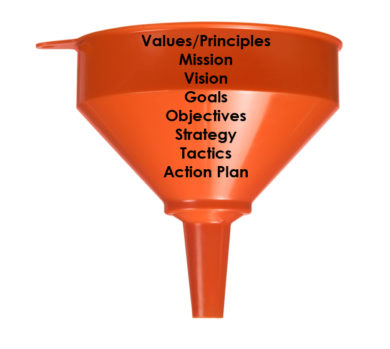
Different people have slightly different definitions or uses for these various terms, for example, some regard objectives as the more general and goals as the specific, quantified targets. This article quickly defines each of these elements as I use them when consulting with clients. As they are described you will see that they blend together and move from a very broad view to very specific statements of action, hence the analogy of the funnel.

Values/Principles are the fundamental beliefs that the organization has about certain things, most frequently in regard to how it treats or deals with its various stakeholders. These values may be implicit in the way that the organization is managed or they may be explicitly stated.

Mission is a statement of the purpose of the business or organization. It describes what it is. We can view it as the statement to the world of what the organization does. Think of it as the sign on the front lawn.

Vision is a statement of what the organization wants to be. In my mind this is a private view of the hopes and dreams of the business. This might be the statement that one would use to draw in a potential investor.

Goals are statements of where the business wants to be or what they want to achieve in the future. Goals are qualitative statements that further define the vision. In a planning process we might set out some goals early as general targets that later become more specific objectives.

Objectives are the specific, quantified targets that further define the goals. They have associated dates and are milestones on the future pathway of the organization. Depending on the organization and the environment, the timeframe could be expressed in weeks, months, years, or decades. For most businesses these objectives will be 3 or 5 years in the future and often consist of targets for sales revenue, profits, market share, etc.

Strategy describes where and how the business will compete. It is the path to the goals and objectives. For a business this strategy is set in the context of customer needs, core competencies of the company, and the value offering relative to that of the competitors.

Tactics are programs, initiatives, and projects to implement the strategy, to incrementally change the organization in the direction of the vision, goals, and objectives.

The action plan describes the specific tasks that will be performed in order to carry out the tactics, implement the strategy, and achieve the goals and objectives. These action plans need specific definition of the task, the responsible person, the completion date, and any resources required.

Hopefully it is obvious that the elements of the management system must be in perfect alignment. When they are not aligned, we simply confuse the organization. There are certain actions that are a requirement of maintaining a business such as paying taxes and fixing a leaky roof. Other than these required tasks, all of our actions should be related to the higher levels of our system – the strategy, the objectives, and the vision. In developing this strategic management system the important measurement is not the weight of the documents but rather the clarity, logic, and consistency of communication.

As leaders of an organization, we are tasked with developing and communicating this management system and providing the guidance and resources to accomplish the vision.