It’s lonely at the top is not just a cute saying, leaders often do feel isolated. It is difficult to find a safe and helpful place for deep conversations about the challenges that we face in leadership. One of the best tools for personal growth as a leader is a peer group. A good peer group can provide accountability, encouragement, advice, and a perspective that helps a leader recognize strengths, weaknesses, and areas for growth. See the article for nine ways that peer groups help leaders overcome the challenges that they often face.
Author: Ken Vaughan
An Effective Strategy Should Say ‘No’
An effective strategy sets the direction for a business but it also should be specific enough to say no—no to pursuing certain customers, no to entering certain markets, no to certain programs or investments, even no to hiring a certain person. No to choices that diverge from the optimal direction for the organization.

Strategic planning sets the direction for an organization by describing where and how the business will compete in order to provide value to target customers that will lead to accomplishing the organization’s strategic objectives. The purpose is to define and provide a clear, succinct statement of strategy that can guide decisions within the organization.
Strategy should focus the organization’s efforts and investments on those with the highest return potential. The strategy then becomes a screen that sifts through decisions regarding which business opportunities to pursue and about the allocation of resources. With an effective plan and management process the organization can then say yes to the right opportunities and no to the suboptimal choices.
For example, one of my recent manufacturing operation clients lacked a clear strategy. They were indiscriminately pursuing sales volume in hopes of making up losses on individual products with volume. In the meanwhile, they were teetering on the brink of bankruptcy.
Sensing an opportunity, an outside group acquired the company. Their first action was to define a clear strategy, a route to profitability. They identified the organization’s core competencies and the customers that were buying the specific products utilizing those competencies. This identified the size, shape and other characteristics of their preferred products and the specialized elements of the associated manufacturing process. Then they carefully examined the customers of such products and their value criteria. This led to identifying small lot sizes and quick-order turnaround as things highly valued by the target customers.
By focusing their new strategy on these very specific criteria, they moved from competing with 11,000 companies within a similar industry classification to facing only two or three operations with a similar value offering.
Having documented and communicated this newly defined strategy throughout the organization, they went about transforming the business. One early step was shedding the customers and products that no longer fit within their strategy yet represented two-thirds of sales—not a task for the faint of heart. But they quickly found that some good cost management and the early steps in growing their targeted business resulted in a strong return to profitability.
This strategy, with time and energy spent on buy-in throughout the organization, greatly simplified company management. Being more focused, the company is now recognized in their industry for their expertise, and many potential customers come seeking quotes. The strategy also provides the guidance to allow them to quickly say, “Nope, that doesn’t fit what we do well.” The people on the shop floor understand the importance of quick product changeovers and turning around orders quickly. This understanding results in a steady stream of innovations and process improvements coming from the floor. Every investment or expenditure of resources can now be examined with the strategy as a guiding light: “Does this investment help us move further down the path described by the strategy?” In short, the specificity and clarity of the strategy has resulted in unity and clarity within the organization in providing value to the customer, which in turn has enabled the company to achieve above-average returns.
Organizations typically make two mistakes in their strategic planning efforts. First, by not thinking deeply enough or not recognizing the value and purpose of effective strategic planning, they don’t develop a plan with the clarity and specificity to actually guide any decisions. Second, they don’t recognize that the purpose of planning is to guide every decision. The strategic plan does not belong on the bookshelf. It must be clearly communicated to the organization and continually held up as the signpost providing direction for the long-term development of the business.
Does your strategic plan optimize your decision-making process? Does it indicate when to say no and when to say yes?
(This article was previously published in IndustryWeek.)
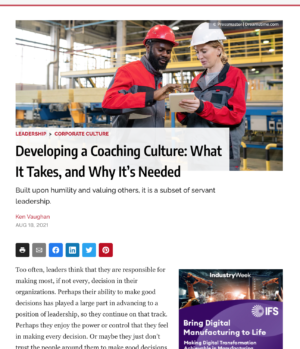
A Coaching Culture: What It Takes, Why It’s Important
Today’s workers often base their job satisfaction on three major factors:
- Purpose – they want to know how they contribute to society.
- Partnership – they want connections with the people around them and with the organization.
- Plan for development – they want to know that their leaders care enough to help them grow and prepare for the future.
We can achieve these things and many other advantages by developing a coaching culture in our organizations. This recent article, published in IndustryWeek, describes what a coaching culture looks like, how it can be developed, and how it benefits the organizations.
Feedback Is Best Served Warm

Effective leaders understand the benefit of liberally providing both positive and corrective feedback. Positive feedback demonstrates appreciation for the effort and value for the person. Corrective feedback, when done well, demonstrates the desire to help the team member to grow and develop.
Here are 12 tips for building the habit of giving feedback and doing it well:
Focus on performance, not personality. Always deliver feedback in reference to specific actions or behaviors, either by expressing appreciation for an action and the resulting benefit, or discussing an action or behavior that you want to see improved. “You’re so smart” is not nearly as valuable as “I really appreciated the way that you helped the team come to that conclusion.” With the latter, the person understands the action and the benefit to the team. Regarding corrective feedback, a statement such as, “The project was not delivered on time, which resulted in a big cost penalty from our customer” can lead to a discussion of reasons and corrective action. On the other hand, “You really messed up that project, as usual” is likely to simply prompt a defensive reaction.
Emphasize facts, not feelings. “We have received seven complaints about missed deliveries” has more value than, “You really disappoint me.” Facts verify the reality behind the discussion and, again, keep the discussion from becoming a personal matter.
Focus on the individual effort. Often the workplace includes team efforts. If the feedback is about the team’s results, the discussion needs to include the team. If the feedback is for an individual on the team, the discussion needs to focus on that person’s specific actions or his/her specific contribution to the team’s effort. Unless there is evidence that one person single-handedly impacted the team’s results, it is unfair and disheartening to be confronted with the team’s performance.
Feedback is best served warm. In other words, provide feedback as soon as possible after (or even during) the activity. The longer the time gap between the action and the feedback, the harder it will be for the recipient to tie the two together. The impact or benefit is much reduced if the person has difficulty recalling all of the facts regarding the action due to lapsed time.
Be clear, direct, and specific. A discussion that is focused on specific action or behavior and the specific results leads to a more productive analysis of the cause and a better definition of the specific action plan required to improve. Speaking in generalities ends with little understanding and minimal impact on the future. Feedback takes an investment of time and attention to develop value.
Focus on the future. The goal of feedback is not to criticize a person or to gather a history. The goal is to help the recipient to grow and improve. The discussion of the situation or the past history is just to establish the need for an action plan. Therefore, the discussion should be weighted in favor of the future, with positive expectations for improvement and growth.
Be intentional. It is too easy to move quickly from one meeting to another, or from one interaction to another. Leaders need to develop the habit of noticing. They must keep their eyes open for opportunities to recognize positive actions and behaviors and to correct undesired actions and behaviors.
Use your words wisely. Feedback should be a respectful, professional discussion aimed at producing a positive outcome. Our language and behavior should be in line with this objective. Better to use the word “I” in demonstrating the impact and refrain from using the word “you,” which can sound judgmental of the person rather than the behavior.
Provide feedback in digestible doses. If you expect your feedback to have an impact on future performance, it is better for the recipient to walk away with one action item regarding one issue. Storing up several items for discussion results in a confusing mess for the recipient to sort out after the discussion.
Make it a two-way conversation. With a goal of developing an action plan for future performance, the feedback session needs to be a dialogue, not a monologue. People are more likely to implement an action plan that they have developed than one that is forced upon them. Therefore, once the issue has been identified and agreed upon, the feedback discussion works best when the leader moves to a coaching role, helping the recipient to identify and own the cause of the problem and the action plan for improvement. It goes without saying that feedback is done best face-to-face or at least person-to-person, never via text, email, or letter.
Balance negative or corrective feedback with affirmational or positive feedback. People respond more strongly to negative than positive statements. That’s why relationships are stronger when positive statements outweigh negative statements by a factor of 5:1 or even 8:1. Even when giving corrective feedback, the leader should find some positive things to say about the other person: the part of the process that was done correctly, a belief in their ability to improve, etc. When a person only hears negative comments or criticism from a boss, they lose heart and look for the door.
Develop the habit of providing feedback. Feedback is the tool with which we nudge the actions and behaviors within the organization to conform with our desired culture and vision. It takes many of these nudges to achieve the results that we hope for. We need to continually and liberally provide effective feedback.
When done well, both positive and corrective feedback can feel like positive interaction that is beneficial to the recipient and result in growth and improved performance. Done well, they both identify the behavior that is valued and expected. And they show the value that the leader places upon the team member and the desire to assist in building their future.
Do you continually watch for opportunities to provide feedback? Are you motivated by the desire to develop the people that you lead?
(This article was previously published in IndustryWeek.)
150 Great Coaching Questions
One of the best descriptors of a coaching relationship is the analogy of a stagecoach – a coach helps a person move from where they are to where they want to be. As a coach, we help the client make that movement through the combination of powerful listening and asking powerful questions. Through these two skills, the client discovers answers or direction within themselves that lead to the desired movement.

Coaches most often establish a relationship with a client in which, over time and through several sessions together, the client develops a plan and takes action to achieve the goal that he/she has established for the coaching relationship. Often, we use the G.R.O.W. model to guide the coaching relationship through the process of establishing a Goal for growth or change, examining the Realities around this goal and the process, exploring some Options that the client might use to grow or change, and then defining the Way (some call it Will) that the client chooses to pursue this growth or change.
Below are 150 questions that provide examples of the types of questions that a coach might use within the coaching relationship, to help the client discover and define a plan for growth or change. Every coaching relationship is a little bit different, so these questions need to be tailored to the coach, the client, and the nature of the relationship.
The coaching relationship generally extends over a number of sessions together. While we often use the G.R.O.W. model to guide the overall relationship, the client also sets goals for each coaching session and defines actions to be pursued between sessions. This first set of questions are some examples that might be used at the beginning of each coaching session.
- How was your week, two weeks, month?
- What’s on your mind today?
- How have you grown this week?
- What did you learn?
- What are you grateful for?
- What did you accomplish this week?
- Of the actions we talked about last time, what did you accomplish?
- What progress have you made towards your goal for our coaching relationship?
- What would you like to focus on for our conversation?
- What is the biggest issue on your mind today/this week?
- Based on the amount of time we have together today, what would be your ideal outcome from our conversation?
- What would you like to have achieved by the end of this session?
- What would you like to take away from our conversation?
- How can our session today help you with the current challenges you are facing?
Once the session moves into coaching, the first session(s) are most likely focused on defining the Goal for the coaching relationship. Questions regarding the Goal might look like the following:
- What do you want to get from this coaching relationship?
- What is your current biggest problem or challenge?
- What’s missing in your life right now?
- What would you like more of in your life?
- What would you like less of?
- What is your desired outcome or goal?
- What’s the real challenge here for you?
- What is it specifically that you want to achieve?
- What would it look like if you were entirely successful?
- Describe your ideal outcome from this coaching…
- What would you like to happen that is not happening now, or what would you like not to happen that is happening now?
- Why are you hoping to achieve this goal? What is the deeper meaning or personal significance that this goal has for you?
- What do you want to achieve long term?
- When do you want to achieve it by?
- What will change if you achieve this goal?
- Help me understand why this change is particularly meaningful to you.
- Describe this goal or challenge a bit more…
- What positive things do you feel will happen if you accomplish what you’re trying to achieve?
- If you don’t change this, what will it cost you in the long run?
- How would your life be transformed if you changed this right now?
- What does success look like?
- What do you imagine it would look like if you could accomplish this?
- How will you know if you have achieved your goal?
- How long have you been thinking about this goal? What are some of the thoughts that you have had about this?
- What’s important to you about that outcome or result?
- Is this goal pulling you forward or are you struggling to reach it?
- Is that positive, challenging, attainable?
- What would be your next goal after you achieve your current one?
- What’s the bigger picture?
Once a Goal has been defined (or at least a first version of one), coaching moves on to examining the Realities of the situation. Here are some sample questions that demonstrate what this phase of the coaching relationship might look like:
- What’s the current situation?
- How would you like it to be?
- What’s your biggest obstacle to achieving this goal?
- What have you tried?
- What will happen if you don’t take this step?
- What is in your control?
- What’s standing in your way?
- What’s the cost of not taking action?
- What’s the benefit of taking action?
- What’s getting in the way of your progress?
- What will things look like after you’ve been successful?
- What’s worked for you in the past?
- When have you been successful in a similar situation in the past?
- What did you do to make it successful?
- How does this affect the people around you?
- Are you focused on what’s wrong or what’s right?
- How long have you been thinking about this?
- What’s stopping you from taking action?
- What will you have to give up in order to make room for your goals?
- What qualities/resources do you have to help you?
- What are the internal/external obstacles?
- What’s the downside of your dream?
- What’s the benefit of this problem?
- What strengths can you utilize in making this change?
- How can you turn this around and have better results next time?
- What does your intuition tell you about this?
- Have you ever experienced something like this before?
- What are some ways this challenge is impacting you or others?
- What can you learn from this situation?
- Do you have a gut feeling about this?
- How do the key principles and priorities you live by apply here?
- If you could start over again, what would you do differently?
- What specific events led you to that conclusion?
- What are you doing to not achieve your goal?
- If your main obstacle didn’t exist, how would your life look?
As the client comes to more fully understand the Realities of the situation, she/he is equipped with the information to begin exploring the Options that might exist for moving toward the goal. The coach might use questions such as the following to assist in that process.
- What do you see as the first step to accomplishing your goal?
- Are there any steps you could take right away that would significantly improve your situation?
- What might you do to take you closer after that?
- Can you think of some alternatives? Is there another way?
- Who might you ask for help? Who else?
- What are the pros and cons of this option?
- Which possible pathway do you feel prepared to go down?
- What would you do if time/money/resources weren’t an issue?
- What has worked for you in the past when it comes to situations like this?
- How might you draw on that same approach in this case?
- Tell me about the resources that would be helpful? How or where might you acquire those?
- What might your family or friends suggest that you do?
- If a friend were in your shoes, what advice would you give them?
- How would you tackle this if time wasn’t a factor?
- What option appeals to you most right now?
- Imagine you had no barriers, what would that look like?
- What else could you do?
- Think of someone you respect. How would she/he handle this situation?
- What haven’t you considered that might have an impact?
- What resources do you need?
- What would you have to believe for this option to be right?
- What’s the worst that can happen, and can you handle that?
- How can you solve this problem so it never comes back?
- How can you learn what you need to know about this?
- Is this the best option you can imagine or is there something greater?
- Which step could you take that would make the biggest difference, right now?
- What fears or inner drives are influencing your response? How could you remove those things from the equation so you can make a better decision?
- Tell me what you think would happen if you tried doing that?
- How might you broaden your current line of thinking?
- What has worked for you already? How could you do more of that?
- What’s the best/worst thing about that option?
- What are the pros/cons of pursuing each option? Which is most advantageous?
- What would it cost in terms of time and resources to do this? What would it cost if you don’t do this? What’s the cost if you don’t decide or let circumstances overtake you?
- What decision would best align with your faith? What is God saying to you on this?
- What will really make the biggest difference here?
- If you weren’t scared, what would you do?
- What might make the difference that could change everything?
After exploring Options, the client should be ready to choose or define a specific action plan (the Way) with milestones and target dates for moving forward. Here are some sample questions for the Way (or Will) phase of coaching:
- Which opportunity or option are you going to pursue?
- What is a first step you can take?
- What are the steps you’re going to take? What’s the very first thing you will do?
- What are the next three steps? What else?
- What specific actions will you take to achieve your goal? What is your time frame?
- Have you decided to take action or are you just hoping you will?
- What are you willing to commit to here?
- Who do you have to support you or hold you accountable?
- What support do you need to get that done?
- When precisely are you going to start and finish each action step?
- How might you turn these steps into a plan?
- Who needs to know what your plans are?
- What will you do now?
- When will you do it?
- How specifically will you know you’ve completed that action/goal?
- What could arise to hinder you in taking these steps?
- What personal resistance do you have, if any, to taking these steps?
- What will you do to eliminate these external and internal factors?
- What support do you need and from whom?
- What will you do to obtain that support and when?
- What roadblocks do you expect or that require planning?
- Have you considered the potential barriers?
- Tell me how you plan to overcome these obstacles…
- What commitment on a 1-to-10 scale do you have to taking these agreed actions?
- What prevents this from being a 10?
- What could you do or alter to raise this commitment closer to 10?
- What does this accomplishment mean to you?
- How will you celebrate that?
- To what extent does this meet all your objectives?
- Is there anything missing?
At the end of each coaching session, the coach needs to check in with the client to assure that they are both on track and that the client is achieving his/her expectations for the coaching relationship. The client should also have a set of action steps to accomplish prior to the next coaching session. The wrap-up to each coaching session might use questions like the following:
- Is there anything else you want to talk about now or are we finished?
- What was your biggest win of the session today?
- What actions do you plan to take in preparation for our next session?
- Are there any other actions that would be helpful before we next meet?
- What was most useful for you?
- What’s been your major learning, insight, or discovery so far?
- Are there any important questions that have not been asked?
- What had real meaning for you from what you’ve spoken about? What surprised you? What challenged you?
As mentioned earlier, these are simply examples of the types of questions that might be used in a coaching relationship. Some of these might easily fit into different phases of the G.R.O.W. model or a coach might prefer some other model for guiding the conversation, still using similar questions.
The important thing to remember in coaching is that the coach’s responsibility is to practice powerful listening that leads to powerful questions. The coach’s role is to use questions like these to assist the client in drawing out the thoughts, hopes, dreams, fears, etc. that play a part in the client’s understanding and moving forward.
What other questions do you find effective in coaching others?
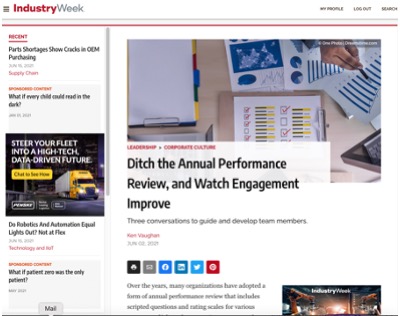
Ditch the Annual Performance Review
This article appeared in IndustryWeek and related newsletters in early June 2021 and was in the top 10 of most-read articles for the month of May and into June. The article proposes a more meaningful way of coaching and guiding team members in place of what is often a bureaucratic system of annual performance reviews. Give a read and tell me what you think.
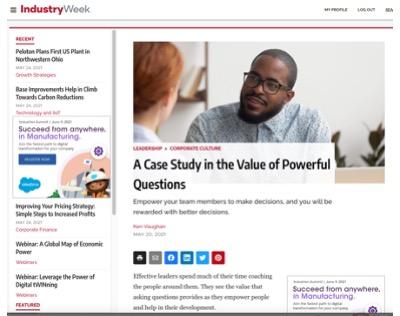
A Case Study in the Value of Powerful Questions
This article, describing the impact of a leader who started the new habit of asking questions rather than giving answers, appeared in IndustryWeek magazine and a variety of related newsletters in May 2021.
‘Tell Me How I’m Doing’: The Three Elements of Effective Feedback
Management often thinks that wage levels or benefits are the most important elements of creating satisfaction in employees. But instead, workers are saying, “Tell me how I’m doing” or “Help me grow and do a better job.”
Of course, they want feedback: It’s necessary to shape their actions and behaviors in the workplace to align with desired culture, established policy, and the leader’s expectations.
For the feedback process to be effective, these three elements must be clearly communicated:
Recognition of a specific action or behavior. This recognition can be either in direct response to something we want to see more of or less of in the future. We often say that “feedback is best served warm,” meaning that it should happen as soon as possible after observing the action or behavior, while it is still fresh and relevant.
The feedback process is not appropriate for addressing job performance, attitude, or other longer-term matters. These are better dealt with through a performance review discussion or a coaching session.
The conversation might begin with a description of the action, such as “the way that you helped the team reach a consensus by drawing each person in was great” or “the three crisp and concise conclusions as you wrapped up your presentation really hit the mark.” Or, in the case of corrective feedback, “the tone that you used in replying to Joe seemed very condescending” or “the facts that you presented don’t support the conclusions that you drew.”
Too often people think that they are providing feedback with a very general statement, such as “great job on the presentation” or “you add a lot to this team.” Such general statements have little value for guiding future behavior, thus not really constituting feedback. The more specific and descriptive our statement, the better guidance it provides for future behavior.
Often feedback is better received when we first ask for permission, especially in the case of corrective feedback. Also, when providing corrective feedback, a bit of positive at the front end makes the recipient more open to the negative. An example might be, “Your presentation was good, with a logical flow of the background information and each slide was a nice, bite-sized addition to our understanding, but may I offer some advice?” and then move into identifying specific opportunities for improvement.
Identify the impact of the action or behavior. There are two components of impact worth sharing: first, how the action or behavior affected the person giving the feedback and second, the broader impact, whether it be on the organization, audience, peers, etc.

Personalizing the impact makes the feedback easier to digest. Did their action, behavior, event, or process make you feel pleased, intrigued, disappointed, angry, confused, excited, etc? If this is important enough to provide feedback, there should be some emotion that arose, telling you that you should address it. Perhaps this is a good time to remind ourselves that, since feedback is important, we may need to train ourselves to notice those opportunities and to respond and provide feedback.
Providing a broader context aligns the person’s performance with the organization’s values and goals. Did an action add value to a meeting or discussion; did it fit nicely into the organization’s desired culture; did it hinder a project or hurt a team’s collaboration?
Again, our goal in feedback is to be as specific as possible in order to tie the referenced action with the results, either positive or negative. Specifics make it more likely for the feedback to be clearly understood and accepted, thus increasing the likelihood of long-term impact. A statement such as “You were rude, and I don’t want that to happen again” has little value. Rather a statement like this is more likely to gain the attention and acceptance of the recipient: “I was disappointed to hear the rude comment you made when you said ___. That sort of comment breaks down the cohesion of our team and makes it more difficult to work together. We want this organization to be a place where each person is valued and accepted.”
Set expectations for future actions or behaviors. Feedback is about identifying what we want more, less, or the same amount of in the future. This requires a statement or a discussion of our expectations relative to the specific action that we are addressing. The feedback process must provide clear expectations for the future. This can be a simple statement, such as, “I hope you continue to find more opportunities to repeat this” or “I trust you understand, agree, and will not repeat this behavior.”
Depending upon the situation, the third step of the feedback process might also include consequences or a plan of action. If we are talking about a serious negative action or behavior, the process may call for identifying the disciplinary action that will take place in the event of a next occurrence. If we have communicated the specific action and the specific impact of that action, it is only natural that a specific consequence be communicated.
On the other hand, the feedback discussion may be related to an action or behavior that is beyond the recipient’s present capabilities. In this case, the discussion may call for either the feedback recipient to create a developmental plan of action or it may require that the feedback provider and the recipient together define a developmental plan.
“The growth and development of people is the highest calling of leadership.” – Harvey S. Firestone
One of the highest priorities for leaders is the development of the people around them. Effective feedback is a tool to guide that development. Spotting opportunities where feedback is appropriate and then providing it in a way that helps the recipient’s development is the best way to guide the growth of the people that we lead. Nudging the actions and behaviors of team members to align with organizational vision, goals, culture, and strategy is the best way to maximize the effectiveness of the organization. As leaders, we need to understand the power of feedback and prioritize the many opportunities for providing it.
This article originally appeared in IndustryWeek magazine in December 2020 and in EHSToday magazine in January 2021, along with several newsletters from Endeavor Business Media.
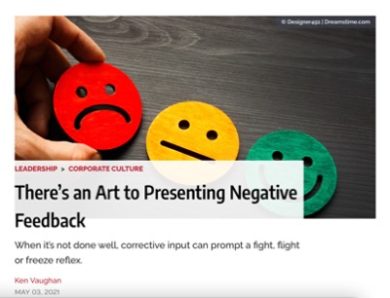
There’s an Art to Presenting Negative Feedback
This article providing eight tips for making negative feedback positive appeared in IndustryWeek magazine and a variety of related newsletters in May of 2021.
A Leadership Lesson from the Psalms
Without question, King David and his son, Solomon, were the two greatest kings of the Israelites. In fact, they may set the gold standard for any ruler or for any leader. Yes, they both had some moral issues, which we can’t excuse, but their leadership holds many lessons for us as leaders.
Often, we speak about how effective leadership is built upon a strong combination of both character and competency. This passage from Psalm 78 describes how God chose David and how David’s leadership demonstrated just such a combination of both character and competency:

“He chose David his servant
and took him from the sheepfolds;
from following the nursing ewes he brought him
to shepherd Jacob his people,
Israel his inheritance.
With upright heart he shepherded them
and guided them with his skillful hand.”
(The Holy Bible: English Standard Version. (2016). (Ps 78:70–72). Wheaton, IL: Crossway Bibles.)
Here we see that David led Israel with an upright heart and with skillful hands. An upright heart could rightly be understood as strong and positive character. Character can be thought of as who David was at his core. He cared deeply about those that he led. We see in other passages how David put the wellbeing and the development of his people ahead of his own personal needs and wants. He demonstrated the character traits that we see in effective leaders: humility, love for those he led, authenticity, vulnerability, and a passion for their growth and wellbeing.
But his character alone, while extremely important, was not enough to lead well. He also needed a skillful hand, which can be understood as the competencies necessary to accomplish what God had set out for him to do. He was both a strategist and a tactician in battle. He was able to rally, organize, and unite the people that he led. He designed and planned well and he communicated as we only wish we could.
Leadership is built upon a relationship of mutual respect and trust. Character and competence are necessary to develop this respect and trust between leaders and their followers. The proper character might lead to respect, but without competence, people will have a difficult time in trusting that we are capable of taking them where they need to go. On the other hand, the most competent leader will not be respected without the necessary character.
Do you have both the character and the competence of an effective leader? What are you doing to further develop in character and competence?