Solutions, Not Problems

Leaders are forward-thinking. As important as completing today’s tasks, leaders focus on building their people and the organization in the process. An element of developing the members of the team is identifying the behaviors that hinder performance and coaching to new levels of capability.

When team members fail or underperform, one of the keys of successful coaching is to focus on solutions, not on the problem. Rather than saying “Why did this happen?” we should say “What did you learn?” or “What can you do different the next time?” Every failure should be viewed as a learning and growth opportunity.

If we focus on the “why” or the problem we are not developing for the future, but are focusing on the past. In fact, neuroscience tells us that we are raising the attention on the problem and likely to further imbed it into the team member’s thought process, therefore possibly increasing the likelihood of repetition in the future. If our discussion focuses on the “what” or the solution, we reinforce that mindset and make it more likely as a future behavior. When the next instance arises, we will have developed a thought process that can achieve a better outcome.

There are instances where a focus on the “why” or the problem makes sense. When we are addressing failure in a process, the “5 Why” methodology can lead to root cause identification. In this way, “why” leads to process improvement. But when dealing with people, the better question is a “what” question. For example,

  • Not “Why did you not close the sale?” but “What would be another way to try to close the next sale?”
  • Not “Why did you produce so much scrap?” but “What can you improve that will increase your quality levels?”
  • Not “Why did you fail?” but “What will you do next time to increase the chance of success?”

When dealing with processes, ask “why?” When dealing with people, ask “what?”

By focusing the discussion on the solution rather than the problem, the leader helps the team member develop the analytical skills to break down the problem, consider alternatives, and make decisions. A discussion of the problem is a negative discussion of the past. The solution discussion is a positive discussion that looks to the future

Are you spending too much of your time and energy on the past or are you moving forward?

Competency and Character

Great leadership is based on a combination of both strong competencies and excellent character. The best skills without the positive character traits leaves people cold. Great skills alone can obtain results for the short term but a stressful or highly emotional situation draws out true character and, if that character is weak, will cause followers to not trust and follow. . Great character traits without the skills can make a leader likeable but people don’t see a benefit for the future. Without strong leadership skills, people don’t see enough substance to develop long-term results.

Leadership competency or skills include such things as the ability to communicate, manage change, create a vision, read and understand people, influence others, and negotiate effectively. It includes the ability to digest information and think strategically. Relevant technical and functional skills are important such as scientific knowledge or a strong financial background. Competencies include decision-making and the ability to organize and manage. Competencies in the area of communication include the ability to write or speak clearly and convincingly, the ability to teach, and the ability to organize and manage meetings.

Competencies are learned skills. We develop them through experience, following an example or model, or some education process. This might be from a book or seminar. In a sense, competencies can be viewed as tools in a toolbox.

While competencies are what a person knows or is capable of doing, character is who we are. Character can be defined as the sum of virtues, values and traits. The character of a strong, effective leader includes such traits and virtues as integrity, honesty, confidence, humility, authenticity, passion, selflessness, ethical, and respect for others. Character is built into our lives through our beliefs and the practice of those beliefs over time.

In an effective leader competency and character flow together. It may be difficult at times to differentiate whether actions are based on competency or character. On the other hand, when a person is attempting to lead without a base of both competency and character, it can be both obvious and ineffective. Some further examples of both one-sided and blended actions are shown below.

  • A person with good communication skills can craft a document that presents the facts clearly. A leader with both communication skills and a respect for others presents the facts clearly and in a manner that values the audience and considers the impact and likely emotions of the reader.
  • A person with meeting management skills can organize and conduct an efficient meeting. A leader with both competency and character can conduct a meeting where the attendees feel a part of the process and that their input is valued.
  • A person with the ability to teach others can present information clearly when asked to do so. A leader with both competency and character looks for teaching opportunities in every interaction.

Evaluating and building our competencies can be straight-forward. What skills do we have and where do I need to build more or deeper skills? Evaluating and building our character requires a deeper look and a greater effort as we often actually need to change who we are as we strengthen our character.

Where do you need to grow and what is your plan for doing so?

A Primer on Emotional Intelligence

“What did people do before there was emotional intelligence?” I was asked at a leadership workshop a short time ago. The term emotional intelligence has grown in popularity and become an important concept in leadership over the past twenty years. But before we began using the term, emotional intelligence was a skill of great leaders. We can see references to emotional intelligence from the ancient Greek philosophers and from King Solomon in Proverbs. One of the reasons why Abraham Lincoln is considered to be one of our greatest presidents is because he seems to have had strong emotional intelligence. Dale Carnegie’s classic book, How to Win Friends and Influence People, is full of emotional intelligence.
While emotional intelligence (“EI”) has existed forever, it’s just in the last 20-30 years that it has been labeled, studied, and grown in awareness of its importance in all sorts of social interaction. The term “emotional intelligence” seems to have first been used by Michael Beldoch in a scientific paper in 1964. In 1983, Howard Gardner’s Frames of Mind: The Theory of Multiple Intelligences was an introduction to a different way of thinking about intelligence, including the idea of intrapersonal intelligence and interpersonal intelligence. The doctoral thesis of Wayne Payne, A Study of Emotion: Developing Emotional Intelligence, was published in 1985. In 1989 Salovey and Mayer published a model of emotional intelligence, as did Stanley Greenspan. All of these papers were academic works in the area of psychology and sociology.

The work that really ignited interest in emotional intelligence was Daniel Goleman’s 1995 book, Emotional Intelligence – Why it can matter more than IQ, which reached the mass audience and achieved best-seller status. This book was prompted by the previous academic papers and by the growing ability of neuroscience to actually see and measure the emotional activity of the brain. It spread the idea that emotional intelligence can be important in developing positive relationships, and therefore can impact the quality of any type of social interaction.

Goleman’s book opened the floodgate for a stream of books by many authors and scientific studies and papers postulating and examining the impact of EI. While measuring and comparing EI in individuals is not an exact science (one of the criticisms), it is generally recognized that emotional intelligence contributes to more effective relationships and therefore, better results. Goleman claims that 67 percent of all abilities associated with strong job performance were related to emotional intelligence. Travis Bradberry, the author of Emotional Intelligence 2.0, claims that 90% of top performers at work are also high in emotional intelligence while just 20% of bottom performers at work are high in emotional intelligence. He also claims that 58% of job performance is due to EI. A 2010 meta-analysis conducted by Virginia Commonwealth University and published in the Journal of Organizational Behavior found that emotional intelligence was very important to job performance. Some results from specific studies are as follows:

  • Restaurant managers with higher EQ create 34% greater annual profit growth, increased guest satisfaction, higher employee retention.
  • In a study with naval officers, emotional intelligence proved to be more powerful at predicting leadership efficacy than either IQ or managerial competence.
  • Of the leaders with high emotional self-awareness, 92% created positive workplace climates.
  • After supervisors in a manufacturing plant received training in emotional competencies, lost-time accidents were reduced by 50%, formal grievances were reduced from an average of 15 per year to 3 per year, and the plant exceeded productivity goals by $250,000.
  • Plant efficiency increases by 9.4% during major EQ initiative focused on managers and the creation of vital teams.

Emotional intelligence consists of skills and traits relating to understanding and managing emotions. The various models of EI fall into two camps: the ability model that defines emotional intelligence as a cognitive ability and the mixed model that defines it as a combination of cognitive and learned personal aspects.

The Mayer and Salovey model was the earliest model and defined emotional intelligence in the following four branches:

  1. The ability to perceive emotions in oneself and others accurately.
  2. The ability to use emotions to facilitate thinking.
  3. The ability to understand emotions, emotional language, and the signals conveyed by emotions.
  4. The ability to manage emotions so as to attain specific goals.

The most popular of the later, mixed models are those described by Goleman in Primal Leadership or by Bradberry in Emotional Intelligence 2.0. Goleman labels these as domains, with traits and skills in each domain. Bradberry labels these as skills, with specific strategies in each skill.

  1. Self-awareness
  2. Self-management
  3. Social awareness
  4. Relationship management

In other publications Goleman has used five domains: self-awareness, self-regulation, motivation, empathy, and social skill. Both the Mayer and Salovey model and the Goleman model are hierarchical in that the lower levels are prerequisites for the higher levels.

While some models describe emotional intelligence as a cognitive ability, it is clear that emotional intelligence can be developed and grown through specific effort. The intentional change theory of Richard Boyatzis, referenced in Primal Leadership, is one method. A related tool for growing EI is a cohort leadership group where the group members can provide input into each others’ lives and growth. The general idea behind growing in emotional intelligence is retraining the brain, or developing new neural networks that provide the pathway to responding to emotional triggers in a different, more preferable manner. There are a variety of assessment tools that provide relative measures of emotional intelligence.

Mayer and Salovey defined emotional intelligence as “the ability to monitor one’s own and others’ feelings and emotions, to discriminate among them and to use this information to guide one’s thinking and actions.” Other definitions of EI include “the ability to identify, assess, and control one’s own emotions, the emotions of others, and that of groups” or “the ability to recognize, understand and manage our own emotions and to recognize, understand and influence the emotions of others.”

Since emotional intelligence impacts social interaction and relationships, the development of EI skills can contribute to more effective leadership, marriages, parenting, politics, community, or any other scenario requiring personal interactions. Those with low EI will struggle in awareness or control of their own emotions or will find it difficult to comprehend and deal with emotions in others. On the other hand, those with high EI can function at a higher level in terms of their own emotions and understanding and building effective relationships with those around them.

How effective is your emotional intelligence? How are you growing?
12 Habits of Genuine People

Often the most highly valued character traits of leaders, in fact of any person, are listed as authenticity, sincerity, vulnerability, transparency, or integrity. These are descriptors of the type of person that draws others into relationship. They can be trusted as a safe person. WYSIWYG – what you see is what you get. People without these sorts of character traits might be better kept at a bit of distance because they cannot be fully trusted.

Another word describing a person with these sorts of character traits is “genuine.” Dr. Travis Bradberry, the author of Emotional Intelligence 2.0, wrote an article titled 12 Habits of Genuine People describing such genuine people. Genuine people are self-aware, self-confident, and comfortable in their own skin. They are also humble, respecting and valuing others. Here are the 12 habits that Dr. Bradberry used to describe genuine people in case you don’t have time to read the full article:

  1. Genuine people don’t try to make people like them. Genuine people are who they are. They know that some people will like them, and some won’t. And they’re okay with that.
  2. They don’t pass judgment. Genuine people are open-minded, which makes them approachable and interesting to others.
  3. They forge their own paths. Genuine people don’t derive their sense of pleasure and satisfaction from the opinions of others.
  4. They are generous They want you to do well more than anything else because they’re team players and they’re confident enough to never worry that your success might make them look bad. In fact, they believe that your success is their success.
  5. They treat EVERYONE with respect. Genuine people treat everyone with respect because they believe they’re no better than anyone else.
  6. They aren’t motivated by material things. Genuine people don’t need shiny, fancy stuff in order to feel good. Their happiness comes from within and from relationships with those around them.
  7. They are trustworthy. You know that if they say something, it’s because they believe it to be true.
  8. They are thick-skinned. Genuine people have a strong enough sense of self that they don’t go around seeing offense that isn’t there.
  9. They put away their phones. Genuine people create connection and find depth even in short, everyday conversations. Their genuine interest in other people makes it easy for them to ask good questions and relate what they’re told to other important facets of the speaker’s life.
  10. They aren’t driven by ego. Genuine people don’t make decisions based on their egos because they don’t need the admiration of others in order to feel good about themselves. Likewise, they don’t seek the limelight or try to take credit for other people’s accomplishments.
  11. They aren’t hypocrites. Genuine people practice what they preach. They don’t tell you to do one thing and then do the opposite themselves. That’s largely due to their self-awareness.
  12. They don’t brag. They’re confident in their accomplishments, but they also realize that when you truly do something that matters, it stands on its own merits, regardless of how many people notice or appreciate it.

See the full article for a further development of these 12 traits of genuine people.

Understanding Market Attractiveness

Whether reviewing business strategy and current performance, considering entering a new market, or evaluating an acquisition or investment, understanding market attractiveness is an important step. Market attractiveness analysis provides a view of profit potential based on an examination of the underlying market factors. While the operating performance of a business may determine the actual level of profitability, market attractiveness sets the boundaries around profitability potential. The best performing company in a market with low attractiveness can only achieve a mediocre return. A company operating in a market that is highly attractive has the potential for high returns, given a strong strategy and effective implementation.

An understanding of market attractiveness is an essential part of the situation analysis in strategic planning, the step where we examine the business environment and the company’s position as the foundation for the business strategy. In making choices about the future direction of a business, market attractiveness is key. Market attractiveness is also a critical part of valuing an existing business. A common pitfall of investors is solely relying on past financial performance as a predictor of the future without ever looking at the underlying market attractiveness.

A recent consulting project provides a good illustration of the value of understanding market attractiveness. The client was interested in vertically integrating into a market (call it Mkt. A) that they saw growing. They asked our consulting firm to help them understand this market and guide them through planning and implementing the steps necessary for market entry. During our analysis we realized that Mkt. A was not particularly attractive but there was an adjacent market space, Mkt. B, that was much more attractive. Mkt. A was relatively unstructured; it was difficult to clearly define customers and competitors, but there were a lot of competitors. The customers were generally small, poorly-capitalized installers. The customers’ customers were open to a wide variety of substitute products. The buying factors were dominated by price. All of this meant that players in the market were under constant price pressure and margins were likely to be low. The adjacent Mkt. B, on the other hand, was highly structured and stable. The customers were capable and well-financed. There were only two viable competitors. The buying factors were predominantly product specifications and quality. While Mkt. A was larger and growing more rapidly, the profit potential in Mkt. B was greater. It was going to take a little more work for the client in terms of product development and manufacturing process improvement, but they were capable and the return on investment was likely to be much greater. Our analysis convinced the client to re-focus on the more attractive market and laid out a plan for market entry into Mkt. B.

While market size and market growth are often the first things that people think of in assessing market attractiveness, there are other more important considerations. The relative importance of various factors will be different for each company based on its vision, goals, and objectives. If the vision is to become a billion-dollar company, market size may be critical. On the other hand, for a company in the 95% of businesses that are less than $10 million in revenue, there may be many other factors more important than market size as it considers the means to maximizing return on investment.

In general terms, the factors of market attractiveness can be grouped into three overlapping areas: differentiation potential, pricing potential, and growth potential. Within each of these three areas are a variety of factors. The following might be some of the factors that determine market attractiveness.

Differentiation potential – The ability to differentiate, that is, to provide a unique value to customers, is a key factor in driving the potential profitability of a business. Certain elements of market attractiveness contribute to the ability to differentiate, and therefore to the potential return.

  • Customer factors – Who are the customers? Are they identifiable? How definable are their needs or buying factors? How complex are their needs? (Complex might be good or bad.) Are there opportunities to develop unique product or service offerings to meet customer needs? How well are their needs currently being met?
  • Technology factors – What sort of technology is involved in the product or in the production process? How mature is the technology? What opportunities are there for developing unique technology, either in product or process? Are there opportunities to develop unique and defendable intellectual property?

Pricing potential – Pricing potential is partially dependent upon the ability to differentiate but the industry structure and competitive environment determine the intensity of competition and the pressure on pricing.

  • Industry structure factors – How much leverage do buyers have in price negotiations? Are there many choices available to them, either in the number of suppliers or in alternative or substitute products? How much leverage do suppliers have in this industry? Can suppliers squeeze margins of the competitors?
  • Competitive factors – Who are competitors in this market? Are they identifiable? What are their capabilities? How intense is the competition? How easy is it for new entrants to come into the market?

Growth potential – Market size and growth is relevant but the most important part of market and growth is understanding the specific market segments that are to be addressed.

  • Market size – What is the market size? What is the growth rate? How will the market size and growth rate change over time?
  • Market factors – What factors are the drivers of the market? What are the growth opportunities? What are the risks regarding market size and growth? What are the segments or potential segments of the market?

Each particular business has its own market idiosyncrasies that determine market attractiveness. The challenge is to look beyond the simple and easy factors to develop a clear understanding of the structure of the market and the factors that will present either restraints on sales revenue and profitability or opportunities that can be exploited through a well-crafted strategy and action plan.

Do you understand the relative attractiveness of the market in which you operate? Are there opportunities to focus on more attractive market segments?

React or Respond?

Two words that sound very similar describe how we might reply to things that people around us might say or do – we might react or we might respond. Yet there is a big difference between the two words, both in how we reply and the consequences of our reply. Consider the example of a doctor saying that our body is reacting to medication or responding to medication. The meaning is much different. When we find ourselves in a conversation or situation that raises the emotions, we need to be intentional in order to achieve positive results.

To react to comments or actions of those around us is generally a defensive or emotional reply. Sometimes a reaction is described as saying something “without even thinking about it.” This is because we don’t think about reactions. We hear or see something that trips an emotional trigger within us. In an emotional reaction our limbic system, that part of our brain responsible for protecting us and controlling our reflexive actions, jumps in and blurts out a reply. The limbic system is responsible for the flee, fight, or freeze reaction to perceived threats. If the limbic system of our brain senses anger, fear, humiliation, or other negative emotions in the comments or actions around us, even if not intended to be so, it springs into action and reacts.

Reacting tends to be a subconscious reflex. The impact of a reaction is often to escalate the emotional tone of a discussion. A reaction by one person prompts an emotional reaction from the other party.

To respond to comments or actions of those around us is to provide a more thoughtful reply. A response is the result of the brain taking control away from the limbic system and giving control to the prefrontal cortex, the cognitive or logical part of the brain. This move to thoughtfulness is intentional and is a result of developed emotional intelligence. In a response we take into account the emotion of the other party, we consider the intent, and we construct a more logical response. The words of a response might even be the same as a reaction but they are offered in a different context and without the negative emotion.

Responding is a conscious and deliberate action. In a response you are more likely to maintain your integrity, remaining true to who you are. The impact of a response is to draw the other party into the conversation and develop a more positive dialogue and outcome.

To respond rather than react, we could follow these seven APPLIED steps:

Awareness – Recognize the emotion that rises up within us. This requires exercising our emotional self-awareness to sense when our limbic system is taking control.

Pause – Interrupt the tendency to react without thinking by taking a deep breath or taking a few minutes.

Perceive – Intentionally engage the prefrontal cortex by thinking through the possible explanations of intent from the other person and alternatives for a constructive response.

Loosen up – When our limbic system jumps into react mode, it reflexively begins arming our body for confrontation. Energy flows, muscles tighten, fists clench. It is difficult to convince the other party that we want to have a civil conversation while our body is saying otherwise, so we may need to intentionally relax a bit.

Inquire – Seek clarification. One of the effective ways of engaging our cognitive brain is to ask questions and explore the situation with the other party. Rather than jumping to a conclusion, first gather more information.

Envision – Think with the future in mind. What is the outcome that best serves the long-term vision and goals of both parties? Structure a response that provides a benefit to both.

Dialogue – Rather than firing back a salvo of reaction, respond with a thoughtful comment to draw the other party into a dialogue. Seek to understand and be understood. For the other party, being understood meets a deeply human need and draws them into relationship, the opposite result from what a reaction would cause.

A response is more likely to produce a positive outcome while a reaction is more likely to cause a negative outcome. This strategy applies to our leadership but can also be applicable to marriage, dealing with our children, or any relationship. Train yourself to respond, rather than react.

How strong is your emotional self-awareness? Are you able to thoughtfully respond or do you often get sucked into reaction mode?

Dealing with Conflict

One of the important elements of an organization’s culture is how it deals with conflict. Most often the way that the organization deals with conflict is a reflection or a result of the way that leadership deals with conflict. Conflict is often viewed as negative but it does not need to be. There are three general ways in which organizations deal with conflict: they allow negative conflict, they avoid conflict, or they strive to keep conflict positive. The difference between these three is the way in which conflict is managed and modeled by leadership.

Conflict culture leadership Ken Vaughan

Negative conflict is the type with which we are most familiar, filled with tension and anger. In fact, many of the definitions of conflict describe it in this way: 1) “hostile encounter: fight, battle, or war” or 2) “the pursuit of incompatible goals, such that gains to one side come about at the expense of the other.” Conflict becomes negative as it becomes an emotional, interpersonal battle where one party must win and the other must lose.

Negative conflict is destructive conflict. By its nature it fractures relationships. The results of negative conflict include such things as:

  • tension and stress in the organization
  • atmosphere of negativity
  • damaged group dynamics as people take sides
  • less commitment to organizational goals
  • loss of productivity as energy is spent on conflict rather than productive tasks
  • breakdown in communication
  • reduced exchange of ideas and information
  • diminished trust and support
  • development of lasting animosities
  • lower job satisfaction
  • potential loss of disgruntled employees.

A culture of negative conflict often develops when either the leader is prone to making personal attacks himself or when the leader is afraid of conflict and is unable to step in to resolve or diffuse it. Both of these leadership practices are signs of a character weakness in the leader that needs to be addressed.

Some organizational cultures attempt to prevent negative conflict by avoiding conflict altogether, most often because their leader cannot deal with any conflict. Conflict-avoidant leaders are unable to effectively face conflict, generally because of something within their character that tells them to withdraw and protect themselves rather than leaning in to deal with it positively. The culture of conflict-avoidant organizations says that conflict is unacceptable and cannot be tolerated. Such a stance does not resolve conflict but rather drives it underground where it often festers and grows.

The effect on the conflict-avoidant organization is similar to the effect caused by negative conflicts, except that many of the effects take place below the surface. Therefore there is even less likelihood of resolution. Since conflict is underground in such organizations the effects can include quiet alliances, organizational subterfuge and sabotage, loss of energy and productivity, and loss of employees due to the negative work environment.

Both negative conflict and conflict avoidance are generally interpersonal struggles. Even when they begin with a business issue they often denigrate into a win/lose battle between individuals or groups. This interpersonal nature is the cause of the negative consequences.

There is a third way of dealing with conflict, the positive conflict. Positive conflict’s main feature is that it invites discussion and opposing views in business discussions without becoming personal attacks. The leader builds a culture that is safe and trusting for its people while encouraging a thorough review of business facts and issues. Rather than a destructive personal attack and a win/lose battle, positive conflict values the contribution of everyone in the business discussion with the expectation that various perspectives can drive better decisions. The culture of such an organization says that people and their input are always valued as we seek the best solutions.

With a culture that encourages positive conflict the outcome is more often:

  • stimulate involvement in the discussion
  • enhance creativity and imagination
  • facilitate employee growth
  • increase movement toward goals
  • create energetic climate
  • build more synergy and cohesion within teams
  • foster new ideas, alternatives, and solutions
  • test positions and beliefs
  • improved quality of decisions.

Coworkers who are able to successfully use positive conflict management strategies to solve problems in the workplace tend to become a more cohesive and unified work group. When a group of people works together through the process of resolving a disagreement in a constructive manner, the group is likely to be more committed to the decision that is reached as well as to the group itself. Working through conflict can create fresh insights that result in unique solutions. Often, the solutions that arise from conflict are better and more creative solutions than would have developed if everyone had been in agreement from the beginning. Effective conflict management can result in both enhanced overall productivity in addition to the accomplishment of goals.

How can an organization make conflict positive? In positive conflict the discussion should focus on the problem, not the person and on the future, not the past. When resolving conflicts, focus on finding ways that will allow all people to “win.” Negative conflict results in one side “winning” at the expense of another. Conflict becomes unhealthy when it is avoided or approached on a win/lose basis, where one side is the winner and one is the loser. The responsibility of both leaders and team members is to ensure that this situation doesn’t occur, because it has negative effects for both the winner and loser. Instead, strive to build a culture that is safe and trusting where each person is valued and the team works together for a common goal of finding the best solutions. To do so, build these values and practices:

  1. Commit to the value of every individual
  2. Do not manipulate others
  3. Do not use threats or bluffs to achieve goals
  4. Try to understand personal needs and the needs of others accurately
  5. Openly and honestly communicate with other people
  6. Attempt to pursue a common goal rather than individual goals
  7. Evaluate ideas and suggestions on their own merits regardless of the source
  8. Attempt to find solutions to problems
  9. Strive for group cohesiveness.

As a leader, it is necessary to have the character traits and emotional intelligence that allows perceiving when conflict begins to become personal and leaning in to protect the individual and focus on the issue.

Does your organization use conflict in a positive manner? Are you comfortable leaning in to make conflict positive and productive?

“Boundaries for Leaders” by Henry Cloud

Leaders are “can do” people and, therefore, can sometimes take on responsibilities for many things, including responsibilities that could easily be managed by the people around them. A basic principle for success in leadership and life is maintaining a reasonable ratio of responsibilities to personal resources. When the responsibilities that we take on substantially exceeds our personal resources, we are spread too thin to be effective in all that we wish to accomplish. In the book “Boundaries for Leaders: Results, Relationships, and Being Ridiculously in Charge” by Dr. Henry Cloud outlines seven areas in which leaders need to maintain boundaries in order to maximize our effectiveness as a leader.

Boundaries for Leaders New Horizon Partners

This book is one in a series of books that began with “Boundaries” by Dr. Cloud and Dr. John Townsend, published in 1992. The series includes books regarding boundaries in marriage, parenting, and other areas. The basic premise of boundaries is to clearly define where our responsibilities end and other peoples’ responsibilities begin. We are personally effective when we manage and protect those responsibilities within our boundaries and allow others’ to manage their responsibilities that are outside of our boundaries.

Leaders must accomplish the organization’s goals with and through the people around them. Leaders are responsible for providing things like direction and empowerment, setting the stage for the team’s efforts, but their accomplishments are the sum total of what is achieved by those within their sphere of influence. Therefore, leaders need to focus on the things that are within their vital responsibilities and they need to enable and allow team members to manage their own responsibilities. Boundaries for leaders can be defined as what leaders create and what they allow. The seven areas of boundaries that Dr. Cloud describes as necessary for leaders to be most effective are summarized below:

  1. Boundaries that focus attention on what is crucial and inhibit distractions from everything non-crucial, while keeping the crucial ongoing and current.
    Dr. Cloud refers to the executive functions of the brain, i.e., to focus on the specific thing to be accomplished, to not get off track by losing or shifting focus, and to continuously be aware of relevant information. In the same way, the leader needs to guide the organization.
  2. Boundaries that build a positive emotional climate that leads to high performance brain functioning.
    This boundary is about creating positive relationships while maintaining high expectations. Negative emotions lead to a flee, fight, or freeze response while positive emotions broaden peoples thinking and responses. Yet a leader needs to expect, even demand, a high level of performance. The integrated leader is able to be “hard on the issue, soft on the person.”
  3. Boundaries that keep people connected to each other and inhibit fragmentation, compartmentalization and isolation of people, teams, departments, or business units.
    Organizations function most effectively when its people are working together. People function most effectively when they share connection with those around them. Dr. Cloud lists the ingredients of shared connection as shared purpose, awareness, nonverbal cues, collaboration, coherent narrative, conflict resolution, emotional regulation, emotional reflection, emotional repair, and listening. It is the leader’s responsibility to manage these ingredients in order to enable team effectiveness.
  4. Boundaries that steward the dominant thinking paradigms that rule the organization, keeping the dominant thinking optimistic and proactive as opposed to pessimistic and powerless. No negative or victim thinking patterns allowed to take root.
    Leaders need to continually audit their own thinking and the organization’s thinking to identify and root out any negative thinking. Helplessness thinking has a way of progressing from personal to pervasive to permanent. Instead of allowing this, the leader needs to change the paradigm to positive thinking by reframing or identifying incremental steps of progress.
  5. Boundaries that align people with the behaviors that they can actually control and that specifically lead to results, empowering them to do the activities that actually “move the needle” of measureable results, as opposed to focusing on what they cannot control and/or is not directly related to real results. Aligning them with the true drivers of measureable results.
    Neuroscience has shown that the more experiences people have of being in control, the better their “thinking brain” functions. Leaders who continually help their team focus on what they individually and collectively can control and accomplish are most effective.
  6. Boundaries that structure teams around well-defined purposes with values and behaviors which lead to high performance through defined roles, activities, and mutual accountability, along with the ability to diagnose, correct and fix what is not working quickly.
    A team is not just a group of people but it is a group that has a shared purpose or goal. It has an identity, a culture, and a set of values and behaviors. A key element for team effectiveness is trust within the team. Only after defining or creating these things can it operate as a unit to accomplish its purpose.
  7. Boundaries on themselves that keep them from being a closed system, missing and repeating patterns, not getting honest feedback, falling into problematic thinking patterns, leading out of fear, avoiding necessary organizational change, not quarantining weaknesses, and losing control of their time and energy.
    Leaders can allow the reality of the circumstances or mission to define them. They can become reactive and spend all of their time and energy on the urgent while ignoring the vital. Leaders also need to lead themselves. This requires strong self-awareness and seeking feedback and outside input. With self-awareness, it then requires setting boundaries on fears, weaknesses, patterns, and the use of their personal resources.

I am a big fan of Dr. Henry Cloud because we are generally on the same page in many respects. Every interaction that I have with Henry tends to expand my thinking or encourage greater depth of thought. Nevertheless, I thought that this book was somewhat forced in trying to piggyback on the “Boundaries” franchise that Drs. Cloud and Townsend have created. I like the boundaries concept and there are a lot of good thoughts about leadership in “Boundaries for Leaders” but I would more highly recommend Dr. Cloud’s book “Integrity” as a better representation of his leadership thinking.

PEST Analysis

One of the potential tools for the situation analysis in strategic planning is the PEST analysis. No, this is not looking for insects and it is not referring to the competitors that make your life difficult. PEST analysis is shorthand for Political, Economic, Social and Technological analysis. It is often a part of the market and competitive environment analysis in a strategic planning process.

strategic planning outer focus

The big idea in PEST analysis is that a firm and its leaders should consistently have an outer focus that scans the horizon and remains aware of the trends and factors that are or may be impacting the business now or in the future. The strategic planning process provides a reminder to look at the big picture factors that might affect the market or business conditions and incorporate the potential effect and necessary actions related to those macro-factors. While often referred to under the acronym of PEST, this analysis may also extend into other areas that might affect the market or business such as legal, environmental, ethical, etc. although these can often be included under the primary PEST categories.

Too often firms can operate with a set of blinders, becoming too complacent in believing that nothing can change the way that the market has traditionally operated or the way that customers have functioned. Another risk is the result of being unwilling to face reality; we might see the changes but refuse to believe them. The PEST factors are not always threats; they can also present opportunities to take advantage of a changing situation to gain an advantage in the market.

Political factors can include rules and regulations that might change the way that business can operate as well as international issues. These might include things such as:

  • Employment law
  • Environmental regulations
  • Trade regulations
  • Tax policies
  • Governmental leadership
  • Political stability
  • International relations

Economic factors can include the macroeconomic environment that might affect the buying power of potential customers or the firm’s cost of capital. These might include things such as:

  • Inflation rates
  • Interest rates
  • Economic growth
  • Disposable income
  • Unemployment level
  • Foreign exchange rates

Social factors include demographic and cultural aspects that affect the external environment. They affect the way that people think and operate, impacting both buying decisions and employment practices. Social factors can be a broad range of things that might include:

  • Age distribution or demographics
  • Population growth
  • Lifestyle trends
  • Consumer attitudes and opinions
  • Consumer buying patterns
  • Fashion and role models
  • Ethnic/religious factors
  • Ethical issues

Technological factors are all of the changes of technology on a global basis. These can change a market or even obsolete a market. They can change the power or position of competitors and potential customers. Technology can affect any point in the value chain with the potential, for example, of eliminating the need for a customer’s product or services, thus impacting down the chain. Technological factors can include things such as:

  • Research and development
  • Trends in global technological advancements
  • Associated or substitutionary technologies
  • Legislation in technological fields
  • Patents
  • Licensing
  • Consumer preferences
  • Automation and manufacturing technologies

No doubt you can think of examples where the failure to comprehend or appreciate such PEST factors have eliminated or greatly impacted businesses, e.g., Google’s failure in China due to underestimating the political challenges, countless companies that have disappeared due to lower-priced imports, Blockbuster’s failure to see the shift to on-demand films, or the many phone and tech device manufacturers that missed the integrating of technologies in the iPhone. Admittedly, some of these factors can seem a greater risk to large, international companies but no firm can afford to ignore the potential threats or opportunities that might surface in the market environment that affects them.

Do you have an outer focus that is aware of threats and opportunities on the horizon?

Humility, Confidence, and Arrogance

Humility and confidence are two of the most important character traits of an effective leader. Healthy humility and confidence based on reality are both important in building a relationship of influence. The more complete our humility and confidence, the better will be our ability to influence as a leader. What does not fit as a part of leadership is the character trait of arrogance, which is opposite of humility and confidence.

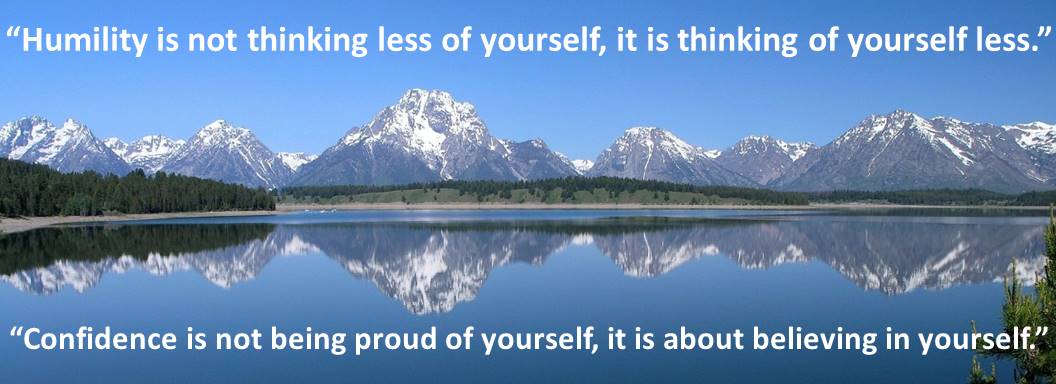
Humility is not meekness or weakness. It is not a low view of oneself, but rather a low view of one’s importance relative to other people. The Merriam-Webster dictionary defines humility as “the quality or state of not thinking you are better than other people.” Healthy humility is a character trait that is built upon the character value of believing in the importance of every person. Leadership is influence and influence is built upon relationships. William James said that “The deepest craving of human nature is the need to be appreciated.” This healthy humility invites the other person into relationship because the value that is placed on the other person is evident. Healthy humility then draws people into relationship where they feel valued and appreciated and therefore open to the influence of leadership.

Humility character development New Horizon Partners

Confidence is not pride or arrogance. The Merriam-Webster dictionary defines confidence as “a feeling or belief that you can do something well or succeed at something.” It is the self-assurance arising from one’s appreciation of one’s own abilities or qualities. Healthy or well-placed confidence is based on a firm grip on reality, the self-awareness of clearly understanding one’s capabilities as well as strengths and weaknesses. Confidence is not based on the magnitude of our abilities but on the accuracy of our self-awareness. This confidence shows up in the leadership relationship as strength or self-assurance upon which people can rely. This strength or confidence also draws people into relationship because they see the strength and feel able to trust it.

Humility and confidence have a positive relationship with each other. These two character traits have no need to be balanced because by nature they balance each other. With a clear understanding of our capabilities and our strengths and weaknesses, we can be comfortable with who we are and what we are able to do. Therefore, with strong confidence we are able to be humble, valuing those around us for what they can contribute. If we truly are humble and place high value in others, we can be secure in our own capabilities, knowing that we have no need to outshine others or puff ourselves up.

Arrogance is also a character trait, although not an attractive one in leadership. Arrogance is largely the result of not having healthy humility or of not having confidence based on reality. The Merriam-Webster dictionary defines arrogance as “an attitude of superiority manifested in an overbearing manner or in presumptuous claims or assumptions.” In other words, arrogance is an attitude of self-importance or pride. Where humility is based on a belief in the importance of others, arrogance is based on a belief in the importance of self, polar opposites in attitude. Arrogance can often be the result of an effort to compensate either for a lack of capability or a lack of confidence. Without confidence, a person could feel the need to puff oneself up and pretend to be superior or arrogant.

Where humility and confidence draw those around us into a relationship where we are able to influence, arrogance has the opposite effect. Arrogance creates a lack of trust and respect, driving people away from relationship, undermining the potential for influencing as a leader. Thus there is no room for arrogance in effective leadership.

How do we build healthy humility and confidence based on reality? Growing humility is a matter of character growth, building our belief in the value of other people and coming to terms with a lower level of self-importance relative to others. Growing in confidence is a matter of further developing our own self-awareness and self-acceptance. Character growth is not a matter of learning a new skill but is a matter of retraining our brain to incorporate new values and traits into the way that we think and behave.

Do you possess healthy humility and confidence rooted in reality? Are you growing in character?