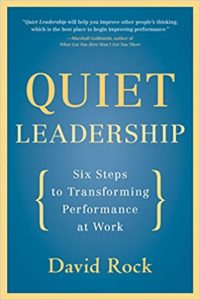
“Quiet Leadership” by David Rock

Thinking drives emotions that drives behaviors that then produce results. Managers spend their time trying to control results and to some extent behaviors. Leaders should apply their effort to impacting thinking, with a greater and longer-lasting effect on results. This is the big idea that David Rock sets forth in his book, “Quiet Leadership: Help People Think Better – Don’t Tell Them What to Do!

The book begins with a short discussion of neuroscience and how the brain hardwires patterns of thinking. Yet the brain has a great deal of neuroplasticity, making it able to learn and adapt new ways of thinking. David Rock encourages leaders to understand and take advantage of this ability of the brain as they encourage the growth of the people that they lead. To do so, the author lays out a six-step process of transforming performance of the people that we lead.

Step 1 – Think About Thinking
This step goes back to the subtitle of the book. Rather than providing direction and instructions, leaders should guide and develop the thinking process of their people. We do this by asking thinking questions. Discussions should focus on solutions rather than problems and accentuate the positive. Conversations or meetings can easily get sidetracked. The author provides a tool that is termed “Choose Your Focus” to be used in guiding conversations, with five mental frames: vision, planning, detail, problem, and drama. He suggests that the parties in a conversation refer to these to be sure that all are on the same page.

Step 2 – Listen for Potential
David Rock suggests listening with the expectation that the person speaking can and will solve their own dilemmas. Listening for potential means using the advantage of an outside or distant perspective to help the speaker see their own insights, possibilities, and future.

Step 3 – Speak with Intent
The author suggests that quiet leaders are succinct, specific, and generous when speaking with others. They use few words to communicate the core of the idea that they desire to transmit. They speak so that the listener can clearly understand and relate. And the leaders objective is develop thinking.

Step 4 – Dance Toward Insight
Leaders are accustomed to giving advice and answers. It seems to be part of their DNA and they have been trained over years to do so. People come to them for answers. David Rock suggests a different response in this, what he calls the central thought of quiet leadership. It describes the conversation where the leader prompts the person toward finding the insight within themselves. This is done through a process consisting of seeking permission to dig into the dilemma, anchoring the conversation to define what is going to be accomplished, then questioning and clarifying in such a way as to help the other person clearly understand the dilemma. Of course, the questioning and clarifying process is delicate so that it draws out the other person rather than stifling them. See the book for details here.

Step 5 – Create New Thinking
Following on to the insight regarding the dilemma, the author describes a process for discovering a desired outcome through what he terms a CREATE model – Current Reality, Explore Alternatives, and Tap Energy. The concept is to guide the person through this model to build a thinking process and find their own best path to a solution.

Step 6 – Follow Up
Rock returns to neuroscience in this sixth step to emphasize that hardwiring the brain requires repeated and intentional practice. The follow up step reminds and embeds the thinking process. The author recommends his FEELING model to assure that the person has completely embraced the process. The FEELING model includes following up with a discussion that includes Facts, Emotions, Encouragement, Learning, Implications, and a New Goal.

This book is basically an instructional manual on how to coach people in developing their thinking capability. Since all leaders should be continually coaching their people, the book presents useful tools. These tools are not just for the workplace or for a leader working with subordinates. These tools can make the reader a more effective communicator and improve relationships of influence in any part of life. In this book David Rock encourages us to move away from giving quick answers towards building relationships of understanding and developing people.


Celebration!

One year ago today, on September 5, 2016, we introduced our new website and this blog on leadership, character, and business strategy. Our goal at that time was to publish a relevant and interesting article on the subject of leadership, character, or business strategy about once a week. This is now the 58th article in this series. Over the past 52 weeks there have been a few weeks when the crush of projects has made it difficult to write, but we have met the goal over the year. Hopefully, our readers have found some food for thought and opportunities for growth.

In addition to the articles that we publish here, we also write a series on leadership that you can find at the PolymerOhio website.

At this time I would like to express my appreciation for the many visitors to our website who have taken the time to view our blog articles. Thanks for reading! It’s a gift!

Strategic Differentiation

The purpose of any business is to provide goods or services that offer benefits which fulfill the needs of customers. The value offering of a company is the package of benefits that it provides to its customers, which includes all of the benefits resulting from the goods and services provided. Customers pay for the benefits provided in a supplier’s value offering. If a company’s value offering is very similar to that of other competitors, then the suppliers can be forced into a price war to gain business.

Research shows that the most successful and profitable businesses are those that are able to differentiate themselves from their competitors. Differentiation can be defined as distinguishing one company’s value offering from those of competitors by providing unique or more benefits. Differentiation is sometimes referred to as product differentiation but we must not be too restrictive. Customer needs can encompass a broad range of benefits including those directly related to the product as well as many dimensions of support. In our days of lean organizations, customers might rely on suppliers for engineering or R&D, so a supplier could differentiate based on their technical expertise while producing a product that is similar to competitors’. One of our clients produces what is clearly a commodity product but is very successful because their customer service is head and shoulders above all of their competitors.

Differentiation can be based on a broad range of benefits but it is always based on the customer’s needs and their perception of the benefit. It can be based on the benefits received from a product (or in the case of a service company, the service) including such things as functional performance, quality or durability, fit and finish, etc. It can be based on the services that surround the product such as delivery, accuracy, return policies, accessibility, or many other things. It can be based on brand perception or personal relationships. In any case, it is always in the eyes of the customer who makes the judgement of the true value of a supplier’s value offering.

Since differentiation is based on the customer’s needs and perception of value, the value will be different for different customers. In the case of our client with commodity products and superior service, the customers that most highly valued the service levels were industrial distributors. Other customers would not have assigned the same value to the level of service provided. A supplier seeking to differentiate must find the group of customers that are willing to pay for the differentiation. And when thinking about needs, it is not looking for a customer that needs a widget. Rather it is in the details of the needs – a widget with these certain characteristics or a supplier of widgets who will also provide these services.

A good differentiation strategy makes a supplier stand out from the competition when customers assign value to the benefits in the value offering. For suppliers that have a substantial benefit, either based on an economic advantage in providing it or even based on being the only supplier to recognize and fulfill a particular need, a price premium can be obtained, resulting in superior levels of profitability. A good differentiation strategy can also lead to gain in market share and high levels of customer retention.

To pursue a differentiation strategy, first identify a core group of customers that have a specific benefit in their list of needs. Then identify and build the capability to meet that need in either a unique way or a more economical fashion than competitors. And, of course, be sure to tell prospective customers about this differentiating benefit.

See this article by Chris Zook and James Allen in HBR for more detailed thoughts on differentiation.

Is your company satisfied with a “me too” strategy? What can you do to stand out from the crowd and increase the value delivered to your core customers?

It’s What’s Inside that Counts

Leadership is the result of the combination of character and competency. Character is the far more important ingredient.

“It’s what’s inside that counts” may sound like a trite marketing statement. But leadership is influence and that influence is based on establishing a relationship of trust between leader and followers. Followers want to know that their leader is capable and competent. They want to have confidence that the leader can make good choices and guide positive change. But before they place trust in the skills of the leader, they must first be able to place their trust in the person of the leader. They need to see what is inside.

Another popular saying is appropriate here. “People don’t care how much you know until they know how much you care.” Followers entrust their careers, their livelihood, even their health and safety into the control of a leader. Before they are willing to go all in they need to see the character of the leader and make a judgement as to the trustworthiness of the person. Character shapes the relationship that leaders have with followers. It is the foundation of a trusting relationship.

Character can be defined as the traits, values, and virtues that guide the decisions that a person makes. It is what’s inside a person that defines how they will interact with others. Some of the most important character traits necessary to build this relationship of trust are the following:

  • Honesty
  • Forward-looking / Vision
  • Positive outlook / Confident / Inspiring
  • Results oriented
  • Empathetic / Caring
  • Openness / Approachable / Personable
  • Flexible / Resiliency
  • Principled / Integrity
  • Authenticity / Vulnerability
  • Humility

Without the character of leadership followers will hold back their loyalty and commitment. The results then are a half-hearted effort, limiting productivity and innovation.

Both character and competency can be learned or built, but character requires more effort. Building competency is a matter of learning new skills. Building character is more often a matter of changing what we think and who we are.

Do you have the character of a leader? How are you further developing your character to become the best leader possible?

“The Advantage” by Patrick Lencioni

The big idea from Patrick Lencioni’s book, “The Advantage“, is summed up in the subtitle, “Why Organizational Health Trumps Everything Else in Business.” The book weaves together company culture, business strategy, and leadership philosophy to describe the path to organizational success. Lencioni makes the case that without health, organizations are prone to confusion, politics, and frustration that saps energy and makes them far less effective than their potential. The book makes the case that the best strategy, the best products, or the best people are all crippled within organizations that have not developed organizational health. With organizational health, the people within the organization are focused and efficient, therefore achieving higher goals more quickly.

Lencioni defines organizational health as integrity within the organization, “when it is whole, consistent, and complete, that is, when its management, operations, strategy, and culture fit together and make sense.” Another way to describe organizational health is a united leadership team with a clear business description and direction. He describes two fundamental requirements for success of an organization, when it is smart (demonstrated by effective strategy, marketing, finance, and technology) and healthy (demonstrated by minimal politics, minimal confusion, high morale, high productivity, and low turnover). His view is that most organizations spend the bulk of their effort on the smart requirement and very little effort on the organizational health requirement. This despite the belief that organizational health is far more important.

To achieve the advantage of organizational health, the book describes four disciplines, as follows:

  1. Build a Cohesive Leadership Team.
    This leadership team is defined as “a small group of people who are collectively responsible for achieving a common objective for their organization.” The key to building a healthy organization is in building cohesiveness in the leadership team, where the team members sacrifice their personal desires or interests for the benefit of the team. Lencioni lists five behavioral principles that must be embraced to build cohesiveness, as follows:
  • Building trust
  • Mastering positive conflict
  • Achieving commitment
  • Embracing accountability
  • Focusing on results
  1. Create Clarity.
    Too often we find organizations that exist as a group of silos, each with their own view of what is best for the organization or simply focused on their own departmental interests. A healthy organization is based on the leadership team rallying around a clear and consistent description of their business and its direction. Lencioni defines these six critical questions to provide the organization with what he terms clarity, describing the organization and its goals and direction:
  • Why do we exist?
  • How do we behave?
  • What do we do?
  • How will we succeed?
  • What is most important, right now?
  • Who must do what?

These questions define the business, its strategy, and the tactical priorities for achieving success. In Lencioni’s view, these six questions sum up the rallying points that bring the organization together.

  1. Overcommunicate Clarity.
    Of course, the author could have said that organizations need to communicate the answers to the six questions that provide clarity. But too often leadership sees this communication as a one-time activity rather than a continuous requirement. People in the organization will easily forget or become distracted unless leadership continually reinforces these critical elements of clarity. So that everyone in the organization is working toward the same goals, they all need to be reminded consistently and the leadership team needs to be sure that they are all giving the same message. Some organizations think that presenting the plan to all employees once should be enough to get buy-in. Other organizations never communicate; they just want people to do their jobs without any understanding of their employer and what needs to be accomplished to be successful. Instead, Lencioni suggests that organizations overcommunicate using every means possible so that everyone is focused on the same priorities.
  2. Reinforce Clarity.
    The fourth discipline that Lencioni describes as a necessity for building organizational health is through all of the human systems of the organization. For example, the hiring process needs to be structured so that candidates are screened first by their ability to fit with the values of the organization and then secondly for technical skills and past accomplishments. Similarly, the onboarding or orientation process should be considered a prime opportunity to communicate the answers to the six clarity questions. In the same way, the clarity questions should play a part in performance management, recognition, and compensation. Employees that do not fit with the values should be managed out of the organization, since they will cause a distraction to the rest of the organization

A theme throughout the book is simplicity. Bureaucracy and complicated systems defeat the purpose of uniting the entire organization with clarity. After describing the four disciplines of a healthy organization, Lencioni spends a final chapter describing his view of effective meetings consistent with the concept of a healthy organization.

Most of Patrick Lencioni’s books are written as business fables in which he focuses on elements of company culture and demonstrates failures and successes in building a successful organization. “The Advantage” is a practical guide that incorporates many of the concepts from Lencioni’s other books. While he tends to be a bit dogmatic, this book has a lot of great advice for building a healthy organization and healthy organizations outperform the rest of the world.

Leaders: Extroverts or Introverts?

Which personality type makes the best leader, extroverts or introverts? For perhaps the past century there has been a bias toward extroverts, although this is much different than the prior historical view. Wharton professor, Adam Grant, conducted research that found 96% of leaders self-identify as extroverts. Of course, part of the explanation of this high number could be the cultural bias that extroversion is more preferable than introversion. In fact, there are reasons why introverts make great leaders and there are reasons why extroverts might be the better leaders. But rather than a preference for a certain personality type, it seems that the best explanation for leadership capability is character.

People often think of introverts as quiet and extroverts as gregarious or outgoing, but this is an oversimplification. Introverts focus inward, into their own thoughts, and extroverts focus outward, into the world. The difference is sensitivity to stimulation. An introvert is prone to being overstimulated by intense or prolonged social interaction. Extroverts crave stimulating activities like social interaction, social gatherings, and even activities that provide stimulus such as amusement parks or mountain climbing. Another simple way to describe the difference is extroverts gain energy from social interaction while introverts use energy.

At one time it was thought that people were one or the other – extrovert or introvert. It seems more logical that everyone has some of both, with one being more predominant. Also, the predominance of either extroversion or introversion can vary in different settings or circumstances. And people can train themselves to be more of what they deem desirable. Since extroversion is more socially acceptable, at least in the western world, there are many people that would naturally be introverts but have developed the habits of an extrovert, except that they may find it more tiring than a true extrovert would.

The strength that the extrovert personality type brings in leadership is perhaps boldness or persuasiveness. An extrovert is especially effective when leading a group of passive followers, providing energy and direction. The downfall of an extrovert in leadership can be failing to listen and allow team members to express their own thoughts and feelings, resulting in dissatisfaction of those that want to be heard.

The strength that the introvert personality brings to leadership is the ability to think deeply and seek out the input of those around them. An introvert is especially effective when leading a team of highly capable and motivated people where the group’s input and interaction are crucial. The downfall of an introvert could be some degree of isolation or the inability to energize certain followers.

While they differ in how they seek and react to stimuli, both extroverts and introverts are capable of building the character of an effective leader. And it is character more than personality type that determines the effectiveness of a leader. Character traits such as honesty, integrity, authenticity, and humility are not a function of personality type. Both extroverts and introverts can be strong in their respect and appreciation of other people and the thoughts and feelings of others. Extroverts may need to restrain their voice to hear others and introverts may need to become more intentional about seeking out interaction with others. But the personality type of extroversion – introversion does not define a leader.

The lesson for organizations is to not be caught up in what shows on the surface, which is where introversion and extroversion reside. Rather, organizations should make decisions on hiring and promotion based on underlying character traits, the more important definition of leadership ability.

For an interesting discussion of the societal shift toward extroversion, see the TED talk by Susan Cain, author of Quiet: The Power of Introverts in a World That Can’t Stop Talking.

Where are you on the introversion / extroversion scales? What do you see as the advantages or disadvantages of these two personality types?

Strategic Situation Analysis

In the strategic planning process, defining the strategy is a function of combining goals and objectives that define what the organization would like to accomplish with the realities of the situation. The situation analysis is a vital part of the planning process because it sets the context in which the organization will operate in the planning period and results in a clear view of priorities.

The situation analysis provides the basis for the decisions to be made in the definition of strategy and the implementation steps for moving forward. It is sometimes referred to as the SWOT (strengths, weaknesses, opportunities, and threats) analysis but we should think of it more broadly than people generally view SWOT analysis. The situation analysis should not be an onerous documentation of everything we know about the market and our position. Rather it provides a disciplined opportunity to think through and identify the particular factors that will affect our market and our ability to be effective in it. It’s better to have five bullet points of the things that will prompt a decision about where and how to compete than five pages of data, tables, and graphs that have no bearing on the way that we will do business in the future.

The situation analysis examines both the external and internal factors that will affect the business and its ability to compete in the planning period. In other words, it answers the questions “what will affect the market in which we compete?” and “what will affect our ability to be successful in competing?”

The external elements of the situation analysis can be divided into macro and micro factors. Macro factors would include analysis of political/legal, economic/demographic, social/cultural, or technological (sometimes called PEST analysis) changes or trends that will affect, either positively or negatively, the market or our ability to compete in the market.

The micro factors focus on customers and competitors. Regarding customers, we answer the question of “what are the important elements or what changes will we see in potential customers and their need, willingness, or desire to purchase products or services similar to ours?” This might include the number or health of potential customer, changes in industry structure, changes in end markets, etc. Regarding competitors the analysis addresses similar questions, such as “who are the key competitors and what are their capabilities that impact our ability to compete?”, “what changes are we likely to see in the number or the capabilities of competitors?”, or “what is the competitive environment and how is it likely to change?”

Again, the purpose of the situation analysis is to identify the factors that will affect our ability to compete and achieve the goals and objectives. We are searching for the threats and opportunities that will impact the organization over the planning period or beyond. We need enough information to enable us to understand the threat or opportunity and then to craft a strategy that will appropriately respond.

The second major part of the situation analysis is the analysis of internal factors. The internal analysis is focused on where we stand, how well we compete, where we need to improve, and what are we able to capitalize upon. It examines the strengths and weaknesses relative to customer needs and relative to other competitors in the market. In preparing the internal analysis we need to examine areas such as market position (market share, brand awareness and position, distribution or channel position, sales capability, etc.), technology (product or process capabilities), staff or culture, access to resources (financial and other), operational capability (efficiency, capacity, etc.), and other areas that might affect our ability to compete in the market. The goal in the internal analysis is to provide the information that will enable us to identify and prioritize the way to use resources that will strengthen our ability to compete.

The biggest challenges that organizations struggle with in the situation analysis portion of strategic planning is either 1) not thinking broadly enough about the areas that might affect their market opportunities and ability to compete or 2) spending a lot of time documenting things that have no impact on their future. The analysis that backs up the strategic planning process should be an ongoing effort of the organization to understand the market, the customers, the competitors, and themselves. The plan itself is then a distillation of all of these areas to identify where the threats and opportunities exist and where our strengths can be applied or our weaknesses shored up to make us a more effective competitor. The end result of the situation analysis should be a crisp and clear description of the factors that lead to strategic choices.

Is your strategic plan crisp and clear? Where do you find the greatest struggle in analyzing and communicating the situation that your organization faces?

Leaders Are Servants

The best leaders are, by their nature, servants of those that follow. This servant mentality comes from the character traits that define the best leaders. To be a leader is not a title or position that is assigned to a person. The role of leader is one granted by followers who deem a person worthy of trust to the degree that they are then willing to follow. The characteristics of a servant leader are the traits that draw people to trust and follow.

The servant leader should not be viewed as wimpy or subservient. The traits that define leadership presence are not in conflict with the traits of serving. The best example of a servant leader might be Jesus Christ who, regardless of his position as Son of God, did not regard himself as better than those who followed him. And his servant attitude did not make him subservient to anyone except his heavenly Father.

The servant attitude of a leader is a result of character traits such as the following:

  • The servant leader respects and values people. They think you, not me. The leader would not ask anyone to do what they themselves would be unwilling to do. They value the opinions, thoughts, and emotions of team members.
  • The servant leader acts with humility. They are not haughty or proud. They rely on their inner person rather than using position or title. There is a sense of equality and team.
  • The servant leader encourages those around them. They have a positive attitude and they believe in their team members. Their confidence is contagious.
  • The servant leader seeks the success of those around them. They are committed to help people grow and blossom. They develop leaders in those that they lead.
  • The servant leader is authentic. They are comfortable with who they are and are willing to allow others to see both their strengths and weaknesses.
  • The servant leader develops a culture of trust. They are consistent in keeping their word and caring for others.
  • The servant leader has a long-term view. They are thinking of the benefits to the organization and their people over time. They are willing to invest in others for future results.
  • The servant leader values results for others. They are not self-centered or selfish but seek benefits for those around them.

Leadership is influence and influence is based on relationship. The underlying theme in all of these traits is that servant leaders think of others rather themselves and the end result is that their people respect and trust the leader. This respect and trust leads to performance and results.

Are you developing the character of a servant? What other characteristics do you see as valuable in serving those that you lead?

Leaders Are Communicators

Leadership is influence and influence can only be achieved with good communications. Whether we are promoting a shared vision, encouraging team collaboration, developing our people, or any other part of the leadership role, communication is a key element that determines success as a leader.

Leadership is composed of character and competency. Since good communication is so fundamental to leadership it should be no surprise that there is also both a character and a competency component to good communications.

The best leaders have a drive to communicate, the character element. Because these leaders have a respect for people and a desire to build relationships, the desire to communicate is a part of who they are, a part of their character. These leaders have a desire to know and be known by the people with whom they interact. Communication ties in with the character traits of transparency, humility, openness, empathy and other key traits of leaders.

This desire to communicate should not be confused with the personality factors of introversion and extroversion. Extroverts gain energy through interaction with others while introverts use energy to interact. But the desire to know others and to communicate is a separate trait.

The other part of a leader’s communication is the competency or skill developed to do so most effectively. Great leaders are great communicators. They work hard at learning to communicate effectively. Some of the essential elements of communication competency are clarity, candor, consistency, congruency, and connection.

Clarity – leaders must communicate clearly at a level that is easily understood by the audience.

  • Be proactive; people left in the dark wander from the vision and waste energy speculating.
  • Understand the purpose of every communication, define the objective, and tailor the means and content to meet the objective.
  • Make it simple and concise, understandable to the audience, and focused on the objective; communicate specifics not ambiguities.
  • It’s not just the “what” but also the “how” of communicating – appropriate to the purpose, with authority.

Candor – leaders need to be trusted in order to be followed.

  • Speak the truth; honesty and transparency builds trust.
  • Be open and authentic; communicate from the heart.
  • Admit mistakes; people don’t relate to those pretending to be perfect, they relate to those that are human and humble.
  • Be willing to embrace the negative, both to admit it and to hear it.

Consistency – maintain a continual flow of information to stay connected.

  • Develop and implement a communication plan that schedules periodic communication, both written and verbal, to institutionalize communications.
  • Make a point of communicating both with the larger audience and on an individual basis with people throughout the organization.
  • Another part of consistency is making the message continually reflect the culture.

Congruency – communication is more than just the words that you write or speak.

  • In speaking, both to individuals as well as to a group, be sure that your body language reflects the message that you are seeking to deliver.
  • In written and oral communications, check the tone as well as the words you use.

Connection – communication is more than speaking and writing, leaders need to know and relate to their audience.

  • Communication is not just distributing information, it includes listening to understand and perceiving emotions and attitudes.
  • In individual communication, read body language.
  • Speak to the concerns of the listener, know the context.
  • Promote two-way communication, solicit feedback.

Your leadership success is dependent upon your communication character and competency.

What are doing to build your communication capability? What are the stumbling blocks to great communications?

Strategy Is Not

A statement of business strategy describes where and how the firm will compete in order to accomplish its objectives, meet customer needs, and obtain a superior financial return. Strategy sets the boundaries around future decisions, describing which business opportunities should be pursued, how to invest resources, which skills to develop, who to hire, etc. The statement of strategy needs to be clear, specific, and concise enough to say yes to the preferred choices that are consistent with the strategy and no to the choices that are distractions from the strategy. The statement of strategy must be useful to all decision makers within the firm to keep everyone and everything operating within the direction defined by the business strategy.

Too often firms are either unable or unwilling to state a clear, specific, and concise strategy. Instead we find what purports to be strategy but simply consists of a bunch of buzzwords, or an agglomeration of goals and objectives, a very general description of mission, or a set of actions. Such a weak statement of strategy does not serve its purpose of guiding the future decisions of the firm or of defining where and how the firm will compete.

“Our differentiating value-added strategy is transformational change to reach a new paradigm of performance.” A collection of buzzwords does not define a strategy because it can be interpreted to be about anything. It does not provide direction for decision-makers.

“Our strategy is to grow top-line revenue 20% per year for the next five years.” Goals and objectives are not the strategy but are a prerequisite for strategy. The goals and objectives define where the firm wants to go but not how to get there. The strategy statement is intended define the path and drive the firm to a course of action to achieve the goals and objectives.

“Our strategy is to provide metal stampings and other metal components and fabrications.” A mission statement is not a business strategy. It simply describes what the firm is but not where and how the firm will compete. It does provide a specific definition of how the firm will develop its competitive advantage, so it cannot guide decisions as the firm evolves.

“Our strategy is to increase our machine shop capacity.” An action plan is not a statement of strategy. The action plan is the implementation of strategy, the specific things that will build the competitive advantage defined in the business strategy.

All of the examples above lack the clarity and specificity required to guide decisions by the organization. On the other hand a statement such as “We provide high quality, large, flat, injection-molded parts to the high-end, low-volume business and medical equipment market” provides a clear direction for decisions. The members of the organization know where and how they compete and what will be the expectations of their customers. The decisions that are made throughout the organization are then consistent with this defined strategy.

What are some examples of both good and bad strategy statements that you have seen?

Does your organization have a clear, specific, and concise strategy?