Why Strategic Planning Fails

Strategic planning is a key process for driving change, growth, and value creation in an organization. Business strategy defines where and how to compete. The strategic planning process provides a discipline for understanding customer needs, the market and competitive environment, the competitive position of the firm, the strategy and the core competencies required, and the actions necessary to develop the core competencies and implement the strategy. It is the tool for changing the firm from what it is to what it aspires to be.
Some organizations struggle with the strategic planning process. They may have made some effort at planning without realizing any noticeable benefit. Some organizations go through the motions of strategic planning and then put the resulting document on a shelf and dust it off the next time they get around to planning again. Without a clear understanding of the process and purpose, strategic planning can be frustrating or intimidating.

The strategic planning process need not be burdensome. But there is a certain amount of discipline required to plan effectively. There are nine major reasons why organizations fail to achieve the appropriate value from the strategic planning process, as follows:

Failure to understand customer needs. The reason for any firm’s existence is to serve the customer and meet their needs. Unfortunately, some organizations have lost sight of this. Instead their focus is on generating revenue or profits or simply producing products. An important element of the strategic planning process is understanding the customer and their needs. Competition is all about providing value as perceived by the customer, which means meeting their needs. Only when a firm understands those customer needs are they ready to identify a plan to provide a value offering with a competitive advantage.

Failure to recognize the market environment correctly. The strategic plan should identify the path to competitive advantage over other suppliers in providing value to the customer. Underestimating or failing to understand the capabilities of competitors can allow the firm to head down a path that is already crowded with similar suppliers. Or failing to see a logical evolution in market structure or the market environment can leave a firm without a tenable market position. The organization needs to have confidence that the plan, when achieved, will provide a great future for the constituents of the firm. Being blindsided by industry or market changes similarly reduces the value of the plan. It is impossible to be totally prescient but the planning effort needs to take a close look at the market and competitive environment and provide a path to competitive advantage with appropriate contingencies for high risk scenarios.

Failure to see the reality of the firm’s position. Too often organizations spend a good part of their planning efforts patting themselves on the back. Sometimes firms stumble for the opposite reason, a “woe is me” attitude without thinking creatively about what are or could be competitive strengths. Instead the company should realistically assess strengths and weaknesses as compared to competitors in light of customer needs. Only after developing a clear understanding of where they stand today is a firm able to plan the path towards what they wish to become.

Failure to define a strategy that is strategic. A common failure is developing a statement of strategy that prompts no action. The central part of the strategic planning process is developing a business strategy that will build and leverage core competencies to meet customer needs. A previous article described what this strategy statement is not; it is not buzzwords, a set of goals, a long-range forecast, or a few random actions for the future. Instead it is a clear description of where and how to compete. The strategy prompts action to build the capability to do compete effectively.

Failure to determine the action plan required. The strategic planning process provides the framework for prioritizing all of the actions that will create competitive advantage and provide value to the customer. Most strategic plans will have an action plan. The big error that occurs is in not identifying the critical actions required to build or enhance the firm’s core competencies and pursue the strategy and instead including a list of random actions. This stage of the planning process requires the firm to focus its efforts and resources on the actions that will create value for the firm over the long term.

Failure to do the implementation. It is not enough to list actions, they must be accomplished. Too often these are considered long-term actions and the organization forgets about them and goes about its day-to-day activities. This is why the action plan should always list the responsible parties and the milestone dates. Since these are the actions that determine how effectively the firm will compete in the future, these should be the highest firm’s priority actions and receive appropriate attention.

Failure to communicate the plan with clarity. The strategic plan is more than a planning tool. It is the means to organize, prioritize, and energize the organization and transform it from what it is today to what it must be in the future. The strategic plan needs to be communicated broadly and clearly within the organization to motivate people and change the organization. One common error is producing an overly complex document. The information required for strategic planning is the information that the leadership team should be considering every day. The plan itself then should be the most critical information that guides the decisions and actions of the firm.

Failure to get buy-in from the organization. Sometimes a committee or even an individual is assigned the task of strategic planning. Or the executive team goes off for a two-day planning session. Then the plan is revealed to the organization. Without any ownership or involvement much of the organization then ignores what is being communicated. Rather it is better to plan in stages and seek input broadly throughout the organization. The greater the ownership, the greater the participation in implementation.

Failure to use the plan to drive day-to-day decisions. Perhaps the most common cause of failure, too often the strategic planning process is viewed as an annual process with little relevance to daily operations. The purpose of strategic planning is to guide the firm into a successful future based on building the capability to better meet customer needs and provide an advantage over competitors in doing so. A myopic focus on shipping today’s product while ignoring the future competitiveness of the firm is short-sighted. Business strategy and the strategic plan should set the priorities and guide every decision. Therefore, the strategic plan should impact the annual operating plan, the budgeting process, the performance management process, the weekly staff meetings, and every other decision-making process.

Strategic planning is about the options and the choices. It needs to be comprehensive but does not need to be complex. The strategic planning process needs to answer a few questions, such as – Which customers are we best suited to serve? What are their needs? What factors in the market environment present threats or opportunities? Which competitors do we face and what are their strengths and weaknesses? How do we best compete and deliver value to our customers? What differentiates us from our competitors? What actions do we need to take in order to better meet customer needs and distance ourselves from our competitors? With the answers to such questions the organization has a direction for the future.

Is your strategic planning process building the organization for the future? Do you see other modes of failure of the planning process?


Leadership Drives Focus

Focus is a necessary discipline of any organization. In order to achieve goals and objectives efficiently and effectively, the organization must be focused. Without focus the likely result is either stagnation or confusion and chaos. In a recent article we described how business strategy provides focus for the organization. In a similar way, one of the important roles of a leader is to set a shared vision and then to assure that the organization remains focused on achieving it.

There are five conditions that result in a lack of focus:

  • No priorities – The organization is simply going through the motions or possibly priorities have not been clearly communicated. Perhaps they are producing products or serving customers, but there is no impetus for growth and change. Therefore, in the minds of the members of the organization, there is nothing on which to focus.
  • Ever-changing priorities – Often the case when run by entrepreneurs, some organizations or their leaders constantly change priorities. The organization is left scrambling to act on the priority of the month, the week, the day, or even the hour. When priorities constantly change, the organization becomes frustrated knowing that today’s efforts will be for naught when the next priority is announced.
  • Too many priorities – When organizations develop a laundry list of the number one priorities, the organization is overwhelmed. There is no way to focus on a long list of top priorities, and efforts are spread so thin that little can actually be accomplished well.
  • Priorities that are not shared – When leadership is too fractured, everyone has their own set or view of priorities. Therefore, the various parts of the organization can be working at cross purposes, certainly not working in a united way toward overall organizational priorities.
  • Easily forgotten priorities – When leadership announces a priority, only to never mention it again the organization gets permeated with an attitude of feebleness. Priorities are not taken seriously and therefore there is no need to focus upon them.

To best move forward efficiently and effectively, the organization needs several elements. The first requirement is a leadership team that is competent and cohesive. If the leadership team is not united, the organization will also be fractured and lame. The leadership needs to adopt one to three high priority initiatives driven by their shared vision, specific goals or objectives, and the business strategy.

To develop and maintain focus on these priority initiatives then requires three things: communication, communication, and communication.

The first communication is raising and maintaining awareness throughout the organization of the priorities. In his book, The Advantage, Patrick Lencioni describes the requirement as “overcommunication.” Too often leaders, because a priority is at the top of their mind, might think that communicating once to constituents is adequate. In fact, continual communication is required in order to keep the priority at the top of everyone’s mind. If an initiative is truly important to the organization, every opportunity to energize and involve the entire organization must be utilized.

The second part of communication required to maintain focus is the coordination of efforts. A communication methodology must be developed to keep all of the participating elements informed of activities to enable collaboration and appropriate availability of resources.

The third part of communication required to maintain focus is tracking of progress or results. If an initiative is a high priority, then the results impact the future of the organization and the well-being of all of the people in the organization. Everyone needs to know the results and see that the organization has made a serious effort to achieve.

One of greatest factors that limit the potential of organizations is the lack of focus on the few areas of priority that can truly impact the future. Without focus, the energy of the organization is diffused rather than applied to high-leverage initiatives. Driving and maintaining focus is a necessary role of leadership.

How effective is your organization in focusing on the high-impact priorities?

Strategy Focuses Effort

One of the primary benefits of business strategy is providing focus for the organization. Without strategy to serve as the mantra, the organization can wander into chaos as people pull in different directions or as a stream of new priorities emerge.

Business strategy is a statement of where and how the organization will compete. It defines the competitive advantage that the organization seeks to develop in meeting the needs of a defined set of customers. It then serves as a screen for the decision-making process of the organization. As such, the business strategy statement must be crisp and clear. (See a previous article that describes what strategy is not.)

Without a clear business strategy chaos can ensue within the organization. For example, the engineering function may want to differentiate based on technology while the sales function wants to compete on price while the marketing function wants to offer customized products while the manufacturing operations gears up to only provide standardized products. Another trap for chaos is a leadership team that pursues a new priority every day. This can often be a weakness of an entrepreneurial founder.

A business strategy that is well thought out, clearly defined, and enjoys the buy-in of the leadership team focuses the organization. The strategy becomes the banner behind which the organization marches together. Moving the organization forward in the pursuit of the strategy is the permanent number one priority of the organization. The leadership team can refer to the strategy in every decision to assure consistency.

There can be danger in too much focus on the established business strategy. If the strategy becomes groupthink that prevents the organization from recognizing changes in the business environment or customer needs, then the process has failed. The organization needs peripheral vision to stay aware of the world outside and it needs to be open to occasional changes in strategy when clearly necessary.

A crisp, clear, and consistent business strategy focuses efficient allocation of resources and drives a sense of urgency to move forward in building the core competencies that lead to competitive advantage. This focus alone can be an advantage over competitors who are wandering in chaos without a clear strategy.

Does your organization have a clear strategy that provides focus?

The Value of Vulnerability

Vulnerability. The word alone is enough to make some of us uncomfortable. Yet, vulnerability is a necessary ingredient of any relationship of depth and value. If we recognize that effective leadership is based in relationship rather than position, then vulnerability must be a part of our character.

Historically those in leadership positions (and others) were encouraged to never show emotion. “Never let them see you sweat” was the mantra. We often learned to put up our force field in order to not feel or show any emotion.

Fortunately we have learned that leadership is not the same as dictatorship and that professionalism doesn’t require stoicism. Instead we have learned that effective leaders are those that draw people to follow. And people only follow those that they trust and respect. They will only trust and respect those to whom they can relate. Effective leadership requires building a relationship of trust and respect in order to influence people and that means that some level of vulnerability is a requirement. Without vulnerability only weak connections are possible, not the level of trust and respect that we need to influence well.

Vulnerability should not be viewed as weakness or being wimpy. In fact, vulnerability is a sign of strength. It says, “I am comfortable with who I am and I have the courage to allow others to see the real me.” Vulnerability is being genuine and taking risks in relationship. Dictionaries often define vulnerability as the quality or state of being exposed to the possibility of being attacked or harmed, either physically or emotionally. Brené Brown, the social researcher, defines vulnerability as “uncertainty, risk, and emotional exposure.” In other words, vulnerability is letting those in relationship see our emotions as a part of our humanity.

Vulnerability is a requirement in any meaningful relationship. Whether the relationship is in our marriage, with our children or wider family, our close friends, or in the workplace, they all require vulnerability to build depth. If the relationship is going to have depth or strength, it must involve connection deeper than the weather, sports, and the tasks for today. A true relationship touches on emotions. In her book, Daring Greatly, Dr. Brown says. “Vulnerability is the core of all emotions and feelings. To feel is to be vulnerable.”

Focusing now on the role of vulnerability for leadership in the workplace, let us examine what the leadership relationship looks like both with and without vulnerability. Without vulnerability –

  • others are held at arm’s length
  • therefore the perception that others have of us can be de-humanizing, they struggle to relate to us
  • therefore, we are not known
  • therefore, we cannot really know others
  • therefore, we cannot see and understand the motivations and challenges that those around us face in their roles and responsibilities
  • therefore, we are not likely to connect in a way that motivates and inspires.

As a leader without vulnerability, we can be perceived as either uncaring or a superhuman that feels no emotion. Either way, we are standing off from those around us. In summary, it’s difficult to build a relationship of respect and trust without some vulnerability.

On the other hand, a proper level of vulnerability on the part of the leader in the workplace provides the following:

  • a recognition by others of our humanity and equality
  • a connection that we all have some level of anxieties and frailties
  • an openness to understanding and empathy (in both directions)
  • the ability to relate to one another at a level that fosters trust and respect.

In the workplace, vulnerability is built upon a level of authenticity and transparency. This doesn’t mean pouring out all of the problems you face at home or in other personal relationships. It does mean sharing with those on your team some of the emotions that come as part of responsibility and decision-making including struggles with fear, uncertainty, perhaps even what that critical judge is telling you. Taking responsibility for a failed project or initiative is one small yet concrete example of a leader practicing vulnerability. Vulnerability is about being a real human being and allowing others to see and know us. This builds connection. Only by doing so can we build a true relationship of trust and respect that invites those around to follow.

Are you comfortable and courageous enough to be vulnerable and allow those in relationship to see and hear the real you? Being vulnerable requires a strong level of emotional intelligence. How are you doing with that?

Strategy Sets Direction

One of the main purposes of business strategy is setting direction. The strategy defines the course of the organization required to achieve its goals and objectives and move cohesively forward.

Business strategy is a statement of where and how the organization will compete. It defines the competitive advantage that the organization will utilize in providing value to a defined set of customers. It serves as a directional signpost for the decision-making processes of the organization. As such, the business strategy statement must be crisp and clear.

A good business strategy is visionary. It looks forward, describing how the organization will compete in the future in a way that is more effective than today or is responsive to foreseen changes in the market environment. Since a strategy is visionary or dynamic, it drives movement or action.

By defining where and how to compete, the strategy naturally defines the priorities for the organization. The strategy prompts the question “what do we need to do in order to compete effectively as the strategy describes.” These priorities then are the driving force behind the tactics and actions in a strategic plan. This is the direction that the organization needs to be moving.

There is a danger in becoming so fixated on a given direction that the organization does not see the cues that tell of a change in the market or of a need to re-think or revise the strategy. A healthy organization steps back occasionally to question assumptions and refine their strategy.

If the organization has a clear business strategy it sets direction for all business decisions and the allocation of resources. A good strategy statement keeps the organization on the path towards achieving its goals and objectives.

Is your organization’s business strategy clear enough to set the direction for resources and actions?

Lead Up, Down, and Sideways

Mention leadership and oftentimes people think only in terms of leading as a position. They might think of an elected official, an executive, or someone else that has a position in which they are expected to lead. But leadership is quite separate from the title or position.

Leadership is influence. Researchers Anderson, Spataro, and Flynn define influence as “the ability to change the actions of others in some intended fashion.” Most people desire to have influence in a wide variety of settings. This can include family, community, organizations, and the workplace. This abiity to lead or influence is a result of character and competency, in other words, who you are and what you know and do.

In the workplace one has the opportunity to lead more than just those who are a team or who are appointed as subordinates. If a person wants to have an impact on the organization, they should lead up, down, and sideways. Leading down is obvious; it is leading those that one is assigned to manage or lead. (In other articles we have drawn the distinction between leading and managing, so we won’t repeat it here.) Whether a person has a team to lead or not, they also have an opportunity to lead in the other two directions, up and sideways. Perhaps a true test of one’s leadership ability, leading up and sideways requires one to use the character and competency of leadership without any benefit of position. Leading up or sideways is solely dependent on one’s ability to build a relationship of influence.

Leading up is behaving and communicating in a way that influences those in higher levels of the organization. The objective in leading up is likely to be one of the following:

  • To move the organization toward a vision or goal that higher levels might not yet see.
  • To build respect and influence within the organization as part of career development.

To do so often means going beyond the normal responsibilities of one’s job. It means building a relationship of influence where one demonstrates the character and competency of leadership in dealing with those in the hierarchy. Leading up the organization can require developing ideas that are then delivered and claimed by people up the hierarchy. This can require a broader perspective than being concerned about receiving credit.

Leading sideways is working to influence one’s peers and others in the organization. The objective in leading sideways is often a matter of breaking down silos and building collaboration, towards either a personal or a professional goal. To lead sideways requires building a relationship of trust and respect where others in the organization are willing to accept one’s influence. Again, this relationship is a function of one’s character and competency. (See this article for an example of effective sideways leadership.)

Unless a person is at the top of the pyramid, every member of an organization has an opportunity to lead or influence those around them. Good leadership always benefits the organization and often leads to promotion and a greater opportunity for influence. (One caveat here is that good leadership does not work at cross purposes with an organization’s proper vision, goals, and strategy.)

Are you positively influencing those around you by leading up, down, and sideways?

An Example of Leading Sideways

Leadership is influence in order to achieve a vision or goal. In a recent article we described the advantages of leading up, down, and sideways. Carrying that idea further, the following article describes an experience of leading sideways.

In the early days of my career I spent a short time as a manufacturing engineer for a struggling producer of construction equipment. I was able to establish influence throughout most of the organization based on intelligence, common sense, and interpersonal skills. The operations function however was run based on toughness. The foremen were tough; the department superintendents were rough and tough; the plant superintendent, Rex, was the roughest and toughest of them all. He had little use for what I had to offer. Therefore, I was struggling to establish my influence on plant floor activities.

There was a certain operation in the fabrication department that the hourly workers hated. It required a lot of climbing and movement that was difficult and exhausting. No doubt the way the operation was designed led to quality and consistency problems.

I developed a redesign of this process that required some major changes in tooling and in the plant itself. I most likely could have built the case for investing in the changes to improve the process and gained approval for the investment with some effort. Instead I decided another route would provide additional benefits. In a casual conversation with Rex I planted the idea for improving this operation. Within the week people in the plant were at work implementing “Rex’s idea.” The welders loved the improvements in the process and everybody in the plant thought it was a great idea that “Rex had suggested.”

I don’t believe that anyone other than Rex knew that I was the actual source of the idea but it accomplished both of my objectives. The investment was made to improve the process with little effort on my part. But more importantly, from that point on I had a new relationship with Rex. I had earned his respect and his ear by giving him that idea. My improved relationship with the plant superintendent seemed to flow down into improved relationships with the departmental superintendents and the foremen.

For the price of one idea, I gained substantial respect and influence across the plant floor. This increased influence allowed many more ideas to be accepted and adopted with the cooperation of the operations staff rather than resistance. One idea bought the benefit of greater leadership equity.

Healthy Leaders Have Needs Also

As a leader, have you ever had times when you felt emotionally spent or empty? That the well had run dry?

It is not unusual for a leader to reach a point where they feel like they have used all of their emotional energy and have nothing left to give. Yet, relating to followers and meeting their emotional needs in the work setting is a basic function of an effective leader. The people that we lead need affirmation, encouragement, understanding, challenge, and other such emotional support in order to face their challenges and perform at a high level.

A typical leader has a large store of emotional energy and they use it liberally. Often a leader uses from their emotional tank without getting the tank refilled. The result is a feeling of emptiness, of being spent out.

The statement, “it’s lonely at the top” is generally true. Often leadership can be lonely. Leaders are especially susceptible to emptying their emotional tank, despite its large capacity, for reasons such as the following:

  • Leaders are servants. They have a keen awareness of emotional needs in the people that they lead and they seek to fill those needs. They want their people to be healthy and productive.
  • Leaders do have a large store of emotional energy and they can dispense it liberally without realizing that they are running a deficit.
  • The people around leaders often perceive their leader as being strong, capable, and not having any needs. Leaders tend to “have it all together.” So, while leaders watch for opportunities to provide emotional support to others, those others do not see any need to reciprocate.
  • Leaders sometimes view themselves as a bit of a superhero, able to take on anything and not show any needs.

Every person has emotional needs. There are those people that are emotionally unhealthy and overly needy, but we are not talking here about them. Leaders tend to be very emotionally healthy. But even the healthiest person needs to take in some emotional fuel occasionally. Some people do not want to recognize that they have any emotional needs because they have been taught that needs are weaknesses. But this is not true; emotional needs are a part of human nature. We were created for relationship and a part of being in relationship is both having and filling emotional needs.

Sometimes we need to learn how to recognize and voice our emotional needs. The idea of having needs is so foreign that we may have trained ourselves (or been trained) to not recognize that they exist. So a first step might be to learn what emotional needs are and how they manifest themselves. An emotional need can be a simple hunger for affirmation after having done something difficult. It can be a desire for empathy (not sympathy, by the way) after suffering a loss. It can be a need for encouragement or challenge when facing a difficult task or decision. It can be a need for understanding or acknowledgement when facing tough circunstances.

How does a leader go about getting his or her emotional needs met? They need to develop a group of people where they have a safe relationship. They need to be able to voice their need and have others who care about them step in to meet this need. (We can’t wait and hope that others perceive these needs.) Within an organization this might be a few trusted colleagues. Sometimes people develop a sort of personal board of advisors who serve in such a role. Often the most effective means is to join a peer group of similar leaders who can develop relationships and provide connection and support to each other.

A leader can be thought of as a high-performance jet. Our emotional energy is the jet fuel that makes us effective. But if we spend all of our fuel in helping our people and then run dry ourselves, we are in danger of crashing and burning, or at least being less effective. We need to get our emotional tank topped off once in a while so that we can run at maximum efficiency.

Do you recognize your emotional needs? Do you have a means of getting your emotional tank refueled?

Attitude Drives Action

In leadership a positive attitude has many benefits, both personally and corporately. It makes the leader more productive. It influences those around us to lift their attitude and helps them be more productive. We are no doubt familiar with situations where a negative or defeatist attitude puts a cloud over the organization and saps energy.

A positive attitude helps a person to be more creative and open, producing ideas for new and better ways to move forward. A positive attitude makes thinking about the future attractive rather than foreboding. Positive people are more confident. While the stress of a negative attitude saps energy, a positive attitude provides more energy to accomplish the tasks before them. Positive people approach tasks with expectations of accomplishment and success. Obstacles seem smaller when approached with a positive mindset; it is easier to see solutions when we expect to continue moving forward.

A positive attitude is infectious. Positive people are more likeable and develop relationships more easily. Therefore, a leader with a positive attitude is more likely to draw positive people into her team. The attitudes of leadership are generally reflected in the culture of an organization. A positive attitude in a leader leads to a positive culture, especially in a smaller organization.

A positive leader and culture is more likely to encourage a positive attitude in the people in the organization. Therefore, the positivity of the leader trickles down into more energy, creativity, and productivity from the people in the organization. So a positive person not only attracts other positive people but also leads those around them to become more positive.

A negative attitude can result from a negative self-critic; low self-esteem; high levels of stress, fear, resentment, or anger; or past experiences. Depending on the circumstances, a more positive attitude can be developed with some work. Some of the tools for building more positivity in life include the following:

  • Choose to look at the bright side and be optimistic.
  • Replace a negative self-critic with more positive self-affirmation.
  • Be grateful.
  • Develop positive relationships; seek out positive people.
  • Keep things in perspective.
  • Have fun.
  • Exercise and manage your health.

Does your organization have a positive culture? What steps are you taking to be more positive?

Generic Strategies

The concept of generic strategies was popularized by the book “Competitive Strategy” from Michael Porter in 1980. These are not business strategies in the sense that they do not provide clarity and definition of the strategic direction of a business. Business strategy describes where and how the firm intends to compete in order to gain a competitive advantage. The purpose of a business strategy is to provide a clear guide for all decisions regarding priorities and allocation of resources. Generic strategies do not provide the clarity and definition required to guide all decisions.

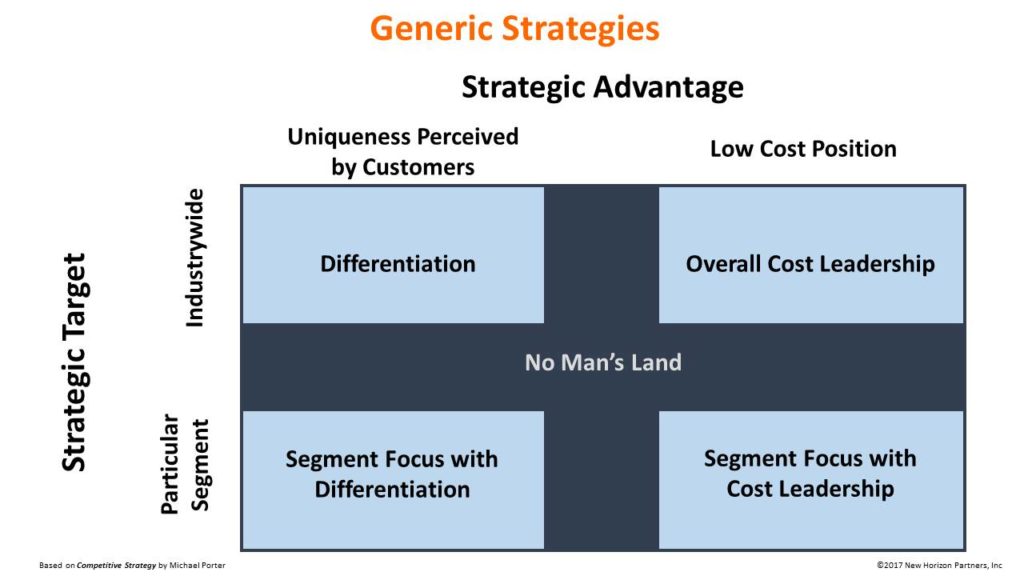
What generic strategies do provide is an approach to strategy or a general description of strategic direction. These can be useful in the firm’s early stages of strategy selection or in providing a general description of competitors’ strategies. Porter listed three generic strategies – overall cost leadership, differentiation, and focus. I prefer to think of them as four general choices, as shown in the graphic. In essence, however, they all describe a method of differentiation based on either cost or features and benefits which are targeted at either the total market or the customer needs in a select segment.

The graphic is useful in demonstrating that strategy is a matter of choice. It is not possible for a single organization to choose more than one of these general directions. Firms must choose whether they will pursue a low cost position or a strategy of differentiation by offering features and benefits in either product or service that meet customer needs in a way superior to competition. Of course, the buying decision on the part of customers is based on an evaluation of the value offerings of the various competitive suppliers and evaluating each offering based on the entire list of customer needs. This means that even with a differentiation strategy, the economic value of the features and benefits must justify the price. Likewise, pursuing a low cost position still requires some fundamental offering of features and benefits. But a firm cannot compete with one foot in each camp of chasing the lowest cost position while trying to outdo competitors in features and benefits.

In a similar way, firms also sometimes struggle by attempting to be all things to all people. If the firm’s decision is to serve the entire market, the choice of features and benefits must be driven by the general requirements of customers across the industry. In some markets it is difficult to identify an industry-wide position and, by necessity, the firm must choose a segment or segments for which to target their product/service offering. Unlike the cost vs. differentiation choice, it is possible to target more than one segment for a focus strategy. However, firms should be cautious about compromising their competitive position by either mixing the features and benefits requirements of various segments or not clearly communicating with customers regarding the appropriate product/service. (Some firms address this issue by using different brands for different segments.)

A market focus with a low cost position, again, is a matter of defining the fundamental needs of a segment, which may differ from the overall market, and then pursuing the lowest cost position for serving that segment. By definition, the focus with low cost means that features and benefits are limited to the segments basic requirements.

The concept of generic strategies is an important tool for use in building a consensus within the firm regarding a general direction of business strategy. When it is understood and accepted that this decision is about choices, the leadership team can then be united in pursuing a full definition of the firm’s business strategy.

Is your business strategy firmly planted in one of the generic strategy boxes? Does your strategy have enough definition and clarity to drive the organization’s decisions?