Power of a Peer Group

The best leaders make a point of continually growing and working to maximize their effectiveness. They work on growing both in character and competency. Effective leaders are high in self-awareness, understanding their strengths and weaknesses. They establish personal goals for growth and work towards achieving those goals.

One effective tool for growth is participation in a peer group with other leaders. A strong peer group can help a leader recognize areas for growth and achieve his or her goals. A peer group can be effective in overcoming some of the hurdles that a leader might face in going it alone in the growth struggle.

Some of the advantages of participating in a good peer group include the following:

Escape the isolation trap of leadership. “It’s lonely at the top” is more than a cliche. Leaders can easily become isolated because they have no trusted peers within their organization with whom they can dig deep or share feelings and there are many business and leadership issues that they cannot profitably share at home. A group of peers can understand, accept, and respond appropriately to the struggles that a leader might face.

Gain different perspectives. We each see issues and challenges from a viewpoint that is based on our history of experiences and knowledge. Though a group may be composed of peers, each one will have a different perspective based on their own experiences and competencies. There is great value in hearing and considering a range of perspectives and alternative paths as we consider a decision.

Absorb emotional nutrients. Leaders are generally wired in such a way that they pour into other people’s lives. But they often are so busy doing so that they don’t have the time or else that don’t have the people that can pour into their lives. We are talking here about the emotional needs that all humans have to receive such things as acceptance, affirmation, containment, empathy, etc. The natural result of pouring out emotional support and lacking any inflow, is that our tanks run dry and we feel like we have little or nothing left to give. A group of peers can keep your tank full.

Learn from others’ competencies. With a group that has a mix of skills and backgrounds, there is much that can be gained in terms of both experience and depth of knowledge from other members of a peer group. The best groups will include people that have a range of backgrounds in their path to leadership. Exploring issues with a group that might include people who were once CFOs, sales and marketing executives, and technical experts can provide valuable advice.

Increase self-awareness. While advantages of a peer group include the combined wisdom and diverse skills and knowledge of the group, one of the greatest values of a peer group is its ability to help each individual dig deeper into themselves. This is accomplished through asking thought-provoking questions rather than providing answers and advice.

Benefit from accountability relationships. The best groups develop trusting relationships where the members can present a balance of grace and truth to each other. Committing to goals within a group that will hold us accountable makes the likelihood of achieving those goals vastly greater than our own private efforts.

Create a laboratory in which to practice. An upcoming difficult conversation can create a great deal of anxiety. We might question the right way to approach the discussion or whether we can be effective in presenting the information. In those circumstances, the chance to think through what that conversation might look like and to even practice it can reduce the anxiety and prepare for a positive and successful dialog.

Enjoy confidentiality. Leaders often deal with sensitive issues regarding the people around them. Outside input or perspective can be helpful, but leaders often have no place that they can discuss private information. A peer group that consists of trusted advisors who are able to maintain strict confidentiality is a valuable sounding board.

Receive guidance from a personal board of advisors. Organizations value a board of advisors that can become familiar with the organization and then provide suggestions and advice about future direction and decisions. In a similar way, a peer group can serve as an advisory board at the personal level for each of the group’s members. They can develop a deep knowledge of each other and provide input into the growth needs and plans of their compatriots.

The most effective peer group is a small group of committed members, perhaps 7-12, who recognize the value that each member receives and contributes to the group. The group should have a balance between homogeneity and diversity, able to relate to each other as true peers but with a range of experience, expertise, and personalities. As a business peer group, they need to not include any competitors or any other source of conflict of interest. They must all be trustworthy and able to hold confidential all of what the group shares. The most important ingredient is the desire and willingness to have a positive impact on each others’ lives.

Do you have a group of peers that are helping you maximize your growth and effectiveness? Are you interested in participating in such a group?


Positive Conflict

There are three basic ways for an organization to deal with conflict. Only one of the three is healthy or positive. The two unhealthy ways of dealing with culture are the most predominant. This is unfortunate since healthy conflict is an important part of building a healthy and successful organization.

The two unhealthy ways of dealing with conflict are either to avoid any conflict or to use conflict as a means to gain power over another person by using conflict as a personal attack.  These are generally a result of learned behavior from early in life where a person saw conflict modeled in one of these unhealthy ways. They might have been taught that conflict is bad and should always be avoided. Or they might have been in a climate of conflict as personal attack and either adopted that behavior or resolved that conflict was dangerous and always to be avoided.

Positive conflict is seeking or sharing truth in a climate of grace. For an organization, healthy conflict provides the means to explore ideas and contribute to the group’s intelligence in a way that gathers the best thoughts from everyone. Positive conflict allows the team members to challenge and explore ideas and proposals without the discussion seeming to be a personal attack or confrontation. Healthy conflict builds a strong and healthy organization.

In speaking about marriage, the late psychologist Gary Smalley would often say, “Conflict is the doorway to intimacy.” Healthy conflict allows a couple to share the truth about their thoughts and feelings. This truth leads to understanding which should lead to acceptance and appreciation of each other.

In a similar way, in an organization healthy conflict provides a means for developing an understanding of the other team members. As team members understand and appreciate each other, the team is able to work together more effectively.

How does an organization develop this culture of healthy conflict or truth in a climate in grace? Here are some suggestions:

  1. Set clear expectations and model the behavior. Remember that the organization’s culture is a reflection of the leader’s character. Therefore, the leader must demonstrate value for the individual and value for truth. Encourage a culture that values diversity of thought and opinions. Focus the team on their shared goals and the leverage that can be gained from different viewpoints.
  2. Encourage and reward people who are willing to take a stand and support their position. If the team is in the habit of saying yes to the leader, the leader should speak last. Ask for dissenting views. Express appreciation for those that are willing to speak up and disagree with the group or the dominant voice. Check for your own congruency between both verbal and non-verbal expressions of openness. A part of the culture needs to be the ability to express divergent views but then fully support the group decision. Expressing truth should be enlightening, not divisive.
  3. Set a group norm that dissent is focused on ideas, issues, or direction and never on people. One way to to do so is to separate the idea from the person by providing a means of visualizing the idea as a thing or body of its own in the middle of the discussion. Be quick to intercept any personal inferences or signs that the conflict is stepping beyond the bounds of truth regarding the issue. Add a measure of grace to balance any elevated emotion that seems personal. Be sure that the dissenting parties leave the discussion at peace with each other. Watch for side or secret meetings that might take place and violate the team’s expectations of truth in grace.
  4. Expect people to support opinions with facts and data. Opinions are valuable and encouraged but there needs to be a basis in fact. Encourage people to do the research and come back with demonstrated data that adds to the group’s collective truth.

For organizations that have been in the habit of unhealthy conflict, either avoiding conflict or allowing personal conflict, some diligent effort is required to root out the unhealthy practices and replace them with truth in grace. However, the benefits of an expanded base of knowledge and increased cohesiveness of the team make it well worth the effort.

Does your organization practice a truth in grace model of conflict? If not, what is the cost to your organization?

Leadership Is a Balancing Act

Leadership can be defined as influence. The ability to influence is based on a complex blend of many traits and practices. These traits and practices can sometimes tug a leader in different directions. Some of them are at different ends of a spectrum and require that the leader find a healthy place in the middle. For some of these opposing traits and practices, only in the middle can we be effective. To over-emphasize one versus the other makes a leader ineffective. Certain circumstances might require a short-term emphasis towards one end of the spectrum to deal effectively with a given situation, but the norm of leadership is often in the middle between opposing traits and practices.

Some examples of traits and practices where a leader needs to effectively blend two opposite traits or practices are given below. There isn’t a point of perfect balance. It will differ based on the personality of the leader and the circumstances in which he or she is operating.

Vision vs. action. You may have known someone who was always dreaming about the future but was so busy dreaming that there was no doing. It takes action to actually move from the present position to the future. But it is vision that energizes and motivates the team members, so a focus solely on action may leave the team uninspired. Leaders need to tie the action to the vision and let them work together.

Long-term vs. short-term. Leaders, almost by definition, are leading into the future. If they aren’t thinking with the future in mind, there is no vision for team members to follow. But ignoring the present or short-term can allow things to happen (or not happen) that jeopardize the ability to support or survive into the future. There needs to be a balance between the long-term view and the short-term.

Results vs. relationships. Leaders are driven to produce results, but results are produced by people. A focus that is solely on results risks burning out the team or making them feel like unvalued pawns. A leader that overly emphasizes results can be viewed as an uncaring bulldozer. On the other hand, a focus on people only can sacrifice performance and achievement of goals. An overly compassionate leader may avoid the difficult conversations that are required to address performance issues. Leaders need to have both but in balance.

Control vs. delegation. Some people function better with clear instructions and prefer to know that they are on track. Others find an overly controlling supervisor to be stifling. There can be circumstances where firm control is necessary because the outcome is so critical. But delegating can be effective in growing the self-confidence and abilities of those that seek constant feedback. Finding the middle ground and adapting to the personalities and requirements of the situation makes an effective leader.

Firmness vs. flexibility. A leader needs to set and maintain high standards. But firmness can become rigidity or narrow-mindedness when carried too far. The opposite extreme can be flexibility that becomes lackadaisical or sets no standards. An effective leader is both level-minded and open-minded.

Optimistic vs. realistic. It is important that a leader be both realistic and optimistic. Optimism carried too far becomes pollyannish, unable to recognize and admit the challenges that must be overcome. A realistic view taken to the extreme can focus too much on the challenges and potential hurdles to overcome, deflating or paralyzing the leader and the team. An effective leader is realistically optimistic, providing a vision and a path to get there.

Consistency vs. change. Especially in the entrepreneurial leader, there is sometimes a plan of the day, ever-changing. The organization is either continuously changing direction or the team learns to ignore the leader and move on their own. Other people are unable to adapt and adjust; they become fixated on the plan no matter what the environment or the team says. An effective leader charges forward but is aware and able to change direction when a better alternative is warranted.

Character vs. competency. Leadership is built on the combination of character and competency. The person who has been promoted into a position of leadership based solely on competency can sometimes fulfill the “Peter Principle”, failing because of a lack of character and leadership skills. On the other hand, a leader who has great character but is totally lacking in appropriate competencies can face difficulty in gaining the respect of the team members.

Leadership vs. management. In other articles we talk of the difference between management and leadership. Management is about accomplishing tasks; leadership is about influencing people. In many leadership positions, the leader needs to do some of both. But the better the leader, the less managing is required because the team members accomplish the tasks without needing to be managed.

Effective leaders have a base of strong traits and practices that make up the ability to lead or influence. The ones listed here are just a sampling and they are all important to leadership. But, as our pastor says in a different context, “A good thing becomes a bad thing when it becomes a ruling thing.” Leaders need these many traits and practices. But importantly, the best leaders have an awareness of both themselves and the situation along with the ability to nimbly adjust the levels of the various traits and practices to deal appropriately with the circumstances of the moment.

Do you have areas of your leadership where you need to find better balance? What are the challenges?

Case Study in Strategy Effectiveness

I define business strategy as a description or statement of where and how an organization intends to compete. A longer version of this definition would be business strategy is a description of where and how an organization intends to compete, using the organization’s core competencies to meet customers’ needs and provide a compelling value to the customer. Sometimes it can be difficult to translate this rather academic definition into a real-life strategy. A case study of what strategy is and how it can transform a business can be helpful in developing our understanding.

Some years ago, two of my friends bought a business and transformed it simply by defining and implementing a great strategy. Of course, it took some effort to first define a great strategy and then to implement it by changing the way the business operated. On the other hand, the investment was primarily in thought and discipline.

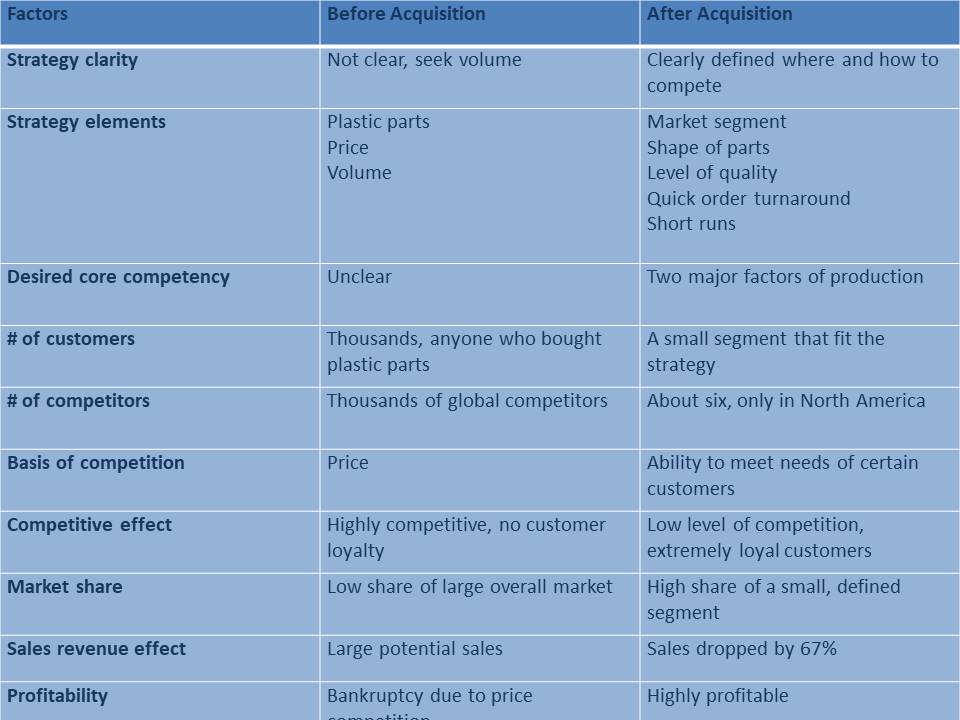
The business happened to be an injection molding business. Before the acquisition, the company was a fairly large molder of plastic parts mainly for the automotive industry. While every business has a strategy of some sort, either explicit or implicit, it is hard to describe just what the strategy was before the acquisition. As with many of the thousands of injection molding businesses, the strategy could be described as “find and pursue any business that they could make.” That would be the where of strategy. The how of their strategy might be described as competing on price with a hope of building volume. Without any clear core competency or competitive advantage, the company competed mainly on price. And without anything to set it apart, it competed with hundreds or thousands of other companies with similar capabilities. Therefore, the company faced stiff price competition and customers that had no loyalty but would quickly switch suppliers for a lower price. Since they continually needed to give price concessions to keep their volume, it was not surprising that the business went into bankruptcy.

As my friends acquired the business out of bankruptcy, they defined a strategy for success. The impetus of the strategy was to utilize the productive capacity of the acquired company while developing some particular core competencies. The immediate impact of the new strategy was to fire most of the previous company’s customers and focus on a new set of customers, resulting in an immediate shrinking of the company to one-third of the sales revenue. However, the one-third of the revenue was more profitable than the previous company had ever been.

Their new business strategy had five elements that defined where and how they would compete. First, it defined the sorts of products that they thought they could produce well. Secondly, it defined the kinds of markets that they hoped to serve, and then it described what the expectations would be of their target customers and the skills that they would need to offer. There were two primary markets that they wished to serve, and these were narrowly defined, both expensive equipment markets. They knew that the producers of this sort of high-priced equipment would have high expectations for quality and that suited the company just fine. By the nature of these equipment markets, they expected that customers would demand short runs and much smaller quantities than the norm that they had dealt with before their business had collapsed. Also, these customers would demand quick order turnaround.

The newly-defined strategy was targeted at meeting a clear set of needs for a specific set of customers. By providing a clearly superior value to these customers, the strategy led to satisfied customers. More importantly, the strategy defined a market and way to compete that eliminated most of the potential competitors. For this particular set of customers and their needs, there were not many competitors who were able or willing to develop the capability to serve this segment.

The new strategy provided focus for the re-organized company. It identified the customers that they would and, by default, would not serve. It defined the products that they would and would not produce. Most importantly, it defined the two core competencies that they would pursue – 1) the ability to consistently make this type of part at the necessary levels of quality and 2) the ability to efficiently produce short runs with fast turnaround. With the strategy in place, they knew precisely what capabilities they needed to develop. The strategy then guided the equipment in which they invested, the skills and technology that they would develop, the employees that they would hire and promote, and other decisions that shaped the company. With a clear strategy that focused and guided all of their decisions, they became a very successful and profitable operation. Most importantly, the strategy defined the value that they would offer to their select set of customers so that they developed strong and stable relationships with their customers.

Does your organization have a clear and compelling strategy that guides your decisions and defines how you will succeed?

The Process of Growth

Growth is the ongoing, intentional process of becoming who you were created to be. This applies to growing as a person, as a leader, in relationships, in professional growth, or in other areas of life. Intentional growth is a process of asking questions, finding answers, and taking action. Where and who are you? What do you hope to become? What is the gap that needs to be filled between who you currently are and who you hope to be? What steps of learning and development begin to fill that gap? What action do you need to take? How will you be held accountable? How will you assess your progress? How will you identify the next step or area for growth?

Growth is an ongoing process because we never reach an end state on this earth. We can make continual progress (or more likely, sporadic progress) but we never reach completion or perfection. There are always opportunities to grow further or in new ways to become more of who we were created to be.

What are the areas of growth on which you need to be working? What is your process for growing?

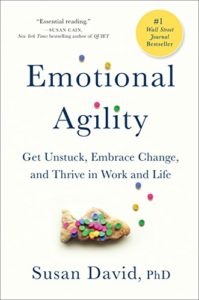
“Emotional Agility” by Dr. Susan David

Agility can be defined as the ability to move quickly and easily or the ability to think and understand quickly. To be agile can be defined as having a quick, resourceful, and adaptable character. When we put the word agility with the concept of emotions we can see that this must be referring to the ability to effectively understand and respond to emotions.

The problem with emotions is that some people have difficulty in recognizing them, controlling them, or responding to them. For some, emotions can be puzzling, scary, or even crippling. Many emotions have a label as being negative and, therefore, might be thought of negatively. People generally do not like to deal with the negative.

People tend to respond to emotions, especially those negative emotions, in one of three ways. Some people push them away, pretending that they don’t exist or walling themselves off from them. Some people let themselves be captured by emotions, stirring them around and ruminating over them. And others recognize emotions for what they are, signals, and deal with them effectively

In her book, “Emotional Agility”, psychologist Dr. Susan David describes some ways to deal with emotions with what she terms as agility. She labels the first two types of people described above as “bottlers” – they try to put their emotions in a bottle on a shelf – and “brooders” – they keep their emotions active by focusing on them without dealing with them. She describes these people as emotionally rigid while Dr. David’s goal with this book is to equip people to deal comfortably with emotions, to help them become more agile.

The big idea in “Emotional Agility” is that people who are effective or whole do not get “hooked” by emotions. To become more emotionally agile, Dr. David describes five behaviors. No doubt there are other behaviors or thought patterns that can affect our ability to deal effectively with emotions, but her opinion is that these are the most important behaviors leading to emotional agility.

  1. Showing up. The first logical step toward emotional agility is to face your thoughts, emotions, and behaviors willingly. Some emotions are valid and appropriate, in fact, they may be there to protect or alert us. Others are old bits that are stuck in our minds and triggered by some unrelated or, more precisely, some unconsciously related, event. In either case, the first step in dealing effectively with an emotion is to recognize it and choose to understand it.
  2. Stepping out. “This next element, after facing your thoughts and emotions, is detaching from and observing them for what they are – just thoughts, just emotions.” The author refers to Victor Frankl’s position that, in order to evaluate emotions, we must first create some space so that we can view them with a non-judgmental perspective and properly evaluate them.
  3. Walking your why. Continuing with the idea of perspective, once you have recognized, accepted, and then stepped back and examined your thoughts and emotions, the next step is to compare your thoughts and emotions with your long-term values and aspirations. This assumes that you have done the work to first understand your core values. Dr. David spends quite a bit of time talking about core values and how they should guide decisions. This, of course, is a part of personal wholeness.
  4. Moving on – the tiny tweak principle. The first portion of this chapter is built on the idea that life changes are best done in incremental steps. The author talks of tweaking your mindset, tweaking your motivations, and tweaking your habits. As mentioned above, emotions have a way of triggering behaviors based on some long-buried history. In order to keep from being emotionally hijacked, we need to identify those triggers and then change the course of what happens when certain emotions arise.
  5. Moving on – the teeter-totter principle. The teeter-totter principle says that wholeness comes in part through maintaining a balance between comfort and challenge. If we spend all of our time in total comfort, we become complacent. If we spend all of our time too far on the challenge side, we become stressed, frazzled, and distracted. The author recommends that be “whelmed”, that is, not overwhelmed but with enough challenge to keep us growing and sharp.

This book was good, not great. The book is very readable and has many good thoughts. It is built on solid research. Much of it seemed to be good practices on the path to wholeness that comes from knowing yourself or what Dr. Henry Cloud describes as “Integrity.” If you are on the path to wholeness, this implies that you have emotional agility, which can be described as the ability to properly understand and collaborate with emotion in a healthy manner.

SWOT Analysis

Most people in the business world are familiar with SWOT analysis – Strengths, Weaknesses, Opportunities, and Threats. SWOT analysis is useful in many life and business decision-making situations. It is an important part of the strategic planning process. Despite being familiar to most people, it is not always used effectively in the planning process. This article presents a reminder of how SWOT should be used in the strategic planning process.

The Strengths and Weaknesses portion of SWOT is an inward view. They present the advantages or disadvantages of the organization, Strengths providing the advantages and Weaknesses describing the disadvantages. They are considered relative to the capabilities of competitors and in the context of customer needs. As an example, a new building or a certain manufacturing process is not a strength. Being more efficient because of a new, more organized building or a new manufacturing process could be a strength if it provided an advantage of faster delivery or lower costs, assuming that this was important to customers. The strength is actually then faster delivery or lower costs due to ….. Or another example, the ability to make our product a brighter blue is only an advantage or a Strength if customers actually would prefer a brighter blue. If any shade of blue is acceptable or if the customer would not pay more or switch suppliers for a brighter blue or if competitors already have a brighter blue, then there is no advantage or Strength.

Sometimes in evaluating Strengths and Weaknesses, organizations might ask the question “What do we do well or not so well?” But this question is too vague. In identifying Strengths it is better dig deeper and to answer questions such as the following. Imagine just the opposite to understand Weaknesses.

  • What would our customers say is our strength or advantage?
  • Why do we get the order?
  • What resources do we have or have access to that give us an advantage?
  • What knowledge or intellectual property do we have that others might not have?
  • What processes are we skilled at that give us an advantage?
  • What do we have, know, or do that our competitors wish they had?
  • What are the major reasons for our profitability or market share?

The Strength or Weaknesses needs to precisely defined, such as a $10 cost advantage due to specially-designed production advantage or 20% advantage in signal attenuating performance due to patent #99999.

Opportunities and Threats are the result of external factors. Opportunities are elements in the market environment that could be exploited. Threats are elements in the market environment that could present risk or cause trouble for the business. The market environment in Threats and Opportunities must be thought of broadly. It is more than current customers or current markets. Threats and Opportunities are affected by the entire value chain, by world politics and economics, by social changes, by environmental or resource impacts, by technologies of various sorts, etc. as well as factors impacting customers and competitors.

The questions that might be asked relative to identifying Opportunities are endless but here are a few examples:

  • Do our customers have unmet needs relative to our products or services?
  • Are there similar customers or markets that have similar needs to our markets or customers?
  • Are there particular segments of the market that are underserved or where competition is thin?
  • Are there competitors that might be exiting the market or leaving opportunities for us?
  • Are there potential changes in economics, politics, societal norms, regulations, or technologies that could result in opportunities for our products or services?
  • Are there changes in technologies or other factors that could present opportunities to improve or greatly change the way that we produce products?

Similarly, there could be a long list of questions regarding threats. Here is a sampling:

  • How healthy are our customers and is there risk of an industry shakeout?
  • How likely is the potential for new competitors entering our market?
  • What current or potential activities could lead to more aggressive action from our competitors?
  • Is there a potential for changes in the value chain that could adversely affect our customers or their need for our product or services?
  • Are there potential changes in economics, politics, societal norms, regulations, or technologies that could present risks for the market for our products or services?
  • Are there changes in technologies or other factors that could threaten our ability to produce products?

To get the full value of SWOT analysis in the planning process requires a rigorous effort. The items listed should be precise and definable. The list in each section should be realistic and prioritized. The analysis communicates best with only a short list of the most important factors. The purpose of the SWOT analysis is to increase the understanding of the business and to drive the implications into strategy and action plans.

Once you understand how to compile a good SWOT analysis, the results should provide a deeper view of your business. The SWOT analysis tool provides a means to explore new opportunities and improve your decision-making process.

Is your SWOT analysis clear enough to impact your strategic direction?

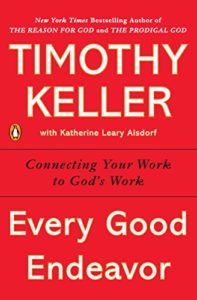
“Every Good Endeavor” by Tim Keller

“In a work world that is increasingly competitive and insecure, people often have nagging questions: Why am I doing this work? Why is it so hard? Is there anything I can do about it?” Thus the flyleaf for “Every Good Endeavor” introduces Tim Keller’s book about faith and work. This book is much more than a “how to” book regarding faith at work. It is a study of the theology of work with practical application.

While a popular view of work may be that it is a necessary evil resulting from man’s rebellion from God’s creative plan, the book quickly dispels that notion. Work is an ordained part of creation in which man is given what is known as the cultural mandate. The cultural mandate is the command to exercise dominion over the earth, subdue it, and develop its latent potential that appears in the first chapter of Genesis. In essence, mankind is given the work instructions to continue the process of creation.

Unfortunately, as a result of man’s rebellion and the fall, work became toil and in Genesis 3 we are promised thorns and thistles. Keller says, “Work exists now in a world sustained by God but disordered by sin. Only if we have some understanding of how sin distorts work can we hope to counteract its effects and salvage some of the satisfaction that God planned for our work.” This distortion shows up as work often being seen as fruitless, pointless, or selfish and as work revealing our idols.

The author provides this insight “We should be willing to be very engaged with the cultural and vocational worlds of non-Christians. Our thick view of sin will remind us that even explicitly Christian work and culture will always have some idolatrous discourse within it. Our thick view of common grace will remind us that even explicitly non-Christian work and culture will always have some witness to God’s truth in it.”

Work is a vehicle of God’s providence. Keller makes the point that a Christian worldview should naturally flow into a Christian workview. This right view should result for the follower of Jesus in a different view of work, a different set of virtues, a different view of humanity, a different source of guidance, and a different audience for our work. 1 Corinthians 10 exhorts us to “do it all for the glory of God.” Keller references the writings of Luther to point out that, no matter what our profession, our work is a ministry and we are called by God to serve in our work. We should be serving our profession, our employer, our customers, our co-workers, and even our suppliers and the broader community as we serve Jesus Christ. The author makes an important point in a discussion of dualism vs. integration. Dualism is a term used to describe a separating wall between the sacred and the secular. We see dualism most clearly in the practice of Christianity on Sunday morning or only within church activities and the rest of the week is lived with a different set of values. Integration of faith and work is the opposite of dualism where a person’s core values show up in and guide every part of their life.

I highly recommend this book for anyone who wants to grow in living their faith in every part of their life.

Core Values Drive Choices

The process of defining and communicating the core values of a business has become more popular in recent years. But just as important is the process of defining our own personal core values. Core values are the fundamental or foundational beliefs of a person. These principles guide behavior and can help people understand the difference between what they believe to be right and wrong. Core values set priorities and guide decisions for our life.

Core values are often ingrained into who we are based on family or community values and life experiences. A small percentage of people have made the effort to think through and define their core values. Many people have some idea of what their core values are but rely on those ingrained values. Other people have a mish-mash of loosely-defined or situationally-based values, in essence not knowing or caring what their true core values really are.

As mentioned, core values guide our decisions. They make our lives more orderly or consistent in terms of where we spend our time and energy. Core values guide our priorities and serve as guideposts in life.

If you haven’t defined your core values, how might you do so? It is better not to pick out values from a list. Rather the process of identifying your core values should a process of self-discovery, with multiple steps to draw out of your inner self the values that are already there. The process of identifying your core values is not a one hour process or a one day process. As a process it requires several steps over some weeks or months. Here are some thoughts for a process. It is not necessarily a step-by-step process but following these steps in this order might be helpful.

  1. Start with an open mind. Defining your core values means searching inside for what is important and what drives you. Your values are not anyone else’s values and they may not even be obvious to you. So relax, take a deep breath, and let your mind take you to your values.
  2. Review a list of possible core values. The purpose is not to select your values but rather to start your mind on a discovery process, thinking about what values look like and which ones might be important to you. (Here is one sample list with more than 500 values.) Read the list through and then go back through and circle the values that develop some emotion in you.
  3. Think about some people who have impacted your life or whom you admired because of who they were and what values they exemplified. List some of the values that come to mind.
  4. Think about what you would like your life to exemplify. One way to do this is to picture the eulogies that you would hope to be spoken at your funeral. Another way to think about this is to picture an older you coming into your life to tell you what you did well or not so well. What values do you hear as you think about these scenarios?
  5. Think back to some meaningful moments, some times when you felt particularly satisfied with what you had done or an important decision that you made. What values were you following at that time? In the same way, think back to some times when you might have been angry or disappointed by your actions or decisions. Think about the values that you might have violated that caused your discontent.
  6. Think about your code of conduct. What are the driving values in the decisions that you make? What is important to you? What must you have in your life to be fulfilled? What would frustrate you? What are the values that show up as you consider these?
  7. If you can do so, write a list of the important values that you are discovering. If you have difficulty in developing a list, read through the list of sample core values. Are there more that need to be circled? Highlight the ones that seem really important.
  8. You may have listed or circled quite a few values but a core values statement should typically be 5-7 values, never less than three and never more than ten. If your list is longer than that (and it quite likely is), then it is time to start prioritizing. Think about the core values that you are considering and what each one means to you. Are there some that can be grouped or that simply repeat one thought? Which ones are the highest priority, in other words, the most meaningful or critical to whom you are? Watch ones are good values but not the most important to you? Work on the list, perhaps even going back to some of the previous steps, until you find the 5-7 core values that represent you and what you believe important in your life.
  9. The process is not finished yet. Once you have a draft list of core values, they each need to be tested. Study the definition of each of the ones on your list. Does it ring true? Thing about circumstances or decisions where you might need to stand up for your values or, even more difficult, violate your values. What would this feel like? As you think through each of your core values and the implications on your life and your decisions, you can either verify your list or go back and revise it until it does ring true.

While your core values are foundational to who you are and how you behave, they can change over time as you move through different stages of life or as you mature and grow. Therefore, you may need to repeat this process occasionally.

Core values clarify who we are and how we behave. Developing a set of core values that is true to our life and ourselves provides a vision where we can be content. A clear set of core values makes hard decisions much easier. Of course, if we have a list of core values that is not true, we produce frustration and discontent in our lives. So it is important that we have thought through the process well.

As Mahatma Ghandi said, “Your beliefs become your thoughts. Your thoughts become your words. Your words become your actions. Your actions become your habits. Your habits become your values. Your values become your destiny.”

Have you defined your destiny by defining your core values?

Developing Leadership: Self-Awareness vs. MBA

Leadership is built upon the combination of character and competency. A highly competent person that is deficient in the character traits of leadership cannot build the relationship of trust and respect to effectively lead. On the other hand, certain skills or competencies are necessary for a person of strong character to effectively develop and communicate the vision and to develop the credibility required to lead.

A recent article in the Harvard Business Review, titled “Self-Awareness Can Help Leaders More Than an MBA Can”, discussed the effectiveness of an MBA for preparing a leader with the effectiveness of self-awareness in molding a leader. This article is another argument for the necessary combination of character and competency. It makes the point that an MBA alone, or a set of competencies alone, does not prepare a person to lead. In fact, it can do the opposite when a person has low self-awareness. Without self-awareness, a person can place too much value in their skills, intelligence, or education, perhaps even becoming arrogant and unapproachable. Self-awareness provides a leader with a realistic view of who they are and how they relate. Self-awareness in itself does not make a leader but it opens the door to growth and development of the character traits necessary for effective relationships and effective leadership. Self-awareness also keeps us from thinking that we are the “cat’s pajamas.”

While the referenced article has a bit of self-promotion for the authors and their consulting practice, it is still a good read. For some further thoughts on self-awareness, see this article from a few months ago.

Are you leaning on your competencies or building your character?